
The humble conjunction “if” is a cornerstone of expressing hypothetical situations, conditions, and possibilities in any language. In English, we use it freely to discuss everything from weather forecasts to future plans. However, when delving into the Spanish language, understanding how to translate and utilize “if” requires a nuanced approach, moving beyond a simple one-to-one mapping. The true power of expressing “if” in Spanish lies in its intricate relationship with verb tenses, particularly the conditional and subjunctive moods. This exploration will unpack these grammatical structures, providing a comprehensive guide for learners to accurately and eloquently convey conditional statements in Spanish.
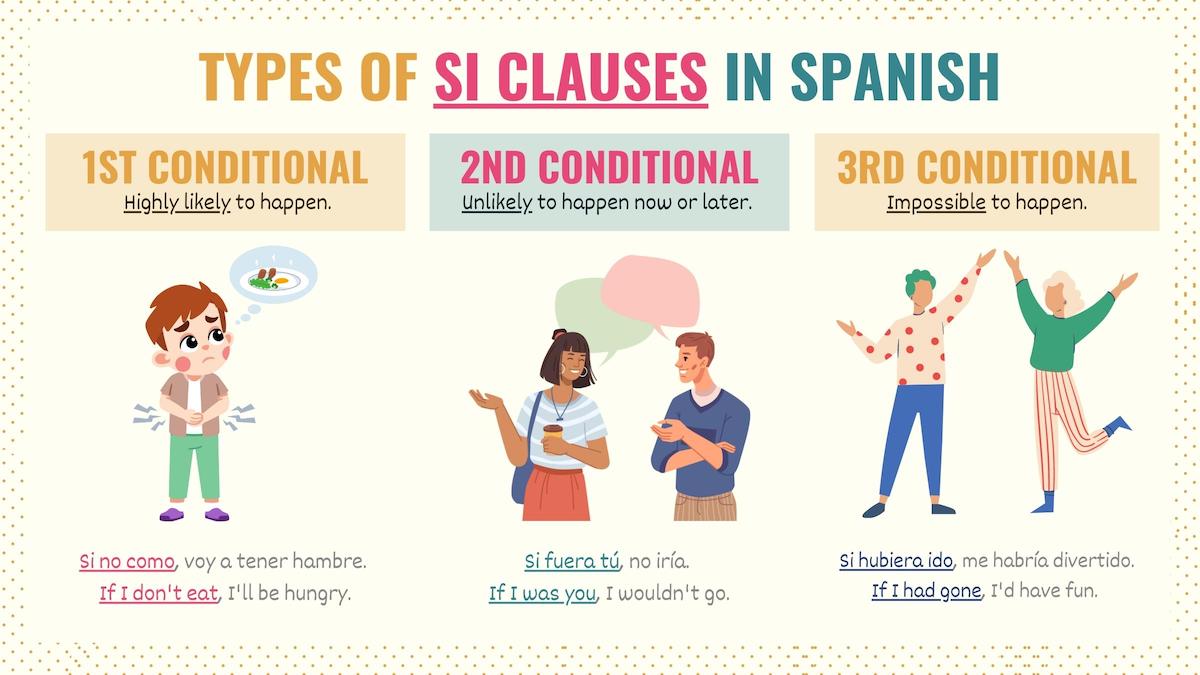
The Nuances of “Si”: More Than Just a Direct Translation
The most direct translation of “if” in Spanish is “si”. However, simply substituting “si” for “if” in every instance will often lead to grammatically incorrect or unnatural-sounding Spanish. The crucial factor in correctly employing “si” lies in the tense and mood of the verbs that follow it, and the tense and mood of the verbs in the main clause of the sentence. Spanish grammar demands a precise understanding of how these elements interact to create meaning.
Conditional Clauses: Expressing Possible Scenarios
Conditional clauses in Spanish, introduced by “si,” are used to talk about situations that are possible or likely to happen. These clauses typically involve a situation and its consequence. The structure of these clauses can be broken down into two main types: those that express a likely condition and its outcome, and those that express a hypothetical or unlikely condition.
Type 1: Likely or Possible Conditions (Present/Future)
When the “if” clause refers to a condition that is likely or possible in the present or future, the structure is generally straightforward:
- “Si” + Present Indicative Verb + Future Indicative Verb (or Present Indicative, or Imperative)
This is the most common and versatile type of conditional clause. It’s used to express cause and effect in situations that are considered real or probable.
-
Example: Si tengo tiempo, iré al cine. (If I have time, I will go to the cinema.)
- Here, “tengo” is in the present indicative, indicating a present possibility. The consequence, “iré” (I will go), is in the future indicative, expressing a likely outcome.
-
Example: Si estudias mucho, aprobarás el examen. (If you study a lot, you will pass the exam.)
- Again, the present indicative “estudias” sets a condition for the future indicative “aprobarás.”
-
Example: Si llueve, no saldremos. (If it rains, we won’t go out.)
- The present indicative “llueve” leads to the future indicative “saldremos” (in its negative form).
In some instances, the main clause can also use the present indicative or the imperative mood, depending on the context:
- Using Present Indicative in the Main Clause: Si tengo hambre, como algo. (If I’m hungry, I eat something.) This implies a habitual or general truth.
- Using Imperative in the Main Clause: Si puedes, ayúdame. (If you can, help me.) This is a direct request based on a condition.
Type 2: Hypothetical or Unlikely Conditions (Present/Future)
When the “if” clause expresses a condition that is hypothetical, unlikely, or contrary to fact in the present or future, the imperfect subjunctive is employed in the “si” clause, and the conditional simple in the main clause.
- “Si” + Imperfect Subjunctive Verb + Conditional Simple Verb
This structure signals that the condition is not currently met or is improbable.
-
Example: Si tuviera dinero, compraría una casa. (If I had money, I would buy a house.)
- The imperfect subjunctive “tuviera” (from “tener” – to have) indicates that the speaker likely does not have money. The conditional simple “compraría” (from “comprar” – to buy) expresses the hypothetical action that would follow.
-
Example: Si hiciera sol, iríamos a la playa. (If it were sunny, we would go to the beach.)
- “Hiciera” (imperfect subjunctive of “hacer” – to do/make) suggests it’s not sunny. “Iríamos” (conditional simple of “ir” – to go) expresses the hypothetical outing.
-
Example: Si yo fuera tú, le diría la verdad. (If I were you, I would tell him the truth.)
- The imperfect subjunctive “fuera” (from “ser” – to be) highlights the impossibility of being the other person. “Diría” (conditional simple of “decir” – to say/tell) expresses the advice.
Type 3: Past Unreal Conditions (Past)
To discuss conditions that were not met in the past, and their hypothetical consequences in the past, Spanish uses a specific structure that combines the pluperfect subjunctive in the “si” clause and the conditional perfect in the main clause.
- “Si” + Pluperfect Subjunctive Verb + Conditional Perfect Verb
This structure deals with counterfactual situations in the past – things that did or did not happen, and what would have resulted.
-
Example: Si hubiera estudiado más, habría aprobado el examen. (If I had studied more, I would have passed the exam.)
- “Hubiera estudiado” (pluperfect subjunctive of “estudiar” – to study) indicates that the studying did not happen. “Habría aprobado” (conditional perfect of “aprobar” – to pass) expresses the unrealized outcome.
-
Example: Si hubieras venido a la fiesta, te habrías divertido mucho. (If you had come to the party, you would have had a lot of fun.)
- “Hubieras venido” (pluperfect subjunctive of “venir” – to come) suggests the person did not attend. “Habrías divertido” (conditional perfect of “divertirse” – to have fun) describes the missed enjoyment.
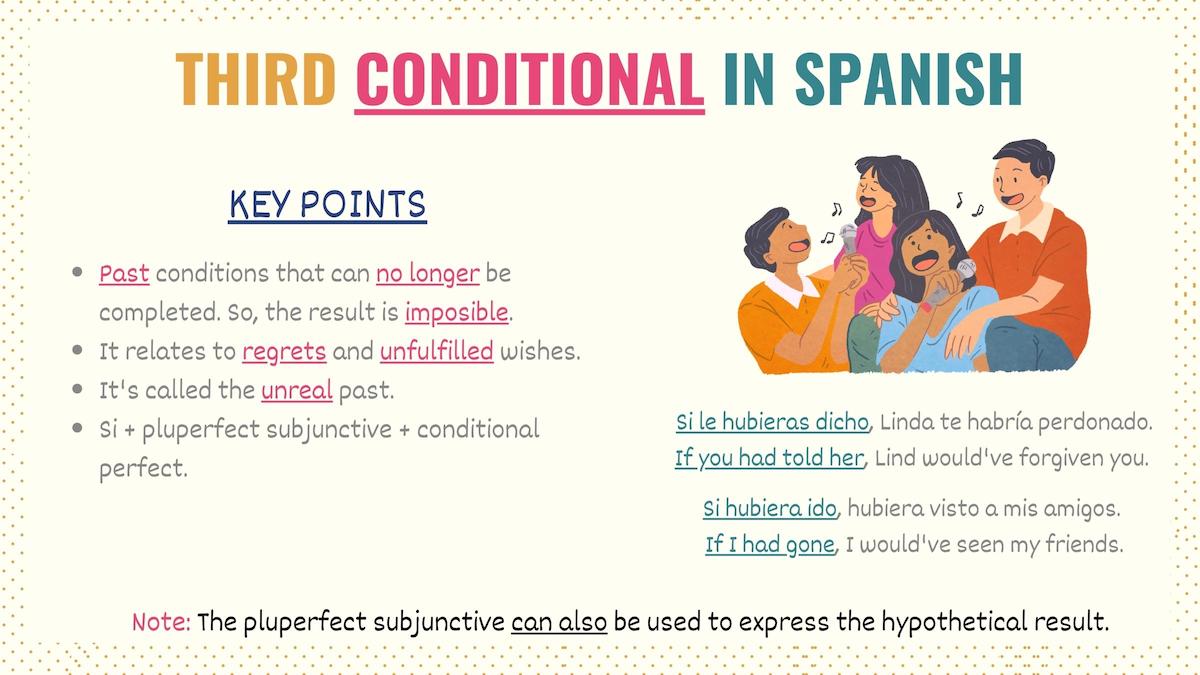
It is also common to see the conditional simple used in the main clause with the pluperfect subjunctive in the “si” clause for past unreal conditions, though the conditional perfect is considered more precise for a past consequence:
- “Si” + Pluperfect Subjunctive Verb + Conditional Simple Verb (less common for strict past consequence)
- Si hubiera sabido la verdad, te habría dicho. (If I had known the truth, I would have told you.) – This is the most standard form.
- Si hubiera sabido la verdad, te decía. (Slightly less common for a specific past consequence, might imply a more general past tendency).
The Subjunctive Mood: Expressing Doubt, Desire, Emotion, and Improbability
The subjunctive mood in Spanish is a critical component of expressing “if” clauses, particularly when the condition is not presented as a factual statement but rather as something uncertain, desired, emotional, or improbable. Unlike the indicative mood, which describes reality, the subjunctive explores subjective states and possibilities.
When to Use the Subjunctive with “Si”
The subjunctive mood is triggered by the semantic nature of the conditional statement. You’ll encounter it frequently in the following scenarios when dealing with “if” clauses:
Hypothetical and Counterfactual Situations
As discussed in the conditional clauses, the imperfect subjunctive is the go-to for hypothetical situations in the present/future, and the pluperfect subjunctive for unreal past conditions. This is because these situations are inherently not factual and exist in the realm of imagination or possibility.
-
Example (Hypothetical Present/Future): Si fuéramos ricos, viajaríamos por todo el mundo. (If we were rich, we would travel the world.)
- “Fuéramos” (imperfect subjunctive of “ser”) indicates that “we are not rich” currently.
-
Example (Unreal Past): Si yo hubiera tenido la oportunidad, habría aceptado el trabajo. (If I had had the opportunity, I would have accepted the job.)
- “Hubiera tenido” (pluperfect subjunctive of “tener”) implies the opportunity was not present or was missed.
Conditions Expressing Doubt or Uncertainty
When the “if” clause introduces a condition that is tinged with doubt or uncertainty, the subjunctive may be used, especially if the main clause expresses a consequence that is also uncertain or dependent on this doubt. This usage is less common with “si” compared to conjunctions like “aunque” (although) or “cuando” (when) in certain contexts, but it can appear.
- Example (Subtle Doubt): Si es que vienes, avísame. (If you are indeed coming, let me know.)
- Here, “es que” adds a nuance of slight doubt or seeking confirmation about the coming. The imperative “avísame” follows.
Conditions Related to Desire or Will
While less direct with “si” than other subjunctive triggers, if the “if” clause implies a desired condition that is not yet fulfilled, the imperfect subjunctive can be used to express that underlying desire.
- Example (Implied Desire): Si existiera la máquina del tiempo, iría al futuro. (If a time machine existed, I would go to the future.)
- The imperfect subjunctive “existiera” expresses the wish for such a machine to exist.
Common Pitfalls and Best Practices
Navigating the various uses of “si” and its associated verb tenses can be challenging. Understanding common mistakes and adhering to grammatical rules will significantly improve fluency and accuracy.
Avoiding the “Double Conditional” and “Double Future”
A frequent error for English speakers is the overuse of the conditional or future tense in the “si” clause. Spanish grammar strictly prohibits this.
- Incorrect: Si iría al cine, vería la película. (Incorrect: “If I would go to the cinema, I would see the movie.”)
- Correct: Si voy al cine, veré la película. (If I go to the cinema, I will see the movie.) – Future possibility.
- Correct: Si fuera al cine, vería la película. (If I were to go to the cinema, I would see the movie.) – Hypothetical.
Similarly, avoid using the future tense in the “si” clause when it’s not appropriate.
- Incorrect: Si comeré bien, estaré sano. (Incorrect: “If I will eat well, I will be healthy.”)
- Correct: Si como bien, estaré sano. (If I eat well, I will be healthy.)
Distinguishing Between “Si” and “Sí”
It’s crucial to remember the accent mark. “Si” means “if” (conditional), while “sí” means “yes” (affirmative) and is often used with a reflexive pronoun (e.g., “él se síe”). This distinction is fundamental.
The Importance of Context
Always consider the context and the intended meaning. Is the situation a certainty, a possibility, a hypothetical, or a past regret? The answer will dictate the correct verb tenses and moods.
- Certainty/Fact: “Si está lloviendo, me quedo en casa.” (If it is raining, I stay at home.) – Present indicative.
- Likely Future: “Si tienes frío, ponte un suéter.” (If you are cold, put on a sweater.) – Present indicative + imperative.
- Hypothetical Present/Future: “Si fuera millonario, viajaría por el mundo.” (If I were a millionaire, I would travel the world.) – Imperfect subjunctive + conditional simple.
- Unreal Past: “Si hubiera sabido, te habría llamado.” (If I had known, I would have called you.) – Pluperfect subjunctive + conditional perfect.
Mastering the use of “si” in Spanish is a journey that involves understanding the interplay between the conditional and subjunctive moods. By diligently practicing these grammatical structures and paying close attention to context, learners can unlock the full expressive potential of this essential conjunction, moving from basic translation to sophisticated and nuanced communication.
aViewFromTheCave is a participant in the Amazon Services LLC Associates Program, an affiliate advertising program designed to provide a means for sites to earn advertising fees by advertising and linking to Amazon.com. Amazon, the Amazon logo, AmazonSupply, and the AmazonSupply logo are trademarks of Amazon.com, Inc. or its affiliates. As an Amazon Associate we earn affiliate commissions from qualifying purchases.