
The term “Artificial Intelligence” (AI) has become ubiquitous, permeating discussions across technology, business, and even everyday life. We hear about AI powering our smartphones, optimizing supply chains, and even composing music. However, much of this AI is what we call “Narrow AI” or “Weak AI” – systems designed and trained for specific tasks. The true frontier, the one that sparks imaginations and fuels ambitious research, is General AI, also known as Artificial General Intelligence (AGI) or Strong AI.
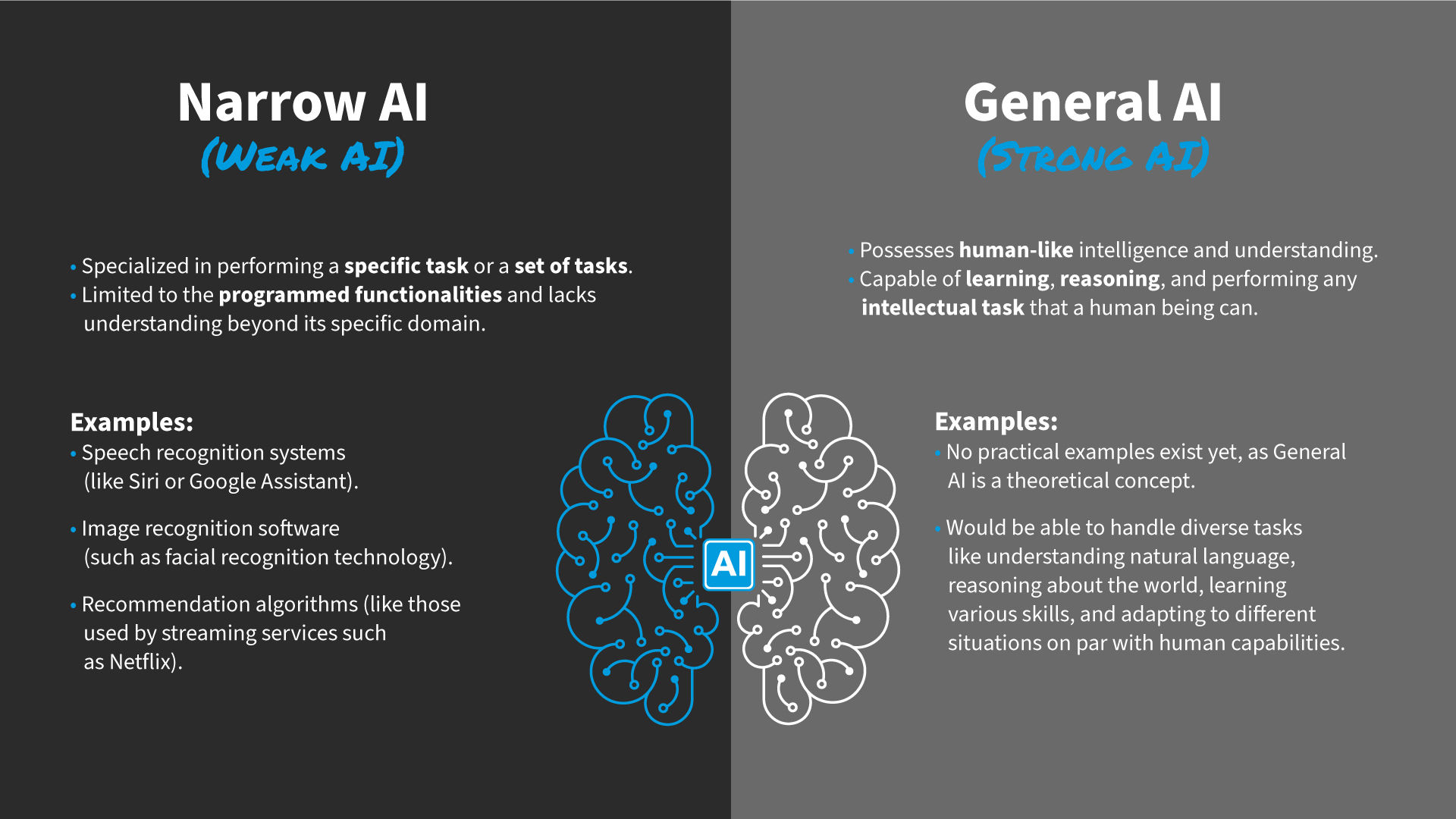
At its core, General AI refers to a hypothetical type of AI that possesses the ability to understand, learn, and apply knowledge across a wide range of tasks at a human-like level. Unlike current AI systems, which are masters of one domain but novices in others, AGI would exhibit flexibility, adaptability, and a general cognitive ability comparable to that of a human being. This isn’t just about performing a task better or faster; it’s about possessing genuine intelligence, capable of reasoning, problem-solving, abstract thinking, and learning from experience in novel situations.
The concept of General AI sits at the intersection of cutting-edge technology and profound philosophical questions. While the practical realization of AGI remains a subject of ongoing research and debate, its potential implications are monumental, touching upon every facet of our lives and industries.
Understanding the Spectrum: From Narrow AI to General AI
To truly grasp what General AI represents, it’s crucial to understand where it fits within the broader AI landscape. The current state of AI is overwhelmingly dominated by Narrow AI.
Narrow AI: The Specialists of Today
Narrow AI systems are designed to perform a very specific set of tasks. They excel within their defined parameters but lack the ability to generalize their knowledge or skills to other domains. Think of it like having a brilliant calculator that can solve any mathematical equation you throw at it, but it can’t write a poem or understand your emotions.
Examples of Narrow AI abound:
- Image Recognition Software: Trained to identify objects in images, like facial recognition systems or apps that identify plant species.
- Natural Language Processing (NLP) Tools: Powering virtual assistants (like Siri or Alexa) or translation services, these are adept at understanding and generating human language within specific contexts.
- Recommendation Engines: Used by streaming services and e-commerce platforms to suggest content or products based on your past behavior.
- Autonomous Driving Systems: While incredibly complex, these are designed for the singular purpose of navigating and operating a vehicle.
- Game-Playing AI: Programs like AlphaGo that can defeat human champions in games like Go, but cannot perform any other task outside of that specific game.
These systems are incredibly powerful and have driven significant technological advancements. They are the workhorses of modern AI, offering efficiency, automation, and new capabilities. However, their intelligence is specialized; they are expert performers in their designated fields but lack the broad, transferable cognitive abilities that define human intelligence.
The Leap to General AI: A Human-like Cognitive Ability
General AI, on the other hand, aims to bridge this gap. It envisions an AI that can:
- Learn anything a human can learn: From mastering a new language to understanding complex scientific theories.
- Reason and solve problems in novel situations: Without prior specific training for that exact scenario.
- Exhibit common sense and contextual understanding: Navigating the nuances of human interaction and the physical world.
- Be creative and adaptable: Generating new ideas, concepts, and solutions.
- Possess self-awareness and consciousness (a more philosophical debate): While not a universally agreed-upon requirement, some definitions of AGI touch upon these aspects.
The key differentiator is the generality of the intelligence. An AGI wouldn’t need to be retrained from scratch to learn a new task; it would be able to leverage its existing knowledge and learning capabilities to acquire new skills and understanding organically. This would make it an incredibly versatile and powerful entity, capable of tackling a vast array of challenges.
The Path to General AI: Research and Development
The quest for General AI is a monumental undertaking, attracting some of the brightest minds in computer science, neuroscience, psychology, and philosophy. The development of AGI is not a single breakthrough but rather a culmination of advancements across various fields.
Machine Learning and Deep Learning: The Foundations
Modern AI, including the progress towards AGI, is heavily reliant on machine learning (ML) and its subfield, deep learning (DL).
- Machine Learning: This is a broad field of AI that focuses on enabling systems to learn from data without being explicitly programmed. Algorithms identify patterns, make predictions, and improve their performance over time as they are exposed to more data.
- Deep Learning: A subset of ML that uses artificial neural networks with multiple layers (hence “deep”) to process and learn from data. These networks are inspired by the structure and function of the human brain and have been instrumental in breakthroughs in areas like image and speech recognition.
While Deep Learning has enabled remarkable achievements in Narrow AI, it’s still largely focused on pattern recognition and prediction within specific data sets. The challenge for AGI researchers is to move beyond these specialized learning capabilities to a more general form of reasoning and understanding.
Exploring Different Approaches to AGI
Researchers are exploring various avenues in the pursuit of AGI:
- Symbolic AI (Good Old-Fashioned AI – GOFAI): This approach focuses on representing knowledge using symbols and logical rules, aiming to mimic human reasoning through deduction and inference. While it has strengths in structured domains, it struggles with ambiguity and learning from raw, unstructured data.
- Connectionist AI (Neural Networks): This is the dominant paradigm today, focusing on learning from data through interconnected nodes (neurons) in artificial neural networks. Deep learning falls under this umbrella.
- Hybrid Approaches: Many researchers believe that the most promising path to AGI lies in combining the strengths of symbolic and connectionist approaches. This could involve systems that learn from data while also possessing a symbolic reasoning engine.
- Cognitive Architectures: These are theoretical frameworks that aim to model the human mind, integrating various cognitive functions like perception, memory, learning, and reasoning into a unified system.
- Neuroscience-Inspired AI: Drawing inspiration from the biological brain, this research seeks to replicate the complex processes of neural computation and learning in artificial systems.
The development of AGI is a long-term endeavor, and it’s unlikely to be achieved through a single algorithm or approach. It will likely involve a convergence of breakthroughs in multiple areas.
The Impact and Implications of General AI
The advent of General AI would represent a paradigm shift, with far-reaching consequences across virtually every sector of society. The potential benefits are immense, but so are the challenges and ethical considerations.
Transforming Industries and Innovation
AGI has the potential to revolutionize industries by tackling complex problems that are currently beyond the scope of Narrow AI.
- Scientific Discovery: AGI could accelerate scientific research by analyzing vast datasets, identifying novel hypotheses, and even designing experiments. This could lead to breakthroughs in medicine, materials science, and fundamental physics.
- Healthcare: Imagine AGI systems capable of diagnosing diseases with unparalleled accuracy, developing personalized treatment plans, and assisting in complex surgical procedures.
- Education: AGI tutors could provide personalized learning experiences for students of all ages, adapting to individual learning styles and paces.
- Creative Arts: AGI could collaborate with artists, musicians, and writers, pushing the boundaries of creative expression and generating entirely new forms of art.
- Economic Productivity: AGI could automate a wide range of complex tasks, leading to unprecedented gains in productivity and economic growth. This could manifest in optimized supply chains, intelligent resource management, and highly efficient service delivery.
- Solving Global Challenges: AGI could be instrumental in addressing some of humanity’s most pressing problems, such as climate change, poverty, and resource scarcity, by modeling complex systems and devising innovative solutions.
Ethical Considerations and Societal Adjustments
The development and deployment of AGI raise significant ethical and societal questions that require careful consideration.
- Job Displacement: The automation capabilities of AGI could lead to widespread job displacement, necessitating significant societal adjustments in education, retraining, and social safety nets. The nature of work itself would likely transform.
- Bias and Fairness: If AGI systems are trained on biased data, they could perpetuate and even amplify existing societal inequalities. Ensuring fairness and equity in AGI development is paramount.
- Control and Safety: A major concern is ensuring that AGI systems remain aligned with human values and goals. The “alignment problem” – ensuring that powerful AI acts in humanity’s best interest – is a critical area of research.
- Existential Risk: In the most extreme scenarios, some experts worry about the potential for superintelligent AGI to pose an existential threat to humanity if its goals diverge from ours.
- Regulation and Governance: Establishing appropriate regulatory frameworks and governance structures for AGI will be crucial to guide its development and deployment responsibly.
- The Future of Humanity: The profound impact of AGI on human society raises philosophical questions about the nature of intelligence, consciousness, and our place in the universe.
The Road Ahead: A Future Shaped by General AI
The journey towards General AI is ongoing, filled with both excitement and trepidation. While the exact timeline for achieving AGI remains uncertain – with predictions ranging from decades to centuries – the pursuit itself is driving innovation and expanding our understanding of intelligence.
The development of AGI is not just a technological challenge; it is a societal one. As we continue to explore the possibilities of creating machines with human-like cognitive abilities, it is essential that we engage in thoughtful discussions about the ethical, social, and economic implications. The potential rewards of General AI are immense, offering the promise of solving some of the world’s most complex problems and ushering in an era of unprecedented progress. However, navigating this transformative journey responsibly will require foresight, collaboration, and a deep commitment to ensuring that this powerful technology serves humanity’s best interests. The question of “what is general AI” is evolving, and as we inch closer to its realization, so too will our understanding of what it means to be intelligent.
aViewFromTheCave is a participant in the Amazon Services LLC Associates Program, an affiliate advertising program designed to provide a means for sites to earn advertising fees by advertising and linking to Amazon.com. Amazon, the Amazon logo, AmazonSupply, and the AmazonSupply logo are trademarks of Amazon.com, Inc. or its affiliates. As an Amazon Associate we earn affiliate commissions from qualifying purchases.