
In the world of finance, we are often conditioned to seek out exponential growth. We celebrate the “magic of compounding interest” and the way a small investment can balloon into a fortune over several decades. However, there is a mirror image to this phenomenon that is equally powerful and significantly more dangerous: exponential decay.
While exponential growth is the engine of wealth creation, exponential decay is the silent force of wealth erosion. Whether it manifests as the steady loss of purchasing power due to inflation, the rapid depreciation of physical assets, or the “time decay” inherent in complex financial derivatives, understanding this mathematical principle is essential for any investor, business owner, or individual looking to protect their financial future.
The Mechanics of Financial Decay: Why Value Doesn’t Stay Constant
To understand exponential decay in a financial context, one must first distinguish it from linear loss. Linear loss occurs when an asset loses a fixed amount of value over a fixed period—for example, a machine that loses $1,000 in value every year. Exponential decay, however, occurs when an asset loses a fixed percentage of its value over a fixed period.
The Mathematical Foundation of Wealth Erosion
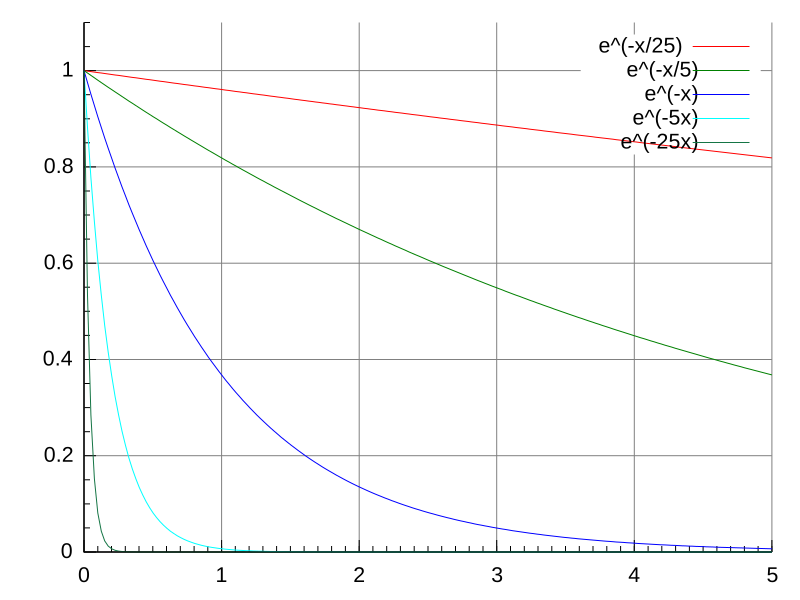
At its core, exponential decay is described by a process where the rate of decrease is proportional to the current value. In finance, this means that as an asset becomes less valuable, the absolute amount of value it loses each year decreases, but the percentage of loss remains constant. This creates a curve that drops sharply at first and then levels off, though it theoretically never reaches zero.
Why It Matters to the Modern Investor
For the modern investor, exponential decay is the “gravity” of the financial universe. It represents the natural tendency of unmanaged capital to lose its potency. In an era of fluctuating fiat currencies and rapid technological turnover, standing still is equivalent to moving backward. If your portfolio is not growing at a rate that outpaces the various forms of decay acting upon it, your “real” wealth is shrinking every single day.
Inflation: The Invisible Force of Exponential Decay
The most pervasive example of exponential decay in money management is inflation. While we often discuss inflation in terms of rising prices, it is more accurately described as the exponential decay of the purchasing power of a currency.
The Consumer Price Index (CPI) and Purchasing Power
When a central bank targets a 2% inflation rate, they are essentially mandating an exponential decay of your cash. If you tuck $100,000 under a mattress, a 2% annual inflation rate doesn’t just take a bite out of the initial sum; it compounds. Over twenty years, that $100,000 doesn’t just lose a fraction of its value; its purchasing power is halved. This is not a linear decline; it is a cumulative erosion where each year’s decay is calculated based on the already-diminished value of the year prior.
The Rule of 72 in Reverse
Most investors are familiar with the “Rule of 72” to calculate how long it takes for an investment to double (72 divided by the interest rate). The rule works equally well for exponential decay. If inflation sits at 4%, your money will lose half of its value in just 18 years (72/4). This highlights the urgency of moving away from “safe” cash holdings toward productive assets that can outpace this decay. For those relying on fixed incomes or stagnant wages, exponential decay is the primary threat to their long-term standard of living.
Asset Depreciation and Technological Obsolescence
In business finance and personal accounting, exponential decay is most visible in the form of depreciation. Unlike the “straight-line depreciation” often used for tax simplicity, the actual market value of most assets follows a “declining balance” or exponential decay model.
Linear vs. Exponential Depreciation
Consider a new vehicle or a fleet of corporate servers. These assets do not lose value in a straight line. Instead, they experience a massive drop in value the moment they are “driven off the lot” or unboxed, followed by a slowing rate of loss over time. This is a classic decay curve. For a business, failing to account for this can lead to a “zombie balance sheet,” where assets are listed at their purchase price despite their actual utility and market value having decayed exponentially.

Dealing with Rapidly Depreciating Business Assets
In the tech-heavy economy of today, the rate of decay (the “decay constant”) has accelerated. Software, specialized hardware, and even certain types of intellectual property lose value faster than ever before. This creates a high “hurdle rate” for businesses. If a company invests in technology that decays at 30% per year, that technology must generate a return greater than 30% just for the business to break even on the investment. Understanding the specific decay rate of your industry’s assets is the difference between a profitable venture and a capital-intensive trap.
Managing Portfolio Decay: Risks in Options and Leveraged ETFs
In the realm of active investing and digital wealth management, exponential decay is not just an abstract economic concept—it is a built-in feature of certain financial instruments. For traders, this is often the most direct way they encounter the math of decay.
Time Decay (Theta) in Options Trading
In the options market, “Theta” represents the rate at which the value of an option contract declines as it approaches its expiration date. This is a textbook example of exponential decay. An option is a wasting asset; as long as the underlying stock remains stagnant, the option loses value every day.
Critically, this decay is not linear. As the expiration date nears, the rate of decay accelerates. A 90-day option might lose a few cents of value per day in its first month, but in its final week, it might lose 20% of its remaining value every 24 hours. Investors who do not understand the exponential nature of Theta often find themselves holding contracts that become worthless far faster than they anticipated.
Volatility Drag in Leveraged Instruments
Another sophisticated form of financial decay is found in leveraged Exchange-Traded Funds (ETFs). These tools are designed to provide 2x or 3x the daily return of an index. However, due to a mathematical phenomenon known as “volatility drag” or “beta slippage,” these funds experience a form of internal decay.
If an index moves up 10% one day and down 10% the next, the index is down 1% overall. However, a 3x leveraged fund would move up 30% and then down 30%, resulting in a total loss of 9%. This constant rebalancing in volatile markets creates an exponential decay of the fund’s principal value over time. This is why these instruments are labeled as short-term tools; holding them long-term is essentially betting against the inevitable decay caused by market variance.
Strategies to Combat Exponential Decay in Your Wealth
Recognizing that exponential decay exists is the first step toward neutralizing its effects. To maintain and grow wealth, one must employ strategies that either offset the decay or utilize it to their advantage.
Asset Allocation as a Shield
To fight the exponential decay of currency (inflation), one must hold assets that have a “scarcity premium” or productive capacity. Real estate, equities, and commodities are traditional hedges because their value tends to adjust upward as the currency decays. By diversifying into assets that historically grow at 7–10% annually, an investor creates a “growth curve” that is steeper than the “decay curve” of inflation, resulting in a net increase in real wealth.
The Role of Compounding Growth
The only true antidote to exponential decay is exponential growth. This is the fundamental principle of retirement planning. By starting early, the “upward curve” of compound interest has more time to reach its vertical stage, where it easily overwhelms the steady downward pull of inflation and taxes.
Leveraging Decay in Business
On the flip side, savvy business owners can use the math of decay to their advantage. Through “accelerated depreciation” schedules, businesses can write off the lion’s share of an asset’s value in the early years, reducing their taxable income and freeing up cash flow to reinvest in new, growth-oriented projects. Furthermore, in debt management, paying down the principal of a high-interest loan early on “kills” the exponential growth of that debt, effectively stopping a decay process that would otherwise eat into the person’s net worth.

Conclusion: Mastering the Downward Curve
Exponential decay is an inescapable reality of the financial landscape. It is the force that turns yesterday’s fortune into tomorrow’s pocket change if left unaddressed. From the macro level of national inflation to the micro level of a daily options trade, the math remains the same: value is a leaking bucket.
However, for the informed individual, exponential decay is not a reason for fear, but a call to action. By understanding the rates at which different assets lose value, recognizing the accelerating nature of time decay in trading, and choosing investments that provide a powerful counter-momentum of growth, you can navigate these curves. Wealth management is, in many ways, the art of managing these two opposing forces—ensuring that your rate of growth always remains higher than the inevitable rate of decay.
aViewFromTheCave is a participant in the Amazon Services LLC Associates Program, an affiliate advertising program designed to provide a means for sites to earn advertising fees by advertising and linking to Amazon.com. Amazon, the Amazon logo, AmazonSupply, and the AmazonSupply logo are trademarks of Amazon.com, Inc. or its affiliates. As an Amazon Associate we earn affiliate commissions from qualifying purchases.