
Understanding Atheism in the Digital Age
The term “atheist” often evokes strong reactions, sometimes fueled by misunderstanding or misinformation. In an increasingly interconnected and information-rich world, understanding diverse viewpoints, including atheism, is not only a matter of intellectual curiosity but also crucial for navigating complex societal discussions. This article aims to demystify atheism, exploring its core tenets, its variations, and its place within contemporary society, particularly through the lens of how technology shapes our understanding and expression of belief systems. We will delve into what it means to identify as an atheist, separating common misconceptions from established definitions, and consider how the digital landscape has influenced both the prevalence and perception of atheism.
The Foundational Pillars of Atheism
At its most fundamental, atheism is the absence of belief in deities. This definition, while simple, encompasses a wide spectrum of thought and personal conviction. It’s important to distinguish atheism from theism, which is the belief in the existence of at least one deity. Atheism is not necessarily an active assertion that no gods exist (though some atheists hold this position, known as strong or positive atheism), but rather a lack of affirmative belief in any. This distinction is crucial and often overlooked, leading to the misconception that atheists are actively anti-theistic or dogmatic in their disbelief.
Defining “Atheist” and its Nuances
The etymology of “atheist” itself, derived from Greek, literally means “without god.” This descriptive origin highlights the core concept: a lack of god-belief. Within this broad umbrella, several distinctions are made:
Positive vs. Negative Atheism
-
Negative (or Implicit) Atheism: This is the most common form of atheism. It’s characterized by a lack of belief in gods, without necessarily making a positive claim about their non-existence. Think of it as not being convinced by the arguments or evidence presented for the existence of deities, rather than actively arguing against them. This is akin to not believing in unicorns; you haven’t proven they don’t exist, you simply lack belief in them because there’s no compelling reason to.
-
Positive (or Explicit) Atheism: This stance goes a step further. Positive atheists not only lack belief in gods but also actively assert that gods do not exist. They often base this position on philosophical arguments, scientific reasoning, or a perceived lack of evidence for the divine. This is a more assertive philosophical position and is sometimes referred to as “strong atheism.”
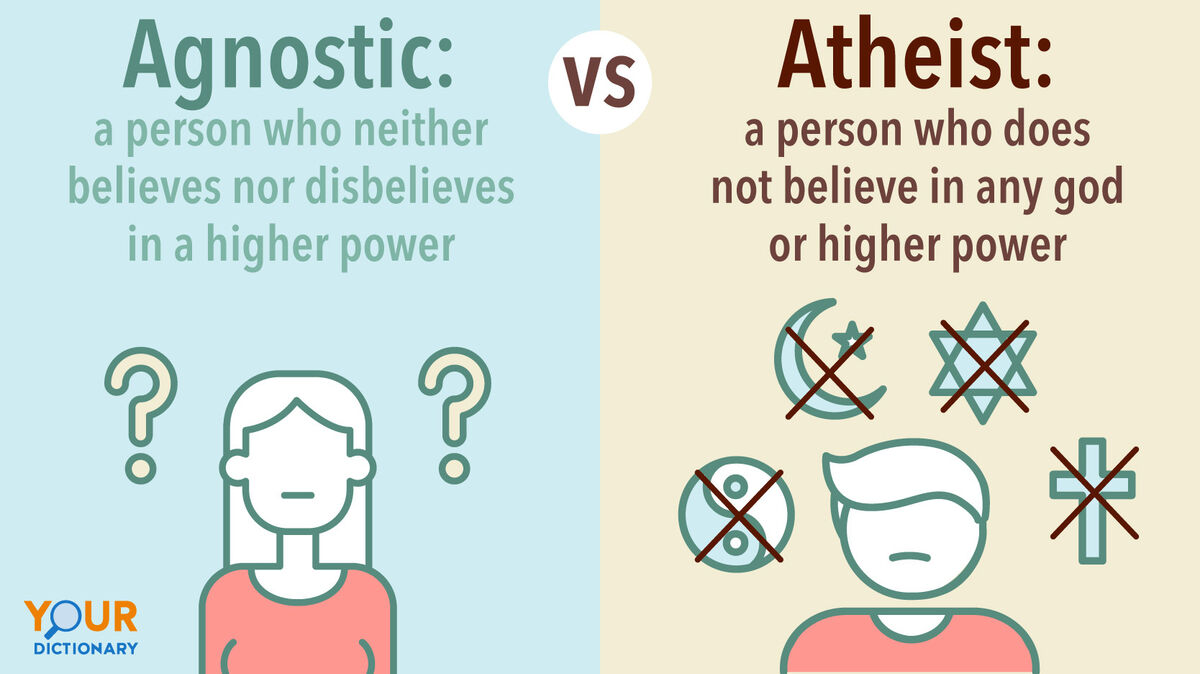
Agnosticism vs. Atheism
Another common point of confusion is the relationship between atheism and agnosticism. While often contrasted, they are not mutually exclusive and address different questions:
-
Agnosticism: This relates to knowledge. An agnostic believes that the existence or non-existence of gods is unknown or unknowable. An agnostic might say, “I don’t know if God exists, and I don’t think anyone can truly know.”
-
Atheism: As discussed, this relates to belief. An atheist lacks belief in gods.
It’s perfectly possible to be an agnostic atheist, meaning someone who lacks belief in gods and also believes that the existence or non-existence of gods is unknowable. Conversely, one can be a gnostic atheist, who lacks belief and claims to know that gods do not exist. Similarly, one can be a gnostic theist (believes in God and claims to know God exists) or an agnostic theist (believes in God but admits they cannot definitively prove it). Understanding these combinations helps to paint a more accurate picture of the diverse landscape of human belief and non-belief.
The Role of Reason and Evidence
For many atheists, the foundation of their non-belief lies in a commitment to reason and empirical evidence. In an era increasingly shaped by scientific understanding and critical thinking, the absence of verifiable evidence for supernatural claims often leads individuals to question or reject the notion of deities. This is not to say that atheists are inherently anti-spirituality or anti-meaning; rather, they seek explanations and meaning within the natural world, using scientific inquiry and philosophical reasoning as their primary tools. The scientific method, with its emphasis on testability, falsifiability, and reproducible results, provides a robust framework for understanding the universe, and for many, it offers a more satisfying and reliable basis for knowledge than faith-based doctrines.
The Modern Landscape: Atheism and the Digital Sphere
The rise of the internet and digital communication has profoundly impacted how atheism is understood, discussed, and experienced. For individuals who may have felt isolated in their non-belief in more insular communities, the digital realm has provided unprecedented opportunities for connection, information sharing, and community building.
Online Communities and Information Access
The internet has democratized access to information on a vast scale. Websites, blogs, forums, and social media platforms dedicated to atheism, humanism, secularism, and skepticism have flourished. These digital spaces allow:
- Information Dissemination: Atheist thinkers, writers, and activists can easily share their ideas and arguments with a global audience, reaching individuals who might otherwise never encounter these perspectives.
- Community Building: For individuals who feel marginalized or alone in their non-belief, online communities offer a sense of belonging, support, and validation. They can connect with like-minded individuals, share personal experiences, and find solidarity.
- Debate and Discussion: The digital space facilitates robust discussions and debates about religion, philosophy, and secular ethics, allowing for the exploration of diverse viewpoints and the sharpening of arguments.
- Counter-Narratives: Online platforms provide a crucial space for atheists to counter negative stereotypes and misinformation, presenting a more nuanced and accurate portrayal of their beliefs and values.

This accessibility has also fostered a greater understanding of atheism, moving it from the fringes of public discourse to a more recognized and discussed position. Campaigns like “Atheists Are Us” and organizations that use social media to advocate for secularism have helped to normalize atheism and highlight the diverse backgrounds and motivations of atheists.
The Influence of Digital Tools on Skepticism and Inquiry
Beyond direct community building, digital tools have significantly influenced the practice of skepticism and critical inquiry, which are often central to atheistic viewpoints:
- Access to Scientific Literature and Data: The internet provides unparalleled access to scientific journals, research papers, and datasets. This allows individuals to delve deeply into scientific findings, understand evolutionary biology, cosmology, and neuroscience, which often inform atheistic worldviews by offering naturalistic explanations for phenomena previously attributed to the divine.
- Fact-Checking and Verification: Online tools and resources empower individuals to fact-check claims made by religious or pseudoscientific sources. Dedicated fact-checking websites and the ability to cross-reference information quickly have become essential for critical thinking.
- Educational Platforms: Online courses, lectures, and documentaries from reputable sources (like universities and scientific institutions) offer accessible educational content that can foster a rational and evidence-based approach to understanding the world. This continuous learning is a hallmark for many who are on a journey of intellectual discovery that may lead to or reinforce atheistic conclusions.
- The “Filter Bubble” and Information Diversity: While digital tools offer immense benefits, it’s also important to acknowledge potential drawbacks. Algorithm-driven content can create “filter bubbles,” where individuals are primarily exposed to information that confirms their existing beliefs. For atheists, this can mean reinforcing their non-belief, but it also underscores the importance of actively seeking out diverse perspectives to ensure a well-rounded understanding.
In essence, the digital age has empowered individuals to be more informed, more connected, and more capable of engaging in critical thought, all of which contribute to a more widespread and nuanced understanding of atheism.
Atheism Beyond Disbelief: Ethics, Humanism, and Values
A common misconception is that atheism inherently lacks a moral framework. This is demonstrably untrue. The absence of belief in a deity does not equate to an absence of ethical principles or a lack of concern for humanity. Many atheists derive their values from secular humanism, a philosophical stance that emphasizes human reason, ethics, and justice, and champions human flourishing in the here and now, without recourse to supernatural beliefs.
Secular Humanism and Ethical Frameworks
Secular humanism, often closely aligned with atheism, offers a robust framework for morality and purpose that is independent of religious doctrine. Its core tenets include:
- Reason and Empathy: Ethical decision-making is based on reason, critical thinking, and empathy for fellow human beings. Understanding the consequences of actions and considering the well-being of others are paramount.
- Human Dignity and Autonomy: Human beings possess inherent worth and dignity. Individuals have the right to autonomy and self-determination, free from coercion or undue influence.
- Social Justice and Compassion: A commitment to justice, equality, and compassion for all members of society is central. Humanists often advocate for social progress, human rights, and the alleviation of suffering.
- The Pursuit of Knowledge and Happiness: Life is valued for its own sake, and individuals are encouraged to seek knowledge, personal growth, and happiness through fulfilling relationships, creative endeavors, and contributing to the betterment of society.
This humanistic outlook provides atheists with a strong moral compass and a profound sense of purpose, rooted in the tangible world and the well-being of humanity. The focus shifts from appeasing divine will to actively creating a better world through human effort and cooperation.
Contributions to Society
Atheists have made, and continue to make, significant contributions to science, arts, philosophy, and social progress. Many prominent scientists, thinkers, and humanitarians throughout history and in contemporary times have identified as atheists. Their contributions are driven by intellectual curiosity, a desire to understand the world, and a commitment to improving the human condition. The narrative of atheism is not one of emptiness or nihilism, but rather one of engagement with the natural world, appreciation for human potential, and a dedication to building a more rational, just, and compassionate society.
Addressing Misconceptions and Fostering Dialogue
Despite increasing visibility, atheism remains subject to numerous misconceptions, often perpetuated by those unfamiliar with its actual tenets. Addressing these misconceptions is vital for fostering a more inclusive and understanding society.
Challenging Stereotypes and Prejudices
Common stereotypes about atheists include:
- Amoral or Immoral: The belief that without God, there can be no morality. As discussed, this overlooks the robust ethical frameworks offered by secular humanism and the inherent human capacity for empathy and reason.
- Angry or Bitter: While some individuals may express anger towards religion, this is not a universal characteristic of atheists. Many are simply individuals who have arrived at their non-belief through rational inquiry.
- Dogmatic or Fanatical: The idea that atheism is a rigid dogma. In reality, atheism is a lack of belief, and the reasons for this lack of belief are diverse. Furthermore, many atheists champion critical thinking and intellectual humility.
- Uninformed or Ignorant: A common assertion is that atheists haven’t “truly” considered religion or God. In fact, many atheists have deep knowledge of religious texts, history, and theology before arriving at their non-belief.
The digital age, while facilitating community, can also amplify these stereotypes through echo chambers and online conflicts. However, it also provides the tools to directly counter these narratives through educational content, personal testimonies, and open dialogue.

The Importance of Open Dialogue and Respect
Fostering respectful dialogue between people of different belief systems, including atheists and theists, is crucial for a harmonious society. This involves:
- Active Listening: Truly hearing and understanding the other person’s perspective, even if you disagree with it.
- Focusing on Shared Values: Identifying common ground, such as the desire for a better society, compassion, and truth.
- Using Evidence and Reason: Engaging in discussions based on logic and verifiable information, rather than emotional appeals or ad hominem attacks.
- Recognizing the Diversity within Groups: Understanding that neither theists nor atheists are monolithic groups, and individuals within each category hold a wide range of views.
By dispelling myths and engaging in constructive conversations, we can move towards a society where individuals are judged not by their belief or non-belief in deities, but by their actions, their character, and their contributions to the common good. The journey of understanding what it means to be an atheist person is, in many ways, a journey towards understanding the diverse tapestry of human thought and values in our increasingly complex world.
aViewFromTheCave is a participant in the Amazon Services LLC Associates Program, an affiliate advertising program designed to provide a means for sites to earn advertising fees by advertising and linking to Amazon.com. Amazon, the Amazon logo, AmazonSupply, and the AmazonSupply logo are trademarks of Amazon.com, Inc. or its affiliates. As an Amazon Associate we earn affiliate commissions from qualifying purchases.