
In the vast and intricate world of digital communication, the ability to accurately and efficiently convert analog signals into a digital format is paramount. From the crisp clarity of a phone call to the seamless streaming of music, every piece of information that travels across networks or gets stored on devices must first undergo a transformation from its continuous, real-world analog form into discrete, measurable digital bits. Among the various techniques developed to achieve this, Delta Modulation (DM) emerged as a particularly elegant, albeit simple, solution. However, its simplicity came with inherent limitations that significantly impacted signal quality. This is where Adaptive Delta Modulation (ADM) stepped in, representing a clever evolutionary leap that addressed these shortcomings and paved the way for more robust digital communication systems.
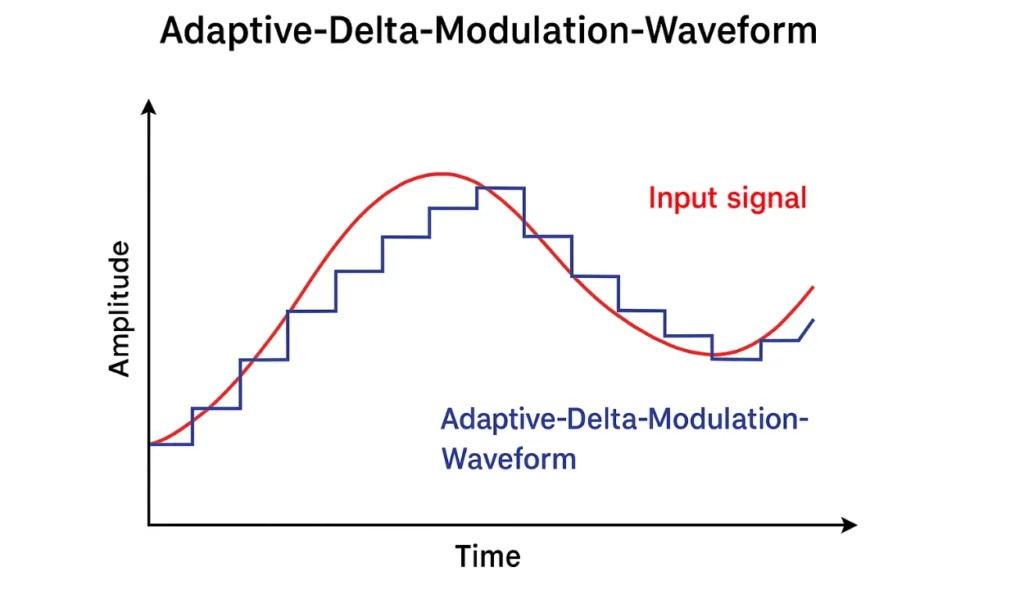
Adaptive Delta Modulation is an advanced form of delta modulation that dynamically adjusts its step size to better track the variations in the input analog signal. By adapting its quantization step, ADM effectively mitigates the two primary distortions present in standard DM: slope overload and granular noise. This adaptive mechanism allows for a more accurate digital representation of the analog signal, especially for signals with wide dynamic ranges like human speech, making it a pivotal development in the history of digital signal processing and communication technologies.
The Foundations: Understanding Delta Modulation (DM)
To fully appreciate the ingenuity of Adaptive Delta Modulation, it’s essential to first grasp the principles and limitations of its predecessor: standard Delta Modulation.
Basics of Analog-to-Digital Conversion
The physical world operates on analog signals—continuous waves of information like sound, light, and temperature. For computers and digital networks to process, transmit, or store this information, it must be converted into a digital format. This process, known as Analog-to-Digital (A/D) conversion, typically involves two main stages: sampling and quantization. Sampling converts a continuous-time signal into a discrete-time signal by taking measurements at regular intervals. Quantization then maps these sampled values to a finite set of discrete amplitude levels, representing them with a specific number of bits. While techniques like Pulse Code Modulation (PCM) quantize each sample to multiple bits, Delta Modulation takes a more minimalist approach.
Principles of Delta Modulation
Delta Modulation is a differential pulse-code modulation (DPCM) technique that encodes analog signals into a 1-bit digital stream. Unlike PCM, which transmits the absolute amplitude of a sample, DM transmits only the change in the signal from one sample to the next. The core idea is to approximate the analog input signal with a staircase waveform.
Here’s how it fundamentally works:
- Prediction: A predictor estimates the next sample value based on the previous sample’s output.
- Comparison: The current analog input sample is compared with the predicted value.
- Quantization: A 1-bit quantizer determines if the input signal is higher or lower than the predicted value. If the input is higher, a ‘1’ (or positive step) is generated; if lower, a ‘0’ (or negative step) is generated.
- Step Size: This 1-bit output then controls the direction of a fixed step size (Δ). If ‘1’, the predictor output increases by Δ; if ‘0’, it decreases by Δ.
Essentially, DM tries to follow the analog signal by either taking a fixed step up or a fixed step down at each sampling interval. The resulting sequence of 1s and 0s represents the digital approximation of the analog signal’s slope.
Limitations of Standard Delta Modulation
Despite its elegant simplicity and low complexity, standard Delta Modulation suffers from two significant types of distortion due to its fixed step size:
- Slope Overload Distortion: This occurs when the input analog signal changes rapidly, meaning its slope is much steeper than the fixed step size can follow. In such cases, the DM output, limited to small fixed increments, lags behind the rapidly changing input. The staircase approximation cannot keep up with the steep rise or fall of the original signal, leading to a significant difference between the original and reconstructed signals. The system becomes “overloaded” by the steep slope, resulting in a distorted output.
- Granular Noise (Quantization Noise): Conversely, granular noise arises when the input signal is relatively flat or changes very slowly. If the fixed step size (Δ) is too large for such gentle variations, the staircase approximation will oscillate back and forth around the actual signal value. This constant hunting creates a “granular” or “noisy” effect, as the output repeatedly overshoots and undershoots the true signal level without ever settling precisely.
The dilemma for standard DM designers was clear: a small step size minimizes granular noise but exacerbates slope overload, while a large step size reduces slope overload but increases granular noise. It was impossible to optimize for both with a fixed step size, highlighting the critical need for a more flexible approach.
Enhancing Efficiency: The Adaptive Delta Modulation (ADM) Solution
The limitations of standard DM underscored the necessity for a system that could dynamically respond to the changing characteristics of the input signal. This need gave birth to Adaptive Delta Modulation, a brilliant refinement that brought significant improvements to signal fidelity and dynamic range.
The Adaptive Principle
The core innovation of ADM lies in its ability to adjust the step size (Δ) on the fly, rather than keeping it fixed. Instead of using a constant increment or decrement, ADM continuously monitors the input signal’s behavior and modifies the step size accordingly. If the input signal is changing rapidly (suggesting a steep slope), ADM increases the step size to catch up. If the input signal is relatively stable or changing slowly, ADM decreases the step size to minimize granular noise. This adaptive mechanism allows the system to maintain a closer approximation to the original analog signal across a wider range of dynamics.
How Adaptive Delta Modulation Works
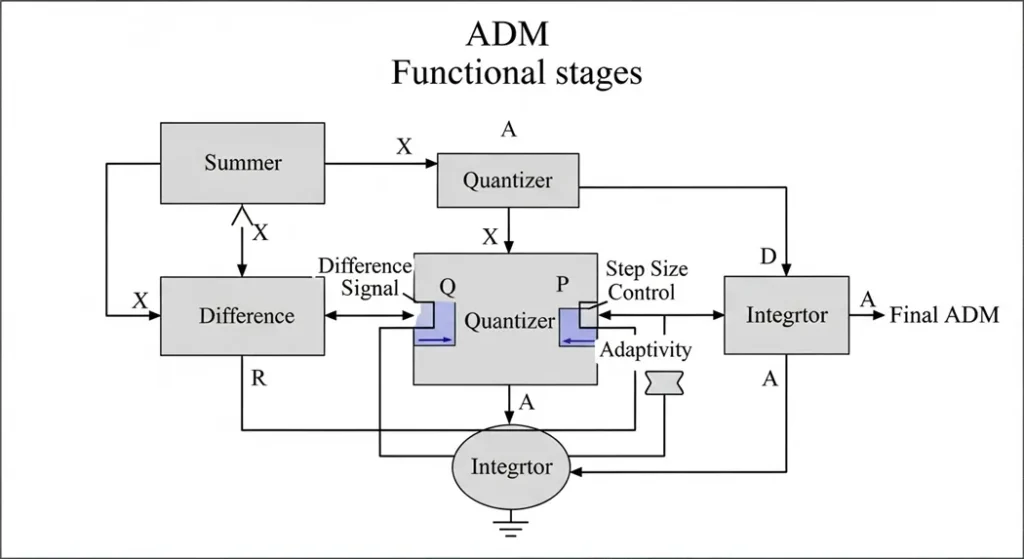
The adaptation logic in ADM is typically based on the recent history of the output bits. A common algorithm involves observing the sequence of output bits to infer the slope of the input signal:
- Detecting Steep Slopes: If two or more consecutive output bits are the same (e.g., “11” or “00”), it implies that the fixed step size was insufficient to track the input signal. For instance, if the system repeatedly outputs “1”s, it means the input signal is consistently higher than the predictor’s estimate, suggesting a steep positive slope. In this scenario, the ADM increases its step size (Δ). A common method is to multiply the current step size by a factor greater than one (e.g., Δnew = P * Δold, where P > 1).
- Detecting Gentle Slopes/Flat Signals: If the output bits alternate (e.g., “10” or “01”), it indicates that the system is oscillating around the input signal, suggesting that the current step size is too large for the relatively flat or slowly changing input. To reduce this granular noise, the ADM decreases its step size. This is typically done by dividing the current step size by a factor (e.g., Δnew = Δold / P, or Δnew = 1/P * Δold).
This dynamic adjustment allows ADM to effectively “zoom in” on flat segments and “zoom out” for steep segments, optimizing its performance across the entire signal. Various specific algorithms exist for step size adaptation, with Continuously Variable Slope Delta Modulation (CVSDM) being one of the most prominent examples.
Advantages Over Basic Delta Modulation

The adaptive nature of ADM provides significant improvements over its fixed-step predecessor:
- Reduced Slope Overload Distortion: By increasing the step size when the input signal changes rapidly, ADM can track steeper slopes much more effectively, minimizing the distortion caused by the inability to keep up.
- Reduced Granular Noise: By decreasing the step size when the input signal is relatively flat, ADM reduces the oscillations around the true signal value, thereby minimizing granular noise.
- Improved Dynamic Range: The ability to handle both rapidly changing and slowly changing signals means ADM can effectively encode signals with a much wider range of amplitudes and frequencies.
- Better Signal-to-Noise Ratio (SNR): By reducing both primary forms of distortion, ADM achieves a better overall signal fidelity and a higher SNR compared to standard DM for the same bit rate.
Key Types and Implementations of ADM
While the fundamental principle of adapting the step size remains constant, several specific implementations and variations of Adaptive Delta Modulation have been developed, each with its own nuances and strengths.
Continuously Variable Slope Delta Modulation (CVSDM)
One of the most widely recognized and practically implemented forms of ADM is Continuously Variable Slope Delta Modulation (CVSDM). CVSDM is particularly effective for voice communication due to the inherent variable nature of speech signals.
Its adaptation mechanism is typically based on integrating the recent sequence of output bits. If a certain number of consecutive output bits are identical (e.g., three “1”s or three “0”s), indicating a persistent error and likely slope overload, the step size is increased significantly. If the output bits alternate frequently, suggesting the approximation is overshooting and undershooting the true signal (granular noise), the step size is decreased. This makes CVSDM highly responsive to changes in the signal’s slope, offering a good balance between mitigating slope overload and reducing granular noise. Its simplicity and robust performance made it a popular choice for early digital voice systems.
Digitally Controlled Delta Modulation (DCDM)
DCDM refers to a broader category where the step size control logic is implemented digitally, often using a lookup table or a more complex algorithm than simple consecutive bit checking. The digital control can incorporate more sophisticated decision-making based on a longer history of samples or other signal characteristics to optimize the step size. This allows for more precise adaptation, though often at the cost of increased circuit complexity.
Block Adaptive Delta Modulation
Unlike the sample-by-sample adaptation of CVSDM, some ADM schemes employ “block” adaptation. In this approach, the step size is not adjusted for every single sample, but rather for blocks of samples. The system analyzes a block of input samples, determines an optimal or near-optimal step size for that entire block, and then applies it. This can reduce the computational overhead associated with continuous adaptation, but it might introduce a slight delay and could be less responsive to very rapid, intra-block changes. However, for certain types of signals or applications, the trade-off in complexity versus performance can be advantageous.
Applications and Relevance in Modern Tech
Adaptive Delta Modulation, while perhaps not a household name in the era of high-fidelity audio codecs, played a crucial role in the development of digital communication and continues to find niche applications due to its inherent efficiency and simplicity.
Early Applications in Voice Communication
ADM, particularly CVSDM, was instrumental in early digital voice systems. Speech signals are highly variable; they can have very steep changes during plosive sounds (like ‘p’ or ‘t’) and relatively flat segments during vowels. ADM’s ability to adapt its step size made it ideally suited for efficiently encoding these complex waveforms at relatively low bit rates. It was widely used in:
- Digital Telephony: For converting analog voice signals into digital form for transmission over early digital networks.
- Military Communications: Its robustness and relatively low complexity made it suitable for secure voice transmission where bandwidth might be limited.
- Voice Store-and-Forward Systems: Where voice messages needed to be stored digitally.
Low Bit-Rate Audio and Data Transmission
One of the key advantages of ADM, particularly when compared to multi-bit PCM, is its ability to operate at very low bit rates. While PCM typically requires 8 or more bits per sample for reasonable quality, ADM, being a 1-bit encoder, achieves acceptable quality for voice at bit rates significantly lower than uncompressed PCM. This efficiency made it valuable for transmitting signals over bandwidth-constrained channels where higher fidelity codecs were either too complex or consumed too much bandwidth. Its simplicity also translated to lower power consumption, making it attractive for battery-operated devices.
Niche Applications Today
While advanced perceptual codecs like MP3, AAC, and modern voice codecs (e.g., Opus, AMR) have largely superseded ADM for general-purpose high-fidelity audio and voice applications, the principles and even direct implementations of ADM still find relevance in specific domains:
- Embedded Systems: For low-power, low-cost microcontrollers that need to digitize analog sensor data, ADM’s simplicity can be a significant advantage. Its low computational footprint allows for efficient implementation even on resource-constrained devices.
- Sensor Data Acquisition: In industrial control, environmental monitoring, or medical devices, ADM can be used for digitizing sensor outputs where the primary concern is not high-fidelity audio but rather accurate tracking of trends and changes with low latency.
- Simple Intercoms and Walkie-Talkies: For basic voice communication where very high fidelity isn’t critical, ADM provides a straightforward and robust solution.
- As a Building Block/Concept: The adaptive quantization principle pioneered by ADM has influenced and paved the way for more sophisticated adaptive coding schemes used in modern digital signal processing. Understanding ADM is fundamental to grasping the evolution of efficient digital signal representation.
ADM’s Legacy and Future
Adaptive Delta Modulation stands as a testament to engineering ingenuity in solving practical problems within technological constraints. It provided a crucial bridge between basic analog signals and the emerging digital world, particularly for voice communication. Its legacy lies not just in its direct applications but also in demonstrating the power of adaptive algorithms. By intelligently responding to the characteristics of the input signal, ADM laid foundational groundwork for the development of more complex and highly efficient data compression and modulation techniques that power our connected world today. While it may operate behind the scenes in niche applications, its contribution to the understanding and implementation of efficient digital signal processing remains significant.
In conclusion, Adaptive Delta Modulation is more than just an obscure technical term; it’s a clever and impactful piece of technology that elegantly solved critical challenges in digitizing analog signals. By dynamically adjusting its step size, ADM overcame the inherent limitations of fixed-step delta modulation, providing a robust and efficient method for converting continuous signals into discrete digital information. Its development marked a pivotal step in the evolution of digital communication, shaping how we convert, transmit, and interact with information in our increasingly digital lives.
aViewFromTheCave is a participant in the Amazon Services LLC Associates Program, an affiliate advertising program designed to provide a means for sites to earn advertising fees by advertising and linking to Amazon.com. Amazon, the Amazon logo, AmazonSupply, and the AmazonSupply logo are trademarks of Amazon.com, Inc. or its affiliates. As an Amazon Associate we earn affiliate commissions from qualifying purchases.