
In the rapidly evolving landscape of automotive technology, the distinction between manual mechanical systems and intelligent automated hardware has become increasingly blurred. Among the most misunderstood yet technologically significant advancements in modern drivetrain engineering is A4WD, or Automatic Four-Wheel Drive. Unlike the traditional “shift-on-the-fly” systems of the past, A4WD represents a sophisticated fusion of mechanical engineering, sensor arrays, and algorithmic processing. It is a system designed to bridge the gap between the raw power of a dedicated off-road 4WD and the seamless, hands-off operation of All-Wheel Drive (AWD).
To understand A4WD, one must look past the transfer case and into the vehicle’s “brain”—the Electronic Control Unit (ECU)—which dictates how and when torque is distributed to the wheels. This technology is not merely a convenience feature; it is a critical component of modern vehicle safety and efficiency suites, utilizing real-time data to navigate the complex physics of traction.

The Mechanics of Modern Traction: How A4WD Operates
At its core, A4WD is a “demand-based” system. While traditional 4WD requires the driver to manually engage a secondary set of wheels through a lever or a dial, A4WD remains in a passive state until the vehicle’s onboard technology determines that intervention is necessary. This transition occurs in milliseconds, often before the driver even realizes a loss of traction has occurred.
The Role of Sensors and Electronic Control Units (ECUs)
The “Automatic” in A4WD is powered by a high-speed network of sensors located throughout the vehicle. These sensors monitor various parameters, including wheel speed, throttle position, steering angle, and even lateral acceleration. All this data is fed into the ECU. When the sensors detect that the rear wheels (the primary drive wheels in most A4WD setups) are spinning faster than the front wheels—a clear sign of slippage—the ECU sends a command to the transfer case.
Inside the transfer case of an A4WD system, there is typically an electronically controlled clutch pack. Rather than a hard mechanical lock found in traditional 4WD, this clutch pack uses electromagnetic or hydraulic force to engage the front driveshaft. The precision of this tech allows the vehicle to send a varying percentage of power to the front wheels, ranging from a slight nudge to a 50/50 split, depending on the severity of the slip.
The Transition from Manual to Software-Defined Drivetrains
The evolution of A4WD marks a significant shift in automotive philosophy: the move from driver-operated hardware to software-defined performance. In older systems, the driver had to anticipate the road conditions—shifting into 4H (4-Wheel High) before hitting a patch of ice. A4WD removes the human error factor. By utilizing complex logic gates and feedback loops, the system can react to micro-slips that a human driver wouldn’t feel, maintaining stability without requiring any input from the cabin.
A4WD vs. 4WD vs. AWD: Deciphering the Technical Differences
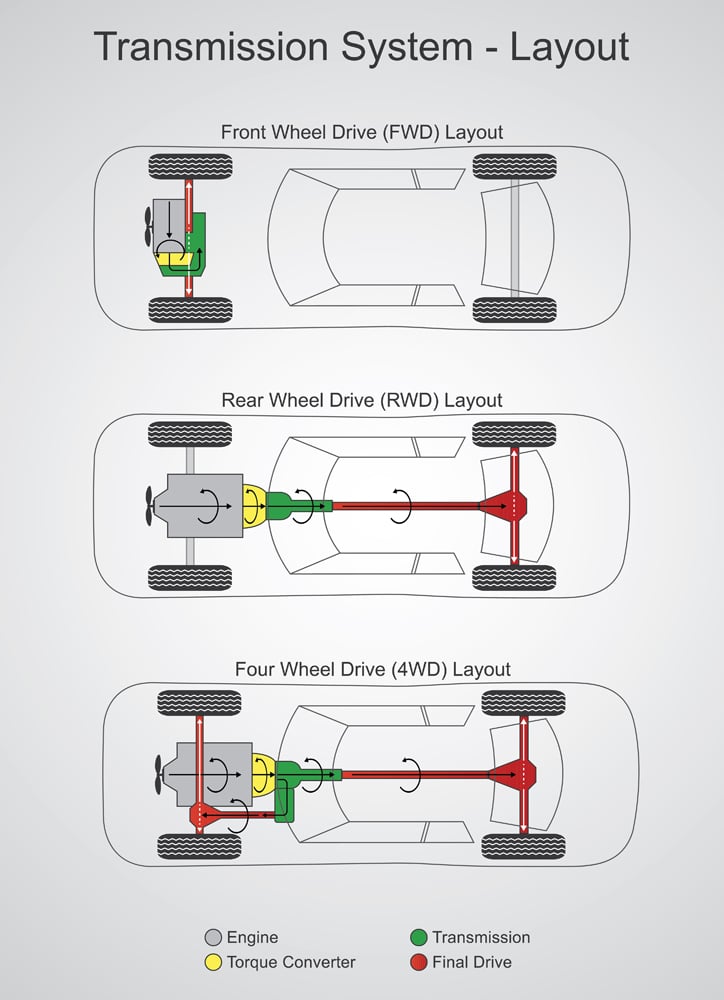
In the tech world, naming conventions often lead to consumer confusion. While A4WD, 4WD, and AWD all aim to provide power to four wheels, their technical architectures and intended use cases differ significantly. Understanding these nuances is essential for grasping why A4WD has become the standard for modern SUVs and trucks.
Part-Time 4WD: The Mechanical Predecessor
Traditional Part-Time 4WD is a binary system. It is either “On” or “Off.” When engaged, the front and rear driveshafts are mechanically locked together, forcing them to turn at the exact same speed. While this is superior for heavy off-roading, it is technologically “dumb” on dry pavement. Because wheels need to rotate at different speeds when turning, a locked 4WD system will cause “driveline bind” on high-traction surfaces, potentially damaging the gears. A4WD solves this by using its clutch-based system to allow for rotational variance, making it safe for use on mixed surfaces.
All-Wheel Drive (AWD): The Constant Variable
AWD is often confused with A4WD because both are automatic. However, the tech behind them differs. AWD systems are typically designed to be engaged at all times, often using a center differential to constantly vary torque between axles. AWD is generally optimized for road performance and handling in cars and crossovers. A4WD, conversely, is usually built on a truck-based platform with a true low-range gear set (4LO) available as a separate option. A4WD provides the “brain” of an AWD system with the “brawn” of a 4WD chassis.
A4WD: The Intelligent Hybrid Approach
A4WD acts as the middle ground. It provides the fuel efficiency of two-wheel drive (by disconnecting the front axle when not needed) and the instant security of four-wheel drive. Technically, it is a “reactive” system that can become “proactive” through advanced software updates. Modern A4WD systems are now being integrated with “Drive Modes” (Snow, Mud, Sand), where the software pre-loads the clutches based on the selected profile to minimize the reaction time even further.
The Software Logic: How the System “Thinks”
The true magic of A4WD lies not in the steel of the gears, but in the lines of code that govern them. Automotive engineers spend thousands of hours refining the algorithms that decide when to engage the front axle. This software must balance three competing priorities: traction, fuel economy, and mechanical longevity.
Slip Detection and Torque Vectoring
The most basic function of the A4WD software is slip detection. However, modern “Tech-Forward” iterations have moved toward torque vectoring. This involves the ECU not just sending power to the front axle, but potentially using the braking system (Electronic Stability Control) to pulse the brakes on an individual wheel that has lost grip. This forces torque to the wheel on the same axle that still has traction. The synergy between the A4WD hardware and the braking software creates a virtual locking differential effect.
Predictive vs. Reactive Algorithms
The next frontier in A4WD technology is the shift from reactive to predictive logic. Reactive systems wait for a wheel to spin before engaging. Predictive systems use external data—such as ambient temperature (predicting ice), windshield wiper engagement (detecting rain), and GPS data (detecting a steep incline)—to engage the transfer case before a slip even occurs. This level of integration represents the pinnacle of current drivetrain tech, turning the vehicle into a proactive guardian of passenger safety.
Maintenance and Longevity in the Digital Age
Because A4WD relies on a complex interplay of electronics and hydraulics, its maintenance profile differs from simpler mechanical systems. Tech-savvy owners must understand that the “Automatic” nature of the system puts a unique set of stresses on the vehicle’s hardware.
Fluid Management and Electronic Diagnostics
The clutch packs inside an A4WD transfer case generate heat whenever they are slipping to provide variable torque. This requires specialized “Transfer Case Fluid” with specific friction modifiers. Over time, these chemicals break down, and the software may begin to struggle to engage the clutches smoothly. Furthermore, because the system is electronically controlled, troubleshooting often requires sophisticated OBD-II (On-Board Diagnostics) scanners that can read manufacturer-specific codes from the Drivetrain Control Module (DTCM).
Common Technical Failures in Automatic Systems
The vulnerabilities of A4WD are often found in the sensors rather than the gears. A failing wheel speed sensor—often damaged by road salt or debris—can “blind” the A4WD system, causing it to default to a 2WD mode for safety. Understanding the digital architecture of the vehicle helps in diagnosing these issues. Often, a “Service 4WD” light is not a sign of mechanical catastrophe, but a software flag indicating that the ECU is receiving irrational data from one of its many peripheral inputs.
The Future of Traction: Electric Vehicles and Beyond
As the automotive industry pivots toward electrification, the concept of A4WD is undergoing its most radical transformation yet. In a traditional internal combustion engine (ICE) vehicle, A4WD requires a complex web of driveshafts, U-joints, and transfer cases. In the world of EVs, the technology is becoming entirely digital.
Dual-Motor e-AWD Systems
The “Tech” of the future removes the transfer case entirely. Most high-performance EVs utilize a dual-motor setup—one for the front axle and one for the rear. In this “e-AWD” or “Digital A4WD” environment, there is no mechanical link between the front and rear wheels. The “Automatic” engagement is handled at the speed of electricity. The software can adjust the torque at each motor thousands of times per second, providing a level of precision that mechanical clutches simply cannot match.

AI Integration in Off-Road Software
We are also seeing the introduction of Artificial Intelligence in traction management. Future A4WD systems will likely utilize machine learning to study a driver’s habits and the specific terrain they frequent. By analyzing historical data, the vehicle’s AI could optimize the engagement thresholds of the A4WD system to maximize battery range or off-road prowess.
In conclusion, A4WD is far more than a simple drivetrain setting. It is a sophisticated technological ecosystem that leverages sensors, complex software logic, and advanced mechanical engineering to provide a seamless driving experience. As we move deeper into the era of the software-defined vehicle, A4WD stands as a prime example of how digital intelligence can enhance the raw mechanical capabilities of the machines we rely on every day. Whether you are navigating a rain-slicked highway or a muddy trail, the technology of A4WD is working silently in the background, making split-second decisions to keep the journey moving forward.
aViewFromTheCave is a participant in the Amazon Services LLC Associates Program, an affiliate advertising program designed to provide a means for sites to earn advertising fees by advertising and linking to Amazon.com. Amazon, the Amazon logo, AmazonSupply, and the AmazonSupply logo are trademarks of Amazon.com, Inc. or its affiliates. As an Amazon Associate we earn affiliate commissions from qualifying purchases.