
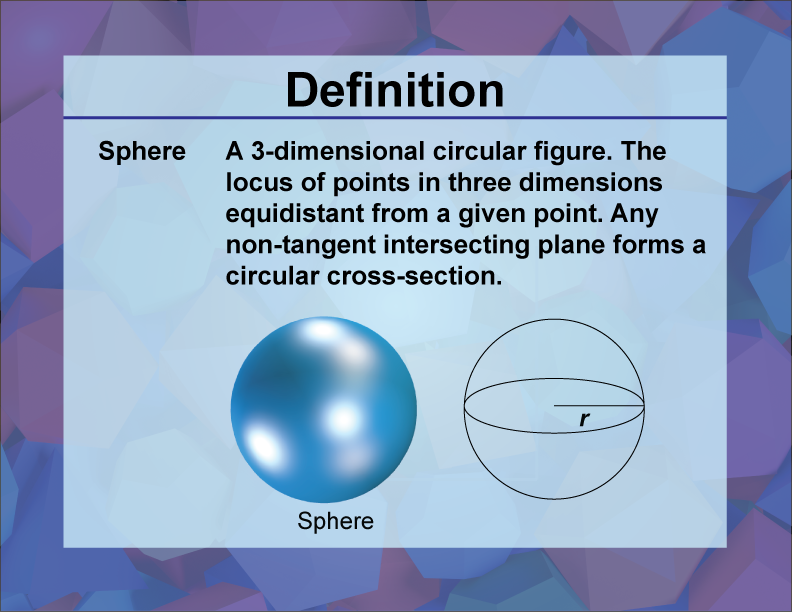
The word “sphere” conjures images of perfect, rounded objects – a ball, a planet, a bubble. In geometry, a sphere is precisely that: a perfectly round three-dimensional object where every point on its surface is equidistant from a central point. While seemingly simple, this fundamental shape underpins numerous concepts and applications across various fields, particularly in the realm of technology. Understanding the properties of a sphere is crucial for comprehending everything from the physics of our universe to the design of cutting-edge software and hardware. This article will delve into the geometric definition of a sphere and explore its profound impact and manifestations within the technological landscape.

The Geometry of a Sphere: Precision in Form
At its core, a sphere is defined by its radius. The radius ($r$) is the constant distance from the center of the sphere to any point on its surface. This unwavering uniformity is what gives the sphere its characteristic smooth, uninterrupted curvature. Unlike polygons, which have distinct edges and vertices, a sphere is a continuous surface with no corners or flat faces.
Defining the Sphere Mathematically
In a three-dimensional Cartesian coordinate system, a sphere can be described by a single equation. If the center of the sphere is at the origin $(0, 0, 0)$, and its radius is $r$, then any point $(x, y, z)$ on the surface of the sphere satisfies the equation:
$x^2 + y^2 + z^2 = r^2$
If the center is shifted to a point $(h, k, l)$, the equation becomes:
$(x – h)^2 + (y – k)^2 + (z – l)^2 = r^2$
This mathematical elegance allows for precise calculations and simulations involving spherical objects, a cornerstone of many technological advancements.
Key Properties and Calculations
Beyond its defining radius, a sphere possesses several important properties that are frequently utilized in technology:
-
Surface Area: The surface area ($A$) of a sphere is given by the formula $A = 4pi r^2$. This calculation is vital in fields like fluid dynamics, heat transfer, and material science, where the interaction of a spherical object with its environment is paramount. For instance, in designing aerodynamic vehicles or understanding the dispersal of particles, the surface area plays a significant role.
-
Volume: The volume ($V$) enclosed by a sphere is calculated as $V = frac{4}{3}pi r^3$. This is fundamental for understanding capacity, storage, and the physical space occupied by spherical components. In software development, for example, estimating the memory footprint of spherical data structures or the storage requirements for 3D models often relies on these volumetric calculations.
-
Great Circles and Small Circles: A great circle is the intersection of the sphere’s surface with a plane passing through its center. The circumference of a great circle is the largest possible circumference on the sphere. Lines of longitude and the Equator on Earth are examples of great circles. A small circle is formed by the intersection of the sphere’s surface with a plane that does not pass through its center. Understanding great and small circles is crucial in navigation, particularly for calculating the shortest distances between points on a spherical surface, a concept that directly translates to network routing and geographical information systems.
Spheres in the Digital Realm: Modeling and Simulation
The perfect symmetry and mathematical definability of the sphere make it an ideal subject for digital modeling and simulation. From the earliest days of computer graphics to sophisticated virtual reality environments, spheres have been a foundational element.
Computer Graphics and Rendering
In 3D computer graphics, the sphere is one of the most basic primitives. It serves as a building block for creating more complex shapes and is used extensively in rendering algorithms.
-
Object Representation: Many real-world objects, or parts of them, can be approximated by spheres or combinations of spheres. For example, a basic eye model in a character animation, a planet in a space simulation, or a simple UI element can be represented as a sphere.
-
Lighting and Shading: The way light interacts with a perfectly spherical surface is predictable and mathematically described. This allows for realistic lighting and shading effects to be calculated efficiently. Algorithms like Phong shading and Blinn-Phong lighting often start with basic spherical geometry to simulate how light reflects and scatters, contributing to the visual fidelity of digital environments.
-
Collision Detection: In game development and physics simulations, spheres are frequently used for basic collision detection. Checking for intersections between spheres is computationally far less intensive than with more complex polygons. This “bounding sphere” approach offers a quick way to determine if two objects might be colliding, allowing for more detailed checks only when a potential collision is detected.
Virtual and Augmented Reality

The immersive nature of VR and AR environments relies heavily on the accurate rendering of 3D space, where spheres play a vital role.
-
World Building: Spherical environments, such as panoramic skyboxes or 360-degree videos, create the illusion of being present in a different location. The rendering of these environments often involves projecting textures onto a virtual sphere, immersing the user within the scene.
-
Interaction and User Interface: Spherical interfaces can offer intuitive ways to interact with virtual objects or navigate menus. For example, a radial menu where options are arranged in a circular or spherical pattern can be more engaging and easier to use in a VR context.
-
Haptic Feedback: Advanced haptic systems aim to simulate touch. When interacting with virtual spherical objects, the system might modulate vibrations or forces to mimic the sensation of touching a smooth, rounded surface.
The Sphere in Hardware and Infrastructure
The geometric properties of spheres also translate into practical applications in the design and function of physical hardware and infrastructure.
Data Storage and Transfer
While not always physically spherical, the concepts of data organization and transfer often leverage spherical metaphors or principles.
-
Data Structures: In certain advanced data indexing or search algorithms, particularly in multidimensional databases, data points can be visualized as residing within hyperspheres. The concept of a sphere in higher dimensions is used to define regions of data and efficiently query for points within a certain range or proximity.
-
Network Topologies: While less common for the entire network, certain network architectures or models might use spherical representations for visualizing global connectivity or traffic flow. The idea of a sphere as a self-contained, interconnected system can inform how distributed systems are conceptualized.
Physical Components and Engineering
The inherent strength and efficiency of the spherical form make it a preferred design choice in various engineering disciplines.
-
Pressure Vessels: Spheres are the strongest shape for containing internal pressure. This is why propane tanks, deep-sea submersibles, and high-pressure industrial vessels are often spherical or cylindrical with spherical end caps. The uniform distribution of stress across the surface prevents localized weak points.
-
Bearings and Ballistics: Ball bearings, crucial components in countless machines, are precisely manufactured spheres. Their smooth rolling action minimizes friction, enabling efficient movement. Similarly, understanding the trajectory of spherical projectiles in ballistics relies heavily on physics principles applied to spherical bodies.
-
Antennas and Sensors: Certain types of antennas, like omnidirectional antennas, are designed to radiate or receive signals equally in all directions, effectively covering a spherical pattern. Similarly, some sensor arrays might be designed with a spherical arrangement to capture data from all angles.
Future Frontiers: Spherical Computing and Beyond
As technology continues to evolve, the fundamental principles of the sphere are likely to be explored in new and exciting ways.
Quantum Computing and Hyperspheres
In the abstract world of quantum mechanics, states can be represented on a sphere (the Bloch sphere for a single qubit). This geometric representation is fundamental to understanding quantum operations and algorithms. As quantum computing progresses, the conceptualization and manipulation of quantum states within these spherical frameworks will become even more critical. Furthermore, in theoretical physics and cosmology, the concept of hyperspheres (spheres in dimensions higher than three) is used to model the universe or specific physical phenomena.
Advanced Materials and Nanotechnology
The development of novel materials, especially at the nanoscale, often involves creating spherical or quasi-spherical structures. Nanoparticles, for instance, are frequently engineered into spherical or near-spherical shapes due to their unique surface-area-to-volume ratios, which dictate their reactivity and properties. Understanding the mechanics and interactions of these nanoscale spheres is vital for advancements in medicine, energy, and material science.
The Ubiquity of the Sphere
From the fundamental geometric definition to its pervasive presence in digital environments and physical infrastructure, the sphere is far more than just a simple shape. It represents a principle of elegant efficiency, uniform distribution, and robust structure. As we continue to push the boundaries of technology, the humble sphere, in its mathematical perfection, will undoubtedly remain a foundational concept, influencing how we model, build, and interact with the digital and physical worlds around us. The continued exploration of its properties and applications promises further innovation across the technological spectrum.
aViewFromTheCave is a participant in the Amazon Services LLC Associates Program, an affiliate advertising program designed to provide a means for sites to earn advertising fees by advertising and linking to Amazon.com. Amazon, the Amazon logo, AmazonSupply, and the AmazonSupply logo are trademarks of Amazon.com, Inc. or its affiliates. As an Amazon Associate we earn affiliate commissions from qualifying purchases.