
In the world of mathematics, the Lowest Common Denominator (LCD) is a foundational concept used to bring harmony to disparate fractions. It is the smallest number that can be used as a common denominator for a set of fractions, allowing for addition, subtraction, and meaningful comparison. While most of us leave the LCD behind in middle school, its logic remains one of the most powerful tools in a professional financial toolkit.
In the niche of personal and business finance, the “Lowest Common Denominator” represents the act of normalization. Whether you are comparing investment returns, consolidating high-interest debt, or scaling a startup, you are essentially searching for a common base to make informed decisions. Understanding what an LCD is in math provides the cognitive framework necessary to deconstruct complex financial data and rebuild it into a clear, actionable strategy for wealth accumulation.
The Fundamentals: Why the Lowest Common Denominator Matters in Finance
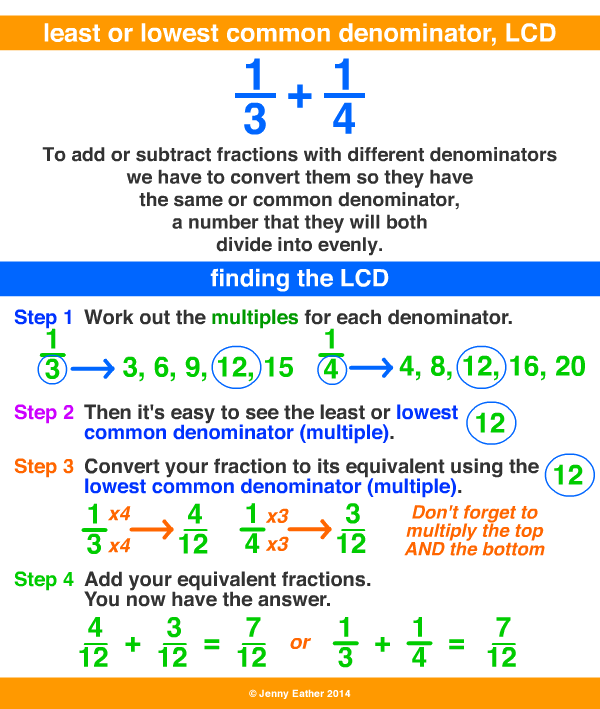
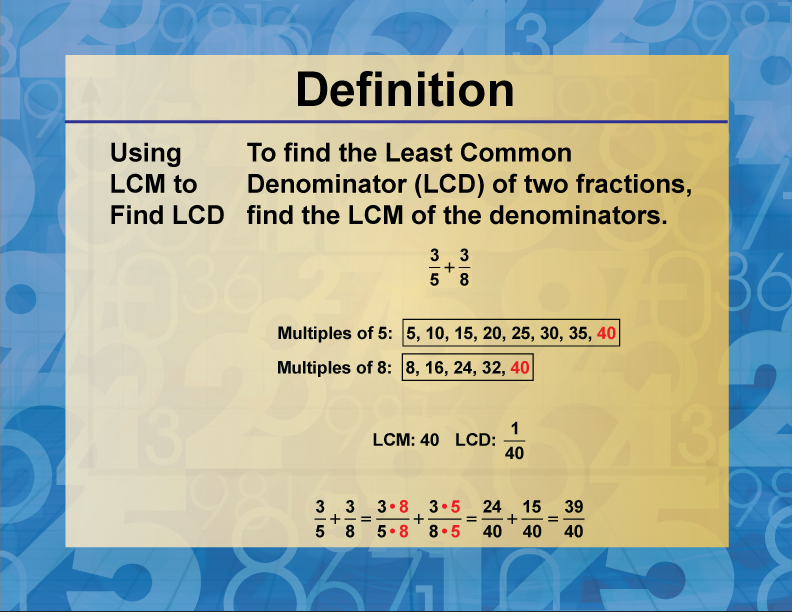
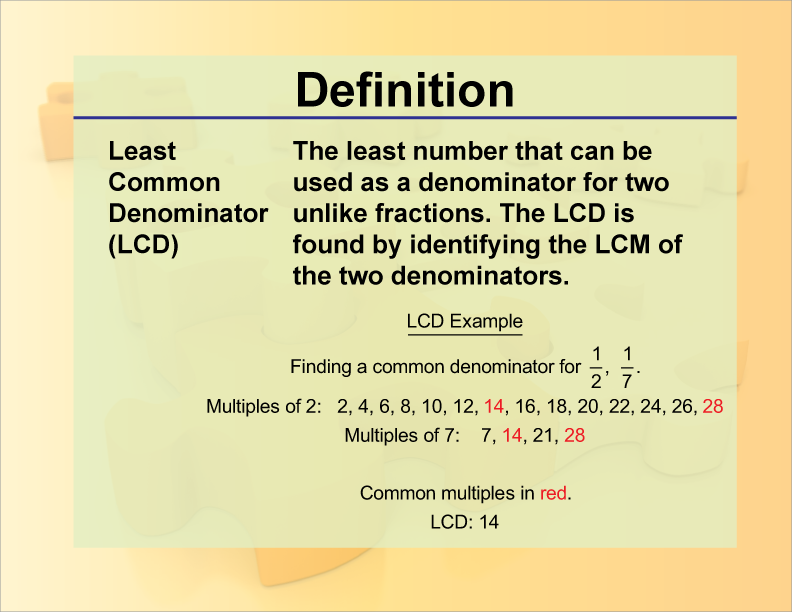
To understand why the LCD is vital for money management, we must first look at the mechanics of the math. When you have fractions like 1/4 and 1/6, you cannot easily combine them because they represent parts of different wholes. By finding the LCD—which is 12 in this case—you transform them into 3/12 and 2/12. Now, they are “speaking the same language.”
In finance, we deal with “fractions” every day: interest rates, percentage yields, and expense ratios. Without a common denominator, you are essentially comparing apples to oranges, which often leads to sub-optimal financial choices.
Decoding the Math for Better Budgeting
Budgeting is the primary arena where the LCD principle is applied. Most individuals receive income on different cycles (bi-weekly, monthly, or quarterly bonuses) and face expenses with varying frequencies (weekly groceries, monthly rent, annual insurance). To create a functional budget, you must find a “common denominator” of time.
Professionals usually use a monthly or annual base as their LCD. By converting a $1,200 annual insurance premium into a $100 monthly “fraction,” you normalize your cash flow. This prevents the “financial shock” of large, irregular expenses and allows you to measure your true savings rate against your total income. Without this mathematical normalization, a budget remains a fragmented list of numbers rather than a cohesive plan.
Comparing Apples to Oranges: Normalizing Financial Data
When evaluating financial products, banks often use different compounding periods or fee structures to obscure the true cost. A credit card might offer a 1.5% monthly rate, while a personal loan offers an 18% annual rate.
Using the LCD logic, a savvy investor converts these into an Annual Percentage Rate (APR) or Annual Percentage Yield (APY). This standardization acts as the lowest common denominator, allowing you to see which “fraction” of your wealth is being consumed by interest. Normalizing data is the only way to ensure that your capital is being deployed in the most efficient manner possible.
LCD in Investment Analysis: Portfolio Balancing and Ratios
Investment management is perhaps the most sophisticated application of the LCD concept. When you manage a portfolio consisting of stocks, bonds, real estate, and perhaps cryptocurrency, you are dealing with assets that have different volatility scales and return horizons. To manage risk effectively, you must find a common metric to evaluate them.
Asset Allocation and Fractional Ownership
Consider a portfolio where you own 50 shares of a high-priced tech stock and 1,000 shares of a low-priced penny stock. Looking at the share count is useless. The “lowest common denominator” here is the total dollar value or the percentage of the total portfolio.
By converting all holdings into a percentage (e.g., 20% Tech, 30% Bonds, 50% Index Funds), you remove the noise of share prices and focus on the “common base” of your total net worth. This mathematical simplification allows you to rebalance your portfolio. If your “Tech fraction” grows too large, the LCD logic tells you exactly how much to sell to bring the ratios back into alignment with your risk tolerance.
Standardizing Returns Across Different Asset Classes
How do you compare a real estate investment that returns $20,000 in rental income annually to a dividend stock that pays $2.00 per share? You apply the LCD of “Return on Investment” (ROI).
By dividing the gain by the initial cost, you derive a percentage. This percentage is the common denominator that allows an investor to decide if the liquidity of a stock is worth the potentially lower yield compared to the illiquidity of real estate. Without finding this common mathematical ground, investors often fall into the trap of chasing high nominal numbers without considering the underlying “denominators” of cost and time.
Debt Management: Finding the Common Base for Repayment
For many, the path to financial freedom is blocked by multiple streams of debt: student loans, car payments, credit cards, and mortgages. Each of these has a different “denominator”—different interest rates, different terms, and different balances.
The Consolidation Strategy: Unifying Interest Rates
Debt consolidation is the literal application of finding a Lowest Common Denominator. When you take out a single consolidation loan to pay off five different credit cards, you are moving from a complex set of disparate fractions to a single, manageable whole.
Mathematically, this simplifies your financial life by providing one interest rate and one monthly payment. However, the professional approach is to ensure that the new “common denominator” (the interest rate of the consolidation loan) is lower than the weighted average of the previous debts. If the LCD of your new loan is higher than the individual fractions it replaced, you have simplified the math but damaged your wealth.
Prioritizing High-Interest Liabilities
In the “Debt Avalanche” method, the LCD is the interest rate. By looking at all debts through the lens of their annual percentage cost, you can ignore the total balances and focus on the “lowest common” factor that is draining your net worth.
This mathematical focus allows for a disciplined approach: paying off the debt with the highest interest rate first. While the “Debt Snowball” method focuses on the psychology of small wins, the “Avalanche” method relies on the cold, hard math of the denominator. It treats all debt as parts of a whole, identifying which parts are the most expensive to keep.
Scaling Business Operations through Common Financial Metrics
In a corporate or entrepreneurial setting, the LCD is used to measure efficiency and scalability. Business owners often struggle with “feature creep” or “expense bloat” because they fail to reduce their operations to a common unit of measurement.
The Unit Economics of Scaling
For a business to be profitable, its Unit Economics must make sense. This is the ultimate “lowest common denominator” in business finance. Whether you are selling software subscriptions or handmade furniture, you must calculate the Customer Acquisition Cost (CAC) and the Lifetime Value (LTV) of a single customer.
By reducing the entire business model to the “unit” level, you can predict how the business will perform when scaled by 10x or 100x. If the common denominator of your unit economics is negative—meaning you lose money on every individual sale—then scaling will only lead to a larger disaster. The math of the LCD ensures that the foundation is solid before the structure is built.
Streamlining Corporate Expenses
Large corporations use a concept called “Common Size Financial Statements.” This involves representing every line item on an income statement as a percentage of total sales. In this scenario, “Total Sales” serves as the Lowest Common Denominator.
When a CEO looks at a common-size statement, they aren’t just seeing that they spent $1 million on marketing; they are seeing that marketing represents 15% of revenue. This allows the leadership to compare their efficiency against competitors of different sizes. If a competitor is only spending 10% of their “common denominator” on marketing while achieving the same growth, it signals an inefficiency that needs to be addressed.
Conclusion: The Mathematical Path to Wealth
While the question “what is a LCD in math” may seem elementary, its application is the cornerstone of sophisticated financial planning. The ability to find a common base among different variables is what separates successful investors and business leaders from those who are overwhelmed by data.
By finding the Lowest Common Denominator in your finances, you gain the ability to:
- Simplify complex budgets into predictable cash flows.
- Normalize disparate investment returns to identify true performance.
- Consolidate and prioritize debts to accelerate freedom.
- Scale businesses by focusing on the core unit economics.
Mastering your money is not just about earning more; it is about understanding the mathematical relationships between what you earn, what you spend, and what you keep. When you learn to see the world through the lens of the common denominator, the “fractions” of your financial life finally begin to add up to a prosperous whole.
aViewFromTheCave is a participant in the Amazon Services LLC Associates Program, an affiliate advertising program designed to provide a means for sites to earn advertising fees by advertising and linking to Amazon.com. Amazon, the Amazon logo, AmazonSupply, and the AmazonSupply logo are trademarks of Amazon.com, Inc. or its affiliates. As an Amazon Associate we earn affiliate commissions from qualifying purchases.