
Understanding the fundamental building blocks of relational databases is crucial for anyone working with data. Among these essential components, the foreign key stands out as a cornerstone of data integrity, relational structure, and efficient data retrieval. In the realm of SQL (Structured Query Language), a foreign key is not merely a technical term; it’s a powerful mechanism that underpins the very concept of relationships between tables. This article delves deep into the nature, purpose, and practical applications of foreign keys in SQL, illuminating their significance for database design and management.
The Foundation: Understanding Relational Databases and Primary Keys
Before we can truly grasp the concept of a foreign key, it’s imperative to establish a foundational understanding of relational databases and their core organizational principles. Relational databases, unlike their hierarchical or network predecessors, organize data into tables. Each table represents an entity (like “Customers,” “Orders,” or “Products”), and the rows within that table represent individual instances of that entity.
Entities and Tables: The Building Blocks
In a relational database, data is logically structured into tables. Each table is designed to hold information about a specific type of item or concept. For example, a retail database might have a Customers table to store details about each customer, an Orders table to record each purchase, and a Products table to list all available items. This tabular structure allows for a clear and organized representation of information, making it easier to manage and query.
The Role of the Primary Key
Within each table, one or more columns are designated as the primary key. The primary key serves a singular, vital purpose: to uniquely identify each row within that table. Think of it as a unique ID card for each record. For instance, in a Customers table, a CustomerID column, typically an auto-incrementing integer, would be an ideal primary key. No two customers can share the same CustomerID, ensuring that each customer record is distinct and addressable.
- Uniqueness: The primary key constraint guarantees that no two rows in a table will have the same primary key value. This is fundamental to data accuracy and prevents ambiguity.
- Non-Nullability: Primary keys cannot contain NULL values. Every record must have a definitive identifier.
- Indexing: Database systems automatically create an index on the primary key columns, which significantly speeds up data retrieval operations when searching or filtering by the primary key.
Without a primary key, it would be difficult, if not impossible, to reliably reference, update, or delete specific records within a table. It’s the anchor that holds each record in place and makes it distinguishable from all others.
Defining the Foreign Key: Establishing Relationships
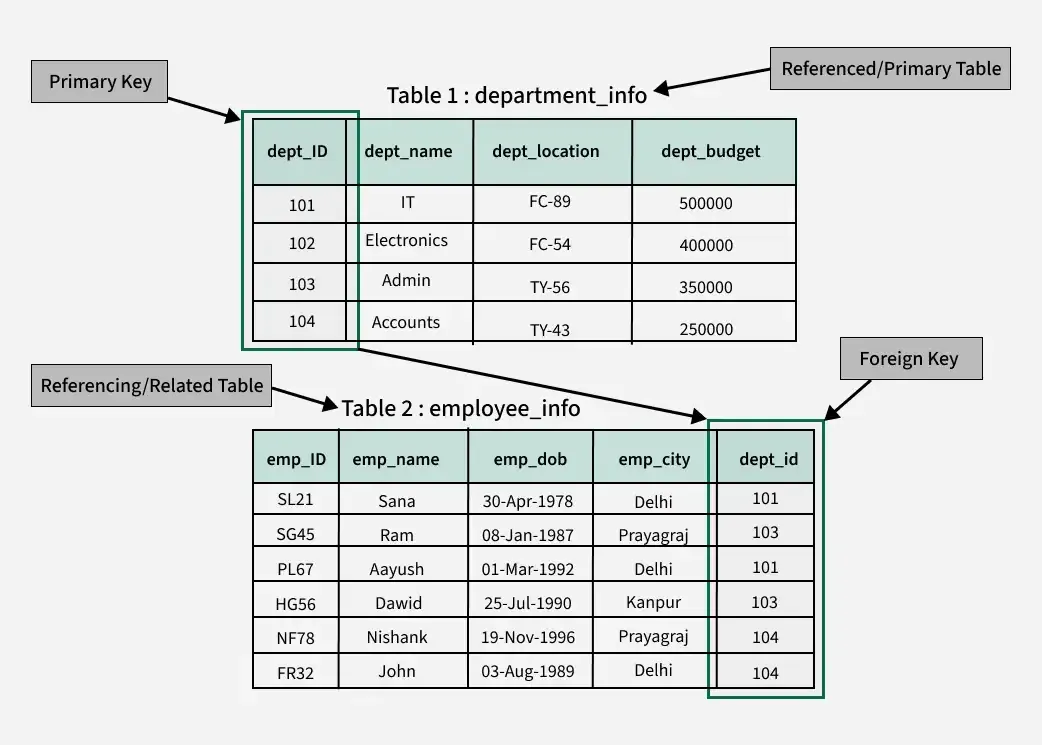
Now that we understand the role of primary keys in uniquely identifying records within a single table, we can introduce the foreign key, which is the mechanism for linking records across different tables. A foreign key in SQL is a column or a set of columns in one table that refers to the primary key (or sometimes a unique key) in another table. Its primary function is to enforce referential integrity, ensuring that relationships between tables remain valid and consistent.
The Mechanics of Linking Tables
Imagine our retail database again. We have a Customers table with a CustomerID as its primary key. We also have an Orders table. Each order is placed by a specific customer. To link an order to the customer who placed it, we can add a CustomerID column to the Orders table. This CustomerID column in the Orders table is the foreign key. It references the CustomerID column (the primary key) in the Customers table.
- Referential Integrity: The core purpose of a foreign key is to enforce referential integrity. This means that a value in the foreign key column must exist as a value in the referenced primary key column. For example, you cannot create an order for a
CustomerIDthat does not exist in theCustomerstable. - Relationship Type: A foreign key establishes a link between two tables, defining a relationship. In the example above, the relationship is typically one-to-many: one customer can place many orders, but each order belongs to only one customer.
- Data Consistency: By enforcing referential integrity, foreign keys prevent “orphan records.” An orphan record is a record in a child table (like
Orders) that refers to a non-existent record in a parent table (likeCustomers).
Syntax and Implementation
In SQL, the foreign key constraint is defined when creating or altering a table. The syntax varies slightly between different database management systems (DBMS), but the core concept remains the same.
Consider creating two tables: Customers and Orders.
Customers Table (Parent Table):
CREATE TABLE Customers (
    CustomerID INT PRIMARY KEY,
    FirstName VARCHAR(50),
    LastName VARCHAR(50),
    Email VARCHAR(100)
);
Orders Table (Child Table):
CREATE TABLE Orders (
    OrderID INT PRIMARY KEY,
    OrderDate DATE,
    CustomerID INT, -- This is the foreign key column
    TotalAmount DECIMAL(10, 2),
    FOREIGN KEY (CustomerID) REFERENCES Customers(CustomerID)
);
In this example:
CustomerIDin theCustomerstable is the primary key.CustomerIDin theOrderstable is the foreign key.- The
FOREIGN KEY (CustomerID) REFERENCES Customers(CustomerID)clause tells the database that theCustomerIDvalues in theOrderstable must match existingCustomerIDvalues in theCustomerstable.
Constraints and Actions
When defining a foreign key, you can also specify actions to be taken when the referenced primary key is modified or deleted. These are known as referential actions:
- ON DELETE:
CASCADE: If a record in the parent table is deleted, all corresponding records in the child table are also deleted. (Use with extreme caution!)SET NULL: If a record in the parent table is deleted, the foreign key column in the child table is set to NULL. This requires the foreign key column to be nullable.RESTRICT(orNO ACTION): The deletion of a parent record is prevented if there are any referencing child records. This is often the default behavior and the safest option.

- ON UPDATE:
CASCADE: If the primary key value in the parent table is updated, the corresponding foreign key values in the child table are also updated.SET NULL: If the primary key value in the parent table is updated, the foreign key column in the child table is set to NULL.RESTRICT(orNO ACTION): The update of a parent primary key is prevented if there are any referencing child records.
These actions are crucial for maintaining data consistency and preventing unintended data loss or corruption when the database is managed.
The Power of Foreign Keys: Benefits and Use Cases
The implementation of foreign keys in SQL offers a multitude of benefits that extend far beyond simply linking tables. They are instrumental in ensuring data accuracy, simplifying query writing, and improving the overall robustness of a database system.
Ensuring Data Integrity and Accuracy
The paramount benefit of foreign keys is their role in enforcing referential integrity. This prevents common data anomalies that can plague databases without these constraints.
- Preventing Orphan Records: As mentioned, foreign keys stop records from existing in a child table without a corresponding valid record in the parent table. This ensures that every order is linked to a known customer, every product listed in an invoice actually exists, and so on.
- Maintaining Consistency: When data is modified, foreign keys ensure that these modifications are propagated consistently across related tables (if
CASCADEis used) or prevent inconsistent modifications altogether (ifRESTRICTis used). This makes the database more reliable. - Validating Data Entry: During data insertion or updates, the database system automatically checks foreign key constraints. If an attempt is made to insert a value that doesn’t exist in the referenced table, the operation will fail, providing immediate feedback and preventing bad data from entering the system.
Simplifying Data Retrieval with Joins
While foreign keys enforce relationships at the database level, they also provide the logical foundation for retrieving related data efficiently. SQL JOIN operations rely heavily on these relationships.
- Understanding Join Logic: When you perform a
JOINoperation, you are essentially telling the database to combine rows from two or more tables based on a related column. Foreign keys define these related columns. - Efficient Querying: By having well-defined foreign key relationships, you can write clear and concise SQL queries to retrieve complex datasets. For instance, to get a list of all orders along with the names of the customers who placed them, you would join the
Orderstable with theCustomerstable on their respectiveCustomerIDcolumns.
SELECT
    o.OrderID,
    c.FirstName,
    c.LastName,
    o.OrderDate,
    o.TotalAmount
FROM
    Orders o
JOIN
    Customers c ON o.CustomerID = c.CustomerID;
This query would not be possible or as reliable without the foreign key relationship linking Orders and Customers.
Common Scenarios for Foreign Key Usage
Foreign keys are ubiquitous in relational database design across various industries:
- E-commerce: Linking
OrderstoCustomers,OrderItemstoOrdersandProducts,ShippingAddressestoCustomers. - Inventory Management: Connecting
ProductstoSuppliers,StockLevelstoProductsandWarehouses. - Human Resources: Relating
EmployeestoDepartments,ManagerstoEmployees,SkillstoEmployees. - Content Management Systems: Linking
ArticlestoCategories,UserstoComments. - Financial Systems: Associating
TransactionswithAccounts,CustomerswithAccounts.
In essence, any scenario where data in one table needs to be logically connected to data in another table is a prime candidate for the use of foreign keys.
Best Practices and Considerations
While foreign keys are indispensable tools, their implementation requires careful planning and adherence to best practices to maximize their benefits and avoid potential pitfalls.
Designing for Relationships
- Choose Appropriate Data Types: Ensure that the data types of the foreign key column and the referenced primary key column are identical or compatible. Mismatched data types can lead to errors and performance issues.
- Consider Composite Keys: In some cases, a primary key might be composed of multiple columns (a composite key). A foreign key referencing such a primary key would also need to be a composite of the corresponding columns.
- Naming Conventions: Adopt clear and consistent naming conventions for foreign key columns. Often, they are named the same as the primary key they reference (e.g.,
CustomerIDin both tables), but prefixing withfk_or clearly indicating its role can also be beneficial. - Database Normalization: Foreign keys are a direct outcome of database normalization. Following normalization principles helps ensure that your database is well-structured, reduces data redundancy, and facilitates the effective use of foreign keys.
Performance Implications
While foreign keys enhance data integrity, they can introduce overhead, particularly during write operations (INSERT, UPDATE, DELETE).
- Indexing: Always ensure that the referenced primary key columns are indexed (which they typically are by default). It is also highly recommended to index the foreign key columns themselves. This dramatically speeds up
JOINoperations and constraint checks. - Heavy Write Loads: In scenarios with extremely high volumes of write operations and less emphasis on strict referential integrity (e.g., bulk data ingestion where validation can occur later), some developers might choose to defer or disable foreign key constraints temporarily. However, this should be done with extreme caution and a robust plan for re-enabling and validating the constraints.
- Database Engine Optimization: Different database systems have varying levels of optimization for foreign key constraints. Understanding your specific DBMS’s behavior can help in fine-tuning performance.
Avoiding Common Mistakes
- Circular Dependencies: Avoid creating scenarios where Table A references Table B, and Table B also references Table A in a way that creates an unbreakable cycle. This can lead to deadlocks and impede operations.
- Over-Reliance on
CASCADE: WhileCASCADEcan be convenient, it can also lead to accidental mass deletions. Carefully assess the risks before implementingON DELETE CASCADE. Often,SET NULLorRESTRICTare safer alternatives. - Forgetting to Index: A common performance killer is forgetting to index foreign key columns. Without an index, the database has to perform a full table scan to check the constraint for every insert or update, which is incredibly inefficient.
- Lack of Documentation: Documenting your foreign key relationships, their purpose, and the referential actions defined is crucial for long-term database maintenance and understanding.

Conclusion: The Bedrock of Relational Data
In conclusion, the foreign key in SQL is a fundamental concept that serves as the backbone of relational database design. It is the mechanism that bridges the gap between independent tables, creating a cohesive and interconnected data structure. By enforcing referential integrity, foreign keys safeguard data accuracy, prevent inconsistencies, and ensure that the relationships within your database remain robust and reliable.
Understanding and implementing foreign keys correctly is not just a technical requirement; it’s a critical step towards building efficient, maintainable, and trustworthy database systems. Whether you are designing a new application or working with an existing one, a solid grasp of foreign keys will empower you to manage your data with greater confidence and efficacy, ensuring that your information remains a valuable asset. They are, without question, a cornerstone of modern data management.
aViewFromTheCave is a participant in the Amazon Services LLC Associates Program, an affiliate advertising program designed to provide a means for sites to earn advertising fees by advertising and linking to Amazon.com. Amazon, the Amazon logo, AmazonSupply, and the AmazonSupply logo are trademarks of Amazon.com, Inc. or its affiliates. As an Amazon Associate we earn affiliate commissions from qualifying purchases.