
When most consumers hear the name “PepsiCo,” their minds immediately go to the iconic blue-labeled cola that has sparred with Coca-Cola for over a century. However, from a business and investment perspective, PepsiCo is far more than a beverage company. It is a diversified global conglomerate with a portfolio that spans across snacks, grains, and energy drinks. For investors and financial analysts, understanding what PepsiCo owns is essential to understanding the company’s “Dividend King” status and its consistent ability to generate massive free cash flow.

PepsiCo’s current structure is the result of decades of strategic mergers, aggressive acquisitions, and a unique business philosophy known as the “Power of One.” By integrating its snack and beverage businesses, the company has created a defensive moat that few other consumer staples entities can match. In this analysis, we will break down the multi-billion dollar brands under the PepsiCo umbrella and explore how this diversification fuels its financial performance.
The Revenue Engines: Frito-Lay and the Power of Snacking
While the beverage side of the business carries the name, the snack division—specifically Frito-Lay North America—is arguably the most important component of PepsiCo’s financial health. In many fiscal years, Frito-Lay accounts for a disproportionately high percentage of the company’s operating profit compared to its revenue share.
Frito-Lay North America: The Profit Powerhouse
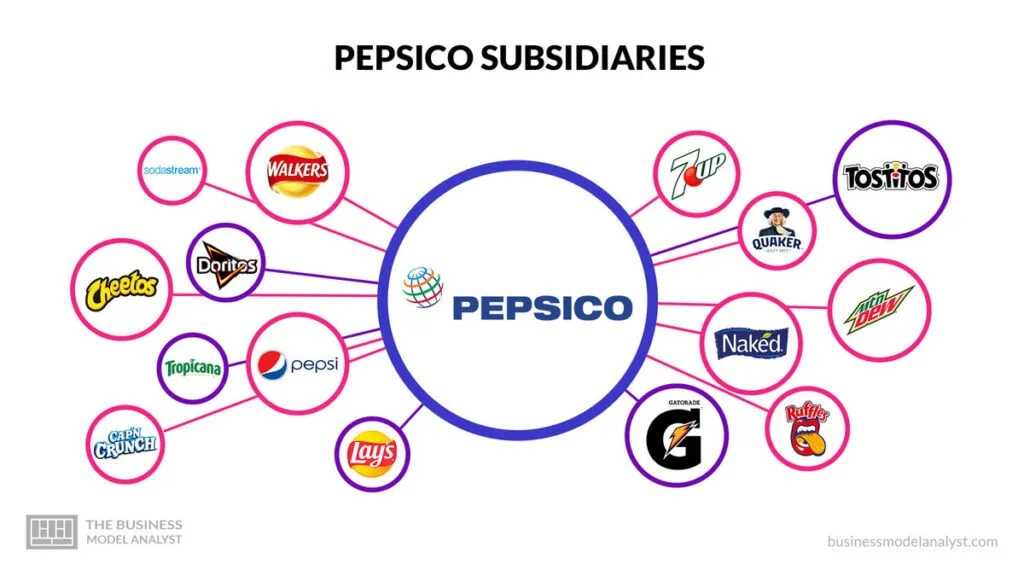
Frito-Lay is a dominant force in the global savory snack market. Its portfolio includes household names like Lay’s, Doritos, Cheetos, Tostitos, Fritos, and Ruffles. From an investment standpoint, Frito-Lay provides PepsiCo with a high-margin revenue stream that is relatively resistant to economic downturns. Snacks are often categorized as “small luxuries”—low-cost items that consumers continue to purchase even when tightening their belts.
The financial synergy between snacks and beverages is a cornerstone of PepsiCo’s business model. Retailers often stock these products together, and through shared distribution networks, PepsiCo reduces its per-unit logistics costs. This operational efficiency is a primary driver of the company’s consistently high Return on Invested Capital (ROIC).
Quaker Foods North America
Acquired in 2001, the Quaker Oats Company added a crucial third pillar to PepsiCo’s domestic operations. Beyond the flagship Quaker Oatmeal, this division owns Aunt Jemima (now rebranded as Pearl Milling Company), Rice-A-Roni, and Cap’n Crunch.
For the “Money” niche, the Quaker acquisition was a masterstroke in portfolio diversification. It moved PepsiCo into the “pantry” segment, providing a hedge against the volatility of the impulse-buy beverage market. While growth in the cereal and grain sector is slower than in snacks, it provides a stable, predictable cash flow that supports PepsiCo’s quarterly dividend payments.
The Liquid Assets: PepsiCo Beverages North America (PBNA)
The beverage division remains the most visible part of the company. However, the modern PBNA portfolio has evolved significantly from the days of the “Cola Wars.” Today, the company’s beverage strategy is focused on “functional” and “non-carbonated” categories, which are currently seeing higher growth rates than traditional sodas.
The Core Soda Portfolio
Despite the shift toward healthier options, the core carbonated soft drink (CSD) brands remain massive cash generators. This includes Pepsi, Mountain Dew, Mug Root Beer, and Sierra Mist (now Starry). Mountain Dew, in particular, holds a unique market position with a loyal demographic that differs significantly from standard cola drinkers, giving PepsiCo a distinct competitive advantage in the caffeine-heavy CSD market.
Dominance in Sports and Hydration
Perhaps the most valuable jewel in the beverage crown is Gatorade. Controlling over 70% of the sports drink market share in the United States, Gatorade is a high-performance brand that commands premium pricing.
In terms of market valuation, Gatorade allows PepsiCo to capture the “wellness and performance” segment of the economy. Additionally, the portfolio includes Aquafina, one of the world’s best-selling bottled water brands, and Bubly, a sparkling water brand launched to compete in the rapidly expanding seltzer market. These brands allow PepsiCo to pivot as consumer preferences shift away from high-sugar beverages toward hydration-focused products.
Strategic M&A: Acquisitions That Redefined the Balance Sheet
PepsiCo’s growth is not merely organic; it is a masterclass in strategic Mergers and Acquisitions (M&A). By identifying gaps in their portfolio and acquiring market leaders, the company has successfully future-proofed its revenue streams.
The 1965 Merger: Pepsi-Cola and Frito-Lay
The most significant event in the company’s history was the 1965 merger between Pepsi-Cola and Frito-Lay. This created the modern conglomerate and established the “salty and sweet” strategy. From a financial perspective, this merger was revolutionary because it allowed the company to dominate two different aisles of the grocery store simultaneously, creating massive leverage during negotiations with retailers.
The SodaStream and Rockstar Energy Acquisitions
In recent years, PepsiCo has moved aggressively to capture the “at-home” and “energy” markets. The $3.2 billion acquisition of SodaStream in 2018 was a strategic move into the sustainable, DIY beverage space. This reduced the company’s reliance on single-use plastics and opened a new recurring revenue model through the sale of CO2 canisters and flavor concentrates.
Furthermore, the $3.85 billion acquisition of Rockstar Energy in 2020 allowed PepsiCo to compete more directly with Monster and Red Bull. By owning Rockstar outright—rather than just acting as its distributor—PepsiCo improved its margins in the high-growth energy drink category. This was further bolstered by a strategic stake and distribution deal with Celsius Holdings, a high-growth “fitness” energy drink brand that has significantly boosted PepsiCo’s presence in the health-conscious demographic.
Global Operations: Geographic Diversification and Emerging Markets
PepsiCo is a truly global enterprise, with its products sold in more than 200 countries and territories. For investors, this geographic spread provides a crucial hedge against regional economic instability or currency fluctuations in any single market.
International Segments
The company’s international business is divided into several reporting segments: Europe, Latin America, Africa, Middle East, South Asia (AMESA), and Asia Pacific, Australia, New Zealand, and China (APAC).
In many of these regions, PepsiCo owns local brands that are market leaders. For example, in the UK, it owns Walkers (the equivalent of Lay’s), and in Latin America, it operates a massive dairy and snack business. By acquiring local champions and integrating them into the PepsiCo supply chain, the company scales its operations while maintaining local brand loyalty.
The Financial Advantage of Scale
The sheer scale of PepsiCo’s global operations allows it to exercise “economies of scope.” This means that as it adds more brands to its portfolio, the cost of distributing each individual brand decreases. For a business finance professional, this is the ultimate goal: increasing the top-line revenue while simultaneously expanding the operating margin through logistical efficiency.
The Investor’s Perspective: Why the Portfolio Matters
When evaluating “what PepsiCo owns,” the conclusion for any financial analyst is clear: PepsiCo is a diversified investment vehicle disguised as a food and beverage company. Its portfolio is designed to produce steady growth, high dividends, and limited downside risk.
Dividend Reliability and Cash Flow
PepsiCo is a “Dividend King,” having increased its annual dividend for over 50 consecutive years. This is only possible because of the diversity of its holdings. When soda sales are sluggish, snack sales often pick up the slack. When North American markets are saturated, emerging markets in Asia and Latin America provide the necessary growth.
Risk Mitigation Through Diversification
The primary risk to a company like PepsiCo is the changing regulatory environment regarding sugar and health. However, because PepsiCo owns Quaker, Bare Snacks, and Sabra (a joint venture in hummus), it is well-positioned to transition its portfolio toward “Better-For-You” options.
From a capital allocation standpoint, PepsiCo’s management has proven adept at using the cash flow from its legacy brands (like Pepsi and Fritos) to fund the acquisition of future-leaning brands (like SodaStream and Celsius). This internal recycling of capital is what keeps the company at the top of the S&P 500 year after year.
Conclusion
Understanding what PepsiCo owns reveals a complex, multi-layered corporate strategy built on the foundations of diversification and operational synergy. It is a company that has successfully moved beyond the bottle to dominate the pantry, the snack aisle, and the gym bag. For the investor, PepsiCo represents a masterclass in portfolio management, proving that in the world of global finance, owning the “share of stomach” is a surefire way to ensure long-term wealth creation. Whether it is a bag of Lay’s in London or a Gatorade in New York, the sun never sets on the PepsiCo empire.