
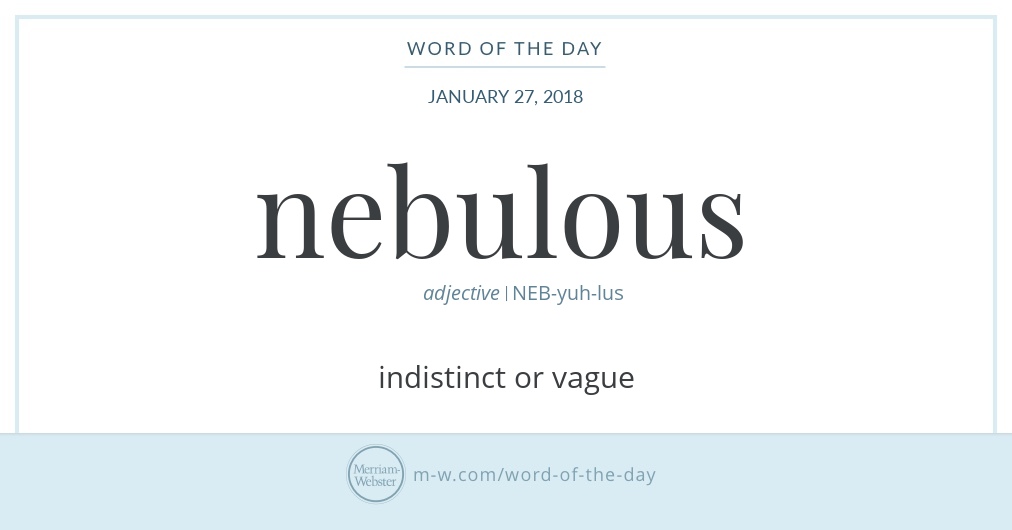
In its literal, etymological sense, the word “nebulous” is derived from the Latin nebulosus, meaning “misty,” “cloudy,” or “foggy.” In common parlance, it refers to something that is ill-defined, vague, or lacking a clear form. While this might sound like a critique in most professional settings, within the world of high technology, “nebulous” has become a defining characteristic of our most advanced systems.
From the ubiquitous reach of cloud computing to the complex, multi-layered logic of deep learning algorithms, technology is moving away from the rigid, discrete hardware of the 20th century toward a more fluid, abstract, and—indeed—nebulous existence. Understanding what “nebulous” means in a tech context is essential for grasping how data is stored, how artificial intelligence thinks, and how digital security must evolve to protect a world without physical borders.
From Latin Roots to Cloud Computing: The Literal Interpretation
To understand the nebulous nature of tech, one must first look at the most significant shift in computing over the last two decades: the migration from on-premise servers to the “Cloud.” The term “Cloud” itself is a metaphor for a nebulous structure—an amorphous mass of processing power and storage that exists “somewhere out there” rather than in a specific box under a desk.
The Etymology of the “Cloud”
In the early days of network engineering, diagrams would often use a cloud shape to represent a network where the internal details were irrelevant to the immediate discussion. It signified a space where data goes in and data comes out, but the “how” and “where” were obscured. This is the quintessence of a nebulous system. In modern tech, we don’t need to know the serial number of the hard drive holding our photos or the geographical coordinate of the processor running our code. The infrastructure has become abstracted, turning a physical asset into a nebulous service.
How Nebulous Architectures Changed the Data Landscape
The shift toward nebulous architecture has enabled unprecedented scalability. In the old model of “fixed” computing, if a website received too much traffic, the server crashed because its physical limits were clearly defined. In a nebulous, cloud-native environment, resources are elastic. Like a literal cloud expanding or contracting based on atmospheric pressure, cloud services like AWS, Google Cloud, and Microsoft Azure allow digital infrastructure to grow or shrink in real-time. This lack of a “hard edge” is exactly what makes modern software-as-a-service (SaaS) so resilient and efficient.
Nebulous Intelligence: Navigating the Ambiguity of AI and Machine Learning
As we move deeper into the era of Artificial Intelligence, the term “nebulous” takes on a more philosophical and structural meaning. We are no longer dealing with “if-then” logic—the rigid, transparent code of the past. Instead, we are building systems that even their creators do not fully understand in a granular way.
The Black Box Problem: Why AI Decision-Making is Often Vague
Large Language Models (LLMs) and deep neural networks are often described as “black boxes.” This is the pinnacle of nebulous technology. When an AI identifies a malignant tumor in a scan or predicts a market fluctuation, it does so by processing data through millions of interconnected “weights” or parameters. The logic isn’t a straight line; it is a sprawling, misty web of correlations. Because the decision-making process is so diffused across these parameters, it becomes nebulous—difficult to pin down to a single point of origin or a specific line of code.
Explainable AI (XAI) vs. Nebulous Algorithms
The tech industry is currently at a crossroads between embracing this nebulous complexity and demanding transparency. This has birthed the field of “Explainable AI” (XAI). The goal of XAI is to shine a light into the “fog” of machine learning to understand how an output was reached. However, as models become more powerful, they inherently become more nebulous. There is a technical trade-off: the more “nebulous” and complex a model’s neural architecture is, the more capable it tends to be at handling nuanced, human-like tasks.

Cybersecurity in a Nebulous Perimeter
In the traditional era of digital security, the “perimeter” was the gold standard. You had a firewall that acted as a castle wall, separating the “trusted” internal network from the “untrusted” external internet. Today, that wall has dissolved, replaced by a nebulous security landscape where the concept of a “inside” and “outside” no longer exists.
Moving Beyond the Firewall: The Rise of Zero Trust
With the rise of remote work and mobile devices, a company’s data is now accessed from cafes, home offices, and transit hubs across the globe. The network is no longer a physical space; it is a nebulous collection of endpoints. This shift has necessitated the “Zero Trust” model. In a Zero Trust environment, the tech assumes that the “perimeter” is compromised or non-existent. Instead of guarding a fixed gate, security protocols must follow the user and the data wherever they go. The security itself becomes nebulous—fluidly adapting based on the user’s location, device health, and behavioral patterns.
Managing Risks in a Borderless Digital Environment
A nebulous security posture is more difficult to manage but ultimately more robust. In a world where hackers use automated tools to find a single crack in a wall, a nebulous defense—one that is decentralized and identity-centric—leaves no single point of failure. However, it requires a high degree of technical sophistication. Systems must use continuous authentication and micro-segmentation, ensuring that even if one part of the “cloud” is breached, the rest of the nebulous network remains obscured and protected.
The Future of Nebulous Tech: Edge Computing and Decentralization
Looking forward, the tech world is becoming even less centralized. We are moving away from massive data centers and toward “Edge Computing” and decentralized networks, further complicating the definition of where “tech” actually lives.
Decentralized Autonomous Organizations (DAOs) and Structural Fluidity
In the realm of software governance, we are seeing the rise of DAOs. These are organizations that exist entirely on a blockchain, governed by smart contracts rather than a central headquarters or a traditional C-suite. A DAO is a nebulous entity; it has no physical location, no single owner, and its “employees” may be anonymous contributors from around the world. This is the ultimate expression of nebulous technology: a functional, high-value organization that exists purely as a distributed protocol.
Web3: The Most Nebulous Frontier of All
The term “Web3” is perhaps the most nebulous term in current tech discourse. It refers to a decentralized internet built on blockchain technology, where users own their data and platforms are governed by communities. Because Web3 is still in its nascent stages, its boundaries are ill-defined. It encompasses everything from NFTs and cryptocurrencies to decentralized file storage (IPFS). The nebulous nature of Web3 is its greatest strength and its greatest weakness; it allows for rapid, permissionless innovation, but it also creates a “fog of war” where scams and revolutionary breakthroughs often look identical from the outside.

Conclusion: Embracing the Fog
To ask “what does nebulous mean” in the world of technology is to ask how we moved from the mechanical to the digital, and finally to the virtual. We have shifted from clear-cut, physical hardware to a reality where our most important tools—our data, our intelligence, and our security—exist in a state of constant, fluid motion.
While “nebulous” may imply a lack of clarity, in tech, it represents a peak of sophistication. It is the ability of a system to be everywhere at once, to process information with human-like complexity, and to protect assets in a world without borders. As we move further into the 21st century, the most successful technologies will likely be the ones that lean into this nebulous nature, trading rigid definitions for the infinite scalability of the cloud. Understanding the fog is no longer optional; it is the primary requirement for navigating the modern digital landscape.