
Tesla has fundamentally altered the landscape of the automotive industry, not just by popularizing electric vehicles, but by redefining the car as a high-performance computer on wheels. Central to this transformation is the Full Self-Driving (FSD) suite—a sophisticated array of software features designed to eventually navigate complex environments with minimal human intervention. For many years, the only way to access these features was through a hefty upfront payment. However, with the introduction of the FSD subscription model, the barrier to entry has shifted. Understanding what it costs for a Tesla Full Self-Driving subscription requires a look beyond the monthly bill; it involves an analysis of hardware requirements, software versioning, and the technological value proposition of Tesla’s AI-driven ecosystem.
The Technical Architecture of Full Self-Driving (FSD)
To understand the cost of the subscription, one must first understand what the technology actually entails. Tesla’s approach to autonomous driving is unique in the tech world because it relies almost exclusively on “Tesla Vision”—a system powered by high-resolution cameras and artificial intelligence, eschewing the LiDAR sensors used by competitors like Waymo or Cruise.
From Basic Autopilot to FSD (Supervised)
Every modern Tesla comes standard with “Basic Autopilot,” which includes traffic-aware cruise control and lane centering. The FSD subscription elevates this significantly. The “Supervised” version of FSD allows the car to navigate local streets, handle intersections, perform lane changes automatically, and respond to traffic lights and stop signs. The technology is powered by deep neural networks that have been trained on billions of miles of real-world driving data collected from the global Tesla fleet.
The Hardware Prerequisites: HW3 vs. HW4
A critical component of the “cost” is the physical hardware within the vehicle. To run the latest FSD software, a vehicle must be equipped with Hardware 3.0 (FSD Computer) or the newer Hardware 4.0. For owners of older Teslas (pre-2019), the subscription cost may be preceded by a hardware upgrade fee. While Tesla previously charged roughly $1,000 to $1,500 for this upgrade to enable FSD features, recent shifts in software efficiency have made the hardware-software synergy even more critical.
Neural Networks and End-to-End AI
With the release of FSD Version 12, Tesla moved toward “end-to-end” neural networks. In previous versions, the software relied on hundreds of thousands of lines of C++ code written by engineers to tell the car how to behave. The current iteration replaces much of that code with AI that has “learned” how to drive by watching human videos. This technological leap is what the monthly subscription fee pays for: continuous access to one of the world’s most advanced AI training pipelines, powered by the Dojo supercomputer.
Breaking Down the Subscription Costs and Tiers
The pricing strategy for Tesla’s software has been volatile, reflecting the experimental and rapidly evolving nature of the product. As of 2024, Tesla has significantly lowered the cost of the subscription to entice a broader user base and collect more data for its AI models.
The Monthly Subscription Fee
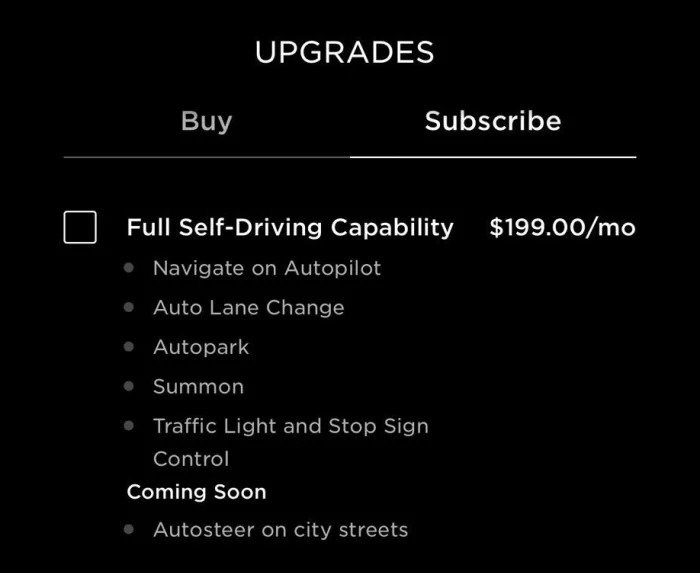
Currently, the standard cost for a Tesla Full Self-Driving subscription is $99 per month in the United States. This is a significant decrease from the previous price of $199 per month. This “Software as a Service” (SaaS) model allows users to toggle the feature on and off based on their needs. For example, a driver might subscribe for a single month during a long cross-country road trip and then cancel the service for their routine city commute.
Subscription vs. One-Time Purchase
Tesla also offers a “permanent” buyout of the software, which currently sits at $8,000. To determine if the subscription is the better financial tech move, a user must calculate their expected ownership period. At $99 a month, it would take roughly 80 months (over six years) for the one-time purchase to become more cost-effective than the subscription. Given how quickly EV technology and hardware versions (HW3 to HW4 to HW5) evolve, many tech-savvy users prefer the subscription to maintain flexibility.
Enhanced Autopilot Upgrades
For users who previously purchased the “Enhanced Autopilot” (EAP) package—which included features like Navigate on Autopilot and Auto Lane Change but stopped short of full city street navigation—the subscription cost is often further reduced. Typically, these users can upgrade to the full FSD suite for a lower monthly fee, often around $99, though the value proposition is thinner since they already own the majority of the useful highway features.

Software Functionality: What the Subscription Delivers
Subscribing to FSD isn’t just about a brand name; it’s about unlocking specific digital capabilities that change the relationship between the driver and the machine.
City Streets and Intersections
The primary draw of the FSD subscription is “Autosteer on City Streets.” This allows the vehicle to navigate through complex urban environments. It can signal, turn into the correct lane, and navigate roundabouts. While it is currently “Supervised”—meaning the driver must remain alert and ready to intervene—the tech is a marvel of computer vision, identifying pedestrians, cyclists, and stray debris in real-time.
Smart Summon and Autopark
The subscription also includes “Smart Summon,” a feature that allows the car to navigate a parking lot autonomously to find its owner. While controversial and sometimes prone to errors in high-density areas, it represents a significant piece of the autonomous puzzle. Additionally, the “Autopark” feature has seen massive improvements with the move to vision-based occupancy networks, allowing the car to identify and slide into parking spots with high precision.
Over-the-Air (OTA) Updates
One of the most valuable aspects of the subscription cost is the inclusion of Over-the-Air updates. Unlike a traditional car that remains static after purchase, a Tesla with an FSD subscription receives regular software “patches” that improve the car’s driving logic, safety protocols, and feature set. In the tech world, this is akin to receiving a new operating system version for your smartphone every few months, ensuring the hardware remains relevant.
The Future of FSD: Robotaxis and Licensing
The current subscription cost is widely viewed by industry analysts as a “beta” price. As the software approaches “Level 4” or “Level 5” autonomy (where human supervision is no longer required), the pricing structure is expected to shift again.
The Robotaxi Vision
Elon Musk has frequently stated that the value of FSD could eventually reach $100,000 per car if the vehicle is capable of operating as an autonomous taxi. In this scenario, the “cost” of the subscription might be replaced by a revenue-sharing model where Tesla takes a cut of the earnings the car generates while the owner is sleeping. While this remains a futuristic tech goal, it informs why Tesla is currently keeping the subscription price relatively low: they need as many “miles driven” as possible to train the AI for this ultimate goal.
Licensing the Tech Stack
There is ongoing discussion in the tech sector about Tesla licensing its FSD software to other automakers. If this happens, the $99 subscription could become an industry standard for autonomous features across various brands. This would position Tesla not just as a car manufacturer, but as the “Windows” or “Android” of the autonomous driving world—a software-first entity that provides the brains for the global fleet.
Data Security and Privacy Costs
A hidden “cost” of the FSD subscription involves data. To function, the car must constantly upload clips of “disengagements” (when the human takes over) to Tesla’s servers. While Tesla anonymizes this data, for the privacy-conscious tech consumer, the cost of using FSD includes contributing to a massive, centralized data pool. This data loop is essential for the AI’s growth but remains a point of contention in the digital security landscape.

Conclusion: Is the FSD Subscription Worth the Cost?
Deciding to pay for a Tesla Full Self-Driving subscription is a choice to participate in a live, global AI experiment. For $99 a month, users gain access to the cutting edge of neural network-based navigation, frequent software enhancements, and a glimpse into the future of transportation. While the system still requires human supervision and is not yet “set it and forget it,” the technical progress made in recent versions is undeniable.
For the tech enthusiast, the subscription offers a flexible way to test the limits of modern computer vision and AI without committing to a permanent $8,000 investment. As hardware continues to improve and the AI models become more refined, the cost of the subscription will likely fluctuate, but its role as a pioneer in the “Car as a Service” market is firmly established. Whether for the convenience of highway lane changes or the novelty of city street navigation, the FSD subscription represents the current pinnacle of consumer-facing automotive technology.
aViewFromTheCave is a participant in the Amazon Services LLC Associates Program, an affiliate advertising program designed to provide a means for sites to earn advertising fees by advertising and linking to Amazon.com. Amazon, the Amazon logo, AmazonSupply, and the AmazonSupply logo are trademarks of Amazon.com, Inc. or its affiliates. As an Amazon Associate we earn affiliate commissions from qualifying purchases.