
In the ever-evolving landscape of communication, clarity is paramount. Whether you’re crafting a compelling marketing campaign, detailing the intricacies of a new AI tool, or explaining a complex financial strategy, your words need to be precise and easy to understand. One of the most common pitfalls that can undermine this clarity is the comma splice. While it might seem like a minor grammatical hiccup, a comma splice can lead to confusion, diminish your credibility, and ultimately detract from the effectiveness of your message. Understanding what a comma splice is and how to avoid it is a crucial skill for anyone looking to excel in today’s content-driven world.

This article will delve into the meaning of a comma splice, explore its common forms, and provide actionable strategies for correcting it. By mastering this fundamental aspect of punctuation, you can elevate your writing, ensure your ideas are conveyed accurately, and strengthen your overall impact, no matter your field – be it technology, branding, or finance.
Understanding the Core Concept: The Comma Splice Explained
At its heart, a comma splice occurs when two independent clauses are joined together using only a comma. An independent clause is a group of words that contains a subject and a verb and can stand alone as a complete sentence. When you place a comma between two such clauses without any additional conjunction or punctuation, you create a run-on sentence that is grammatically incorrect and can be difficult for the reader to parse.
To illustrate, consider this example:
Incorrect: The new AI chatbot is incredibly sophisticated, it can answer complex queries in real-time.
In this sentence, “The new AI chatbot is incredibly sophisticated” is an independent clause. It has a subject (“chatbot”) and a verb (“is”) and makes a complete thought. Similarly, “it can answer complex queries in real-time” is also an independent clause. Joining these two complete thoughts with just a comma creates the comma splice.
Why is it a Problem?
The issue with a comma splice lies in the ambiguity it creates. The reader might pause at the comma, expecting a subordinate clause or a list, only to be presented with another complete thought. This disrupts the natural flow of the sentence and can lead to misinterpretations. In technical writing, where precision is vital, a comma splice could lead someone to misunderstand crucial instructions or technical specifications. In branding, sloppy grammar can damage a company’s reputation, making them appear unprofessional. In finance, unclear sentences can lead to costly mistakes. Therefore, recognizing and rectifying comma splices is not just about adhering to grammatical rules; it’s about ensuring effective and professional communication.
Identifying Different Types of Comma Splices
While the fundamental definition remains the same, comma splices can manifest in slightly different ways, often involving common conjunctions or the absence of necessary punctuation. Recognizing these variations is key to spotting and correcting them.
Heading3: The Simple Comma Splice
This is the most straightforward type, as seen in the initial example. Two independent clauses are joined solely by a comma.
Example: The market for foldable phones is growing rapidly, consumers are drawn to their innovative design.
Here, “The market for foldable phones is growing rapidly” and “consumers are drawn to their innovative design” are both independent clauses. The comma alone is insufficient to connect them properly.
Heading3: The “and,” “but,” “or” Misuse
Often, writers attempt to connect independent clauses using coordinating conjunctions like “and,” “but,” or “or.” However, they sometimes mistakenly omit the conjunction while keeping the comma, or they use the comma incorrectly in conjunction with the conjunction.
Incorrect: The new investment platform offers low fees, and it has a user-friendly interface. (This is actually correct, but often people make a splice by omitting the ‘and’)
More commonly seen splice: The new investment platform offers low fees, it has a user-friendly interface. (Here the “and” was removed, creating a splice)
Another common error is to incorrectly use a comma before a coordinating conjunction when it’s not connecting two independent clauses, but this is not a comma splice, it’s a different punctuation error. The comma splice specifically involves connecting two independent clauses with only a comma.
Heading3: The Conjunctive Adverb Confusion
Conjunctive adverbs like “however,” “therefore,” “moreover,” “consequently,” and “nevertheless” are often used to connect ideas between sentences or clauses. When used to connect two independent clauses, they require specific punctuation. A comma splice occurs when a comma is used before a conjunctive adverb, but no period is used to separate the independent clauses.
Incorrect: The software update was delayed, however, it included several critical bug fixes.
In this instance, “The software update was delayed” and “it included several critical bug fixes” are both independent clauses. “However” is a conjunctive adverb. The comma before “however” is incorrect because it’s trying to join two independent clauses.
Strategies for Correcting Comma Splices
Fortunately, there are several effective ways to fix a comma splice and ensure your writing is clear and grammatically sound. The best method often depends on the relationship between the two independent clauses and the desired flow of your sentence.

Heading3: Method 1: Create Two Separate Sentences
This is the simplest and most direct solution. If the two independent clauses are distinct thoughts, separating them into two complete sentences can often improve clarity.
Original Comma Splice: The app offers advanced data analytics, it helps businesses make informed decisions.
Corrected: The app offers advanced data analytics. It helps businesses make informed decisions.
This method is particularly useful when you want to emphasize each idea separately or when the transition between the thoughts is less direct.
Heading3: Method 2: Use a Coordinating Conjunction
Coordinating conjunctions (for, and, nor, but, or, yet, so – often remembered by the acronym FANBOYS) can be used to join two independent clauses. When you use a comma followed by a coordinating conjunction, you create a grammatically correct compound sentence.
Original Comma Splice: The company’s brand awareness is high, their social media engagement is moderate.
Corrected: The company’s brand awareness is high, but their social media engagement is moderate.
Choosing the right conjunction is crucial. “But” indicates contrast, “and” indicates addition, “so” indicates a result, and so on.
Heading3: Method 3: Employ a Semicolon
A semicolon (;) is a powerful punctuation mark that can be used to connect two closely related independent clauses. It suggests a stronger connection than a period but a weaker one than a comma with a coordinating conjunction.
Original Comma Splice: The startup secured significant funding, they plan to expand their research and development team.
Corrected: The startup secured significant funding; they plan to expand their research and development team.
The semicolon works best when the two clauses are logically linked and the transition between them is smooth.
Heading3: Method 4: Introduce a Subordinating Conjunction or Relative Pronoun
You can also correct a comma splice by turning one of the independent clauses into a dependent clause. This is often achieved by adding a subordinating conjunction (e.g., because, although, since, while, if, when) or a relative pronoun (e.g., who, whom, whose, which, that) at the beginning of one of the clauses.
Original Comma Splice: The website is undergoing maintenance, you will not be able to access your account.
Corrected (using subordinating conjunction): The website is undergoing maintenance, so you will not be able to access your account. (This uses “so” as a conjunction connecting two independent clauses, a form of compound sentence correction.)
More direct subordination: Because the website is undergoing maintenance, you will not be able to access your account.
Here, “Because the website is undergoing maintenance” becomes a dependent clause, and it can be correctly joined to the independent clause “you will not be able to access your account” with a comma.
Heading3: Method 5: Restructure the Sentence
Sometimes, the most effective solution is to completely rephrase the sentence to achieve better flow and clarity. This might involve combining ideas, reordering information, or using different sentence structures.
Original Comma Splice: The gadget is revolutionary, it promises to change how we interact with technology.
Restructured: This revolutionary gadget promises to change how we interact with technology.
By making “revolutionary” an adjective modifying “gadget,” we create a single, concise, and grammatically correct sentence. This approach is excellent for making your writing more dynamic and impactful.
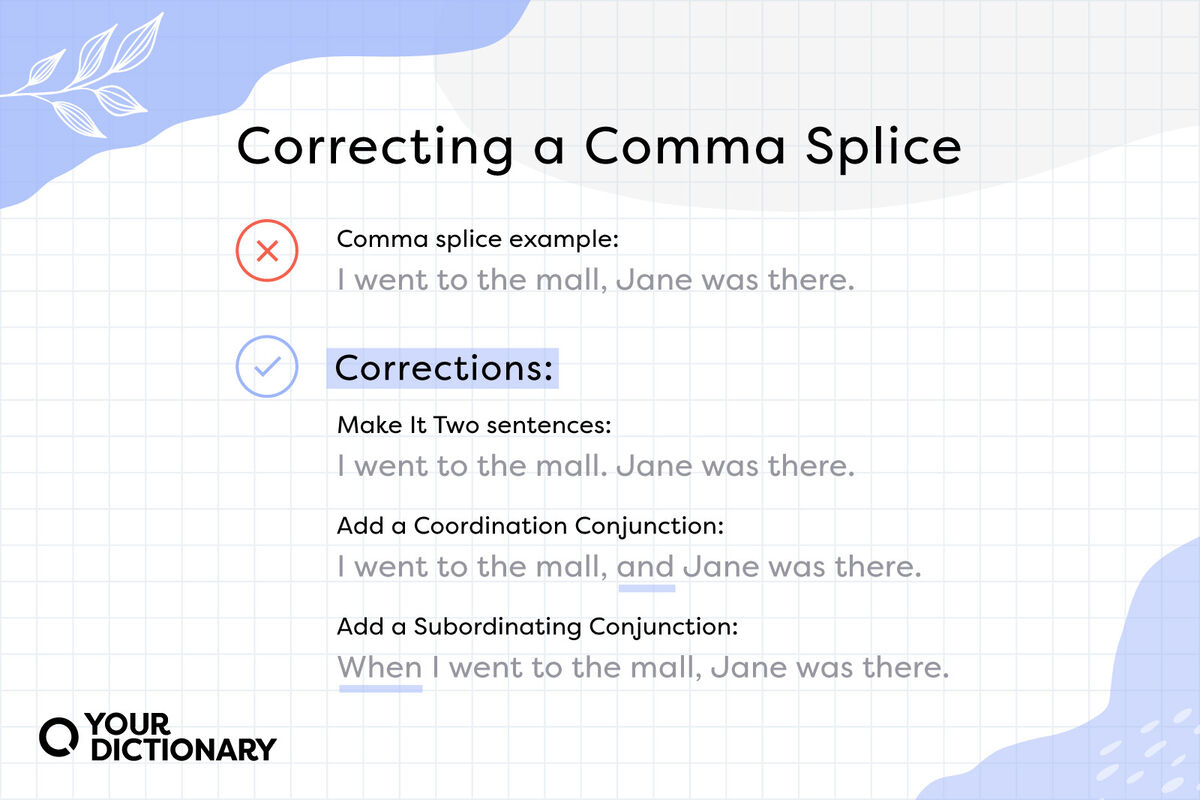
The Comma Splice: A Hurdle to Clear Communication
In conclusion, understanding and avoiding the comma splice is fundamental to effective written communication. Whether you’re detailing the latest tech innovations, crafting a persuasive brand narrative, or explaining the nuances of personal finance, grammatical accuracy is key to building trust and ensuring your message resonates. By mastering the techniques outlined above – separating sentences, using coordinating conjunctions, employing semicolons, introducing subordinating elements, or restructuring entirely – you can eliminate comma splices from your writing. This attention to detail will not only enhance your credibility but will also significantly improve the clarity and impact of your words, allowing your ideas to shine through without obstruction. Make it a practice to review your work for comma splices, and you’ll find your writing becomes more professional, persuasive, and ultimately, more powerful.
aViewFromTheCave is a participant in the Amazon Services LLC Associates Program, an affiliate advertising program designed to provide a means for sites to earn advertising fees by advertising and linking to Amazon.com. Amazon, the Amazon logo, AmazonSupply, and the AmazonSupply logo are trademarks of Amazon.com, Inc. or its affiliates. As an Amazon Associate we earn affiliate commissions from qualifying purchases.