
The sun, a celestial furnace that has powered life on Earth for billions of years, is far from a static, uniform ball of plasma. Upon closer inspection, particularly through the lens of advanced technological instruments, it reveals a dynamic and often turbulent surface. Among its most prominent and visually striking features are the enigmatic “spots” that appear to darken its luminous face. These are not mere blemishes, but rather potent indicators of intense magnetic activity, phenomena that have captivated scientists and driven the development of cutting-edge technology to observe, analyze, and predict their behavior. Understanding what these spots are, how they form, and their far-reaching implications is a testament to humanity’s relentless pursuit of knowledge, propelled by ever-evolving technological prowess.
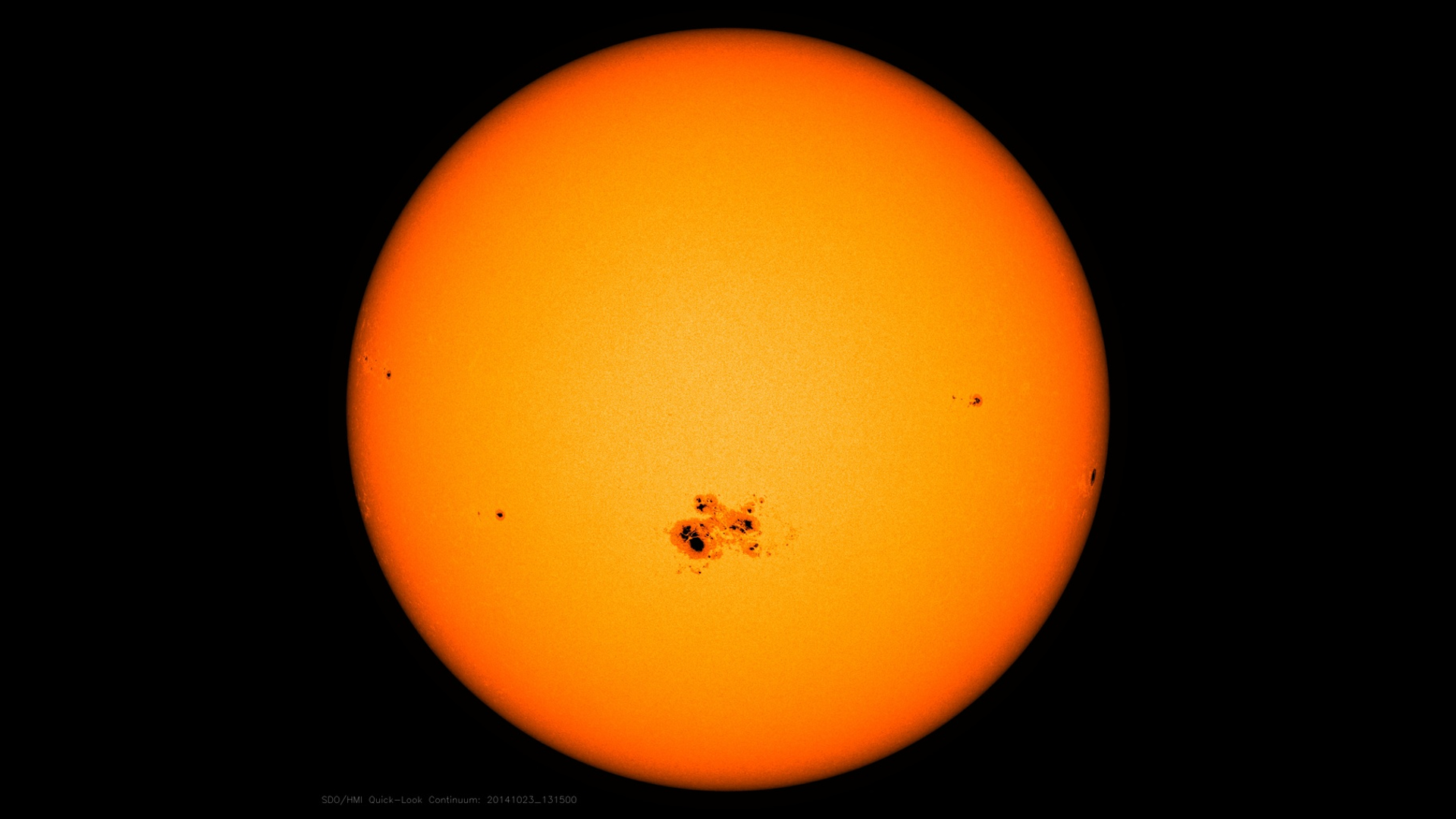
The Birth of Solar Spots: A Technological Symphony of Magnetic Forces
The seemingly dark patches on the sun’s surface are, in reality, regions of intense magnetic activity. Technically known as sunspots, they appear darker because they are cooler than the surrounding solar photosphere. This cooling is a direct consequence of powerful magnetic fields within the sun that inhibit the convection of heat from the sun’s interior to the surface. The study of sunspots has been revolutionized by technological advancements that allow us to probe these deep, magnetic processes with unprecedented detail.
Unveiling the Magnetic Engine: From Naked Eye to Helioseismology
Early observations of sunspots were rudimentary, often relying on the naked eye or simple telescopes. The invention of the telescope in the early 17th century by Hans Lippershey, and its subsequent application to astronomy by Galileo Galilei, marked a pivotal moment. Galileo’s detailed drawings of sunspots, recorded between 1610 and 1613, provided the first systematic evidence of their existence and their movement across the solar disk, suggesting the sun’s rotation. These early observations, though limited by the technology of the time, laid the groundwork for centuries of research.
As technology progressed, so did our ability to study the sun. The development of spectroheliographs in the late 19th century allowed astronomers to observe the sun in specific wavelengths of light, revealing more about the composition and physical conditions within sunspots. However, it was the advent of sophisticated space-based observatories and ground-based instruments equipped with advanced detectors and adaptive optics that truly unlocked the secrets of sunspot formation.
One of the most powerful technological tools in understanding the sun’s internal dynamics, including the processes that lead to sunspot formation, is helioseismology. This field applies the principles of seismology on Earth to the sun, studying the propagation of sound waves (acoustic oscillations) through its interior. By analyzing the frequencies and patterns of these waves, scientists can map the sun’s internal structure, temperature, and the flow of plasma. Technologies like the Solar and Heliospheric Observatory (SOHO) and the Solar Dynamics Observatory (SDO) have provided an uninterrupted stream of data, enabling helioseismologists to create detailed three-dimensional models of the sun’s interior and pinpoint the regions where intense magnetic fields are generated and emerge to the surface, creating sunspots.
The core mechanism behind sunspot formation is the solar dynamo, a complex process occurring deep within the sun’s convective zone. Here, the differential rotation of the sun – meaning different latitudes rotate at different speeds – and the vigorous convection of plasma twist and amplify magnetic field lines. These tangled magnetic field lines can then “snap” and emerge through the sun’s surface, forming the characteristic bipolar regions that we observe as sunspots. Advanced magnetographs, sophisticated instruments capable of measuring the strength and direction of magnetic fields, are crucial in detecting these emerging fields. Technologies like the Michelson Doppler Imager (MDI) on SOHO and the Helioseismic and Magnetic Imager (HMI) on SDO have provided high-resolution, real-time measurements of the sun’s magnetic field, allowing scientists to track the emergence and evolution of sunspot regions.
The Anatomy of a Sunspot: A Technological Look Beneath the Surface
A typical sunspot is not a monolithic entity but rather a complex structure with distinct regions, each revealed through sophisticated imaging and analytical technologies.
The Umbra and Penumbra: Resolving Fine Structures
The most prominent feature of a sunspot is its central, darker region, known as the umbra. This is where the magnetic field is strongest and most vertical, effectively suppressing heat transport. Surrounding the umbra is a lighter, filamentary region called the penumbra. The penumbra is characterized by radial magnetic field lines that are more inclined to the solar surface. Distinguishing these fine structures and understanding their dynamics requires instruments with exceptional spatial resolution.
Modern solar telescopes, both ground-based with adaptive optics to correct for atmospheric distortion and space-based observatories like SDO, employ advanced CCD and CMOS detectors to capture incredibly detailed images of the solar surface. These technologies allow scientists to resolve features on the sun as small as a few hundred kilometers, revealing the intricate patterns within the penumbra, such as the characteristic “filar” or “hair-like” structures. Furthermore, polarization measurements, made possible by sophisticated optical filters and detectors, are crucial for analyzing the magnetic field strength and orientation within these regions, providing quantitative data about the physical processes at play.
Granulation and Convection Cells: The Solar Surface in Motion
The sun’s surface is not smooth but covered by a pattern of bright and dark cells known as granules. These are the tops of convection cells, where hot plasma rises from the sun’s interior, cools at the surface, and then sinks back down. Sunspots are often found within or near these convective regions. High-resolution imaging technologies, capable of capturing rapid changes on the solar surface, allow scientists to observe the dynamic interplay between granulation and the magnetic fields of sunspots. By analyzing the movement and evolution of these granules, researchers can gain insights into how the magnetic fields influence and are influenced by the convective plasma flows.
The Impact of Solar Spots: Technological Forefronts in Space Weather Prediction
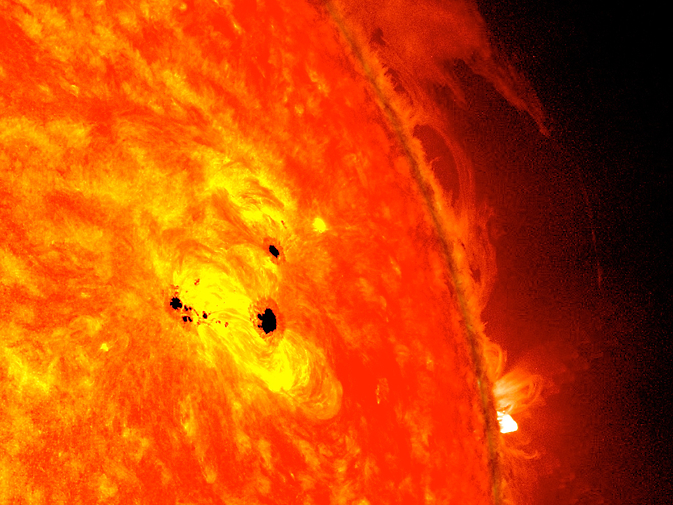
The seemingly localized phenomenon of sunspots has profound implications that extend far beyond the sun’s surface, impacting our technological infrastructure and even human space exploration. The dynamic nature of sunspots leads to a variety of solar activity, the most energetic of which are solar flares and coronal mass ejections (CMEs). Understanding and predicting these events is a critical area where technology plays a leading role.
Solar Flares and Coronal Mass Ejections: Unleashing the Sun’s Fury
Solar flares are sudden, intense bursts of radiation from the release of magnetic energy associated with sunspots. They emit across the electromagnetic spectrum, from radio waves to X-rays and gamma rays. Coronal mass ejections (CMEs) are massive expulsions of plasma and magnetic field from the sun’s corona. While not always directly tied to sunspots, they are often associated with complex sunspot regions.
The technological challenge lies in detecting the precursors to these events and predicting their timing, intensity, and direction. Dedicated solar observatories, both on Earth and in space, are equipped with instruments that monitor various aspects of solar activity. These include:
- X-ray and Gamma-ray Detectors: Instruments like the Reuven Ramaty High Energy Solar Spectroscopic Imager (RHESSI) and instruments on board SDO (like the Extreme Ultraviolet Variability Experiment – EVE) are crucial for detecting the high-energy emissions associated with flares, providing insights into the energy release mechanisms.
- Magnetographs: As mentioned earlier, these instruments track the evolution of magnetic fields in sunspot regions, which are key indicators of potential flare activity.
- Coronagraphs: These instruments, often on space-based platforms, block out the bright solar disk to allow observation of the fainter corona and the detection of CMEs as they erupt from the sun. The Large Angle and Spectrometric Coronagraph (LASCO) on SOHO has been instrumental in this regard.
- Radio Telescopes: These can detect radio bursts emitted by energetic particles accelerated during flares and CMEs.
Space Weather Forecasting: A Technological Arms Race
The prediction of solar flares and CMEs, collectively known as space weather, is a critical application of our understanding of sunspots and their associated phenomena. Disruptions caused by space weather can have significant impacts on our increasingly technology-dependent world.
- Satellite Operations: Energetic particles from solar events can damage satellite electronics, disrupt communication systems, and even lead to premature satellite failure. Technologies like radiation-hardened electronics and sophisticated anomaly detection systems are employed to mitigate these risks.
- Power Grids: Geomagnetic storms, induced by CMEs interacting with Earth’s magnetic field, can cause induced currents in long-distance power lines, leading to blackouts. Advanced monitoring systems and grid management techniques are being developed to predict and respond to these threats.
- Navigation Systems: GPS signals can be distorted by ionospheric disturbances caused by solar activity, affecting the accuracy of navigation.
- Human Spaceflight: Astronauts in space are exposed to higher levels of radiation during solar events. Understanding and predicting these events is crucial for ensuring their safety, necessitating the development of shielded habitats and real-time radiation monitoring systems.
The field of space weather forecasting relies heavily on sophisticated computational models and data assimilation techniques. These models ingest vast amounts of data from solar observatories, interplanetary probes, and Earth-based sensors to predict the trajectory and impact of solar events. Artificial intelligence and machine learning are increasingly being employed to analyze complex patterns in solar data and improve the accuracy of these predictions. Technologies like the Space Weather Research Center (SWPC) at NOAA are at the forefront of providing real-time space weather forecasts and warnings.
The Future of Sunspot Research: Pushing the Technological Frontier
The study of sunspots is a continuously evolving field, driven by the relentless pursuit of better observational capabilities and more sophisticated analytical tools. The quest to understand the sun, our closest star, is intrinsically linked to the advancement of technology.
Next-Generation Observatories and Computational Power
Future research will be spearheaded by next-generation solar observatories, both on the ground and in space. Projects like the Daniel K. Inouye Solar Telescope (DKIST) in Hawaii, with its unprecedented resolution and sensitivity, are already providing breathtakingly detailed views of solar phenomena. Space missions like the planned European Space Agency’s Solar Orbiter and NASA’s Parker Solar Probe are venturing closer to the sun than ever before, offering unique perspectives on solar wind acceleration and the origins of solar activity.
The sheer volume and complexity of data generated by these advanced instruments necessitate a corresponding leap in computational power and data analysis techniques. High-performance computing, cloud computing, and advanced visualization tools are essential for processing and interpreting this deluge of information. Machine learning algorithms are being refined to identify subtle precursors to solar events and to develop more accurate predictive models.

Unraveling the Sunspot Cycle and Beyond
Sunspots exhibit a cyclical behavior, with the number of sunspots waxing and waning over an approximately 11-year period known as the solar cycle. While the general pattern is understood, the precise mechanisms that govern the strength and timing of each cycle remain a subject of intense research. Technology plays a crucial role in long-term monitoring of this cycle, providing the data necessary to refine our understanding of these complex rhythms.
Furthermore, research into sunspots is not confined to their immediate manifestations. Scientists are investigating their connection to other solar phenomena, such as solar irradiance variations, which can influence Earth’s climate. The study of solar magnetism through sunspots also provides a crucial benchmark for understanding magnetic activity in other stars, contributing to the broader field of astrophysics. As our technological capabilities expand, so too does our ability to probe the very origins of stellar magnetism and its cosmic influence. The humble “spot” on the sun, once a curious observation, has become a focal point for scientific inquiry, powered by the ingenuity and relentless innovation of technological advancement.
aViewFromTheCave is a participant in the Amazon Services LLC Associates Program, an affiliate advertising program designed to provide a means for sites to earn advertising fees by advertising and linking to Amazon.com. Amazon, the Amazon logo, AmazonSupply, and the AmazonSupply logo are trademarks of Amazon.com, Inc. or its affiliates. As an Amazon Associate we earn affiliate commissions from qualifying purchases.