
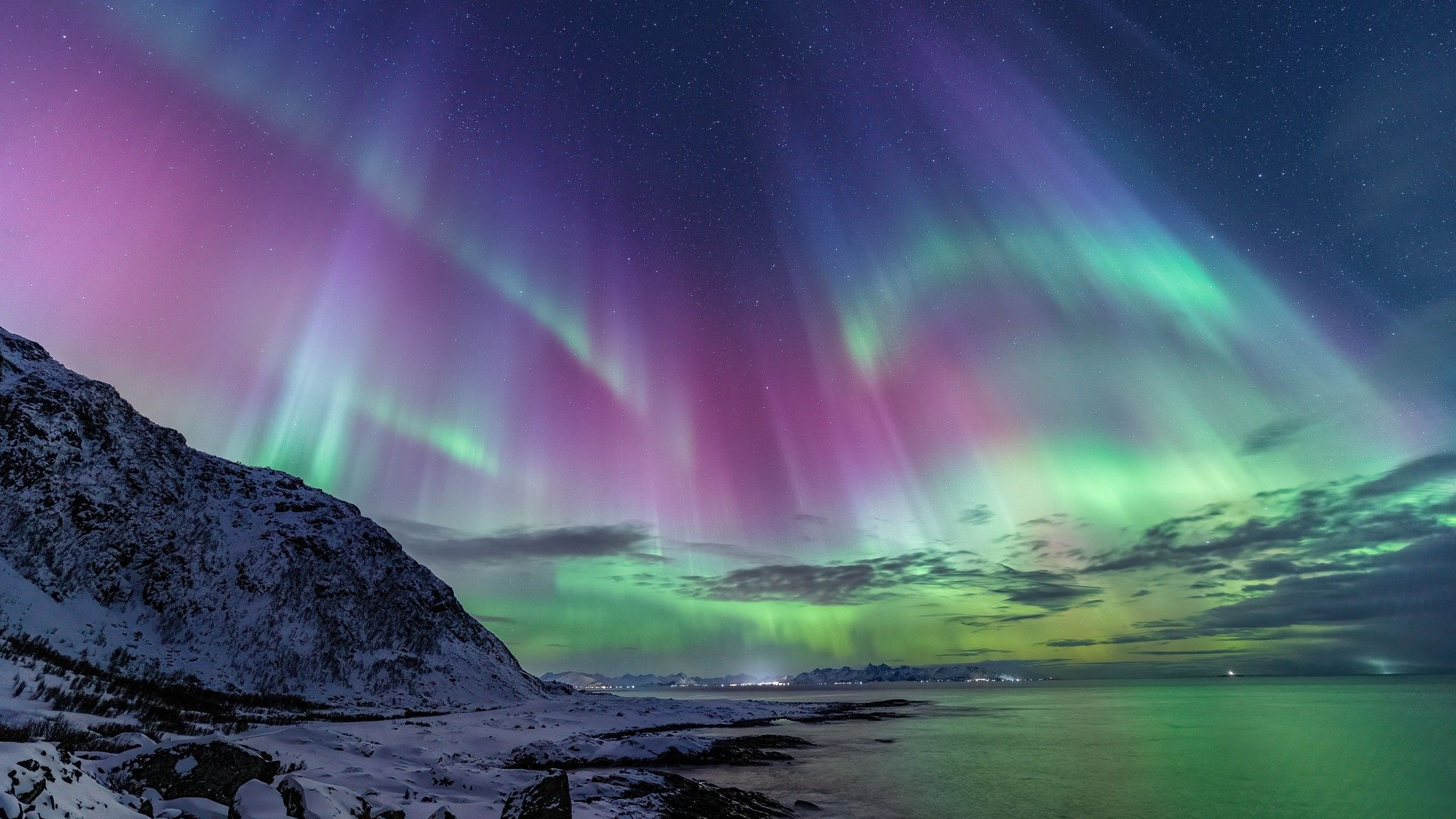
The ethereal dance of lights gracing the polar skies, the Aurora Borealis, has captivated humanity for millennia. Often described as celestial curtains of green, pink, purple, and red, these mesmerizing displays are more than just a beautiful spectacle; they are a profound manifestation of the complex interplay between our Sun and Earth. Understanding the aurora requires delving into the realm of physics, specifically the charged particles that emanate from our star and interact with our planet’s protective magnetic shield. This phenomenon, while seemingly magical, is a testament to the invisible forces that shape our world and the universe around us, offering a unique perspective on the raw power and beauty of our solar system.
The Sun’s Cosmic Breath: Solar Wind and Its Journey
At the heart of the Aurora Borealis lies our Sun, a star that is in constant motion and an inexhaustible source of energy. It is not just light and heat that radiate from its surface; the Sun also emits a continuous stream of electrically charged particles, primarily electrons and protons. This stream is known as the solar wind.
The Unseen Force: Solar Wind’s Composition and Velocity
The solar wind is not a uniform flow. Its density, speed, and temperature can vary significantly, influenced by events occurring on the Sun’s surface. During periods of heightened solar activity, such as solar flares and coronal mass ejections (CMEs), the solar wind can become much more intense, carrying a higher concentration of energetic particles at greater speeds. These particles are not like the gentle breeze we feel on Earth; they travel at astonishing velocities, often exceeding 300 kilometers per second (about 186 miles per second). This high-energy outflow is a fundamental component of space weather, the dynamic conditions in space that can affect Earth and other celestial bodies.
Solar Flares and CMEs: Catalysts for Auroral Displays
While the solar wind is a constant presence, it is particularly powerful events on the Sun that often trigger the most spectacular auroral displays. Solar flares are sudden, intense bursts of radiation from the Sun’s surface. CMEs are even more significant, involving the release of massive amounts of plasma and magnetic field from the Sun’s corona. When these events occur and their ejected material is directed towards Earth, the resulting increase in the solar wind’s intensity and energy can lead to more vibrant and widespread auroras. These events can also be associated with geomagnetic storms, which are disturbances in Earth’s magnetosphere.
Earth’s Invisible Shield: The Magnetosphere’s Protective Embrace
Fortunately, Earth is not defenseless against the onslaught of the solar wind. Our planet possesses a powerful magnetic field, generated by the motion of molten iron in its core. This magnetic field extends far out into space, creating a protective bubble known as the magnetosphere. The magnetosphere acts as a shield, deflecting the majority of the charged particles from the solar wind, preventing them from reaching our atmosphere and potentially harming life on Earth.
The Dance of Deflection: How the Magnetosphere Interacts with Solar Wind
The magnetosphere is not a perfect sphere. It is compressed on the side facing the Sun due to the constant pressure of the solar wind and stretched out into a long tail on the opposite side. When charged particles from the solar wind encounter the magnetosphere, they are largely guided along the magnetic field lines. Most of these particles are deflected around Earth. However, some particles can become trapped within the magnetosphere, particularly in the region known as the Van Allen radiation belts.
Polar Plunge: Entry Points for Auroral Particles
The magnetosphere is weakest at the Earth’s magnetic poles. Here, the magnetic field lines converge and dip down towards the planet’s surface. This creates funnel-like regions where some of the energetic charged particles from the solar wind can penetrate the magnetosphere and enter the upper atmosphere. These polar regions are precisely where the Aurora Borealis (in the Northern Hemisphere) and Aurora Australis (in the Southern Hemisphere) are most commonly observed.
The Spectacle of Light: Atmospheric Collisions and Color

Once the charged particles from the Sun breach the magnetosphere and enter Earth’s upper atmosphere, the magic truly begins. It is through a series of energetic collisions with atmospheric gases that the breathtaking auroral displays are created. The colors we witness are not random; they are a direct consequence of the type of gas particles being excited and the energy levels involved.
Exciting the Atmosphere: Collisions with Oxygen and Nitrogen
The primary gases in Earth’s atmosphere are nitrogen and oxygen. When high-energy electrons and protons from the solar wind collide with these atmospheric atoms and molecules, they transfer energy to them. This energy excites the electrons within the atmospheric atoms to higher energy levels. However, these excited states are unstable. As the electrons return to their lower, more stable energy levels, they release the excess energy in the form of photons of light. This process is analogous to how a neon sign works, where electricity excites gas atoms to produce light.
The Palette of the Aurora: Understanding the Colors
The specific color of the aurora depends on which atmospheric gas is being struck and at what altitude.
- Green: The most common auroral color, green, is produced when energetic electrons collide with oxygen atoms at altitudes between 100 and 300 kilometers (about 60 to 180 miles). This is due to a specific energy transition within the oxygen atom that emits light in the green part of the spectrum.
- Red: Red auroras are also produced by oxygen, but at higher altitudes, typically above 300 kilometers (180 miles). At these greater heights, the oxygen atoms are more spread out, and the collisions are less frequent, leading to a slower release of energy and the emission of red light.
- Blue and Purple: These colors are typically generated by collisions with nitrogen molecules. When electrons strike nitrogen molecules, they can excite them to higher energy states, which then emit light in the blue and violet parts of the spectrum. These colors are often seen at the lower edges of auroral displays.
- Pink: A mix of red and blue/purple emissions can create the appearance of pink or even reddish-purple hues in the aurora.
The intensity of the solar wind and the specific composition of the incoming charged particles can influence the prevalence and vividness of these colors, leading to the ever-changing and dynamic nature of auroral displays.
Factors Influencing Auroral Visibility: Location, Time, and Solar Activity
While the fundamental science behind the aurora is constant, several factors determine whether you will witness this celestial phenomenon and how spectacular it will be. These factors are crucial for anyone hoping to experience the aurora firsthand.
The Polar Pivot: Geographic Location and Magnetic Latitude
The Aurora Borealis is intrinsically linked to the Earth’s magnetic poles. Therefore, geographic location plays a paramount role. Areas closer to the magnetic North Pole, such as parts of Canada, Alaska, Greenland, Iceland, Norway, Sweden, and Finland, offer the highest probability of experiencing auroral displays. The key factor is not just geographic latitude but magnetic latitude, which is determined by the Earth’s magnetic field lines. Higher magnetic latitudes are more directly aligned with the entry points for solar particles into the atmosphere.
The Darkness Dividend: Time of Year and Time of Night
Visibility of the aurora is also heavily dependent on darkness. Since auroras are faint light emissions, they are best observed against a dark sky. This means that winter months in the polar regions, with their long nights, provide the optimal conditions. Furthermore, the aurora can occur at any time of night, but it is often most active during the periods around local midnight. While the aurora itself is a continuous phenomenon, its visibility can fluctuate based on the Earth’s rotation and the specific orientation of the magnetosphere.

Solar Cycles and Space Weather: Predicting the Intensity
The intensity and frequency of auroral displays are directly correlated with solar activity. The Sun goes through an approximately 11-year cycle of activity, ranging from a solar minimum (low activity) to a solar maximum (high activity). During periods of high solar activity, solar flares and CMEs are more frequent and powerful, leading to a greater influx of charged particles towards Earth and, consequently, more frequent and intense auroral displays. Space weather forecasts, which monitor solar activity and predict the potential for geomagnetic storms, can offer valuable insights into the likelihood of observing a strong aurora. Websites and apps dedicated to aurora forecasting use this data to provide predictions for visibility.
In conclusion, the Aurora Borealis is a breathtaking natural phenomenon born from the dynamic interaction between the Sun and Earth. It is a reminder of the powerful forces that shape our planet and the universe, a celestial ballet of light orchestrated by the Sun’s energetic breath and Earth’s magnetic embrace, creating a spectacle that continues to inspire awe and wonder.
aViewFromTheCave is a participant in the Amazon Services LLC Associates Program, an affiliate advertising program designed to provide a means for sites to earn advertising fees by advertising and linking to Amazon.com. Amazon, the Amazon logo, AmazonSupply, and the AmazonSupply logo are trademarks of Amazon.com, Inc. or its affiliates. As an Amazon Associate we earn affiliate commissions from qualifying purchases.