
In the realm of personal finance and investing, numbers are the primary language of progress. Whether you are tracking the growth of a retirement account, evaluating the success of a side hustle, or calculating the impact of inflation on your purchasing power, the ability to accurately work out percentage increase is an essential skill. It transforms raw data into actionable insights, allowing you to see beyond the dollar amounts and understand the actual velocity of your wealth creation.
Understanding percentage increase is not merely an academic exercise in mathematics; it is a strategic tool used by investors, entrepreneurs, and budget-conscious individuals to measure performance over time. In this comprehensive guide, we will explore the fundamental mechanics of calculating growth and apply these concepts to real-world financial scenarios.
Understanding the Fundamentals: The Mathematical Foundation of Financial Growth
Before diving into complex investment portfolios or corporate balance sheets, one must master the basic arithmetic of growth. A percentage increase represents how much a value has grown relative to its starting point. In financial terms, this “starting point” is often your initial capital or a previous year’s revenue.
The Core Formula: New Value vs. Old Value
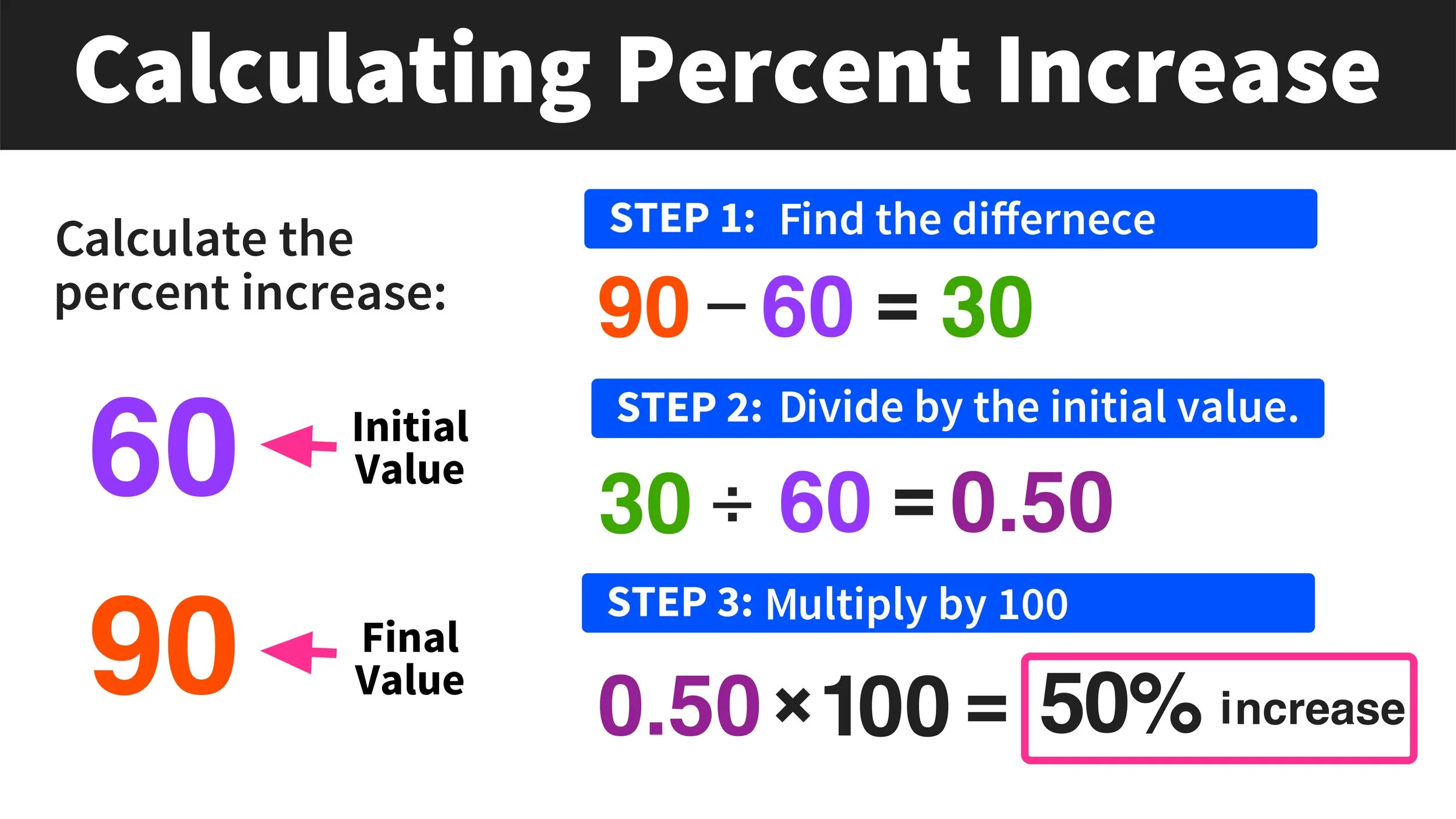
The formula for calculating percentage increase is straightforward, yet its implications are profound. To find the percentage increase between two numbers, follow these three steps:
- Subtract the original value (the old value) from the new value to find the “increase amount.”
- Divide that increase amount by the original value.
- Multiply the resulting decimal by 100 to convert it into a percentage.
Formula: ((New Value - Old Value) / Old Value) * 100 = Percentage Increase
For example, if you invested $1,000 in a dividend-paying stock and its value grew to $1,250 over a year, your calculation would look like this:
- $1,250 – $1,000 = $250 (The absolute increase)
- $250 / $1,000 = 0.25
- 0.25 * 100 = 25%
Why Decimals and Percentages Matter in Your Wallet
While absolute dollar amounts tell you how much money you have, percentages tell you how efficiently that money is working. If Person A makes $500 on a $5,000 investment and Person B makes $500 on a $1,000 investment, they have both earned the same amount of money. However, Person B has achieved a 50% increase, while Person A has only achieved a 10% increase. In the world of finance, Person B is the more efficient investor. Understanding this distinction is vital for comparing different asset classes, such as real estate, stocks, or high-yield savings accounts.
Applying Percentage Increase to Personal Finance and Budgeting
For the average household, working out percentage increase is a vital part of long-term planning. It helps in evaluating career progression and protecting one’s lifestyle against the eroding effects of rising costs.
Tracking Income Growth and Raises
When you receive a salary increase, it is common to focus on the new monthly take-home pay. However, calculating the percentage increase of your raise is crucial for career benchmarking. If you receive a $3,000 raise on a $60,000 salary, that is a 5% increase.
Why does this matter? It allows you to compare your income growth against the national average or the specific inflation rate for that year. If your salary increases by 3% but the cost of living (inflation) increases by 5%, you have effectively experienced a decrease in “real” income, despite having more nominal dollars in your bank account.
Monitoring the Impact of Inflation on Purchasing Power
Inflation is essentially a percentage increase in the price of goods and services over time. For someone managing a household budget, understanding how to calculate these increases is key to maintaining a standard of living. If your monthly grocery bill was $400 last year and is now $460, you can calculate the percentage increase:
- ($460 – $400) / $400 = 0.15
- 0.15 * 100 = 15%
By identifying that your food costs have risen by 15%, you can make informed decisions about where to cut back or whether you need to seek additional income streams to bridge the gap.
Investing and Wealth Building: Calculating Your Returns
In the world of investing, percentage increase is often referred to as “Return on Investment” (ROI). It is the primary metric used to determine whether an asset is worth holding or if capital should be reallocated elsewhere.
Realized vs. Unrealized Gains
When monitoring a brokerage account, you will often see “unrealized gains.” This is the percentage increase in the value of your assets based on current market prices. For example, if you bought Bitcoin at $30,000 and it is now trading at $45,000, you have an unrealized gain of 50%.
It only becomes a “realized” gain—and a taxable event—once you sell the asset. Distinguishing between these two is critical for tax planning. Investors often use percentage increase calculations to decide which lots of a stock to sell to minimize capital gains taxes while maximizing their portfolio’s growth trajectory.
The Power of Compounding: Percentage Increases Over Time
One of the most important concepts in money management is compound interest, which is essentially a percentage increase applied to a value that has already increased. If your portfolio grows by 10% every year, you aren’t just gaining 10% of your original investment; you are gaining 10% on the new, higher total each year.
To calculate the total percentage increase over multiple years, you cannot simply add the percentages together (e.g., 10% in year one and 10% in year two does not equal a 20% total increase; it actually equals 21% due to compounding). Mastering this nuance helps investors understand the long-term benefits of staying invested rather than trying to “time the market.”
Business Finance and Side Hustles: Measuring Profitability
For entrepreneurs and side-hustlers, the ability to work out percentage increase is the difference between running a hobby and running a business. It provides a clear picture of whether a venture is scaling effectively.
Revenue Growth and Profit Margins
If you run an e-commerce store, you likely track your month-over-month (MoM) or year-over-year (YoY) revenue. If your sales grew from $2,000 in January to $2,800 in February, your MoM percentage increase is 40%.
However, savvy business owners also calculate the percentage increase in their expenses. If your revenue increased by 40% but your advertising costs increased by 80%, your profit margins are shrinking. Calculating these percentages allows you to identify “leaks” in your business model and adjust your pricing or operations accordingly.
Customer Acquisition and Scaling Costs
In the early stages of a side hustle, you might focus on the percentage increase of your customer base. Growing from 10 clients to 15 is a 50% increase. While the absolute number (5) seems small, the percentage growth indicates a strong market fit. As you scale, maintaining a high percentage increase becomes more difficult, which is why large corporations celebrate even 5–10% annual growth, whereas a startup might aim for 100% or more.
Digital Tools and Automation: Simplifying the Calculation
While knowing the manual formula is essential for quick mental checks, modern financial management relies heavily on digital tools to track percentage increases across hundreds of data points.
Using Spreadsheets for Complex Financial Modeling
Microsoft Excel and Google Sheets are the gold standards for financial tracking. To work out percentage increase in a spreadsheet, you don’t need a calculator. If your old value is in cell A2 and your new value is in cell B2, the formula is:
=(B2-A2)/A2
Once you hit enter, you can format the cell as a “Percentage” to see the result clearly. This is particularly useful for tracking a diversified portfolio where you might have dozens of different stocks, bonds, and crypto-assets. You can set up a sheet that automatically pulls live price data and calculates your total percentage growth in real-time.
Online Calculators and Financial Apps
Many fintech apps, such as Mint, YNAB, or Robinhood, do the heavy lifting for you. They provide visual dashboards that show percentage increases in your net worth or specific asset buckets. However, relying solely on these apps can be risky. A professional approach to money involves occasionally “checking the math” manually.
By understanding how these tools arrive at their numbers, you can better interpret the data. For instance, some apps might show a “simple” percentage increase, while others show a “time-weighted” return, which accounts for the timing of your deposits and withdrawals. Knowing the difference ensures you have an accurate perspective on your financial health.

Conclusion: The Strategic Advantage of Mathematical Literacy
In conclusion, learning how to work out percentage increase is more than just a math lesson; it is a fundamental pillar of financial literacy. It allows you to strip away the noise of fluctuating market prices and see the underlying growth of your wealth. Whether you are negotiating a raise, analyzing a stock’s performance, or managing a growing business, the percentage increase is your most reliable compass.
By consistently applying this formula to your finances, you gain a professional edge. You stop looking at money as a static pile of cash and start seeing it as a dynamic engine of growth. In the long run, the individuals who master these calculations are the ones best equipped to navigate the complexities of the modern financial landscape and achieve true financial independence.
aViewFromTheCave is a participant in the Amazon Services LLC Associates Program, an affiliate advertising program designed to provide a means for sites to earn advertising fees by advertising and linking to Amazon.com. Amazon, the Amazon logo, AmazonSupply, and the AmazonSupply logo are trademarks of Amazon.com, Inc. or its affiliates. As an Amazon Associate we earn affiliate commissions from qualifying purchases.