
In the modern financial landscape, the ability to accept credit card payments is no longer a luxury—it is a fundamental requirement for business viability. Whether you are launching a boutique retail storefront, an expansive e-commerce platform, or a freelance consultancy, your payment infrastructure dictates your cash flow, customer retention, and overall financial health. For business owners, understanding how to take credit card payments involves more than simply plugging in a card reader; it requires a strategic grasp of merchant services, fee structures, and the financial ecosystem that moves money from a customer’s bank to your business account.
Understanding the Financial Ecosystem of Credit Card Processing
To effectively manage business finance, one must first understand the stakeholders involved in every swipe, dip, or tap. The journey of a single transaction involves a complex network of financial institutions working in concert to ensure the transfer of funds is secure and verified.
The Key Players in the Transaction Chain
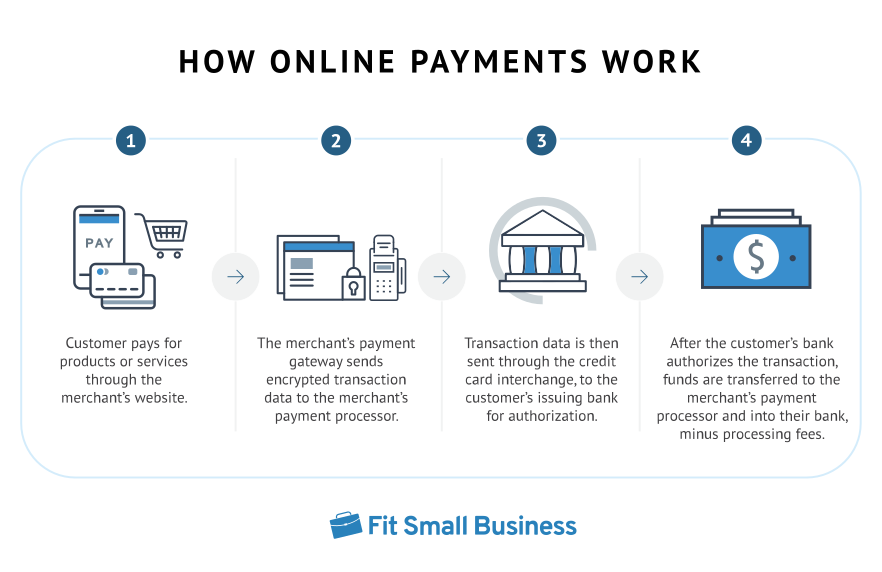
Every credit card payment involves four primary entities. First is the Merchant (you), who provides the goods or services. Second is the Cardholder (the customer). Third is the Issuing Bank, which is the financial institution that provided the customer with their credit card. Finally, there is the Acquiring Bank (or Merchant Bank), which holds your business account and receives the funds.
The Role of the Payment Processor and Gateway
Connecting these four entities are the payment processor and the payment gateway. The processor handles the actual communication of the transaction data, while the gateway acts as the digital “point of sale,” encrypting sensitive information to ensure that the financial data remains secure during transit. From a financial management perspective, choosing the right gateway is critical because it directly impacts your transaction speed and security overhead.
The Lifecycle of a Credit Card Transaction
When a customer presents a card, an authorization request is sent through the gateway to the processor, then to the card network (like Visa or Mastercard), and finally to the issuing bank. The bank checks for available credit and fraud indicators before sending an approval or decline. Once approved, the funds are “captured.” At the end of the business day, the merchant “batches” these transactions, and the funds are typically deposited into the business account within one to three business days.
Selecting the Optimal Payment Processing Model
The financial impact of credit card processing depends heavily on the model you choose. Business owners generally choose between two primary paths: a dedicated merchant account or a Payment Service Provider (PSP).
Merchant Accounts vs. Payment Service Providers
A Merchant Account is a dedicated bank account established specifically for your business to accept card payments. This model often offers lower transaction fees and better stability, but it requires a more rigorous application process and may involve monthly maintenance fees.
Conversely, Payment Service Providers (PSPs) like Square, Stripe, or PayPal aggregate thousands of small businesses into a single large merchant account. The advantage here is speed and simplicity; you can often start taking payments within minutes. However, the trade-off is often a flat-rate fee structure that may be more expensive as your business scales, as well as a higher risk of account freezes if your transaction volume fluctuates wildly.
Navigating Fee Structures: Flat-Rate, Tiered, and Interchange-Plus
The “Money” aspect of payment processing is most visible in the fee structures.
- Flat-Rate Pricing: You pay a fixed percentage for every transaction (e.g., 2.9% + $0.30). This is predictable and excellent for low-volume businesses.
- Tiered Pricing: Transactions are categorized as “qualified,” “mid-qualified,” or “non-qualified.” While it looks cheaper on paper, it is often the most expensive and least transparent model due to the high rates applied to “non-qualified” cards (like corporate or rewards cards).
- Interchange-Plus Pricing: This is widely considered the most transparent and cost-effective model for growing businesses. You pay the exact “interchange” fee set by the card networks, plus a small, consistent markup for the processor. This allows you to see exactly where every cent of your processing budget is going.
Evaluating Total Cost of Ownership (TCO)
When calculating the financial burden of taking credit cards, one must look beyond the per-transaction fee. Consider annual fees, PCI compliance fees, statement fees, and hardware lease costs. In business finance, the goal is to minimize the “Total Cost of Ownership” while maximizing the reliability of the service.
Implementation: Hardware and Software Solutions for Revenue Collection
Once the financial partnership is established, you must implement the tools to facilitate the transaction. This infrastructure varies significantly based on whether you operate in a physical or digital environment.
Point of Sale (POS) Systems and Terminals
For brick-and-mortar operations, the Point of Sale system is the nerve center of financial activity. Modern POS systems go beyond simple card swiping; they integrate with inventory management, employee hours, and financial reporting software. For a mobile business—such as a food truck or a consulting service—mobile card readers that plug into a smartphone offer a low-cost entry point into the credit card ecosystem.
E-commerce Gateways and Virtual Terminals
If your revenue is generated online, you require a robust payment gateway. This software integrates with your website’s shopping cart to provide a seamless checkout experience. For businesses that take orders over the phone or via mail (MOTO), a “Virtual Terminal” allows you to manually enter credit card details into a secure web-based form. This is an essential tool for B2B companies and service providers who do not have a physical checkout counter.
Integrated Financial Reporting
The most effective payment solutions are those that “talk” to your accounting software (such as QuickBooks or Xero). Automating the reconciliation process—where your recorded sales match the deposits in your bank account—saves countless hours of manual bookkeeping and reduces the margin for financial error.
Risk Management: Security, Compliance, and Chargebacks
Taking credit card payments introduces specific financial risks that must be managed to protect your bottom line. Fraud and administrative disputes can lead to significant losses if not handled proactively.
PCI DSS Compliance and Data Security
The Payment Card Industry Data Security Standard (PCI DSS) is a set of requirements designed to ensure that all companies that process, store, or transmit credit card information maintain a secure environment. Failure to remain compliant can result in heavy fines from banks and the loss of your ability to accept cards entirely. From a business finance perspective, investing in PCI-compliant hardware and encrypted gateways is a form of insurance against catastrophic data breaches.
The Financial Impact of Chargebacks
A chargeback occurs when a customer disputes a charge with their bank rather than seeking a refund from you. If the bank sides with the customer, the funds are pulled from your account, and you are typically charged a “chargeback fee” ranging from $15 to $100. High chargeback rates can lead to your merchant account being terminated. Managing this risk involves clear communication, transparent refund policies, and using tools like 3D Secure to verify customer identities.
Fraud Prevention Strategies
Implementing Address Verification Systems (AVS) and Card Verification Value (CVV) checks are standard financial best practices. For high-growth businesses, utilizing AI-driven fraud detection tools can help identify suspicious patterns before a transaction is finalized, saving the business from the cost of lost inventory and associated processing fees.
Future-Proofing Your Business Revenue Streams
As the financial world evolves, the way we take credit card payments is shifting toward more “frictionless” methods. Staying ahead of these trends ensures your business remains competitive and accessible to all consumer demographics.
Contactless Payments and Mobile Wallets
NFC (Near Field Communication) technology allows customers to pay by tapping their card or using mobile wallets like Apple Pay and Google Pay. These transactions are not only faster but often more secure due to tokenization, where the actual card number is never shared with the merchant. Encouraging contactless payments can improve transaction throughput and customer satisfaction.
Recurring Billing and Subscription Models
For service-based businesses, moving toward a recurring billing model can stabilize cash flow. By securely storing card information (vaulting), you can automatically charge clients on a set schedule. This reduces the “accounts receivable” lag and provides a more predictable revenue stream for long-term financial planning.

Exploring Alternative Payment Methods
While credit cards remain king, the rise of “Buy Now, Pay Later” (BNPL) services and even cryptocurrency payments are worth monitoring. Diversifying the ways you can accept value ensures that you never lose a sale due to a lack of payment options. For the forward-thinking business owner, the goal is to create a seamless financial bridge between the customer’s desire to purchase and the business’s receipt of funds.
In conclusion, taking credit card payments is a multi-faceted discipline of business finance. By choosing the right processing model, understanding the underlying fees, and maintaining rigorous security standards, you can turn your payment infrastructure into a powerful engine for growth and financial stability.