
The Standard & Poor’s 500, commonly known as the S&P 500, is arguably the most famous stock market index in the world. It serves as a barometer for the health of the United States economy and a primary benchmark for investment performance. For decades, it has been the cornerstone of retirement portfolios, institutional funds, and individual brokerage accounts alike.
Investing in the S&P 500 is often cited as the most effective way for the average person to participate in the growth of the corporate world without needing the specialized skills of a professional stock picker. However, while the concept is simple, the execution requires an understanding of financial instruments, platform selection, and the psychological discipline of long-term investing. This guide provides a deep dive into how to effectively allocate your capital into the S&P 500 and why it remains a premier strategy for wealth creation.
Understanding the S&P 500 Index
Before committing capital, an investor must understand exactly what the S&P 500 represents. It is not just a list of the 500 largest companies; it is a curated, float-adjusted, market-capitalization-weighted index that represents approximately 80% of the total value of the U.S. equity market.
The Selection Criteria
The index is maintained by the S&P Dow Jones Indices. To be included, a company must meet specific eligibility requirements, including a minimum market capitalization, high liquidity, and at least four consecutive quarters of positive earnings. This “quality filter” ensures that the index only contains viable, profitable enterprises, which naturally weeds out speculative or failing businesses.
Market Capitalization Weighting
Unlike a price-weighted index (like the Dow Jones Industrial Average), the S&P 500 is market-cap weighted. This means that larger companies—such as Apple, Microsoft, and Amazon—have a larger impact on the index’s performance than smaller companies. When you invest in an S&P 500 fund, you are essentially betting on the continued dominance of American “mega-cap” companies while maintaining exposure to a broad range of industries.
The Power of Reconstitution
One of the “secret” advantages of the S&P 500 is that it is self-cleansing. Every quarter, the committee reviews the index. Underperforming companies or those that have shrunk in value are removed, and rising stars are added. By investing in the index, you are participating in a passive management system that ensures you are always holding the current leaders of the American economy.
Why the S&P 500 is a Gold Standard for Investors
The appeal of the S&P 500 lies in its simplicity and historical reliability. While past performance is never a guarantee of future results, the index has provided an average annual return of approximately 10% over long periods before inflation.
Instant Diversification
By purchasing a single S&P 500 fund, you are instantly diversifying your money across 11 different sectors, including Technology, Healthcare, Financials, Consumer Discretionary, and Energy. This prevents a “single-point-of-failure” in your portfolio. If the retail sector struggles, the gains in the technology or healthcare sectors may offset those losses.
Low Cost and Efficiency
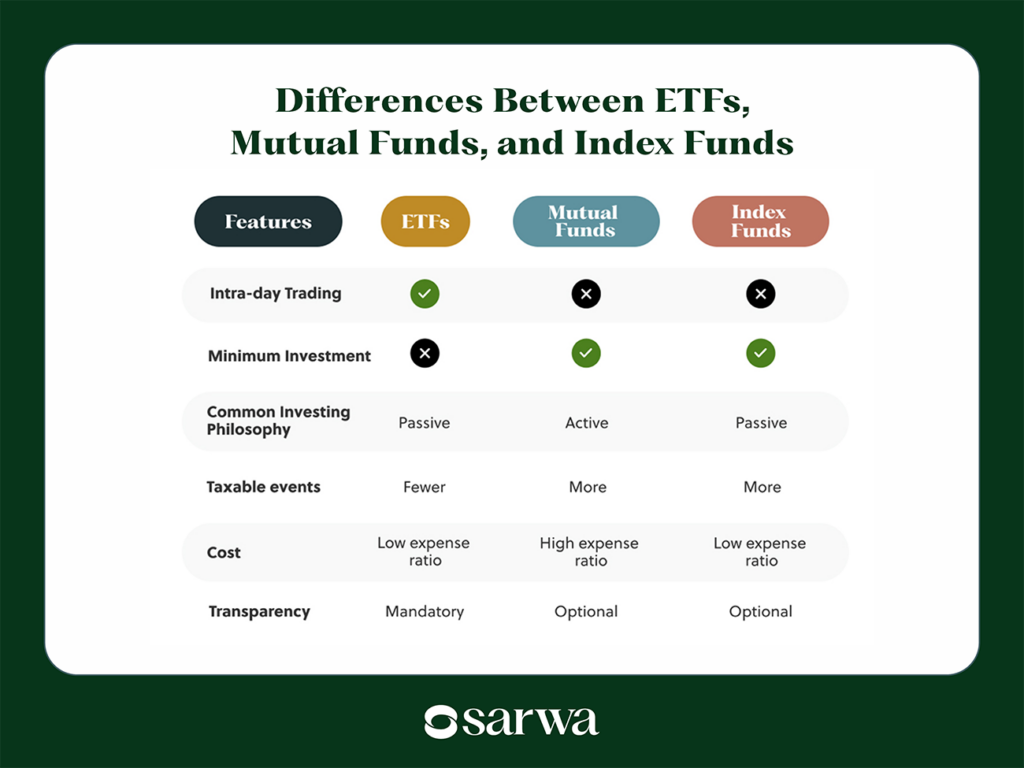
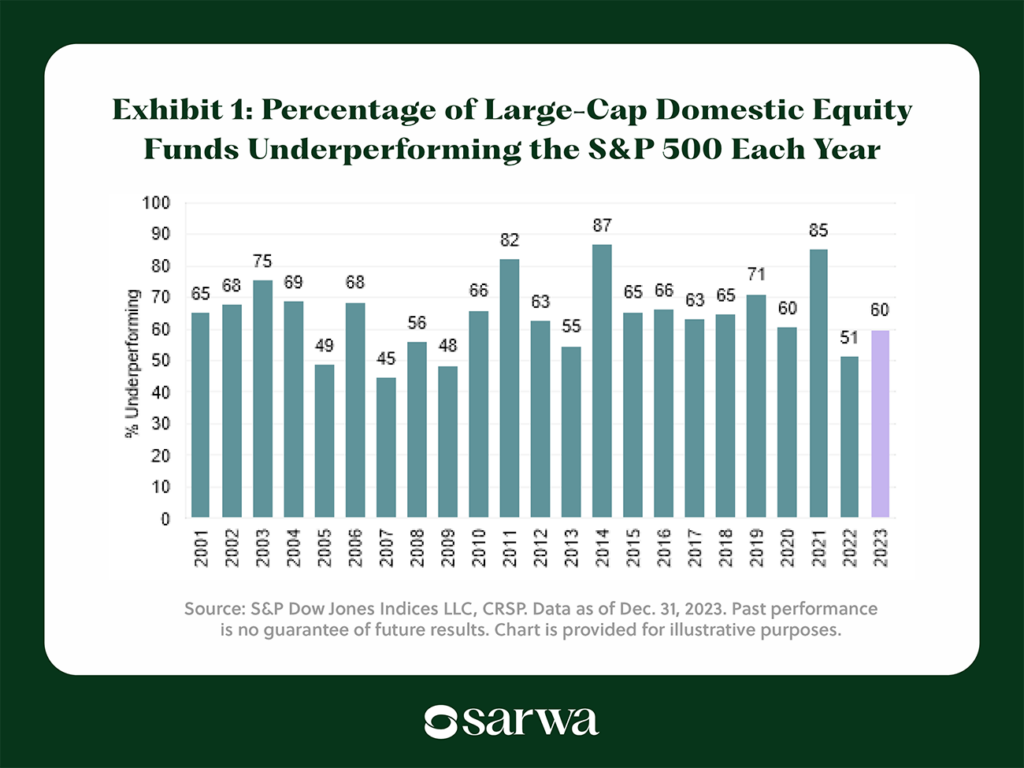
Traditional actively managed mutual funds often charge high “expense ratios” (management fees) because they employ teams of analysts to try and beat the market. Historically, most of these managers fail to beat the S&P 500 over the long run. By choosing an S&P 500 index fund, you benefit from “passive management,” where fees are often near zero, allowing more of your money to stay invested and compound.
Endorsement by Financial Experts
Warren Buffett, one of the most successful investors in history, has famously advocated for the S&P 500 for the average investor. In his will, he instructed that 90% of the cash left to his wife be invested in a low-cost S&P 500 index fund. The rationale is simple: the American economy has a long-term trajectory of growth, and the S&P 500 is the most efficient vehicle to capture that growth.
Practical Steps: How to Start Investing
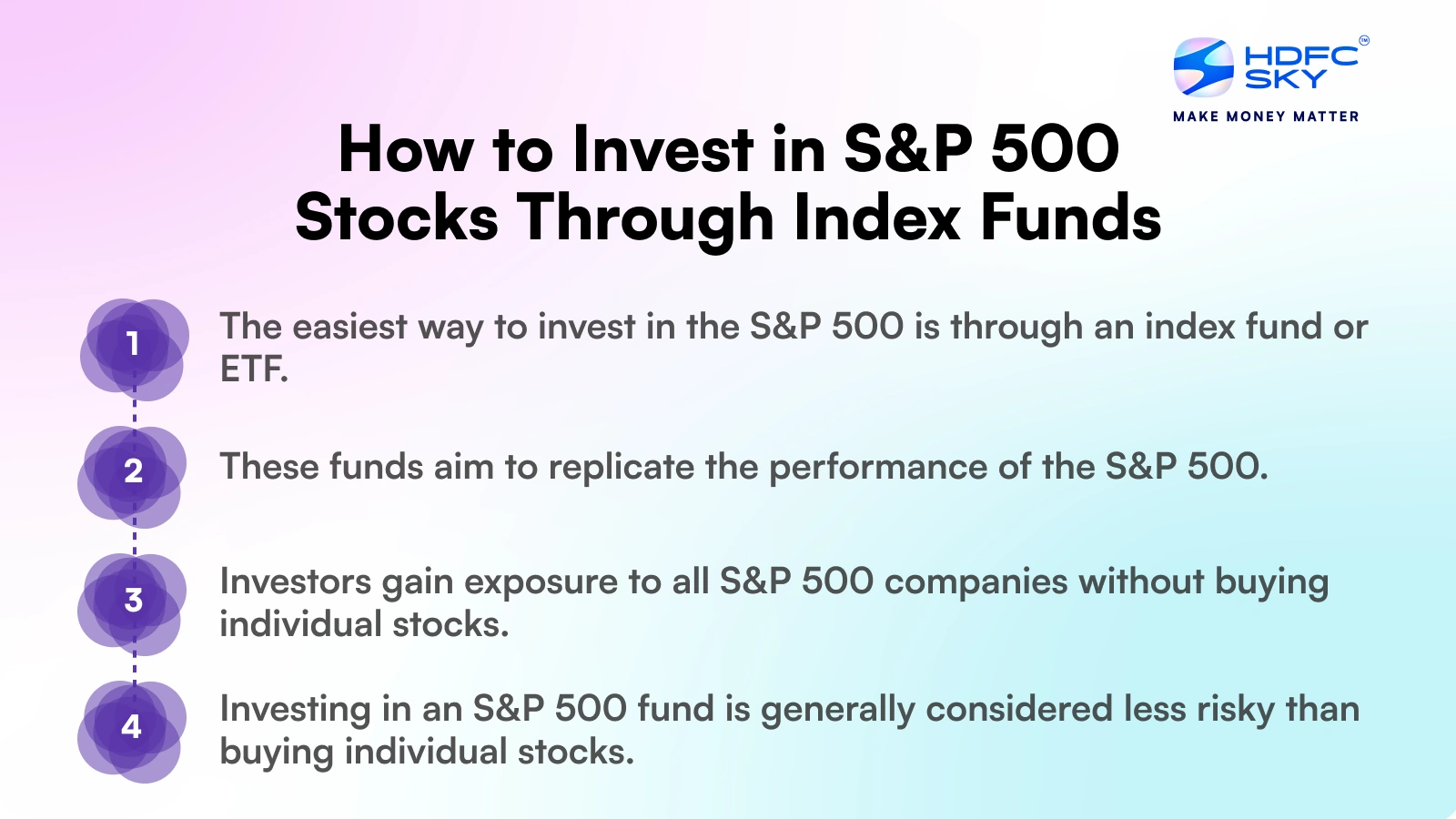
You cannot “buy” the S&P 500 directly because it is an index (a mathematical concept). Instead, you must invest in a financial product that tracks the index.
Step 1: Choose an Investment Account
To start, you need a brokerage account. You can choose between:
- Tax-Advantaged Accounts: Such as a 401(k), Roth IRA, or Traditional IRA. These are ideal for long-term retirement savings due to their tax benefits.
- Taxable Brokerage Accounts: These offer more flexibility as you can withdraw money at any time, but you will owe capital gains taxes on your profits.
Step 2: Select Your Vehicle (ETFs vs. Index Mutual Funds)
There are two primary ways to track the S&P 500:
- Exchange-Traded Funds (ETFs): These trade like stocks on an exchange. They are highly liquid, often have lower minimum investments (you can buy a single share), and are generally more tax-efficient. Popular tickers include VOO (Vanguard), IVV (iShares), and SPY (SPDR).
- Index Mutual Funds: These are priced once at the end of the trading day. They are excellent for investors who want to automate their contributions (e.g., investing $500 every month automatically). Popular examples include the Vanguard 500 Index Fund (VFIAX) or the Fidelity 500 Index Fund (FXAIX).
Step 3: Analyze the Expense Ratio
When choosing between different S&P 500 funds, the primary differentiator is the expense ratio. Since all S&P 500 funds hold the same stocks, there is no reason to pay more for one than another. Look for funds with an expense ratio of 0.03% or lower. A lower fee means more of the market’s return ends up in your pocket.
Strategic Approaches to S&P 500 Investing
Simply buying the index is the first step; how you manage your investment over time will determine your ultimate success.
Dollar-Cost Averaging (DCA)
The market is volatile. Trying to time the “perfect” moment to buy is a losing game for most. Instead, many successful investors use Dollar-Cost Averaging. This involves investing a fixed amount of money at regular intervals (e.g., $200 every payday), regardless of whether the market is up or down. This strategy lowers the average cost of your shares over time and removes the emotional stress of market fluctuations.
Dividend Reinvestment (DRIP)
Most companies in the S&P 500 pay dividends—a portion of their profits distributed to shareholders. While you can take this as cash, the most powerful way to grow wealth is to set up a Dividend Reinvestment Plan (DRIP). This automatically uses your dividends to buy more shares of the fund. Over decades, reinvested dividends can account for a massive portion of an investor’s total returns.
The “Buy and Hold” Discipline
The greatest enemy of the S&P 500 investor is often their own reflection. During market downturns, such as the 2008 financial crisis or the 2020 pandemic crash, the impulse to sell is strong. However, the S&P 500 has recovered from every single decline in its history. Success requires a “time in the market, not timing the market” mentality.
Risks and Considerations to Keep in Mind
While the S&P 500 is a robust investment, it is not without risk. A responsible investor must understand the limitations of this strategy.
Concentration Risk in Tech
Because the index is market-cap weighted, it has become increasingly concentrated in the technology sector over the last decade. If a handful of tech giants experience a significant downturn, the entire index will suffer, even if the other 490 companies are doing well. Investors should be aware that they are heavily exposed to the “Big Tech” narrative.
Market Volatility and Drawdowns
The S&P 500 is 100% equities. This means it can be highly volatile. It is not uncommon for the index to drop 10% (a correction) or even 20%+ (a bear market) in a single year. If you have a short-term time horizon—meaning you need the money in less than five years—the S&P 500 may be too risky for your needs.
Inflation and Real Returns
While a 10% average return sounds excellent, investors must account for inflation. If inflation is 3%, your “real” purchasing power growth is 7%. While still substantial, it highlights the importance of consistent investing and maintaining a long-term perspective to outpace the rising cost of living.
Conclusion: Starting Your Journey
Investing in the S&P 500 is a testament to the idea that “simple is better.” By capturing the growth of the 500 most influential companies in the United States, you align your financial future with the progress of global capitalism.
To begin, identify a low-cost brokerage, select a highly-rated ETF or mutual fund like VOO or FXAIX, and commit to a schedule of regular contributions. Whether you are a novice just starting your first job or a seasoned professional looking to streamline your portfolio, the S&P 500 remains one of the most reliable paths to financial independence. The key is not to find the “next big thing,” but to stay invested in the “current big things” that have already proven their value to the world.
aViewFromTheCave is a participant in the Amazon Services LLC Associates Program, an affiliate advertising program designed to provide a means for sites to earn advertising fees by advertising and linking to Amazon.com. Amazon, the Amazon logo, AmazonSupply, and the AmazonSupply logo are trademarks of Amazon.com, Inc. or its affiliates. As an Amazon Associate we earn affiliate commissions from qualifying purchases.