
The “chicken and egg” paradox of entrepreneurship is a challenge that has haunted prospective business owners for decades: you need money to start a business, but you need a business to make money. For many aspiring founders, the dream of launching a venture is often stalled by a lack of personal liquid capital. However, the modern financial landscape has evolved. While traditional banks remain conservative, a diverse array of lending vehicles and government-backed programs has emerged to support those starting from zero.
Getting a startup business loan with no money—meaning no personal cash injection or significant collateral—is difficult, but far from impossible. It requires a shift in focus from what you have to what you can prove. This guide explores the strategic pathways to securing debt financing when your personal coffers are empty, focusing on creditworthiness, government assistance, and alternative financial structures.
Laying the Financial Foundation: Why Lenders Care About More Than Your Bank Balance
When a lender evaluates a loan application from a founder with no personal capital to “skin the game,” they are essentially assessing risk. In the absence of a cash down payment, the lender must find security in other areas. Your primary objective during the pre-application phase is to fortify your financial profile so that the risk appears manageable.
The Role of Personal Credit Scores
In the world of startup financing, your personal credit score acts as a proxy for your business’s reliability. Because a new business lacks a multi-year track record of profit and loss, lenders look at how you have managed your personal debts. To secure a loan with no money down, a score in the “Good” to “Excellent” range (typically 680 or higher) is often a non-negotiable requirement. If your score is lower, your first step isn’t applying for loans; it is aggressive credit repair—paying down revolving balances and correcting errors on your credit report.
Crafting a Bulletproof Business Plan
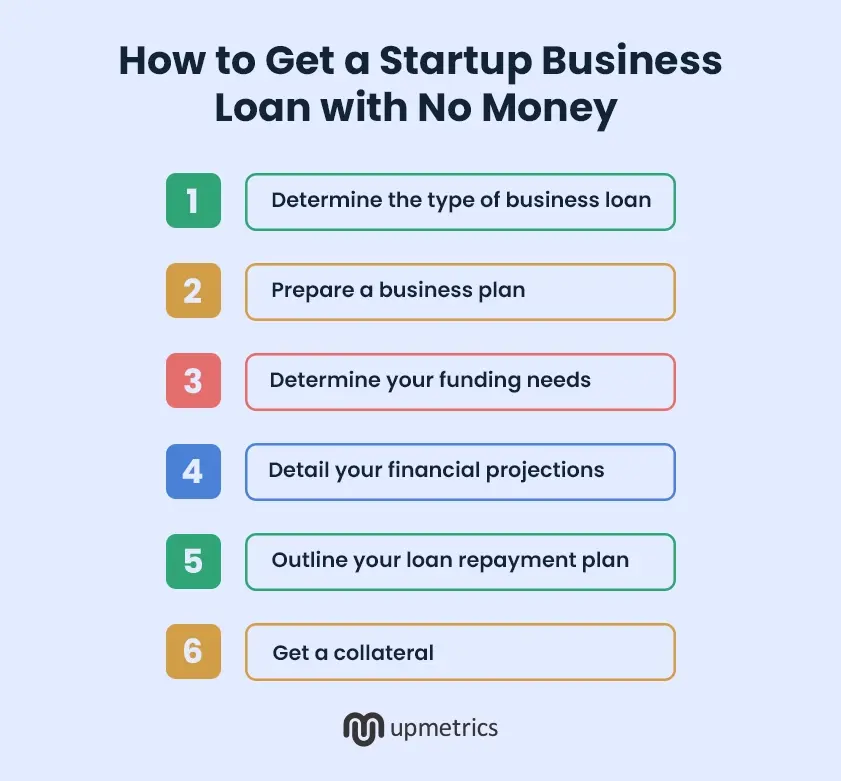
Without collateral, your business plan is your most persuasive sales document. It must demonstrate a clear path to profitability. Lenders want to see detailed financial projections, including a break-even analysis and a two-year cash flow forecast. You must be able to articulate exactly how the loan proceeds will be used to generate revenue. If you can prove that every dollar borrowed has a direct, measurable impact on growth, the lack of an initial deposit becomes less of a deterrent.
Demonstrating Debt-to-Income Feasibility
Lenders will scrutinize your Debt-to-Income (DTI) ratio. Even if you have no savings to invest in the business, you must show that you can manage the monthly loan payments. This often means having a secondary source of income, such as a part-time job or a spouse’s salary, which can cover your personal living expenses while the business scales. A low DTI indicates to the lender that the business’s early revenues won’t be immediately drained by your personal survival needs.
Government-Backed Solutions: Leveraging the Small Business Administration (SBA)
The U.S. Small Business Administration (SBA) does not lend money directly to entrepreneurs. Instead, it provides guarantees to banks and credit unions, promising to repay a portion of the loan if the borrower defaults. This mitigation of risk makes lenders much more willing to work with founders who have little to no capital.
SBA 7(a) Loans for Working Capital
The 7(a) loan program is the SBA’s flagship offering. While some lenders within this program may still require a 10% down payment, “no-money-down” options exist, particularly for smaller loan amounts or if you have existing assets (like home equity) that can be pledged, even if you don’t have cash. These loans offer long repayment terms and capped interest rates, making the monthly debt service more affordable for a cash-strapped startup.
The SBA Microloan Program
For many startups, a massive six-figure loan isn’t necessary. The SBA Microloan program provides loans up to $50,000 to help small businesses start and expand. These loans are administered through non-profit community-based organizations. Because these lenders have a mission to support economic development, they are often more flexible regarding collateral and down payments than commercial banks. They also frequently provide mandatory business training, which adds value to the borrower beyond the capital itself.
Community Advantage Loans
This is a pilot program under the 7(a) umbrella designed to meet the credit, management, and technical assistance needs of small businesses in underserved markets. Community Advantage lenders are often more focused on the “character” of the borrower and the potential impact of the business on the community rather than strictly requiring a specific amount of personal investment.
Alternative Lending Paths for Cash-Strapped Founders
When traditional banking and government programs are not a fit, the “FinTech” revolution has provided several alternative paths. These lenders often use different algorithms to assess risk, looking at real-time data rather than just historical balance sheets.
Equipment Financing and Leasing
If your startup requires specific machinery, vehicles, or technology to operate, equipment financing is one of the easiest ways to get a loan with no money. In this scenario, the equipment itself serves as the collateral for the loan. Because the lender can seize and resell the equipment if you fail to pay, they are often willing to finance 100% of the purchase price. This preserves your liquidity for other operational costs.
Micro-Lenders and Non-Profit Organizations
Organizations like Kiva or Accion Opportunity Fund operate on a mission-driven basis. Kiva, for instance, offers 0% interest loans that are crowdfunded by individuals globally. These organizations prioritize financial inclusion and often do not require traditional collateral or a cash injection. They are ideal for “solopreneurs” or very small startups looking for “gap” funding to get their first product to market.
Peer-to-Peer (P2P) Lending Platforms
Platforms like LendingClub or Prosper allow individuals to borrow from other individuals or institutional investors. While these are technically personal loans, they can be used for business purposes. The advantage here is the speed of funding and the lack of a collateral requirement. The downside is that interest rates can be significantly higher if your credit score is not pristine. However, for a founder with no money but a high personal credit score, P2P lending is a viable “no-questions-asked” capital source.
Creative Strategies to Bridge the Capital Gap
Sometimes, getting a “loan” requires thinking outside the traditional debt structure. There are ways to leverage future earnings or existing assets to create the liquidity necessary to launch.
Crowdfunding: Debt vs. Equity
While most people think of Kickstarter (reward-based) or Wefunder (equity-based), debt crowdfunding is a growing sector. Platforms like Mainvest allow businesses to raise capital from their local community in exchange for a revenue-sharing agreement. This isn’t a traditional loan with a fixed interest rate; instead, you pay back a percentage of your revenue until a certain multiple is met. If you have no money but a strong community presence, this is a powerful tool.
Rollover for Business Startups (ROBS)
If you have no liquid cash but have a significant balance in a 401(k) or traditional IRA from a previous employer, a ROBS allows you to use those funds to start a business without paying early withdrawal penalties or taxes. While technically not a loan, it functions as a way to “borrow” from your future self. It is a complex legal maneuver that requires a professional provider to execute, but it is one of the few ways to access significant capital with zero out-of-pocket cash.
Utilizing Merchant Cash Advances Wisely
A Merchant Cash Advance (MCA) is an advance against your future credit card sales. While typically used by established businesses, some lenders offer “starter” advances if you can show a few months of consistent (even if small) sales. MCAs are expensive and should be a last resort, but they offer a pathway to capital without collateral or a high personal credit score.
Maximizing Your Approval Odds Without Collateral
To win over a lender when you are bringing zero capital to the table, you must compensate with exceptional preparation and alternative forms of security.
Finding a Co-Signer or Guarantor
If your personal profile isn’t strong enough to secure a “no-money” loan on its own, a co-signer can bridge the gap. A co-signer with strong credit and assets provides the lender with the security they need. This is a significant request, as the co-signer becomes legally responsible for the debt, but for many family-run or partnership-based startups, it is the most direct path to approval.
Emphasizing Industry Experience and Expertise
Lenders are more likely to waive capital requirements for “low-risk” founders. If you are starting a landscaping business and you have ten years of experience as a foreman for a major landscaping firm, that “sweat equity” has value. Highlight your industry certifications, your track record of managing budgets, and your deep understanding of the market. Expertise reduces the likelihood of business failure, which in turn reduces the lender’s risk.

Maintaining Transparency and Financial Discipline
Finally, the relationship with your lender is built on trust. Be transparent about why you have no personal capital to invest. Whether it was a medical emergency, recent graduation, or a strategic decision to stay liquid, honesty is better than evasion. Once you secure a loan, maintain meticulous records. Proving that you can manage a small amount of debt responsibly is the best way to secure larger rounds of financing as your business matures.
Securing a startup business loan with no money is a test of an entrepreneur’s resourcefulness. By focusing on SBA programs, leveraging equipment as collateral, and maintaining an impeccable personal credit profile, you can overcome the initial capital barrier. The goal is to move from a position of “no money” to a position of “growth,” using debt as the bridge to get there.
aViewFromTheCave is a participant in the Amazon Services LLC Associates Program, an affiliate advertising program designed to provide a means for sites to earn advertising fees by advertising and linking to Amazon.com. Amazon, the Amazon logo, AmazonSupply, and the AmazonSupply logo are trademarks of Amazon.com, Inc. or its affiliates. As an Amazon Associate we earn affiliate commissions from qualifying purchases.