
In the complex world of finance, understanding growth is paramount. Whether you’re tracking your personal investments, evaluating a business’s performance, or simply monitoring changes in your household budget, the ability to quantify an upward trend is invaluable. This is where the “percent of increase” comes into play – a fundamental financial metric that allows us to express growth, change, or improvement as a standardized percentage. It’s not just about knowing that something has gotten bigger; it’s about understanding how much bigger it has gotten relative to its starting point. This simple yet powerful calculation provides context, facilitates comparison, and empowers more informed financial decision-making for individuals and organizations alike.
Without the ability to calculate and interpret percentage increases, we would be left with raw numbers that offer little insight into the true scale or significance of change. A $100 increase in your portfolio means vastly different things if your portfolio started at $1,000 versus $100,000. Expressing this change as a percentage immediately clarifies the magnitude. This article will demystify the process of finding the percent of increase, guiding you through its calculation, exploring its myriad applications across personal and business finance, and highlighting key considerations to ensure accurate and insightful interpretation.
Understanding the Fundamentals: What is Percent of Increase?
Before diving into the mechanics, it’s essential to grasp the core concept behind the percent of increase. At its heart, it’s a mathematical tool designed to measure the relative change between two values, specifically when the new value is greater than the original value.
Defining the Concept
The percent of increase represents the percentage by which a value has grown from an initial point to a later point. It quantifies the upward shift, expressing it as a proportion of the original value. For instance, if your stock investment grew from $100 to $120, the absolute increase is $20. But the percent of increase tells you that your investment grew by 20% – a figure that is much more intuitive for comparing against other investments, benchmarks, or past performance. It’s a standardized way to describe growth, making disparate figures comparable and meaningful. This metric is a cornerstone of financial analysis because it normalizes growth across different scales, allowing for clear performance evaluation.
Why it Matters
The significance of the percent of increase extends far beyond mere academic calculation; it is a vital metric for evaluating performance, tracking progress, and facilitating strategic planning.
- Performance Evaluation: In personal finance, it helps you assess the performance of your investments, the growth of your salary, or the rise in your property value. For businesses, it’s crucial for understanding revenue growth, profit margin expansion, market share increase, or the efficiency improvements in operations.
- Tracking Progress: It provides a clear, quantitative measure of progress towards a goal. Are your savings growing at the desired rate? Is your business expanding as projected? The percent of increase offers an objective benchmark.
- Informed Decision-Making: By understanding the rate of increase, individuals can make smarter investment choices, negotiate better salaries, or adjust their budgets. Businesses can identify successful strategies, allocate resources more effectively, and forecast future trends with greater accuracy. Without this metric, financial decisions would be based on absolute numbers alone, which can often be misleading without the context of their starting point.
The Step-by-Step Guide to Calculating Percent of Increase
Calculating the percent of increase is a straightforward process once you understand the formula and its components. It involves just a few simple steps.
The Core Formula
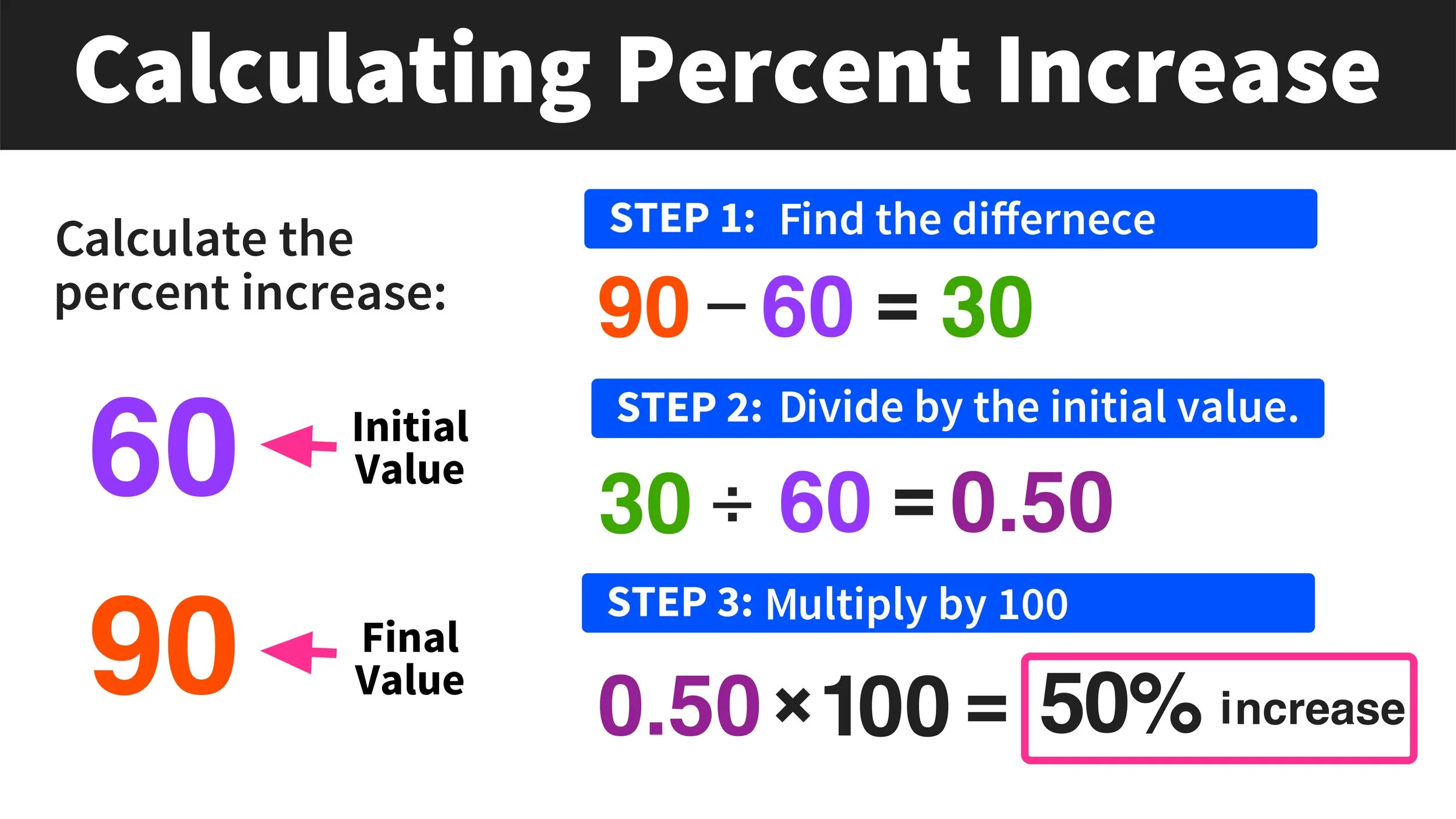
The universal formula for calculating the percent of increase is as follows:
$$ text{Percent of Increase} = frac{text{(New Value – Original Value)}}{text{Original Value}} times 100 $$
Let’s break down each part of this formula to understand its role.
Breaking Down the Components
- New Value: This is the current, later, or end value you are observing. It represents the point after the increase has occurred.
- Original Value: This is the starting, earlier, or initial value before any increase happened. This is your baseline for comparison.
- The Difference (New Value – Original Value): The first step in the calculation is to find the absolute amount of the increase. Subtracting the original value from the new value yields the raw numeric growth.
- Dividing by Original Value: This step is critical. By dividing the absolute increase by the original value, you are expressing the increase as a fraction or ratio relative to its starting point. This normalizes the growth, making it comparable regardless of the scale of the numbers.
- Multiplying by 100: The final step converts this fraction or decimal into a percentage, making it easily understandable and interpretable.
Practical Example Walkthrough (Personal Finance)
Let’s apply this formula to common personal finance scenarios.
Example 1: Investment Portfolio Growth
Imagine your investment portfolio was valued at $50,000 at the beginning of the year (Original Value) and grew to $57,500 by the end of the year (New Value).
- Find the Difference: $57,500 – $50,000 = $7,500
- Divide by Original Value: $7,500 / $50,000 = 0.15
- Multiply by 100: 0.15 * 100 = 15%
Your investment portfolio experienced a 15% increase.
Example 2: Salary Increase
Suppose your annual salary was $60,000 last year (Original Value) and increased to $63,000 this year (New Value).
- Find the Difference: $63,000 – $60,000 = $3,000
- Divide by Original Value: $3,000 / $60,000 = 0.05
- Multiply by 100: 0.05 * 100 = 5%
You received a 5% salary increase.
Practical Example Walkthrough (Business Finance)
The same formula applies robustly to business contexts.
Example 1: Revenue Growth
A small business generated $250,000 in revenue last quarter (Original Value) and $300,000 this quarter (New Value).
- Find the Difference: $300,000 – $250,000 = $50,000
- Divide by Original Value: $50,000 / $250,000 = 0.20
- Multiply by 100: 0.20 * 100 = 20%
The business saw a 20% increase in revenue.
Example 2: Profit Increase
A company’s net profit was $1.2 million in the previous fiscal year (Original Value) and grew to $1.5 million in the current fiscal year (New Value).
- Find the Difference: $1,500,000 – $1,200,000 = $300,000
- Divide by Original Value: $300,000 / $1,200,000 = 0.25
- Multiply by 100: 0.25 * 100 = 25%
The company’s net profit increased by 25%.
These examples illustrate the versatility of the percent of increase calculation across various financial scenarios, making it an indispensable tool for anyone analyzing growth.
Applications Across Personal and Business Finance
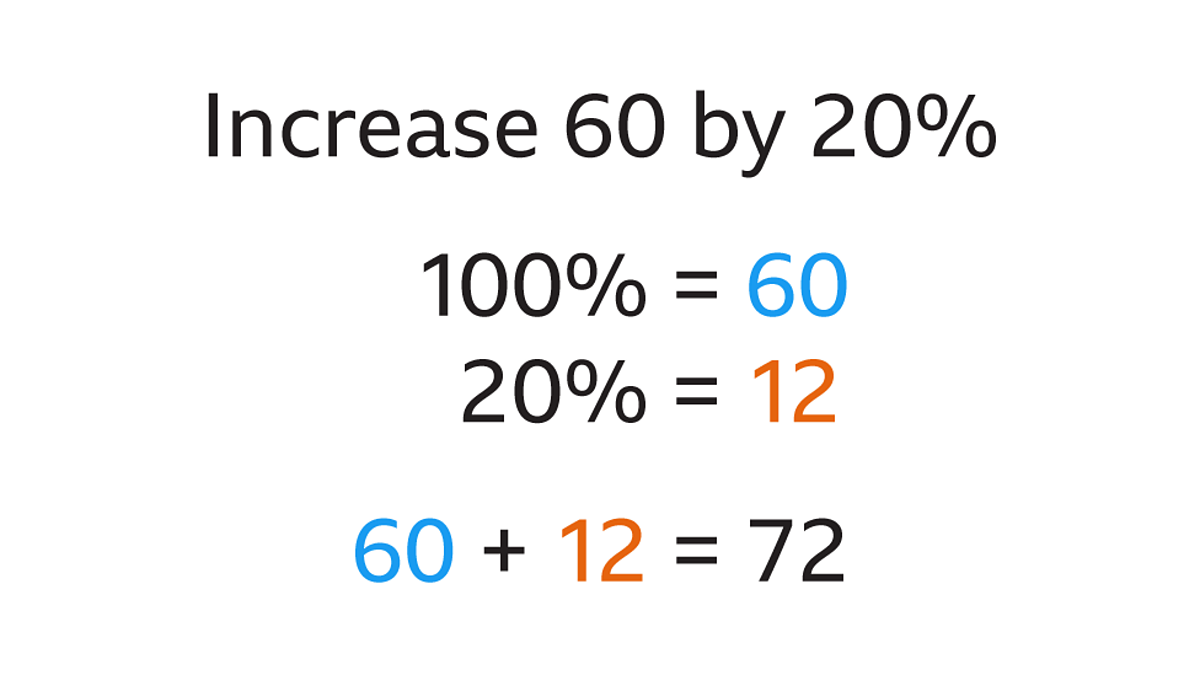
The percent of increase isn’t just a theoretical concept; it’s a practical tool with wide-ranging applications in both personal and business finance, providing clarity and context to financial data.
Personal Finance & Investing
For individuals, mastering the percent of increase is key to managing and growing personal wealth.
- Tracking Investment Returns: This is perhaps one of the most common applications. Whether you’re invested in stocks, mutual funds, bonds, or real estate, calculating the percentage increase allows you to objectively measure your investment’s performance over various periods. It helps you compare different investment vehicles and assess if your portfolio is meeting your financial goals. For example, knowing your stock grew by 15% tells you more than just knowing it went up by $10.
- Analyzing Budget Changes: As living costs fluctuate, so too do budgets. You can use this metric to track the increase in specific expenses (e.g., utility bills, groceries, housing costs) year-over-year. This insight can help you identify areas where spending is rising rapidly and adjust your budget accordingly.
- Evaluating Salary Negotiations or Pay Raises: When you receive a raise offer, understanding the percentage increase allows you to compare it against inflation rates, industry averages, and your own expectations. A 3% raise might sound good, but if inflation is 5%, your real purchasing power has actually decreased.
- Monitoring Personal Net Worth Growth: Your net worth (assets minus liabilities) is a crucial indicator of your financial health. Tracking its percentage increase over time gives you a holistic view of your wealth accumulation strategy and its effectiveness.
Business Finance & Operations
In the business world, the percent of increase is an analytical workhorse, informing strategic decisions and performance reviews across nearly every department.
- Measuring Sales Revenue Growth: This is a fundamental metric for any business. Companies routinely calculate the percentage increase in sales revenue quarter-over-quarter or year-over-year to gauge market penetration, product success, and overall financial health. Consistent growth indicates a thriving business, while stagnant or declining percentages signal potential issues.
- Assessing Profit Margin Improvements: Beyond just revenue, businesses need to track the percentage increase in their net profit or gross profit margins. An increasing profit margin percentage indicates greater efficiency in managing costs relative to revenue, a vital sign of operational excellence.
- Tracking Market Share Expansion: Businesses often compare their sales growth percentage to the overall market growth percentage to determine if they are gaining market share. If your revenue increases by 10% but the market grew by 15%, you’ve effectively lost market share.
- Analyzing Operational Cost Increases: Just as with personal budgets, businesses must monitor the percentage increase in various operational costs (e.g., raw materials, labor, marketing spend). Uncontrolled cost increases can erode profitability, even with robust revenue growth.
- Evaluating Marketing Campaign Effectiveness: Marketers use percent of increase to quantify the success of campaigns, such as the percentage increase in website traffic, lead generation, conversion rates, or customer engagement following a specific initiative.
- Forecasting Future Performance: By analyzing historical percentage increases in key financial metrics, businesses can develop more accurate financial models and forecasts, aiding in budgeting, strategic planning, and investor relations.
The versatility of the percent of increase makes it a universal language for discussing growth and change, providing a standardized basis for comparison and analysis across diverse financial contexts.
Common Pitfalls and Considerations When Interpreting Percent of Increase
While incredibly useful, the percent of increase can sometimes be misleading if not interpreted with a critical eye. To avoid drawing incorrect conclusions, it’s vital to consider several nuances.
The Base Value Matters
One of the most significant factors influencing the perceived impact of a percentage increase is the original (or base) value. A small absolute increase can translate into a massive percentage increase if the original value was tiny.
- Example: A stock that goes from $1 to $2 has a 100% increase. While numerically impressive, it’s only a $1 gain. In contrast, a stock moving from $100 to $105 is only a 5% increase, but it represents a $5 gain. The “wow” factor of 100% can be deceptive without understanding the starting point. This is particularly important when evaluating new ventures or small starting capital investments, where initial percentage gains can be astronomically high but represent minimal absolute value.
Context is King
Numbers alone rarely tell the whole story. Understanding the “why” behind an increase is just as important as knowing “how much.”
- Example: A business reports a 50% increase in revenue. On the surface, this sounds fantastic. However, if this increase was due to a one-time large contract that won’t be repeated, or a significant price hike that alienated customers, the underlying health of the business might not be as robust as the percentage suggests. Conversely, a seemingly modest increase might be highly impressive if achieved during a severe economic downturn. Always inquire about the qualitative factors influencing the numbers: market conditions, industry trends, competitive landscape, and internal strategies.
Beware of Absolute vs. Relative Growth
It’s crucial to distinguish between the absolute dollar amount of growth and its percentage representation. Both provide different, yet equally important, perspectives.
- Example: An investment growing by 10% (relative) from $10,000 to $11,000 yields an absolute gain of $1,000. Another investment growing by 5% (relative) from $1,000,000 to $1,050,000 yields an absolute gain of $50,000. While the first had a higher percentage increase, the second generated a far greater absolute return. Depending on your financial goals (e.g., maximizing capital gain vs. achieving high growth rate), one might be more relevant than the other.
The Impact of Inflation
For long-term financial analysis, especially in personal finance and investing, it’s crucial to consider the effect of inflation. A nominal increase might look good, but if it doesn’t outpace inflation, your real purchasing power has diminished.
- Example: If your salary increased by 3% this year, but the inflation rate was 4%, your real salary (what you can actually buy) effectively decreased by 1%. To get a true picture of growth, particularly over extended periods, adjust for inflation by calculating the “real rate of return” or “real growth.” This often involves subtracting the inflation rate from the nominal percentage increase.
By being mindful of these considerations, you can move beyond simple calculations to gain a deeper, more nuanced understanding of financial data, leading to more sound and strategic decisions.
Leveraging Financial Tools for Seamless Calculation
While the formula for percent of increase is simple enough for manual calculation, modern financial tools can make the process faster, more accurate, and more integrated with your overall financial management.
Spreadsheets (Excel, Google Sheets)
Spreadsheets are arguably the most ubiquitous and powerful tools for financial calculations, offering flexibility and scalability.
- Simple Formulas: You can easily set up a spreadsheet to calculate percent of increase. If your “Original Value” is in cell A2 and “New Value” is in cell B2, the formula to calculate the percent of increase would be
=(B2-A2)/A2*100. You can then drag this formula down a column to apply it to dozens or hundreds of data points instantly. - Data Visualization: Beyond just calculation, spreadsheets allow you to turn your percentage increases into compelling charts and graphs (e.g., line graphs for growth over time, bar charts for comparing different growth rates). Visualizing data can reveal trends and patterns that might not be obvious in raw numbers.
- Automation: For recurring reports, you can set up templates that automatically update calculations as you input new data, saving significant time and reducing the risk of manual errors.
Financial Calculators & Software
For those who prefer dedicated tools or need more advanced features, various financial calculators and software options are available.
- Specific Apps or Online Tools: Many websites and mobile apps offer quick percentage change calculators. These are great for one-off calculations without needing to open a spreadsheet. Simply input your original and new values, and the tool provides the percentage increase.
- Integration with Accounting Software: For businesses, modern accounting software (like QuickBooks, Xero, or SAP) often includes built-in reporting features that can automatically calculate and display percentage increases for key financial metrics such (e.g., revenue growth, expense increases) without any manual formula input. This integration streamlines financial analysis and provides real-time insights.
- Investment Tracking Platforms: Platforms like Mint, Personal Capital, or brokerage dashboards frequently display the percentage increase or decrease of your portfolio, individual holdings, and even spending categories over selected timeframes. These tools automate the calculation, allowing you to focus on analysis rather than arithmetic.
Regardless of your preferred method, leveraging these tools ensures accuracy, saves time, and enhances your ability to visualize and interpret financial growth, thereby supporting more strategic financial management.

Conclusion
The ability to accurately calculate and critically interpret the percent of increase is far more than a basic mathematical skill; it is a fundamental pillar of financial literacy. From the individual managing a personal budget and investment portfolio to the seasoned business leader steering a multi-million-dollar enterprise, understanding how to quantify growth provides clarity, context, and confidence in decision-making.
By grasping the straightforward formula – (New Value - Original Value) / Original Value * 100 – and applying it consistently, you unlock a powerful analytical lens. This metric empowers you to track investment performance, evaluate salary raises, monitor business revenue growth, assess profit margin improvements, and much more. It transforms raw numbers into meaningful insights, enabling apples-to-apples comparisons across vastly different scales and timeframes.
However, true financial acumen extends beyond mere calculation. It requires a nuanced understanding of the pitfalls: the deceptive influence of small base values, the critical importance of underlying context, the distinction between absolute and relative growth, and the silent erosion of inflation. By considering these factors, you ensure that your interpretation of percentage increases leads to genuinely informed and strategic financial choices.
In an increasingly data-driven world, the tools available, from simple spreadsheets to sophisticated financial software, further streamline this essential analysis. Embrace the power of the percent of increase, integrate it into your regular financial reviews, and empower yourself with the knowledge to navigate the landscape of financial growth with greater precision and insight. Your financial journey, whether personal or professional, will be significantly more transparent and strategic for it.
aViewFromTheCave is a participant in the Amazon Services LLC Associates Program, an affiliate advertising program designed to provide a means for sites to earn advertising fees by advertising and linking to Amazon.com. Amazon, the Amazon logo, AmazonSupply, and the AmazonSupply logo are trademarks of Amazon.com, Inc. or its affiliates. As an Amazon Associate we earn affiliate commissions from qualifying purchases.