
In the world of finance, understanding growth is paramount. Whether you’re tracking your investments, analyzing salary raises, scrutinizing business profits, or simply trying to comprehend economic news, the concept of “increase in percentage” is an indispensable tool. It allows us to quantify change in a standardized, easily comparable manner, transforming raw numbers into meaningful insights. While the calculation itself might seem daunting to some, financial calculators – both physical and digital – serve as powerful allies, simplifying the process and empowering individuals and businesses alike to make more informed decisions. This guide will demystify the percentage increase calculation, explain its financial significance, and show you how to leverage financial tools to master it.
Understanding the Essence of Percentage Increase in Finance
At its core, a percentage increase measures the relative growth between two values. Instead of just stating that something went up by X dollars or units, a percentage increase tells you what proportion of the original value that increase represents. This relative measure is incredibly powerful because it normalizes changes, making them comparable across different scales and timeframes.
Why Percentages Matter for Your Money
Imagine your investment portfolio growing by $1,000. Is that good? It depends. If your portfolio started at $10,000, a $1,000 increase is a fantastic 10% gain. If it started at $100,000, the same $1,000 increase is a more modest 1% gain. The raw dollar amount alone doesn’t tell the full story; the percentage does. This relative understanding is crucial for:
- Performance Evaluation: Comparing the returns of different investments, even if they started with varying principal amounts.
- Budgeting and Forecasting: Understanding how much your expenses or income have truly changed over time.
- Economic Analysis: Interpreting inflation rates, GDP growth, or unemployment changes reported in economic data.
- Goal Setting: Setting realistic financial goals, whether it’s for retirement savings or debt reduction, by understanding compound growth and target percentage returns.
Without percentage calculations, financial data remains fragmented and challenging to interpret accurately, leading to potentially misguided financial strategies.
Key Financial Scenarios Where Percentage Increase is Crucial
Percentage increase isn’t just an academic concept; it’s woven into the fabric of everyday financial life. Here are a few common scenarios where mastering this calculation is vital:
- Investment Returns: Calculating the annual percentage yield (APY) on a savings account, the capital gains on a stock, or the overall return on an investment portfolio.
- Salary and Wage Growth: Determining the actual percentage raise you received, which is essential for negotiating future compensation and assessing your purchasing power.
- Business Performance: Monitoring revenue growth, profit margin expansion, or customer acquisition rates. Businesses rely heavily on percentage changes to track success and identify areas for improvement.
- Inflation Impact: Understanding how much the cost of living has increased over a period, directly affecting your purchasing power and the real value of your savings.
- Loan Interest Rates: While often expressed as an annual percentage rate (APR), understanding how percentage increases apply to your principal balance over time helps demystify loan repayments and total interest paid.
In each of these situations, knowing how to quickly and accurately calculate a percentage increase provides clarity and control over your financial narrative.
Deconstructing the Percentage Increase Formula
Before diving into how calculators streamline the process, it’s beneficial to understand the underlying mathematical principle. This foundational knowledge ensures you can interpret calculator results correctly and even perform manual checks when necessary.
The Basic Mathematical Foundation
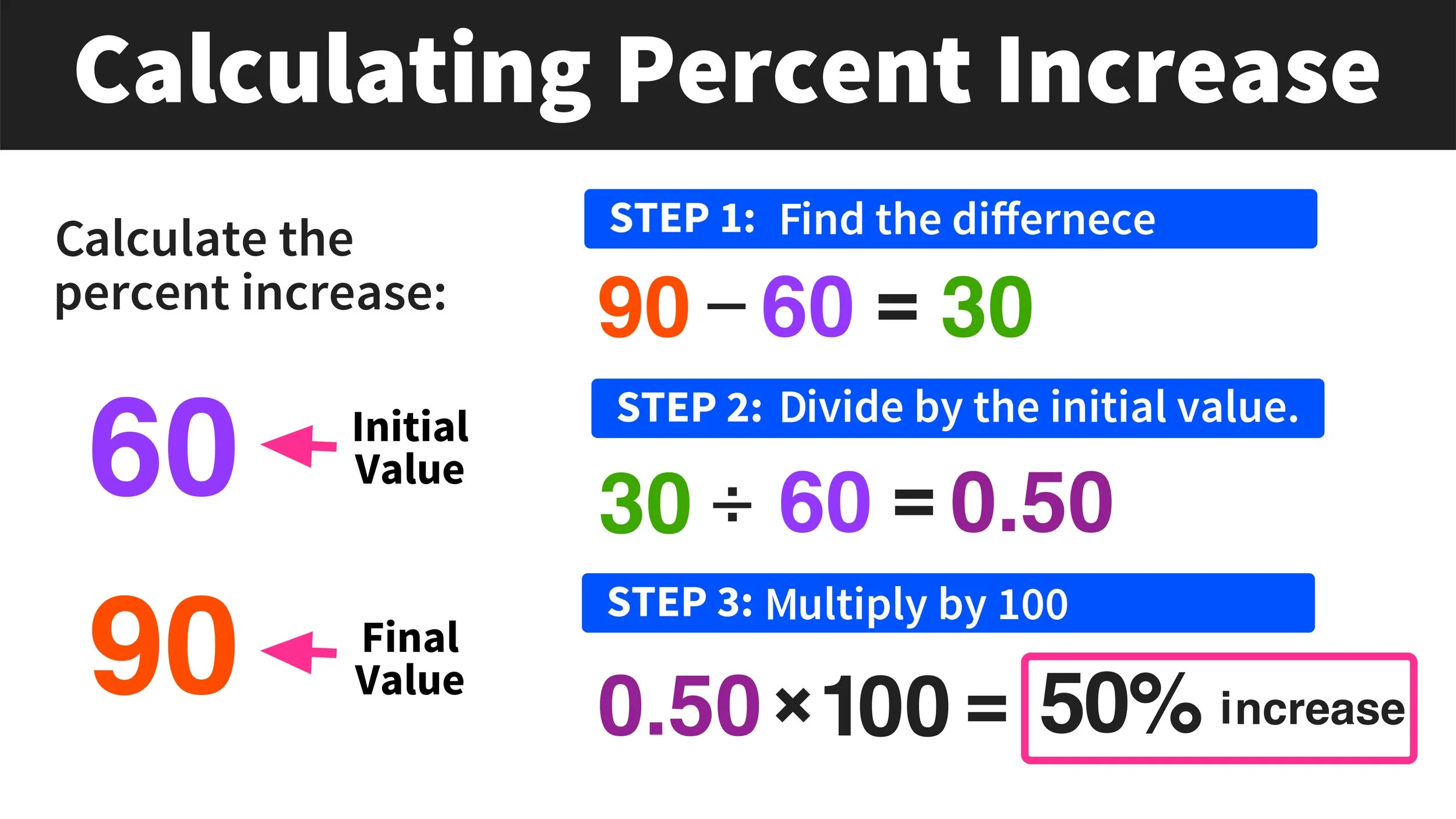
The formula for calculating percentage increase is straightforward:
Percentage Increase = ((New Value – Original Value) / Original Value) * 100
Let’s break down each component:
- New Value: This is the larger, final amount after the increase.
- Original Value: This is the smaller, starting amount before the increase.
- Difference (New Value – Original Value): This gives you the raw amount of the increase.
- Division by Original Value: This step converts the raw increase into a decimal representation of the increase relative to the starting point.
- Multiplication by 100: This final step converts the decimal into a percentage.
Step-by-Step Calculation Without a Calculator (The Manual Way)
Let’s walk through an example to solidify this understanding. Suppose your investment portfolio grew from $50,000 to $55,000.
-
Identify the Original and New Values:
- Original Value = $50,000
- New Value = $55,000
-
Calculate the Difference (the absolute increase):
- $55,000 – $50,000 = $5,000
-
Divide the Difference by the Original Value:
- $5,000 / $50,000 = 0.10
-
Multiply by 100 to convert to a percentage:
- 0.10 * 100 = 10%
So, your investment portfolio increased by 10%. While feasible for simple numbers, this manual process can become tedious and error-prone with larger, more complex figures, highlighting the necessity of financial tools.
Leveraging Financial Calculators for Accuracy and Efficiency
This is where the “calculator” part of our discussion truly comes into play. Financial calculators, whether dedicated devices or integrated into software, are designed to perform these computations swiftly and accurately, freeing you to focus on analysis rather than arithmetic.
Types of Calculators: From Basic to Specialized Financial Tools
The term “calculator” encompasses a broad spectrum of tools:
- Basic Scientific/Arithmetic Calculators: Many standard calculators have a percentage key (often “%”) that can perform simple percentage operations (e.g., adding a percentage for sales tax). However, they might require multiple steps for percentage increase/decrease specifically.
- Online Percentage Calculators: A plethora of free websites and apps offer dedicated percentage increase/decrease calculators. You simply input the original and new values, and it instantly provides the percentage change. These are incredibly convenient for quick, one-off calculations.
- Spreadsheet Software (Excel, Google Sheets): These are powerful financial tools. You can set up custom formulas to calculate percentage increases for entire columns of data, making them ideal for managing large datasets like investment portfolios or business financial statements. For example, if cell A1 has the original value and B1 has the new value, the formula would be
=(B1-A1)/A1. You would then format the result as a percentage. - Dedicated Financial Calculators (e.g., HP 12c, Texas Instruments BA II Plus): These advanced calculators are designed specifically for complex financial calculations, including compound interest, present/future value, annuities, and often have dedicated functions or simplified inputs for percentage changes, making them invaluable for financial professionals.
The best calculator depends on your specific needs and the complexity of the financial analysis required. For most personal finance needs, an online calculator or a simple spreadsheet setup is more than sufficient.
Practical Guide: Using a Digital Calculator for Percentage Increase
Let’s use a common scenario with an online percentage calculator or spreadsheet. Suppose your monthly income went from $3,500 to $3,850.
- Open your chosen digital calculator or spreadsheet.
- Locate the input fields for “Original Value” and “New Value.”
- Enter the Original Value: Type in
3500. - Enter the New Value: Type in
3850. - Trigger the calculation: If it’s an online tool, it might calculate automatically or have a “Calculate” button. In a spreadsheet, the formula
=(B1-A1)/A1(assuming 3500 is in A1 and 3850 in B1) will provide the decimal, which you then format as a percentage. - Interpret the Result: The calculator will display the percentage increase. In this case, it should be 10%.
The beauty of digital financial tools lies in their immediate feedback and reduced potential for manual calculation errors.
Common Pitfalls and How to Avoid Them
Even with calculators, mistakes can happen. Awareness is key:
- Swapping Original and New Values: Entering the larger value as the “original” will result in a negative percentage (a decrease) or an incorrect positive one. Always ensure you input the initial value first.
- Incorrectly Handling Decreases: While this article focuses on increase, if the new value is less than the original, the calculator will show a negative percentage, indicating a decrease. Understand the difference.
- Rounding Errors: Be mindful of how many decimal places your calculator or spreadsheet is showing. While usually negligible for general purposes, precise financial analysis might require higher precision.
- Confusing Percentage Point Change with Percentage Change: If an interest rate goes from 2% to 3%, that’s a 1 percentage point increase. However, the percentage increase in the rate itself is ((3-2)/2)*100 = 50%. This distinction is critical in finance.
By understanding the formula and being attentive to inputs, you can avoid these common pitfalls and ensure your percentage increase calculations are always accurate.
Real-World Applications: From Personal Finance to Business Growth
The ability to calculate percentage increase isn’t just a numerical skill; it’s a powerful lens through which to view and evaluate financial health and progress.
Tracking Investment Growth and Portfolio Performance
For investors, percentage increase is the lingua franca of returns. Whether you’re assessing a mutual fund’s year-over-year performance, the gains on a specific stock, or the overall growth of your retirement savings, calculating the percentage increase reveals the true efficacy of your investment choices. A 7% annual return might sound modest, but understanding that this can compound significantly over decades for retirement planning paints a much clearer picture of wealth accumulation.
Analyzing Income Growth and Cost of Living Adjustments
Understanding your income growth in percentage terms helps you evaluate salary increases against inflation. If you get a 3% raise but inflation is 4%, your real purchasing power has actually decreased by 1%. This insight is vital for budgeting, financial planning, and advocating for fair compensation. Similarly, tracking the percentage increase in your living expenses (housing, groceries, utilities) allows you to make adjustments to your budget and maintain financial stability.
Measuring Business Revenue and Profitability Changes
For business owners and analysts, percentage increase is indispensable for key performance indicators (KPIs). Comparing current quarter revenue to the previous quarter or year-over-year reveals growth trends. Tracking profit margin percentage increases indicates operational efficiency improvements. These percentage metrics guide strategic decisions, marketing efforts, and resource allocation, ensuring the business is on a sustainable growth trajectory.
Beyond Basic Calculations: Interpreting the Numbers
Knowing how to calculate percentage increase is just the first step. The real value comes from interpreting these numbers in context and using them to make astute financial decisions.
The Impact of Inflation and Compounding
When evaluating percentage increases, especially over longer periods, it’s crucial to consider external factors like inflation. A nominal percentage increase in your savings might look good, but if inflation erodes purchasing power at a higher rate, your real increase is less. Conversely, understanding the power of compounding—where your investment gains also start earning returns—is best grasped through percentage growth over time. Even small percentage increases, consistently applied, can lead to substantial wealth creation due to compounding.

Making Informed Financial Decisions
Ultimately, the goal of calculating percentage increase is to empower better financial decision-making. Should you switch investment funds? Is a particular business venture showing promising growth? Is your salary keeping pace with the economy? These questions, and many more, find their answers in the clear, comparable data provided by percentage increase calculations. By mastering this fundamental financial tool, you gain a deeper understanding of the dynamics of your money, enabling you to navigate the financial landscape with greater confidence and strategic foresight.
aViewFromTheCave is a participant in the Amazon Services LLC Associates Program, an affiliate advertising program designed to provide a means for sites to earn advertising fees by advertising and linking to Amazon.com. Amazon, the Amazon logo, AmazonSupply, and the AmazonSupply logo are trademarks of Amazon.com, Inc. or its affiliates. As an Amazon Associate we earn affiliate commissions from qualifying purchases.