
In the realm of personal and business finance, percentages are the universal language of measurement. Whether you are evaluating the performance of a stock portfolio, determining the impact of an interest rate on a mortgage, or simply calculating a sales tax on a commercial purchase, the ability to figure a percentage accurately is an indispensable skill. While basic arithmetic might seem elementary, the application of these calculations within financial contexts requires a nuanced understanding of how numbers translate into real-world economic value.
Understanding percentages allows you to strip away the noise of raw numbers and see the underlying trends. A $1,000 gain on an investment means very little without knowing the initial capital; however, knowing that the investment yielded a 10% return provides immediate clarity and a basis for comparison. This guide explores the fundamental mechanics of percentage calculations and applies them to the most critical sectors of your financial life, from budgeting and debt management to high-level investment analysis.

The Fundamental Mechanics of Percentages in Finance
At its core, a percentage is a way of expressing a number as a fraction of 100. The word “percent” literally stems from the Latin per centum, meaning “by the hundred.” In the financial world, this allows for a standardized comparison across different scales of economy.
Understanding the Basic Formula
To figure a percentage, you must identify two key components: the “part” and the “whole.” The standard formula is:
Percentage = (Part / Whole) × 100
For example, if you are looking to calculate what percentage of your $5,000 monthly income is spent on a $1,500 rent payment, you would divide 1,500 by 5,000 to get 0.3. Multiplying by 100 gives you 30%. In professional finance, this basic formula is the building block for more complex metrics like debt-to-income ratios and gross profit margins.
Converting Decimals to Percentages for Faster Budgeting
Financial professionals rarely use the “multiplied by 100” step in their heads. Instead, they rely on the “two-place shift.” Since a percentage is based on hundredths, any decimal can be converted to a percentage by moving the decimal point two places to the right.
This is particularly useful when dealing with interest rates or tax brackets. If a high-yield savings account offers an interest rate of 0.045, shifting the decimal twice tells you immediately that the rate is 4.5%. Mastering this mental shortcut allows for quicker decision-making during negotiations or while scanning financial statements.
Applying Percentages to Personal Finance and Savings
Personal finance is essentially an exercise in percentage management. How you allocate your income and how you account for the growth of your savings depends entirely on your ability to manipulate these ratios.
The 50/30/20 Rule of Budgeting
One of the most effective ways to manage personal wealth is through the 50/30/20 rule. This framework uses percentages to dictate cash flow:
- 50% to Needs: Housing, utilities, groceries, and insurance.
- 30% to Wants: Dining out, travel, and hobbies.
- 20% to Savings and Debt Repayment: Building an emergency fund or paying down principal on loans.
To apply this, you must first calculate your “net” or after-tax income. If your take-home pay is $6,000, you figure your “Needs” limit by multiplying 6,000 by 0.50 ($3,000). By using percentages rather than fixed dollar amounts, your budget becomes scalable; as your income increases, your savings and lifestyle spending grow proportionally.
Calculating Compound Interest and APY
The “magic” of wealth building lies in compound interest, which is the process of earning interest on your interest. To understand the growth of a savings account, you must look at the Annual Percentage Yield (APY). Unlike simple interest, which is calculated only on the principal, APY reflects the total amount of interest you earn in a year, including compounding.
To figure the impact of a percentage-based interest rate over time, we use the compound interest formula: A = P(1 + r/n)^nt. While this looks complex, the “r” (rate) is the most critical variable. Even a 1% difference in your interest rate percentage can result in tens of thousands of dollars in difference over a 30-year period.
Percentages in the World of Investing
In the investing landscape, percentages are the primary metric for risk and reward. Raw dollar amounts are often misleading; percentages provide the necessary context to determine if a strategy is actually working.
Determining Return on Investment (ROI)
The most common question in finance is: “How much did I make?” To answer this accurately, you must calculate the Return on Investment (ROI). The formula is:
ROI = [(Current Value – Original Cost) / Original Cost] × 100
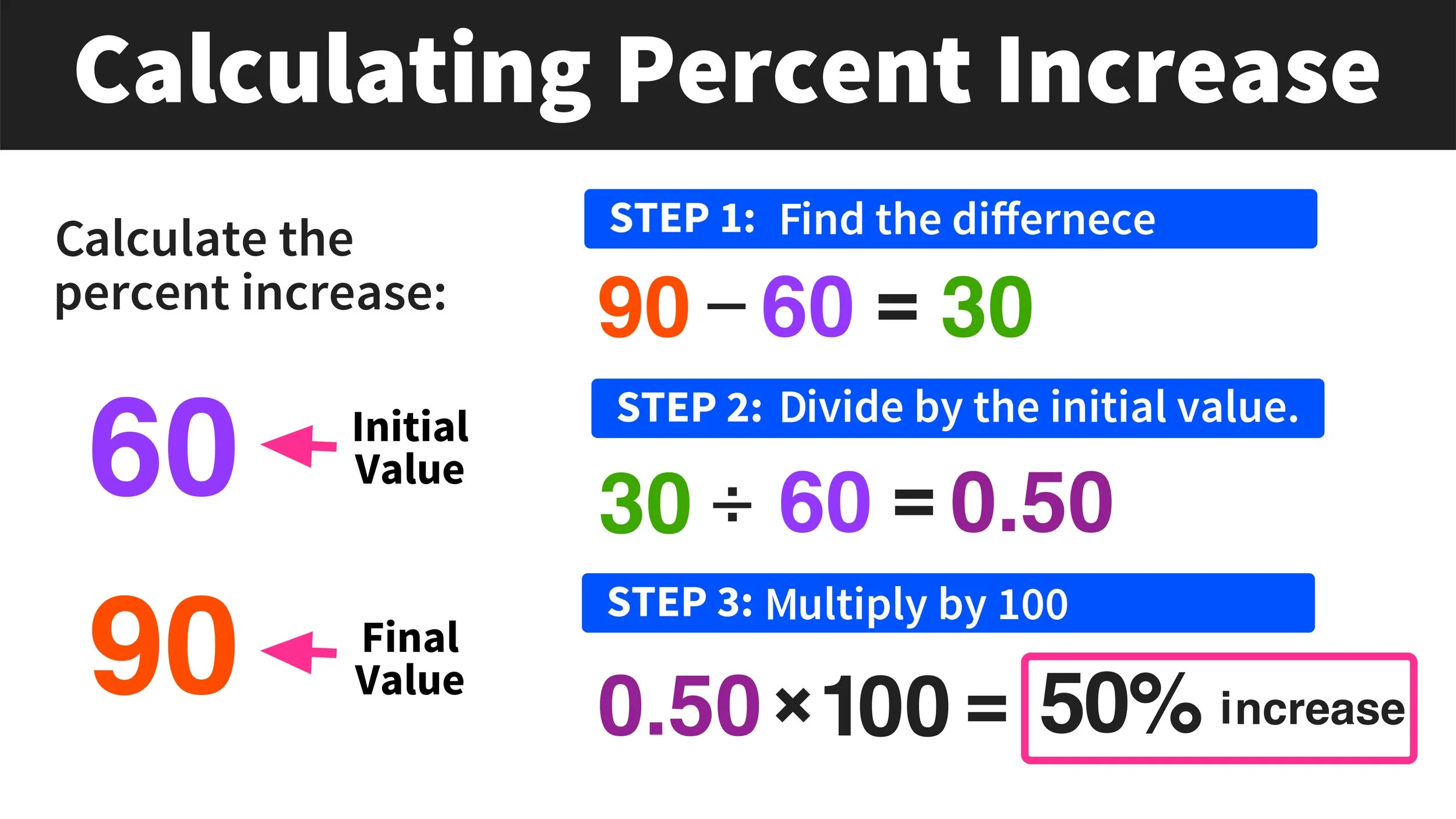
If you bought a stock for $50 and it is now worth $75, your gain is $25. To find the percentage, you divide $25 by the original $50 to get 0.50, or a 50% ROI. This calculation allows you to compare the performance of a high-priced stock with a lower-priced one on an equal playing field.
Calculating Dividend Yields
For income-focused investors, the dividend yield is a vital percentage. It represents how much a company pays out in dividends each year relative to its stock price.
Dividend Yield = (Annual Dividends per Share / Price per Share) × 100
If a company pays $2.00 in annual dividends and the stock trades at $40, the yield is 5%. This percentage helps investors decide whether the income generated by the stock is competitive with other assets, like bonds or real estate.
Portfolio Allocation and Rebalancing
Professional wealth management relies on “Asset Allocation,” which is the percentage of your total portfolio dedicated to different asset classes (e.g., 60% stocks, 40% bonds). Over time, as stocks grow faster than bonds, your portfolio might shift to 70% stocks and 30% bonds. To “rebalance,” you must calculate the percentage deviation from your target and sell or buy assets to return to your original percentage-based strategy. This disciplined approach minimizes risk and is impossible without a firm grasp of percentage-based math.
Navigating Taxes and Debt Using Percentages
Taxes and debt are the two largest “leaks” in any financial plan. Understanding the percentages behind them can save you thousands of dollars over a lifetime.
Understanding Marginal Tax Rates vs. Effective Tax Rates
Many people are confused by tax brackets, fearing that a raise will “put them into a higher bracket” and result in less take-home pay. This is a misunderstanding of marginal percentages. In a progressive tax system, only the income within a specific range is taxed at that bracket’s percentage.
Your Effective Tax Rate is the actual percentage of your total income that goes to the government.
Effective Tax Rate = (Total Tax Paid / Total Taxable Income) × 100
This percentage is almost always lower than your top marginal bracket, and it is the most important number to use when forecasting your long-term financial health.
How APR Affects Your Debt Repayment Strategy
When you carry a balance on a credit card or take out a car loan, the cost of that debt is expressed as an Annual Percentage Rate (APR). Figuring the monthly cost of this percentage is key to debt elimination. To find your monthly interest charge, you divide the APR by 12. For a credit card with a 24% APR, you are paying 2% in interest every month on your average daily balance. By understanding this percentage, you can see why “minimum payments” often barely touch the principal, as the interest percentage consumes the majority of the payment.
Advanced Business Finance: Growth and Margin Analysis
For entrepreneurs and business leaders, percentages are the vital signs of a company. They indicate whether a business is lean, profitable, or in danger of insolvency.
Calculating Profit Margins (Gross vs. Net)
Profit margin is a percentage that expresses how much of every dollar in sales a company keeps as profit.
- Gross Profit Margin: This figures the percentage of revenue exceeding the Cost of Goods Sold (COGS). It shows how efficiently a company produces its products.
- Net Profit Margin: This is the “bottom line” percentage. It subtracts all operating expenses, interest, and taxes from revenue.
A company might have a high gross margin (e.g., 70% for software) but a low net margin (e.g., 5%) if its marketing and administrative costs are too high. Monitoring these percentages allows business owners to identify exactly where their capital is being depleted.
Year-over-Year (YoY) Growth Calculations
To measure the health of a business or the economy at large, we use Year-over-Year (YoY) growth percentages. This compares a financial metric from one period to the same period in the previous year.
YoY Growth = [(Current Period Value – Previous Period Value) / Previous Period Value] × 100
If a business earned $1 million in Q1 of last year and $1.2 million in Q1 of this year, it has experienced 20% YoY growth. This percentage is far more descriptive than the $200,000 increase alone, as it provides a standardized rate of expansion that can be compared against competitors or industry benchmarks.

Conclusion
Figuring a percentage is more than a simple math problem; it is a fundamental tool for financial literacy and wealth accumulation. By mastering these calculations, you move from a passive observer of your finances to an active strategist. Whether you are optimizing your monthly budget, evaluating a complex investment, or managing a corporate balance sheet, the ability to think in percentages provides the clarity needed to make informed, professional financial decisions. In a world of fluctuating markets and complex tax codes, the percentage remains the most reliable constant for measuring progress and ensuring long-term fiscal stability.
aViewFromTheCave is a participant in the Amazon Services LLC Associates Program, an affiliate advertising program designed to provide a means for sites to earn advertising fees by advertising and linking to Amazon.com. Amazon, the Amazon logo, AmazonSupply, and the AmazonSupply logo are trademarks of Amazon.com, Inc. or its affiliates. As an Amazon Associate we earn affiliate commissions from qualifying purchases.