
Embarking on any entrepreneurial journey, whether launching a startup, expanding an existing venture, or even formalizing a side hustle, requires a robust blueprint for success. This blueprint is universally known as a business plan. Far from being a mere formality, a comprehensive business plan serves as the strategic bedrock for financial viability, operational efficiency, and long-term growth. It’s the definitive document that articulates your vision, outlines your strategy, and, most critically, details the financial projections and funding requirements that will steer your enterprise. For anyone serious about generating income, securing investment, or simply understanding the monetary pulse of their business, mastering the art of the business plan is not just advisable—it’s absolutely essential.

The Indispensable Role of a Business Plan in Financial Success
A business plan is much more than a collection of ideas; it’s a meticulously structured document that maps out the financial journey of your enterprise. Its primary function is to provide clarity and direction, ensuring every decision aligns with your overarching financial objectives. Without this foundational document, businesses often drift, make impulsive financial choices, and struggle to attract the capital necessary for sustained growth.
Beyond a Document: A Financial Roadmap
Think of your business plan as a sophisticated financial roadmap. It compels you to scrutinize every aspect of your proposed venture through a monetary lens, from initial startup costs to projected revenue streams, operational expenses, and potential profitability. This granular analysis forces a realistic assessment of market opportunities, identifies potential financial pitfalls, and outlines strategies for mitigating risks. It’s an exercise in foresight that transforms vague aspirations into quantifiable financial targets and actionable steps. This planning phase is crucial for establishing realistic budgets, managing cash flow effectively, and making data-driven decisions that safeguard your financial health from day one.
Attracting Capital: Speaking the Investor’s Language
For many burgeoning businesses, securing external funding is paramount. Whether you’re approaching angel investors, venture capitalists, traditional banks, or even applying for government grants, your business plan is your most potent advocacy tool. Investors and lenders are inherently risk-averse; they need to be convinced not only of your idea’s potential but also of its financial viability and your capacity to deliver a substantial return on investment (ROI).
A well-articulated business plan, particularly its financial sections, demonstrates your understanding of market dynamics, competitive landscape, and, most importantly, how your business will generate profit. It details your revenue model, pricing strategy, projected income statements, cash flow forecasts, and break-even analysis. These financial projections are the language investors speak, providing the hard data they require to assess risk, evaluate potential returns, and ultimately decide whether to commit their capital to your vision. A professional, detailed plan shows you’ve done your homework and are a responsible steward of potential funds.
Operational Efficiency and Budgetary Control
Beyond securing external funds, a business plan is an invaluable internal tool for operational efficiency and stringent budgetary control. It establishes benchmarks for performance, allowing you to compare actual results against planned forecasts. This continuous monitoring is vital for identifying variances early, understanding their root causes, and implementing corrective actions before financial issues escalate.
For instance, if actual sales fall short of projections, or expenses exceed budgeted amounts, the business plan provides a framework for re-evaluating strategies, adjusting budgets, or exploring alternative revenue streams. It ensures that every dollar spent is justified and contributes to the overall financial health of the business. By setting clear financial goals and tracking progress against them, the business plan acts as an accountability mechanism, fostering a culture of financial discipline throughout the organization.
Core Components of a Financially Sound Business Plan
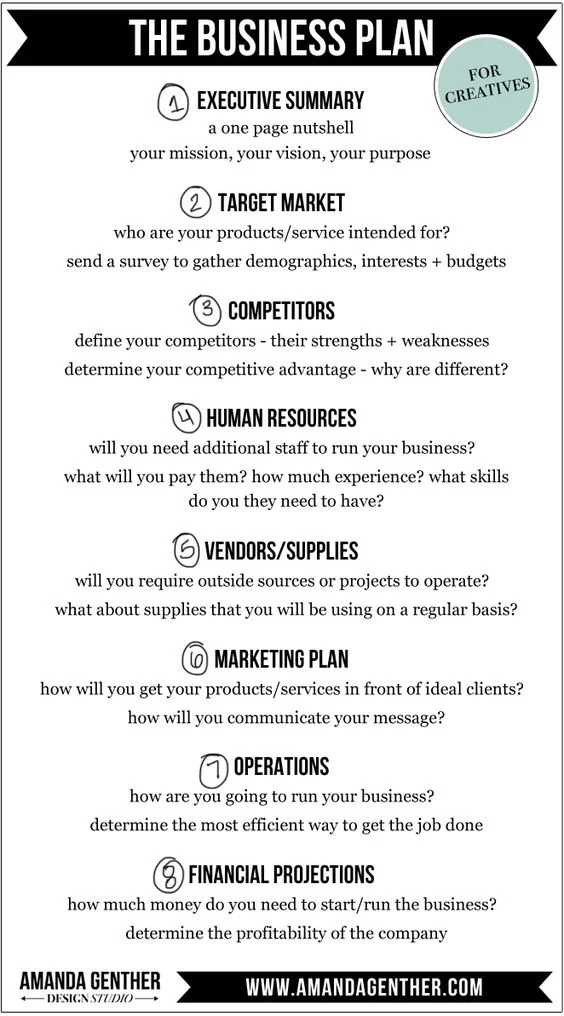
A robust business plan is structured to tell a comprehensive story of your enterprise, with each section contributing to a holistic financial picture. While specific elements may vary, certain core components are universally expected, especially those that underscore financial prudence and potential.
Executive Summary: Your Financial Snapshot
This is arguably the most critical section, often read first (and sometimes exclusively) by busy investors or lenders. It must succinctly capture the essence of your business, its mission, management team, and, crucially, its financial highlights. For funding requests, explicitly state the capital you’re seeking, how it will be utilized, and the projected financial returns for investors. This summary should leave the reader with a clear understanding of your value proposition and the financial opportunity presented.
Company Description: Defining Your Value Proposition
While not strictly financial, this section defines who you are, what problems you solve, and what makes you unique. It sets the stage for understanding your market and how your offering will translate into revenue. A clear value proposition underpins your pricing strategy and ultimately, your profitability.
Market Analysis: Understanding Your Revenue Streams and Competition
This section details your target market, its size, demographics, and growth potential. Critically, it analyzes your competitors, their market share, pricing strategies, and financial strengths/weaknesses. Understanding the market allows you to position your product or service strategically, forecast sales volumes accurately, and justify your pricing model. A thorough market analysis directly influences your revenue projections and helps you anticipate competitive pressures on your profit margins.
Organization and Management: The Team Driving Financial Outcomes
Here, you introduce your leadership team, highlighting their relevant experience, expertise, and roles. For financial stakeholders, it’s crucial to emphasize the financial acumen within your team—who manages the budget, oversees financial reporting, and makes key investment decisions. A strong, experienced team instills confidence in your ability to execute the financial plan.
Service or Product Line: Pricing, Costs, and Profit Margins
Detail what you are selling, its features, and benefits. More importantly, this section must break down the cost of goods sold (COGS) or the cost of delivering your service. Clearly define your pricing strategy (e.g., premium, competitive, cost-plus) and justify how it will lead to healthy profit margins. This demonstrates a deep understanding of your operational expenses and revenue generation.
Marketing and Sales Strategy: Fueling Revenue Growth
This outlines how you will reach your target customers and convert them into sales. It includes your advertising, promotional activities, sales channels, and customer acquisition strategies. Each marketing and sales activity carries a cost, so this section must project the associated expenses and how they align with anticipated sales volumes and revenue targets. It’s about demonstrating a clear path to customer acquisition and the financial returns on your marketing investment.
Funding Request (If Applicable): Detailing Your Financial Needs
If you are seeking capital, this section is pivotal. Clearly state the exact amount of funding required, specifying how these funds will be allocated (e.g., equipment, inventory, marketing, working capital, R&D). Crucially, explain how this investment will enable growth, increase profitability, and ultimately provide a favorable return for investors or ensure timely loan repayment. Include an exit strategy or repayment schedule where applicable.
Financial Projections: The Heart of the Plan
This is arguably the most scrutinized section for any financial stakeholder. It must present a realistic, data-backed forecast of your business’s financial future, typically for the next three to five years.
- Startup Costs: A detailed breakdown of all initial expenses required to launch the business (e.g., legal fees, equipment, initial inventory, permits, rent deposits).
- Sales Forecasts: Projections of revenue based on market research, pricing, and sales strategy. This should be broken down monthly for the first year, then quarterly or annually.
- Income Statements (Profit & Loss): Forecasts showing projected revenues, costs of goods sold, operating expenses, and net profit or loss over a period.
- Cash Flow Statements: Crucial for understanding liquidity, this projects the actual flow of cash into and out of the business, showing how much cash you’ll have on hand at any given time.
- Balance Sheets: A snapshot of your company’s assets, liabilities, and owner’s equity at a specific point in time.
- Break-Even Analysis: Calculation of the sales volume (in units or revenue) required to cover all fixed and variable costs, indicating the point at which your business starts making a profit.
- Sensitivity Analysis: Often included to show “what-if” scenarios, illustrating how changes in key assumptions (e.g., sales volume, pricing, costs) would impact your financial projections. This demonstrates a thorough understanding of risks.
Practical Steps to Develop a Compelling Financial Plan
Creating a robust business plan, especially its financial sections, demands a systematic and rigorous approach. It’s not about making optimistic guesses, but rather constructing a credible and defensible financial narrative.
Research and Data Collection: The Foundation of Accuracy
The integrity of your financial projections hinges entirely on the quality of your underlying data. This means extensive market research to understand customer demand, pricing benchmarks from competitors, and industry-specific financial ratios. Investigate supplier costs, operational expenses (rent, utilities, salaries), and legal/regulatory fees. Talk to industry experts, conduct surveys, and analyze reputable market reports. The more concrete data you can leverage, the more realistic and persuasive your financial forecasts will be. Avoid making assumptions where hard data can be found.
Crafting Realistic Financial Projections
A common pitfall for entrepreneurs is overly optimistic financial projections. While enthusiasm is commendable, investors and lenders value realism and prudence. Start with conservative estimates for revenue and potentially higher estimates for costs. Build in a contingency fund for unexpected expenses. Utilize a “bottom-up” approach where possible, forecasting sales based on detailed assumptions (e.g., average customer spend, conversion rates) rather than broad market share claims. Consider different scenarios—best case, most likely case, and worst case—to demonstrate a comprehensive understanding of potential outcomes and your preparedness for challenges. This approach builds credibility and shows you’ve considered various financial eventualities.
Choosing the Right Financial Tools
While advanced financial modeling can be complex, there are numerous tools to aid in the creation of your financial plan. Basic spreadsheet software (like Microsoft Excel or Google Sheets) is indispensable for building detailed financial models, performing calculations, and creating customizable charts. For more integrated solutions, consider business planning software that offers templates and guides you through the process, ensuring all critical financial components are included. Additionally, familiarizing yourself with basic accounting software can help you understand how financial transactions are recorded and reported, which is invaluable when creating your projections and understanding actual performance. The goal is to use tools that facilitate accuracy, organization, and clear presentation of your financial data.
Seeking Expert Financial Guidance
Even with the best intentions and diligent research, creating complex financial projections can be daunting. Engaging with financial professionals, such as certified public accountants (CPAs), financial advisors, or business consultants, can be immensely beneficial. They can help validate your assumptions, identify potential oversights, ensure compliance with accounting standards, and refine your financial statements. A fresh, expert perspective can transform a good plan into an exceptional one, increasing its credibility with potential investors and lenders. Their insights can save you from costly financial mistakes and strengthen the overall integrity of your business plan.
Maintaining and Adapting Your Business Plan for Continuous Financial Health
The creation of a business plan is not a one-time event. To truly serve its purpose as a financial compass, it must be treated as a living document, subject to regular review and adaptation. The business landscape is dynamic, and your plan needs to evolve alongside it to ensure continuous financial health.
The Living Document Philosophy
Once your business plan is complete and you’ve launched your venture, the work isn’t over. The “living document” philosophy means your business plan should be a dynamic tool that reflects your company’s current reality. Periodically, you should revisit each section, comparing your actual financial performance against your initial projections. This ongoing comparison is crucial for understanding where your business is truly heading financially versus where you intended it to be. It’s an iterative process of planning, executing, measuring, and adjusting.
Monitoring Key Financial Metrics
Your business plan provides the benchmarks against which you will measure your actual financial performance. Regularly monitor key financial metrics such as revenue growth, gross profit margins, operating expenses, customer acquisition costs (CAC), lifetime value (LTV), and cash flow. Are your actual sales hitting targets? Are expenses staying within budget? Is your cash flow positive and stable? By consistently tracking these indicators, you can quickly identify deviations from your plan. Early detection of financial discrepancies allows for prompt investigation and the implementation of corrective strategies, preventing small issues from escalating into significant financial problems.
Adapting to Market Shifts and Financial Realities
The economic environment is constantly shifting. New competitors may emerge, customer preferences can change, input costs might fluctuate, or broader economic downturns can occur. Your business plan must be flexible enough to adapt to these new realities. If market conditions change significantly, your original financial projections may become obsolete. You might need to revise your pricing strategy, explore new revenue streams, or implement cost-cutting measures. Adapting your financial plan demonstrates resilience and strategic foresight, crucial traits for long-term survival and prosperity. It’s about being proactive rather than reactive to financial challenges.

When to Revisit the Financial Plan
Several triggers should prompt a comprehensive review and update of your business plan, particularly its financial components. These include:
- Seeking New Funding: Any time you approach new investors or lenders, your plan must be current and reflect your latest financial performance and future projections.
- Launching New Products or Services: Significant new offerings will impact your revenue streams, costs, and market analysis, necessitating a financial re-evaluation.
- Significant Market Changes: Major shifts in your industry, competitor actions, or economic conditions demand a reassessment of your market analysis and financial forecasts.
- Consistent Underperformance or Overperformance: If your business consistently fails to meet financial targets, or conversely, significantly outperforms them, it’s time to understand why and adjust your plan accordingly.
- Major Strategic Shifts: Any fundamental change in your business model, target audience, or operational structure requires a revised financial blueprint.
In conclusion, crafting a business plan is an invaluable exercise that transcends mere documentation; it’s a disciplined approach to financial foresight and strategic planning. For anyone looking to secure funding, manage their finances prudently, or simply navigate the complex world of business, a well-executed plan is the most powerful tool in their arsenal. By treating it as a dynamic, living document, continuously refining its financial projections and strategies, entrepreneurs can ensure their ventures not only survive but thrive in an ever-evolving marketplace. Start planning today, and pave your way to financial success.
aViewFromTheCave is a participant in the Amazon Services LLC Associates Program, an affiliate advertising program designed to provide a means for sites to earn advertising fees by advertising and linking to Amazon.com. Amazon, the Amazon logo, AmazonSupply, and the AmazonSupply logo are trademarks of Amazon.com, Inc. or its affiliates. As an Amazon Associate we earn affiliate commissions from qualifying purchases.