
Fractions, those foundational yet sometimes intimidating components of mathematics, represent parts of a whole. From baking recipes to financial calculations, understanding and manipulating fractions is a crucial skill. However, the manual process of converting fractions—whether to decimals, percentages, or other fractional forms—can be time-consuming and prone to human error. In an era dominated by digital convenience, technology offers robust, accurate, and incredibly fast solutions to demystify and simplify fraction conversion. This article delves into the technological tools and methods that have transformed this mathematical task, making it accessible and efficient for everyone from students to seasoned professionals.
The Digital Toolkit for Effortless Fraction Conversion
The digital landscape is rich with applications and platforms designed to perform complex mathematical operations with ease. For fraction conversion, a variety of tools stand ready to assist, catering to different needs and levels of complexity.
Online Fraction Converters: Instant Solutions at Your Fingertips
Perhaps the most immediate and accessible technological aid for fraction conversion comes in the form of online converters. Websites dedicated to mathematical utilities offer intuitive interfaces where users can input a fraction and instantly receive its equivalent in decimal, percentage, or other fractional forms (e.g., mixed numbers, improper fractions). These tools typically leverage JavaScript or similar web technologies to perform calculations client-side or server-side, providing near-instantaneous results.
- Ease of Use: Their primary advantage is simplicity. No software installation is required; a web browser and an internet connection are all you need.
- Versatility: Many online converters can handle various input formats, including mixed numbers and improper fractions, and offer multiple output options.
- Accessibility: They are freely available and accessible across different devices, from desktops to smartphones, ensuring you can convert fractions anytime, anywhere.
Spreadsheet Software: Harnessing Formulas for Automation
Beyond simple online widgets, powerful spreadsheet applications like Microsoft Excel, Google Sheets, or Apple Numbers provide a more robust and customizable environment for fraction conversion. For those who frequently work with large datasets involving fractions, spreadsheets offer the ability to set up formulas that automate conversions, ensuring consistency and accuracy across numerous entries.
- Converting to Decimals: The most straightforward conversion in a spreadsheet is from a fraction to a decimal. If your fraction is in the format
numerator/denominator(e.g.,3/4), you can simply enter=(3/4)into a cell, and Excel will display0.75. If your numerator and denominator are in separate cells (e.g.,A1andB1), the formula=(A1/B1)achieves the same result. - Converting to Percentages: To convert a decimal (or the result of a fraction division) to a percentage, you multiply by 100. In a spreadsheet, if
0.75is in cellC1, you can use=(C1*100)or simply apply the “Percentage” number format to the cell containing the decimal value. - Handling Mixed Numbers: Converting mixed numbers to improper fractions or decimals requires a slightly more complex formula, but it’s entirely manageable. For a mixed number like
2 1/3(where 2 is in A1, 1 in B1, 3 in C1), the improper fraction numerator would be=(A1*C1)+B1, and the denominatorC1. The decimal would beA1+(B1/C1). - Batch Processing: The true power of spreadsheets lies in their ability to apply these formulas across hundreds or thousands of rows, making them invaluable for financial analysis, inventory management, or scientific data processing where fractions are prevalent.
Dedicated Mobile Applications: Math in Your Pocket
The ubiquity of smartphones and tablets has led to the proliferation of powerful mobile applications designed to perform advanced mathematical functions, including comprehensive fraction conversions. These apps often go beyond simple calculators, offering step-by-step solutions, graphical representations, and educational resources.
- Advanced Calculators: Many scientific calculator apps include dedicated fraction buttons that allow you to input fractions directly and convert them to decimals or mixed numbers with a single tap.
- Math Solver Apps: Apps like Photomath, Microsoft Math Solver, or Symbolab allow users to input problems (sometimes even by taking a picture of a handwritten fraction) and receive not just the answer but also detailed steps for the conversion process. This makes them powerful learning tools.
- User Experience: Mobile apps are designed for touch interfaces, often offering a more engaging and intuitive user experience than web-based tools for quick, on-the-go conversions.
Understanding the Algorithms: How Technology Performs the Math
While technology makes fraction conversion seamless, at its core, these tools employ fundamental mathematical algorithms. Understanding these principles enhances one’s appreciation for the efficiency of digital converters.
Converting to Decimals: The Division Principle
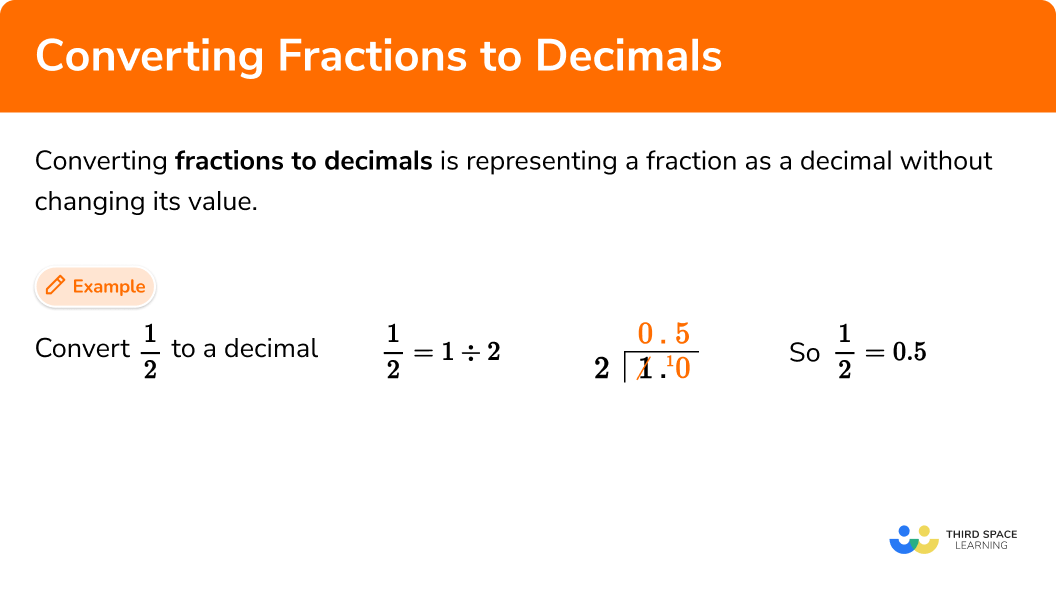
The most common fraction conversion is to a decimal. Mathematically, a fraction a/b simply means a divided by b. Digital tools execute this division with high precision. For example, 3/4 is computed as 3 ÷ 4 = 0.75. Computers perform this operation using floating-point arithmetic, which is designed to handle non-integer numbers with a certain degree of precision, typically far beyond what can be practically calculated manually.
Converting to Percentages: Scaling and Shifting
To convert a decimal to a percentage, the decimal value is multiplied by 100 and then the percent symbol (%) is appended. So, 0.75 becomes 0.75 * 100 = 75%. Technology automates this two-step process. Some tools might directly convert a fraction to a percentage by calculating (numerator / denominator) * 100.
Converting Improper Fractions to Mixed Numbers: Remainder Logic
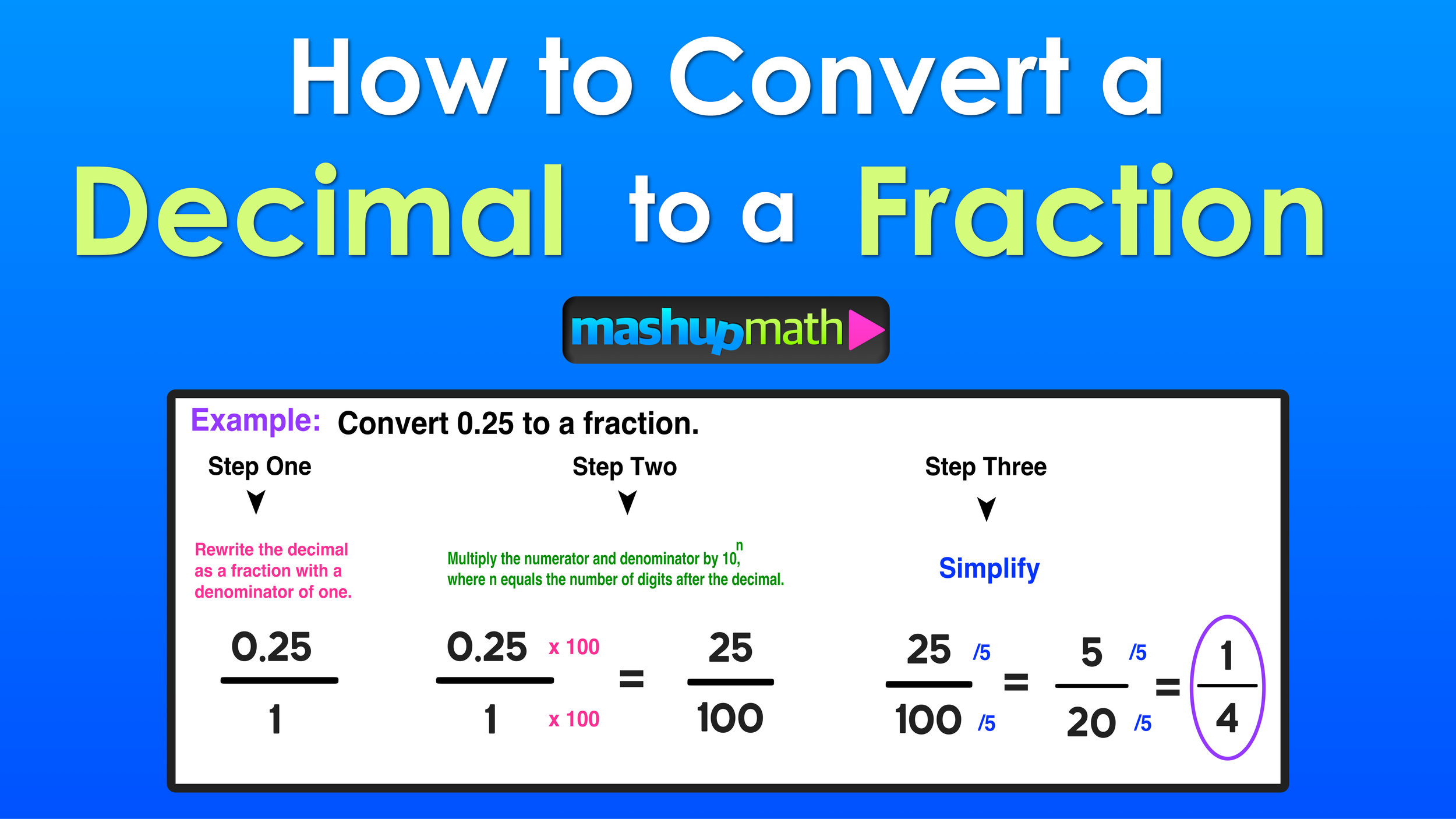
An improper fraction has a numerator greater than or equal to its denominator (e.g., 7/3). A mixed number combines a whole number and a proper fraction (e.g., 2 1/3). Technology converts an improper fraction to a mixed number using integer division and the modulo operator.
- Whole Number: Divide the numerator by the denominator using integer division (which gives only the whole number part). For
7/3,7 ÷ 3 = 2(ignoring the remainder). This is the whole number part. - New Numerator: Calculate the remainder of the division. For
7 ÷ 3, the remainder is1(since7 = 2*3 + 1). This remainder becomes the new numerator. - Denominator: The denominator remains the same.
So,7/3becomes2 1/3. Digital tools perform these operations instantaneously, eliminating the manual steps of long division and remainder tracking.
Advanced Applications: Programming for Custom Conversions
For developers, data scientists, or anyone with specific, recurring conversion needs that off-the-shelf tools don’t fully address, programming offers the ultimate customization. Languages like Python are particularly well-suited for numerical operations, including fraction conversion.
Scripting with Python: A Basic Fraction Converter
Writing a simple Python script to convert fractions demonstrates the underlying logic and offers unparalleled flexibility.
A basic function could look like this:
from fractions import Fraction

def convert_fraction_to_decimal(numerator, denominator):
    return numerator / denominator

def convert_fraction_to_percentage(numerator, denominator):
    return (numerator / denominator) * 100

def convert_improper_to_mixed(numerator, denominator):
    if numerator < denominator:
        return f"{numerator}/{denominator}" # It's a proper fraction

    whole_number = numerator // denominator  # Integer division
    remainder = numerator % denominator     # Modulo operator for remainder

    if remainder == 0:
        return str(whole_number)
    else:
        return f"{whole_number} {remainder}/{denominator}"

# Example Usage:
print(f"3/4 to Decimal: {convert_fraction_to_decimal(3, 4)}")         # Output: 0.75
print(f"3/4 to Percentage: {convert_fraction_to_percentage(3, 4)}%") # Output: 75.0%
print(f"7/3 to Mixed Number: {convert_improper_to_mixed(7, 3)}")     # Output: 2 1/3
print(f"10/5 to Mixed Number: {convert_improper_to_mixed(10, 5)}")   # Output: 2
Python’s built-in fractions module can also handle fraction objects directly, simplifying operations and ensuring precision by representing fractions exactly, rather than as approximate floating-point numbers.
Integrating APIs: Dynamic Data Handling
For applications that need to process fractional data from external sources or integrate fraction conversion capabilities into larger systems, Application Programming Interfaces (APIs) offer a powerful solution. Many mathematical libraries or online conversion services provide APIs that developers can call from their own software. This allows for dynamic data exchange, where an application can send fractional data to a service, receive the converted values, and incorporate them into its workflow without having to rebuild the conversion logic from scratch. This is particularly useful in web services, data analytics platforms, or financial modeling tools that deal with real-time data.
Benefits of Tech-Assisted Fraction Conversion
The adoption of technology for fraction conversion brings a multitude of benefits that extend beyond mere convenience.
Enhanced Accuracy and Error Reduction
Manual calculations, especially with complex fractions or large datasets, are inherently susceptible to human error. A misplaced digit, an incorrect division, or a miscalculation of a remainder can lead to significant inaccuracies. Technology, once programmed correctly, eliminates these errors by consistently applying the correct algorithms. This leads to reliable results, which is paramount in fields like engineering, finance, and scientific research where precision is non-negotiable.
Time Efficiency and Productivity Gains
What might take several minutes or even hours to calculate by hand for a large number of fractions can be accomplished in mere seconds with digital tools. This dramatic increase in efficiency frees up valuable time for individuals and organizations, allowing them to focus on analysis, decision-making, or other higher-level tasks rather than being bogged down by repetitive arithmetic. In business contexts, this translates directly to increased productivity and faster turnaround times.
Educational Aid and Accessibility
For students struggling with fraction concepts, technology serves as an invaluable educational aid. Interactive apps and step-by-step solvers not only provide answers but also illustrate the process, helping students grasp the underlying mathematical principles. Furthermore, digital tools can make mathematics more accessible for individuals with learning disabilities or those who simply learn better through visual or interactive methods. The ability to instantly check answers also builds confidence and encourages exploration.
Choosing the Right Tool for Your Needs
The best tool for converting fractions depends largely on the user’s specific requirements, frequency of use, and technical comfort level.
- For Casual, Quick Conversions: Online converters or basic calculator apps are ideal. They offer instant results with minimal fuss.
- For Batch Processing and Data Analysis: Spreadsheet software (Excel, Google Sheets) is the go-to choice due to its powerful formula capabilities and ability to handle large volumes of data.
- For Learning and Step-by-Step Guidance: Dedicated math solver apps on mobile devices provide a rich, interactive learning experience.
- For Custom Solutions and Integration: Programming languages like Python or leveraging APIs are perfect for developers who need to embed fraction conversion into larger software systems or create highly specialized tools.
Ultimately, whether you’re a student trying to understand mixed numbers, a baker scaling a recipe, a financial analyst dissecting market data, or a programmer building an application, technology offers a robust and versatile array of tools to master fraction conversion. By embracing these digital aids, we not only simplify a fundamental mathematical task but also unlock new levels of precision, efficiency, and understanding in our numerical endeavors.
aViewFromTheCave is a participant in the Amazon Services LLC Associates Program, an affiliate advertising program designed to provide a means for sites to earn advertising fees by advertising and linking to Amazon.com. Amazon, the Amazon logo, AmazonSupply, and the AmazonSupply logo are trademarks of Amazon.com, Inc. or its affiliates. As an Amazon Associate we earn affiliate commissions from qualifying purchases.