
Understanding your annual income is the cornerstone of a healthy financial life. Whether you are applying for a mortgage, planning a household budget, or negotiating a salary for a new position, knowing exactly how much you earn over the course of a year is essential. While the concept might seem straightforward, the calculation can become complex when you factor in hourly wages, overtime, bonuses, commissions, and the distinction between gross and net pay.
In this comprehensive guide, we will break down the methodologies for calculating your annual income across various employment types and explore why these figures are vital for your long-term financial strategy.
1. Understanding the Fundamental Definitions of Income
Before diving into the mathematical formulas, it is crucial to establish a clear understanding of the different types of income. Not all “income” figures are used for the same purpose. Depending on whether you are filing taxes or applying for a car loan, you will need to provide different data points.
Gross Annual Income vs. Net Annual Income
Gross annual income is the total amount of money you earn in a year before any taxes or deductions are taken out. This is the figure most commonly requested by lenders and landlords. It represents your total earning power.
Net annual income, often referred to as “take-home pay,” is the amount remaining after federal, state, and local taxes, Social Security, and Medicare (FICA) have been deducted. It also accounts for voluntary deductions like health insurance premiums, 401(k) contributions, and life insurance. For personal budgeting, net income is the more relevant figure, as it reflects the actual cash flow available to cover your living expenses.
Total Compensation and Fringe Benefits
To get a true sense of your financial standing, you should also consider your total compensation package. While your base salary is the primary component, many employers provide benefits that have significant monetary value. This includes employer contributions to retirement accounts, health savings account (HSA) matches, and tuition reimbursement. While these aren’t “liquid” income you can spend at the grocery store, they increase your overall net worth and reduce your personal out-of-pocket expenses.
2. Calculating Income for Salaried and Hourly Employees
The method you use to calculate your annual income depends largely on how you are compensated. Most workers fall into either the salaried or hourly category, each requiring a different approach to ensure accuracy.
The Salaried Calculation
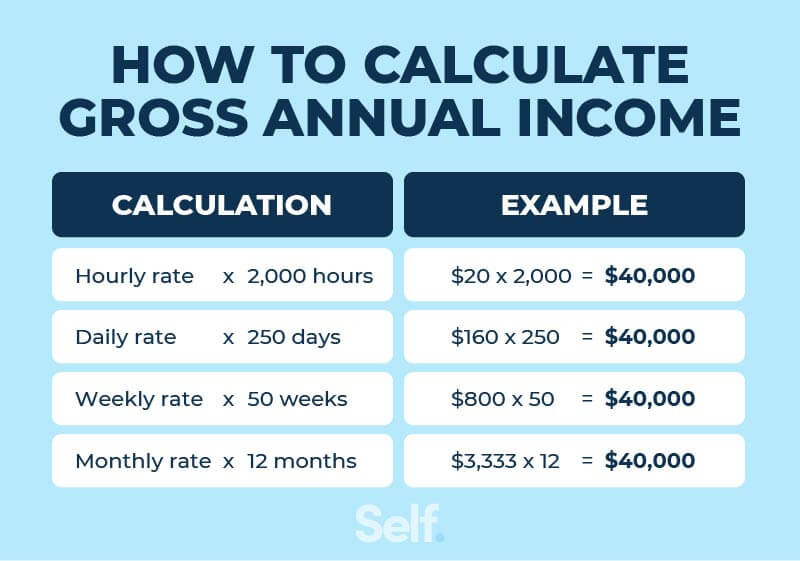
For salaried employees, the process is generally the simplest. Your annual salary is typically stated in your employment contract. However, if you receive your paychecks bi-weekly or monthly and want to verify your annual totals, you can use the following multipliers:
- Weekly: Multiply your gross weekly pay by 52.
- Bi-weekly (every two weeks): Multiply your gross pay by 26.
- Semi-monthly (twice a month): Multiply your gross pay by 24.
- Monthly: Multiply your gross pay by 12.
For example, if your bi-weekly gross pay is $2,500, your annual income is $65,000 ($2,500 x 26).
The Hourly Calculation: The 2,080-Hour Rule
Calculating annual income for hourly workers requires a bit more effort, especially if hours fluctuate. For a standard full-time employee working 40 hours per week, the “2,080-hour rule” is the gold standard. This number is derived from 40 hours per week multiplied by 52 weeks in a year.
- Standard Formula: (Hourly Rate) x (Hours per Week) x 52.
- Example: If you earn $25 per hour and work 40 hours a week, your annual income is $52,000.
If your hours vary, you should look at your year-to-date (YTD) earnings on your most recent pay stub. Divide that total by the number of months passed in the year and multiply by 12 to project your annual total.
3. Navigating Variable Income, Bonuses, and Side Hustles
In the modern economy, many individuals do not rely on a static paycheck. Freelancers, gig workers, and sales professionals often deal with variable income, which requires a more nuanced approach to calculation.

Accounting for Commissions and Bonuses
If your compensation includes performance-based bonuses or sales commissions, these must be integrated into your annual total. Because these amounts vary, the most accurate way to calculate them for future planning is to average the last two to three years of payouts. For current year reporting, add your guaranteed base salary to the “conservative estimate” of your expected bonuses. In the eyes of many mortgage lenders, variable income is only considered “stable” if you have a two-year history of receiving it.
Calculating Income for Freelancers and 1099 Contractors
For those who are self-employed or have side hustles, the calculation shifts from “salary” to “net profit.” As a freelancer, your gross receipts (the total amount clients pay you) are not your annual income. You must subtract your business expenses (software, equipment, home office costs, marketing) to find your true income.
- Self-Employed Formula: Total Revenue – Business Expenses = Adjusted Gross Income (AGI).
It is highly recommended that self-employed individuals maintain a profit and loss (P&L) statement updated monthly. This prevents “sticker shock” during tax season and provides a realistic view of how much the business is actually contributing to your personal annual income.
4. The Impact of Taxes and Deductions on Your Final Number
While your gross income determines your loan eligibility, your “taxable income” determines how much you actually keep. Understanding the layers of deductions is essential for effective financial planning.
Federal and State Tax Brackets
The United States uses a progressive tax system, meaning different portions of your income are taxed at different rates. When you calculate your annual income, you must account for the fact that a $10,000 raise might move a portion of your earnings into a higher tax bracket. Furthermore, state income taxes vary wildly—from 0% in states like Florida and Texas to over 10% in others.
Pre-Tax vs. Post-Tax Deductions
To calculate your actual spendable annual income, you must distinguish between pre-tax and post-tax deductions:
- Pre-Tax: Contributions to a traditional 401(k), 403(b), or Health Savings Account (HSA). these reduce your taxable income, effectively “hiding” that money from the IRS and lowering your immediate tax bill.
- Post-Tax: Contributions to a Roth 401(k) or Roth IRA. These do not reduce your annual taxable income now, but they provide tax-free income in retirement.
Understanding these deductions allows you to manipulate your “Net Annual Income” to better serve your long-term wealth-building goals.
5. Why Accurate Income Calculation Matters for Your Financial Future
Knowing your annual income is not just about filling out forms; it is about strategic financial management. It serves as the foundation for three critical areas of your life:
Debt-to-Income (DTI) Ratio
Lenders use your gross annual income to calculate your DTI ratio. This ratio compares your monthly debt payments (credit cards, student loans, car payments) to your monthly gross income. Most lenders prefer a DTI below 36%. If you underestimate your annual income by forgetting to include a regular bonus or side income, you might be denied a loan for which you actually qualify.
Effective Budgeting and the 50/30/20 Rule
For personal financial health, most experts recommend the 50/30/20 rule based on your net annual income:
- 50% for Needs (Housing, utilities, groceries).
- 30% for Wants (Entertainment, dining out, hobbies).
- 20% for Financial Goals (Debt repayment, emergency fund, investments).
Without an accurate calculation of your annual take-home pay, it is impossible to allocate these percentages correctly, often leading to overspending in the “Wants” category and neglecting “Financial Goals.”
Salary Negotiations and Career Growth
Finally, knowing your current annual income—including the value of your benefits—puts you in a position of power during salary negotiations. When a recruiter asks for your salary expectations, you should base your answer on your “Total Compensation” rather than just your base pay. By understanding the full scope of your annual earnings, you can ensure that your next career move is a genuine step forward in your financial journey.

Conclusion
Calculating your annual income is more than a simple math exercise; it is an audit of your financial reality. By distinguishing between gross and net pay, accounting for variable bonuses, and understanding the impact of taxes and benefits, you gain a clear-eyed view of your economic standing. This clarity allows you to budget with confidence, borrow responsibly, and plan for a future of financial independence. Whether you are a salaried executive or a freelance creator, mastering these numbers is the first step toward mastering your money.
aViewFromTheCave is a participant in the Amazon Services LLC Associates Program, an affiliate advertising program designed to provide a means for sites to earn advertising fees by advertising and linking to Amazon.com. Amazon, the Amazon logo, AmazonSupply, and the AmazonSupply logo are trademarks of Amazon.com, Inc. or its affiliates. As an Amazon Associate we earn affiliate commissions from qualifying purchases.