
In the world of finance, numbers are the language of progress. Whether you are tracking the growth of a retirement portfolio, evaluating the success of a new business venture, or simply trying to understand how much your cost of living has risen over the last year, the ability to calculate percentage increase is an essential skill. While raw numbers provide a snapshot of change, percentages provide the context necessary for informed decision-making.
Understanding percentage increase allows you to compare different sets of data on an even playing field. For example, a $500 gain on a $1,000 investment is vastly different from a $500 gain on a $100,000 investment. This guide explores the fundamental mathematics of percentage increase and its critical applications across personal finance, investing, and business management.
The Fundamental Mathematics of Percentage Increase
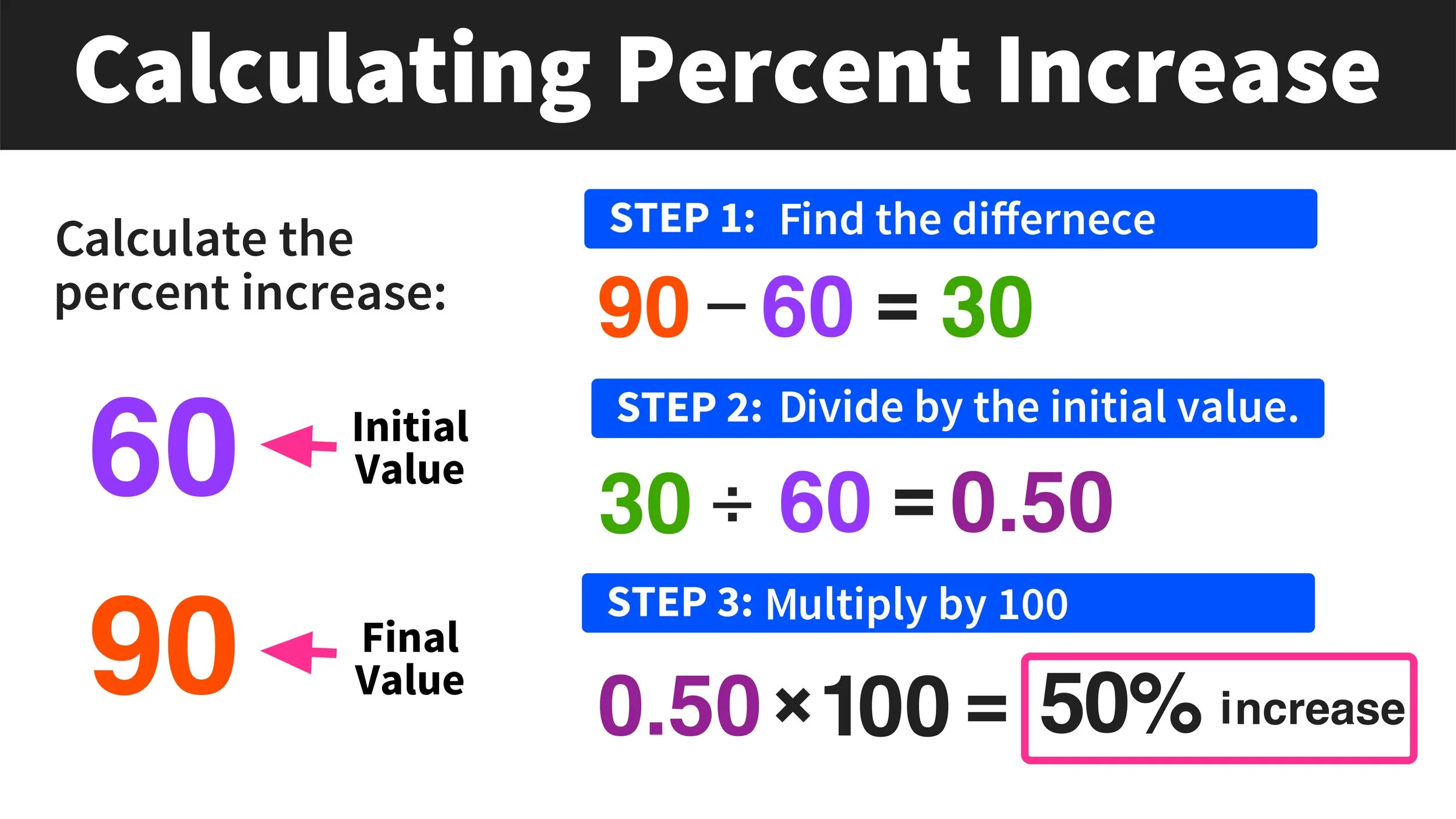
At its core, calculating a percentage increase is a three-step process that translates a numerical change into a ratio of the original value. This mathematical operation allows individuals to see growth relative to the starting point, which is the most accurate way to measure financial momentum.
The Standard Formula Explained
To find the percentage increase between two values, you must first determine the absolute difference between the new value and the original value. The formula is expressed as follows:
Percentage Increase = [(New Value – Original Value) / Original Value] × 100
In this equation, the “Original Value” represents your starting point (the denominator), and the “New Value” represents the ending point. The result of the subtraction in the numerator is the “increase.” By dividing that increase by the original amount, you get a decimal representing the growth rate. Multiplying by 100 converts that decimal into a recognizable percentage.
Step-by-Step Calculation for Personal Finance
Let’s apply this to a common personal finance scenario: a salary raise. Suppose you were earning $50,000 per year, and after a performance review, your salary was increased to $55,000.
- Identify the values: Original Value = $50,000; New Value = $55,000.
- Calculate the difference: $55,000 – $50,000 = $5,000.
- Divide by the original value: $5,000 / $50,000 = 0.10.
- Convert to a percentage: 0.10 × 100 = 10%.
In this case, you received a 10% increase. Understanding this figure is often more useful than the $5,000 figure alone, as it helps you gauge whether your income growth is keeping pace with inflation or meeting your personal wealth-building benchmarks.
Using Percentage Increase for Investment Performance Analysis
For investors, percentage increase is the primary metric for evaluating the efficacy of an asset allocation strategy. Without calculating the percentage change, it is nearly impossible to determine if a specific stock, bond, or real estate holding is truly outperforming the broader market.
Measuring Portfolio Growth Over Time
Investment portfolios are rarely static. They fluctuate based on market volatility, dividend reinvestments, and capital gains. To understand your true “Return on Investment” (ROI), you must use the percentage increase formula over specific time horizons—typically monthly, quarterly, or annually.
If your total portfolio value was $200,000 at the start of the year and grew to $230,000 by December 31st (excluding any new contributions), your portfolio saw a 15% increase. This percentage allows you to compare your performance against benchmarks like the S&P 500. If the S&P 500 grew by 10% in the same period, you know your specific investment strategy yielded a 5% “alpha” or outperformance relative to the market.
Comparing Asset Class Performance
Percentage increase is the “great equalizer” when comparing different types of investments. Suppose you have $10,000 in a high-yield savings account that earned $450 in interest, and $5,000 in a tech stock that gained $400 in value.
At first glance, the $450 from the savings account looks like the “better” return because the dollar amount is higher. However, when we calculate the percentage increase:
- Savings Account: ($450 / $10,000) × 100 = 4.5%
- Tech Stock: ($400 / $5,000) × 100 = 8%
The tech stock actually provided a much higher rate of growth relative to the capital deployed. This insight is crucial for rebalancing portfolios and deciding where to allocate future capital for maximum efficiency.
Business Finance: Leveraging Growth Metrics for Strategic Decisions
In a corporate or entrepreneurial setting, percentage increase is a Key Performance Indicator (KPI) that signals the health and scalability of a business. Stakeholders and managers use these percentages to determine if a company is expanding, stagnating, or requiring a pivot in strategy.
Revenue and Profit Margin Growth
Business owners focus heavily on Year-over-Year (YoY) revenue growth. If a company generated $1 million in revenue in 2022 and $1.2 million in 2023, it experienced a 20% revenue increase. While this is positive, savvy financial analysts also look at the percentage increase in expenses.
If expenses increased by 30% during the same period, the business is actually becoming less efficient despite making more money. Calculating the percentage increase of both the top line (revenue) and the bottom line (net profit) ensures that the growth is sustainable and profitable.
Customer Acquisition and Retention Metrics
For modern digital businesses and subscription-based models, percentage increase is used to track “Monthly Recurring Revenue” (MRR) and user base growth. A startup that grows its user base from 1,000 to 1,500 in a month has achieved a 50% growth rate.
High percentage increases in customer acquisition often justify higher valuations for investors. However, businesses must also monitor the “Churn Rate”—the percentage of customers who leave. Successful business finance requires balancing a high percentage increase in new acquisitions with a low percentage decrease in existing customers.
Common Pitfalls and How to Interpret Percentage Changes Correctly
While the math is straightforward, the interpretation of percentage increase can often be misleading if not viewed through a critical lens. Financial literacy involves knowing when a percentage tells the whole story and when it hides a deeper reality.
The Dangers of Small Base Numbers
One of the most common ways data is manipulated in marketing or financial reporting is through the “small base” effect. A 100% increase sounds massive, but if it represents a move from 1 customer to 2 customers, it is statistically insignificant for a large business.
When evaluating investment opportunities—especially in volatile sectors like cryptocurrency or penny stocks—be wary of massive percentage increases. A coin that increases by 1,000% but has a total liquidity of only $5,000 is not a stable or reliable investment. Always look at the absolute dollar amounts alongside the percentage to get a full picture of the risk and scale.
Nominal vs. Real Growth (Inflation Adjustments)
In an inflationary environment, a percentage increase in your bank balance does not always equate to an increase in purchasing power. This is the difference between “nominal” and “real” growth.
If you receive a 5% raise at work, but the inflation rate (the percentage increase in the cost of goods and services) is 7%, your “real” income has actually decreased by 2%. To truly build wealth, your investments and income must achieve a percentage increase that exceeds the annual inflation rate. Understanding this distinction prevents the “money illusion,” where individuals feel wealthier because they have more currency, even though that currency buys fewer goods.
Tools and Automation for Financial Tracking
In the modern era, you don’t need a manual calculator to track these metrics. Various tools can automate the calculation of percentage increases, allowing you to focus on strategy rather than arithmetic.
Excel and Google Sheets Functions
For those managing their own business or personal budget, spreadsheet software is the gold standard. To calculate percentage increase in Excel, you simply use a formula like:
=(B2-A2)/A2
By formatting the cell as a “Percentage,” the software handles the multiplication by 100 for you. This allows for the creation of dynamic dashboards where you can track monthly spending or investment growth in real-time.

FinTech Apps for Automated Tracking
Modern financial technology (FinTech) apps like Mint, YNAB, or brokerage platforms like Vanguard and Fidelity provide automatic percentage increase visualizations. These tools can show you your “Net Worth” growth over time, automatically calculating the percentage change as asset values fluctuate.
Utilizing these tools allows for more frequent monitoring. By seeing a 2% increase in your savings rate month-over-month, you receive the positive psychological reinforcement necessary to stick to a long-term financial plan. In the end, the ability to calculate and interpret percentage increase is more than just a math trick; it is a fundamental pillar of financial mastery that empowers you to grow your wealth with precision and clarity.
aViewFromTheCave is a participant in the Amazon Services LLC Associates Program, an affiliate advertising program designed to provide a means for sites to earn advertising fees by advertising and linking to Amazon.com. Amazon, the Amazon logo, AmazonSupply, and the AmazonSupply logo are trademarks of Amazon.com, Inc. or its affiliates. As an Amazon Associate we earn affiliate commissions from qualifying purchases.