
Inflation is a word that frequently appears in financial news, economic forecasts, and even daily conversations about the cost of living. But what does it really mean, and more importantly, how is it measured? At the heart of understanding inflation lies the Consumer Price Index (CPI), a critical economic indicator that provides a comprehensive snapshot of changes in the prices of goods and services purchased by consumers. For anyone managing their personal finances, making investment decisions, or simply trying to understand why their money doesn’t go as far as it used to, grasping how CPI and inflation are calculated is not just academic—it’s empowering.

This guide will demystify the CPI and inflation calculations, translating complex economic concepts into actionable insights for your financial journey. We’ll explore what the CPI measures, walk through the essential formulas, and discuss how understanding these figures can help you navigate the ever-changing economic landscape. By the end, you’ll not only know how to calculate CPI inflation but also appreciate its profound impact on your purchasing power and financial well-being.
What is the Consumer Price Index (CPI)?
Before we dive into calculations, it’s crucial to understand the fundamental concept: the Consumer Price Index (CPI). Often referred to as a barometer for the economy, the CPI provides a statistical measure of the average change over time in the prices paid by urban consumers for a market basket of consumer goods and services. It’s the primary gauge of inflation for households and a cornerstone of economic analysis.
Definition and Purpose: The Household Budget Barometer
The CPI essentially tracks the cost of living for the typical urban consumer. Its primary purpose is to provide a comprehensive measure of the price level, indicating whether the cost of goods and services is rising, falling, or remaining stable. When the CPI increases, it signals inflation—meaning your dollar buys less than it did before. Conversely, a decrease in the CPI would indicate deflation, where your dollar buys more.
This index is not just an abstract economic number; it directly impacts millions of people. For instance, Social Security benefits and federal pension payments are often adjusted annually based on changes in the CPI to help maintain the purchasing power of recipients. Union contracts frequently include clauses for wage increases tied to the CPI, and even federal income tax brackets are adjusted using CPI data. Its reach extends into virtually every corner of the financial world, influencing monetary policy decisions by central banks, business pricing strategies, and individual spending habits.
The “Market Basket” Concept: A Representative Sample
The genius of the CPI lies in its “market basket” approach. Imagine a hypothetical shopping cart filled with all the goods and services that an average urban household regularly purchases. This isn’t just a random assortment; it’s a carefully constructed, representative sample of consumer expenditures. The Bureau of Labor Statistics (BLS) in the United States, for example, conducts extensive surveys to determine what goods and services people buy and in what proportions.
This market basket typically includes thousands of items categorized into major groups:
- Food and Beverages: Groceries, restaurant meals, snacks.
- Housing: Rent, homeowner’s equivalent rent, utilities (electricity, gas, water, sewage), household furnishings and operations.
- Apparel: Clothing and footwear.
- Transportation: New and used vehicles, motor fuel, public transportation.
- Medical Care: Prescription drugs, doctor visits, hospital services.
- Recreation: Televisions, sports equipment, admission fees.
- Education and Communication: Tuition, school books, telephone services, internet.
- Other Goods and Services: Tobacco, personal care products, funeral expenses.
Each item in this basket is weighted according to its importance in the average consumer’s budget. For instance, housing typically accounts for a much larger share of consumer spending than, say, tobacco, so changes in housing costs will have a greater impact on the overall CPI than changes in tobacco prices. This weighting ensures that the index accurately reflects the real-world impact of price changes on household budgets. The BLS continually updates and revises the market basket and its weights to reflect changes in consumer spending patterns and the introduction of new goods and services, ensuring its relevance over time.
The Core Formula: Calculating CPI
Understanding the CPI requires delving into its fundamental calculation. It’s not as complex as it might seem, and once you grasp the basic formula, you’ll be well on your way to interpreting economic data with greater clarity.
Understanding the Base Period: Your Reference Point
Every CPI calculation requires a reference point, known as the “base period.” The base period is a specific time frame—often a year or a multi-year average—against which price changes in other periods are measured. The average price level for the base period is assigned an index value, typically 100. This 100 serves as a convenient benchmark: if the CPI in a later period is 110, it means prices have risen 10% compared to the base period. If it’s 95, prices have fallen 5%.
Choosing a base period is crucial because it provides context. Without a consistent reference, comparing price levels across different years would be like comparing apples and oranges. The BLS, for instance, periodically updates its base periods to ensure they remain relevant and representative of the current economic environment.
The CPI Calculation Formula: Step-by-Step
The formula for calculating the Consumer Price Index for a given period is straightforward:
CPI = (Cost of Market Basket in Current Period / Cost of Market Basket in Base Period) * 100
Let’s break this down with a simplified example:
Scenario:
Imagine a very basic market basket consisting of only three items: a loaf of bread, a gallon of milk, and a movie ticket.
-
Base Period (Year 2000):
- Bread: $1.50
- Milk: $2.00
- Movie Ticket: $7.00
- Total Cost of Market Basket in Base Period = $1.50 + $2.00 + $7.00 = $10.50
-
Current Period (Year 2023):
- Bread: $3.00
- Milk: $3.50
- Movie Ticket: $12.00
- Total Cost of Market Basket in Current Period = $3.00 + $3.50 + $12.00 = $18.50
Now, let’s apply the CPI formula:
CPI (Year 2023) = ($18.50 / $10.50) * 100
CPI (Year 2023) ≈ 1.7619 * 100
CPI (Year 2023) ≈ 176.19
Interpreting the CPI Value: What the Numbers Tell You
In our example, a CPI of approximately 176.19 for the year 2023 (with the year 2000 as the base period with a CPI of 100) means that the cost of our hypothetical market basket has increased by 76.19% since the year 2000. In other words, what cost $10.50 in 2000 now costs $18.50.
A CPI value:
- Greater than 100 indicates that prices have risen compared to the base period.
- Less than 100 indicates that prices have fallen compared to the base period.
- Exactly 100 means prices are the same as the base period.
It’s important to remember that the CPI itself isn’t the inflation rate; rather, it’s the raw data point from which the inflation rate is derived. It provides a snapshot of the price level at a specific point in time relative to a baseline.
From CPI to Inflation Rate: The Key Calculation
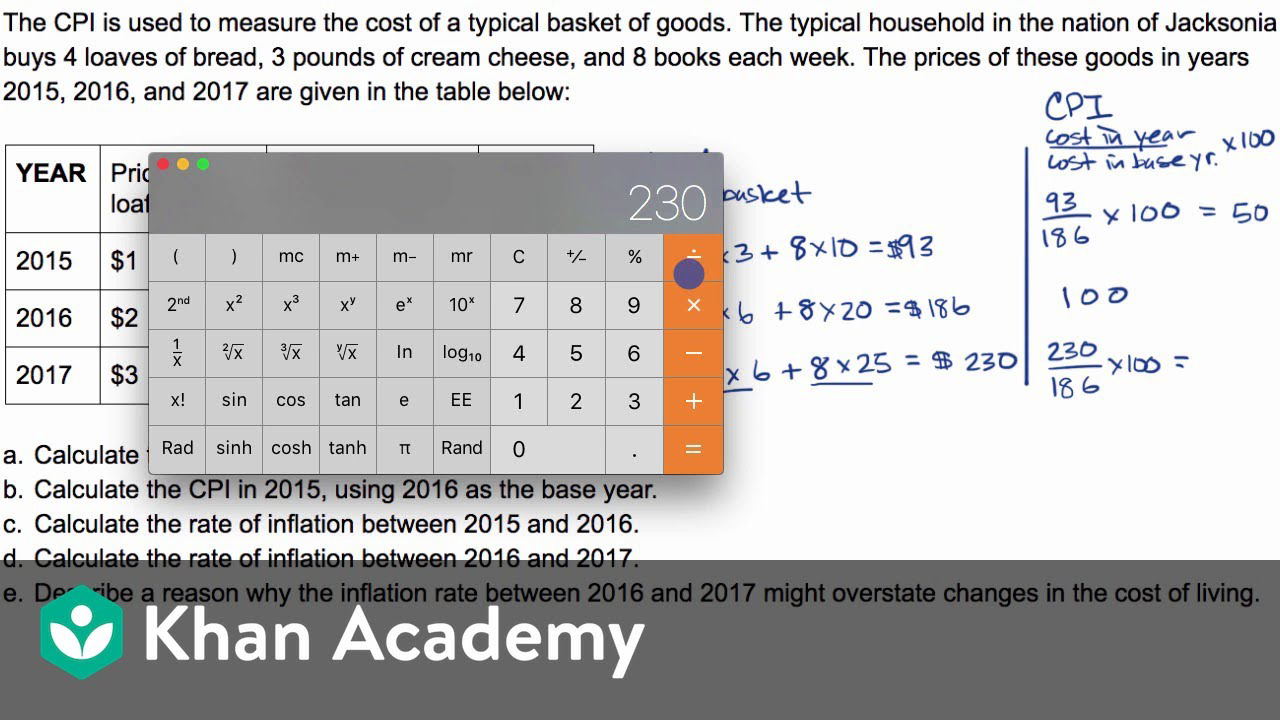
While the CPI tells you the overall price level, what most people refer to as “inflation” is actually the rate of change in the CPI over a specific period. This is the crucial calculation for understanding how quickly your purchasing power is eroding or growing.
Definition of Inflation Rate: The Speed of Price Changes
The inflation rate is the percentage increase in the price level over a period, typically a year. It measures how much more expensive a basket of goods and services has become compared to a previous period. A positive inflation rate means prices are generally rising, while a negative rate (deflation) means prices are generally falling.
Understanding the inflation rate is vital for personal finance. It impacts:
- Savings: High inflation erodes the real value of your savings unless your interest earnings outpace the inflation rate.
- Investments: It helps determine the real (inflation-adjusted) return on your investments.
- Wages: It influences whether your salary increases are keeping pace with the cost of living.
- Debt: For borrowers, inflation can make fixed-rate debt easier to repay over time, as the real value of future payments decreases.
The Inflation Rate Formula Using CPI: Measuring Change Over Time
To calculate the inflation rate between two periods using CPI data, you use the following formula:
Inflation Rate = ((CPI_Current - CPI_Previous) / CPI_Previous) * 100
Let’s continue with our previous example. We found the CPI for Year 2023 was approximately 176.19, with Year 2000 as the base (CPI 100).
Now, let’s say we want to calculate the annual inflation rate from Year 2022 to Year 2023. We need the CPI for Year 2022.
Scenario:
- CPI (Year 2022) = 170.00
- CPI (Year 2023) = 176.19
Applying the inflation rate formula:
Inflation Rate (2022 to 2023) = ((176.19 - 170.00) / 170.00) * 100
Inflation Rate = (6.19 / 170.00) * 100
Inflation Rate ≈ 0.03641 * 100
Inflation Rate ≈ 3.64%
This means that from 2022 to 2023, the overall price level, as measured by our hypothetical market basket, increased by approximately 3.64%. This figure is a direct indicator of how much less your money could buy over that one-year period.
Annual vs. Monthly Inflation: Different Lenses for Analysis
Inflation is typically reported in several ways, with the most common being the annual rate (year-over-year) and the monthly rate (month-over-month).
- Annual Inflation Rate: This is the most frequently cited figure, comparing the CPI of the current month (or quarter/year) to the CPI of the same month a year prior. For example, comparing the CPI for May 2023 to May 2022. This provides a broader perspective, smoothing out seasonal fluctuations and giving a clear picture of the long-term trend. It’s often what central banks and economists refer to when discussing inflation targets.
- Monthly Inflation Rate: This compares the CPI of the current month to the CPI of the immediately preceding month. For example, comparing the CPI for May 2023 to April 2023. While more volatile, it provides a very current snapshot of price changes and can signal emerging trends more quickly. It’s often annualized (multiplied by 12) to estimate what the annual rate would be if the monthly trend continued.
For personal finance, the annual inflation rate is generally more useful for long-term planning, such as retirement savings projections or evaluating the real return on investments. Monthly data can be insightful for short-term budget adjustments or understanding immediate economic shifts.
Beyond the Basics: Nuances and Applications for Personal Finance
While the core calculations are straightforward, the application and interpretation of CPI and inflation data introduce several important nuances that financial planners and savvy individuals consider.
Core vs. Headline Inflation: A Closer Look
When discussing inflation, you’ll often hear terms like “headline inflation” and “core inflation.”
- Headline Inflation is the raw, unadjusted inflation rate calculated directly from the overall CPI, including all items in the market basket. This is the figure most commonly reported in the news.
- Core Inflation is a measure that excludes the more volatile components of the market basket, specifically food and energy prices. Food and energy prices can fluctuate wildly due to factors like weather events, geopolitical tensions, or supply chain disruptions, which might not reflect underlying inflationary pressures in the broader economy. Central banks and economists often pay closer attention to core inflation when making monetary policy decisions, as it’s believed to be a better indicator of long-term price trends and the underlying inflationary pressures driven by demand and supply in other sectors. For personal finance, understanding both is crucial: headline inflation affects your immediate budget, while core inflation hints at the more persistent trends.
Impact on Personal Finance: Guarding Your Wealth
The direct impact of CPI inflation on your personal finance is profound:
- Erosion of Purchasing Power: This is the most direct effect. If inflation is 5%, your $1,000 will only buy what $950 bought a year ago. This means your fixed income, like pensions or annuities, loses value over time if not inflation-adjusted.
- Savings: Money held in low-interest savings accounts loses real value. If your bank account yields 1% interest and inflation is 3%, your real return is -2%. This makes inflation-beating investments essential.
- Investments: Inflation risk is a key consideration for investors. Returns from stocks, bonds, and real estate must ideally outpace inflation to genuinely grow your wealth. Inflation-indexed bonds (like TIPS) are specifically designed to protect against this.
- Debt: While inflation can erode the real value of fixed-rate debt (making it cheaper to repay with future, less valuable dollars), it can also push interest rates higher, affecting new loans or variable-rate debt.
- Retirement Planning: Failing to account for inflation in retirement planning can lead to a significant shortfall. What seems like a comfortable nest egg today might be insufficient in 20-30 years due to eroded purchasing power.
Adjusting for Inflation: Real vs. Nominal Values
Understanding how to adjust for inflation allows you to assess “real” changes in income, wealth, and returns.
- Nominal Values are the figures stated in current dollars, without accounting for inflation.
- Real Values are inflation-adjusted values, reflecting actual purchasing power.
Businesses use CPI to adjust prices, negotiate wages, and plan future investments. Governments use it to index social security benefits, tax brackets, and poverty thresholds. As an individual, you can use it to:
- Evaluate Wage Increases: If your salary increased by 3% but inflation was 4%, your real wage actually decreased by 1%.
- Assess Investment Returns: Calculate your real return by subtracting the inflation rate from your nominal investment return.
- Budgeting: Anticipate how much more expensive your regular expenses might become over time.
Limitations and Criticisms of CPI: A Realistic View
While invaluable, the CPI is not without its limitations and criticisms:
- Substitution Bias: When the price of a good rises, consumers often substitute it with a cheaper alternative. The fixed market basket of the CPI may not fully capture these substitutions in real-time, potentially overstating the true cost of living increase.
- Quality Bias: Improvements in product quality (e.g., a smartphone with more features for the same price) are difficult to account for. If a product offers more for the same price, the real price has effectively fallen, but the CPI might not fully reflect this.
- New Goods Bias: The CPI market basket takes time to incorporate entirely new goods and services (e.g., flat-screen TVs, streaming services), which can delay reflecting their impact on consumer spending and prices.
- Regional Differences: The national CPI is an average. Inflation rates can vary significantly by region or city due to differing costs of housing, transportation, and other local factors.
- Specific Consumer Groups: The CPI is designed for “urban consumers.” The spending patterns and inflation experience of specific groups (e.g., rural residents, the elderly, high-income households) might differ from the average.
These criticisms highlight that while the CPI is the best available measure, it’s an approximation and should be interpreted with an understanding of its underlying assumptions and methodologies.

Conclusion: Empowering Your Financial Decisions
The Consumer Price Index and its derived inflation rate are more than just abstract economic indicators; they are fundamental tools for navigating the complexities of personal finance. By understanding how the CPI is calculated and what the inflation rate truly signifies, you gain a powerful advantage in managing your money.
You can now:
- Accurately assess your purchasing power over time.
- Make informed decisions about savings, investments, and debt.
- Evaluate the true value of your income and wealth.
- Strategically plan for future expenses, such as retirement or large purchases.
In an ever-changing economic environment, inflation is a constant force that shapes our financial realities. Equipped with the knowledge of how to calculate CPI inflation, you are better prepared to protect and grow your wealth, ensuring your financial decisions are grounded in a deep understanding of economic reality. This knowledge empowers you to look beyond the headlines and make truly insightful choices for a more secure financial future.
aViewFromTheCave is a participant in the Amazon Services LLC Associates Program, an affiliate advertising program designed to provide a means for sites to earn advertising fees by advertising and linking to Amazon.com. Amazon, the Amazon logo, AmazonSupply, and the AmazonSupply logo are trademarks of Amazon.com, Inc. or its affiliates. As an Amazon Associate we earn affiliate commissions from qualifying purchases.