
For a single individual navigating the modern economy, managing fixed monthly expenses is the cornerstone of a successful financial plan. Among these expenses, health insurance often represents one of the most significant line items. Since the inception of the Affordable Care Act (ACA)—commonly referred to as Obamacare—the landscape of personal health finance has shifted. Understanding how much health insurance costs on a monthly basis is not just a matter of healthcare; it is a critical component of budgeting, tax planning, and long-term wealth protection.
The cost of an ACA plan for a single person is not a static number. It is a variable influenced by age, income, geography, and plan selection. In this guide, we will break down the financial mechanics of Obamacare to help you determine your projected monthly outlay and how to optimize your coverage for your specific financial profile.
1. The Core Variables Influencing Monthly Premiums
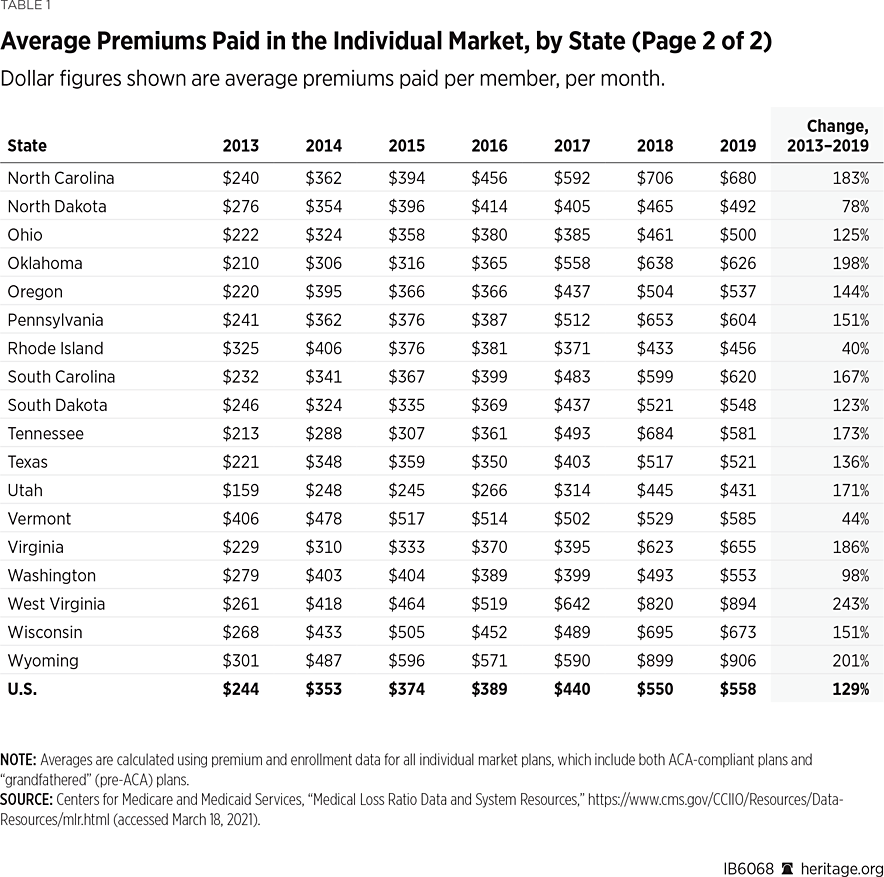
When a single person enters the health insurance marketplace, they are greeted by a wide range of price points. On average, without any financial assistance, a silver-level plan for a single individual in 2024 can range anywhere from $450 to $600 per month. However, very few people pay the “sticker price.” To understand your specific cost, you must look at the primary levers that insurers use to set rates.
The Metal Tier System and Premium Scaling
The ACA categorizes plans into four “metal” tiers: Bronze, Silver, Gold, and Platinum. These tiers do not reflect the quality of medical care but rather the financial split between the insurer and the policyholder.
- Bronze Plans: These have the lowest monthly premiums but the highest out-of-pocket costs. From a cash-flow perspective, these are ideal for healthy individuals who want to minimize monthly expenses and protect against catastrophic financial loss.
- Silver Plans: Often considered the “benchmark” for subsidies, these offer a moderate balance. If you qualify for cost-sharing reductions, you generally must choose a Silver plan.
- Gold and Platinum Plans: These carry the highest monthly premiums but offer the lowest deductibles and copays. These are essentially “pre-paying” for healthcare, which can be a strategic move if you have high recurring medical expenses.
Impact of Age and Geography
Under the ACA, insurers are limited in how they can price plans, but age remains a significant factor. A 60-year-old will inherently pay more for the same plan than a 25-year-old, often by a factor of three. Furthermore, your zip code plays a massive role in your monthly bill. In states with high competition among insurers, premiums tend to be lower. Conversely, in rural areas with limited provider networks, a single person might see premiums 20% to 30% higher than their urban counterparts.
2. Navigating Tax Credits and Financial Subsidies
The most important factor in determining “how much is Obamacare a month” is your eligibility for the Advanced Premium Tax Credit (APTC). This is a federal subsidy designed to cap the percentage of your income spent on health insurance.
The 8.5% Income Cap Rule
Under current legislative extensions (such as those found in the Inflation Reduction Act), the cost of a “benchmark” Silver plan is capped at 8.5% of a household’s annual income. For a single person earning $50,000 a year, this means the most they would have to pay for a benchmark plan is approximately $354 per month. If the market price of the plan is $600, the government provides a tax credit of $246 per month to cover the difference.
Income Thresholds and “Cliff” Mitigation
Historically, there was a “subsidy cliff” where individuals earning more than 400% of the Federal Poverty Level (FPL) lost all assistance. Currently, that cliff has been smoothed out. Even higher-earning single professionals may now qualify for some level of tax credit if the cost of insurance exceeds the 8.5% income threshold. This makes Obamacare a viable financial tool even for those in the middle-to-upper-middle class who are self-employed or do not have employer-sponsored coverage.
Cost-Sharing Reductions (CSR)
Beyond the monthly premium, individuals earning between 100% and 250% of the FPL may qualify for Cost-Sharing Reductions. While these don’t lower the monthly premium directly, they drastically reduce deductibles and out-of-pocket maximums. From a financial planning perspective, a CSR-enhanced Silver plan can offer the benefits of a Platinum plan at the price of a Silver plan, representing a massive value-add for your net worth by reducing potential medical debt.

3. Hidden Costs and Total Financial Exposure
Focusing solely on the monthly premium is a common mistake in personal finance. To truly understand the cost of Obamacare, a single person must calculate their “Maximum Out-of-Pocket” (MOOP) exposure.
Deductibles and the Monthly Cash Flow Impact
A plan with a $200 monthly premium might seem like a bargain until you realize it carries a $9,000 deductible. In a year where you experience a significant health event, that plan actually costs you $11,400 ($2,400 in premiums + $9,000 deductible). Conversely, a Gold plan with a $500 premium and a $1,000 deductible would cost you $7,000 in that same scenario. When budgeting, you must decide whether you want to take the “hit” in small monthly increments (high premium) or save a “sinking fund” to cover a high deductible (low premium).
The “Net Cost” of Going Out-of-Network
Most ACA plans are HMOs (Health Maintenance Organizations) or EPOs (Exclusive Provider Organizations). This means they generally do not cover out-of-network care except in emergencies. If you see a specialist who is not in your network, you are responsible for 100% of the cost. This can lead to financial ruin if not managed carefully. Before selecting a plan based on its low monthly cost, ensure your preferred providers are in-network to avoid unexpected five-figure bills.
4. Strategic Financial Planning for Single Individuals
For the single person, health insurance is an exercise in risk management. There are specific strategies you can use to integrate your health coverage into your broader investment and tax-saving goals.
Leveraging Health Savings Accounts (HSAs)
If you choose a High Deductible Health Plan (HDHP)—typically a Bronze or Silver plan—you may be eligible to open an HSA. In the world of finance, the HSA is a “triple-tax-advantaged” unicorn:
- Tax-Deductible Contributions: You reduce your taxable income for the year you contribute.
- Tax-Free Growth: You can invest the funds in stocks or bonds, and the gains are not taxed.
- Tax-Free Withdrawals: If used for qualified medical expenses, you pay no tax on the way out.
For a single person looking to build wealth, choosing a plan with a slightly higher deductible to gain HSA eligibility can be a superior long-term financial move compared to choosing a plan with a lower deductible but no investment component.
Balancing Premiums vs. Opportunity Cost
When deciding on a plan, consider the opportunity cost of your premium dollars. If you are young and healthy, the $200/month you save by choosing a Bronze plan over a Gold plan could be diverted into a Roth IRA or a high-yield savings account. Over 30 years, that $200 monthly difference, invested at a 7% annual return, grows to over $240,000. For many, health insurance is a “just in case” expense; minimizing the monthly premium while maintaining a healthy emergency fund to cover the deductible is often the most mathematically sound path to financial independence.

Conclusion: The Bottom Line on Monthly Costs
So, how much is Obamacare a month for a single person? While the national average hovers around $477 for a Silver plan, your personal reality is dictated by your income and your appetite for risk. By utilizing tax credits, you could pay as little as $0 per month, or if you are a high-earner in a high-cost state, you could pay upwards of $700.
The key to mastering your health finance is to look beyond the premium. Analyze the tax advantages of HSAs, account for the 8.5% income cap on subsidies, and always calculate your total maximum financial exposure. By viewing health insurance through the lens of a financial asset rather than just a monthly bill, you can protect your health and your wealth simultaneously.
aViewFromTheCave is a participant in the Amazon Services LLC Associates Program, an affiliate advertising program designed to provide a means for sites to earn advertising fees by advertising and linking to Amazon.com. Amazon, the Amazon logo, AmazonSupply, and the AmazonSupply logo are trademarks of Amazon.com, Inc. or its affiliates. As an Amazon Associate we earn affiliate commissions from qualifying purchases.