
When investors mention that “the market” is up or down, they are often referring to the Dow Jones Industrial Average (DJIA). Despite the thousands of companies traded on global exchanges, this single index, composed of just 30 stocks, remains one of the most cited financial benchmarks in the world. For the individual investor, understanding why there are exactly 30 stocks in the Dow—and how those companies are selected—is fundamental to grasping the mechanics of the American economy and personal wealth management.
The Dow is more than just a number; it is a curated snapshot of the “blue-chip” landscape. While other indices like the S&P 500 offer a broader view, the Dow’s concentrated nature provides a unique perspective on the health of the giants that drive industrial, technological, and consumer trends.

The Evolution and Significance of the 30-Stock Composition
To understand why the Dow Jones Industrial Average consists of 30 stocks, one must look back at its origins. Founded in 1896 by Charles Dow and Edward Jones, the index originally contained only 12 companies, primarily in the heavy industry sector—think sugar, tobacco, and rubber. As the American economy expanded and diversified, the index grew to reflect that complexity.
From 12 to 30: A Brief History of the Index
The Dow expanded to 20 stocks in 1916 and finally reached its current count of 30 stocks in 1928. This number was chosen because it was believed to be large enough to represent the broader economy while remaining small enough to be easily calculated by hand in an era before high-speed computing. While the number 30 has remained constant for nearly a century, the companies within that list have changed dozens of times to reflect the transition from a manufacturing-based economy to one driven by technology and services.
Why the Dow Remains a Benchmark for the Global Economy
Critics often argue that 30 stocks cannot possibly represent the entirety of the U.S. stock market. However, the “Money” perspective suggests otherwise. Because these 30 companies are industry leaders with massive global footprints, their performance often correlates strongly with broader market movements. When companies like Microsoft, Walmart, or Boeing report earnings, their results ripple through their respective supply chains, affecting thousands of smaller businesses and millions of retirement accounts.
How the 30 Dow Stocks are Selected
Unlike many other indices that use strictly quantitative rules—such as being among the largest by market capitalization—the selection process for the Dow is more qualitative. This makes it a unique hybrid of financial data and expert editorial judgment.
The Role of the Averages Committee
The Dow is maintained by the S&P Dow Jones Indices. A committee, which includes the managing editor of The Wall Street Journal, decides which companies are in and which are out. There are no rigid rules for inclusion, but the committee generally looks for companies that have an excellent reputation, demonstrate sustained growth, and are of interest to a large number of investors.
The “Blue-Chip” Standard: Qualitative vs. Quantitative Metrics
To be one of the 30 stocks, a company must be a “blue-chip” firm. In the world of finance, this term refers to a company that is nationally recognized, well-established, and financially sound. The committee ensures that the index maintains adequate sector representation. For example, as the “Industrial” part of the name became a misnomer, the committee added tech giants and healthcare providers to ensure the index didn’t become a relic of the smokestack era.
The Mechanics of the Dow: Price-Weighting vs. Market Cap

One of the most important things for an investor to understand is how the Dow is calculated. Unlike the S&P 500, which is “market-cap weighted” (where larger companies have more influence), the Dow is “price-weighted.” This means that the stock price, rather than the total value of the company, determines its impact on the index.
Understanding the Price-Weighted Methodology
In a price-weighted index, a stock trading at $200 per share has twice the influence on the index’s daily movement as a stock trading at $100 per share, even if the $100 company is technically “larger” in terms of total market valuation. This is a crucial distinction for personal finance enthusiasts because it means that a high-priced stock like UnitedHealth Group can move the entire Dow more significantly than a lower-priced stock like Coca-Cola.
The Dow Divisor: How the Math Actually Works
You might wonder how adding up 30 stock prices results in an index value in the tens of thousands. This is due to the “Dow Divisor.” Since stock splits and spinoffs happen frequently, simply dividing by 30 would cause the index to drop artificially whenever a company splits its stock. To prevent this, the divisor is adjusted. Currently, the divisor is a decimal much smaller than one, which effectively acts as a multiplier. This ensures that the index remains a continuous historical record that isn’t distorted by corporate structural changes.
Current Composition and Sector Allocation
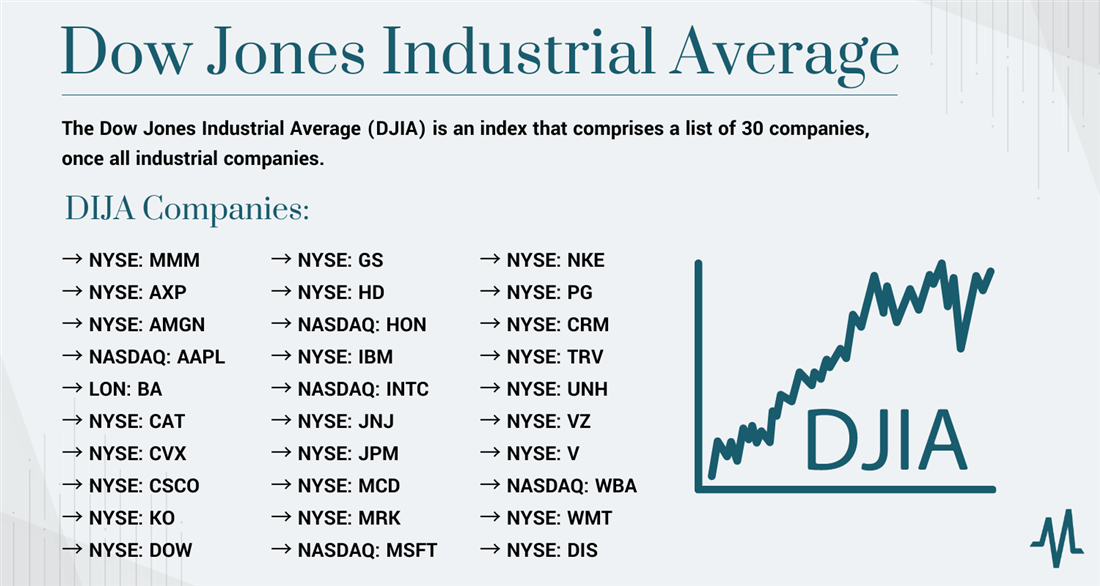
The 30 stocks in the Dow are not static. They are a rotating cast of characters designed to represent the “now” of the American business world. Looking at the current composition offers a masterclass in modern diversification.
Major Sectors Represented in Today’s Average
Today’s Dow is heavily weighted toward Information Technology, Healthcare, and Financials. Companies like Apple, Goldman Sachs, and Johnson & Johnson are cornerstones of the index. By holding these 30 stocks, the index covers everything from the smartphones in our pockets to the insurance we pay for and the banks where we keep our savings. It represents a cross-section of the consumer and corporate spending that drives the GDP.
Recent Changes: Why Stocks Get Swapped Out
The removal of a stock from the Dow is often a sign of a shifting economic tide. A recent notable change was the removal of Walgreens Boots Alliance, which was replaced by Amazon in early 2024. This swap highlighted the decline of traditional retail pharmacy models in favor of the e-commerce and cloud computing dominance of Amazon. For investors, these changes serve as a signal of which industries are ascending and which are facing structural headwinds.
Investing in the Dow: Strategies for Individual Investors
For those looking to build wealth, the Dow Jones Industrial Average offers a blueprint for stability. Because the index is composed of profitable, dividend-paying companies, it is often seen as a “safer” bet than the more volatile, tech-heavy Nasdaq.
Passive Investing through ETFs and Index Funds
Most individual investors do not buy all 30 stocks individually. Instead, they use financial tools like Exchange-Traded Funds (ETFs). The most famous of these is the SPDR Dow Jones Industrial Average ETF Trust, known by its ticker symbol “DIA” or “Diamonds.” By purchasing shares of this ETF, an investor gains exposure to all 30 blue-chip stocks in a single transaction, benefiting from their collective dividends and growth.
The Limitations of the Dow for Diversified Portfolios
While the Dow is a prestigious list, a sound financial strategy usually requires more than just 30 stocks. Because it excludes smaller, high-growth companies and has no exposure to international markets, it should rarely be the only component of a retirement portfolio. However, as a core “Money” strategy, using the Dow as a foundation for the large-cap portion of a portfolio provides a history of resilience. Even during the Great Depression, the 2008 financial crisis, and the 2020 pandemic, the 30 stocks of the Dow have shown an ability to recover and reach new highs over the long term.
In conclusion, while the number 30 might seem small, the weight these stocks carry is immense. The Dow Jones Industrial Average remains the ultimate barometer of corporate America. By understanding its history, its unique price-weighted math, and its evolving membership, investors can better interpret market news and make more informed decisions about their own financial futures. Whether you are a seasoned trader or a novice saver, the “30” is a number that will always matter in the world of money.
aViewFromTheCave is a participant in the Amazon Services LLC Associates Program, an affiliate advertising program designed to provide a means for sites to earn advertising fees by advertising and linking to Amazon.com. Amazon, the Amazon logo, AmazonSupply, and the AmazonSupply logo are trademarks of Amazon.com, Inc. or its affiliates. As an Amazon Associate we earn affiliate commissions from qualifying purchases.