
In the landscape of global finance, few entities command the gravity of Microsoft Corporation. As a cornerstone of the “Magnificent Seven” and a pioneer in the trillion-dollar market cap club, Microsoft represents more than just a software provider; it is a massive economic engine. At the heart of this engine lies its most significant asset and its most substantial operational expense: its employees. For investors, financial analysts, and business strategists, the question of “how many employees does Microsoft have” is not merely a request for a headcount. It is a query into the company’s scalability, its efficiency, and its fiscal trajectory in an increasingly automated world.
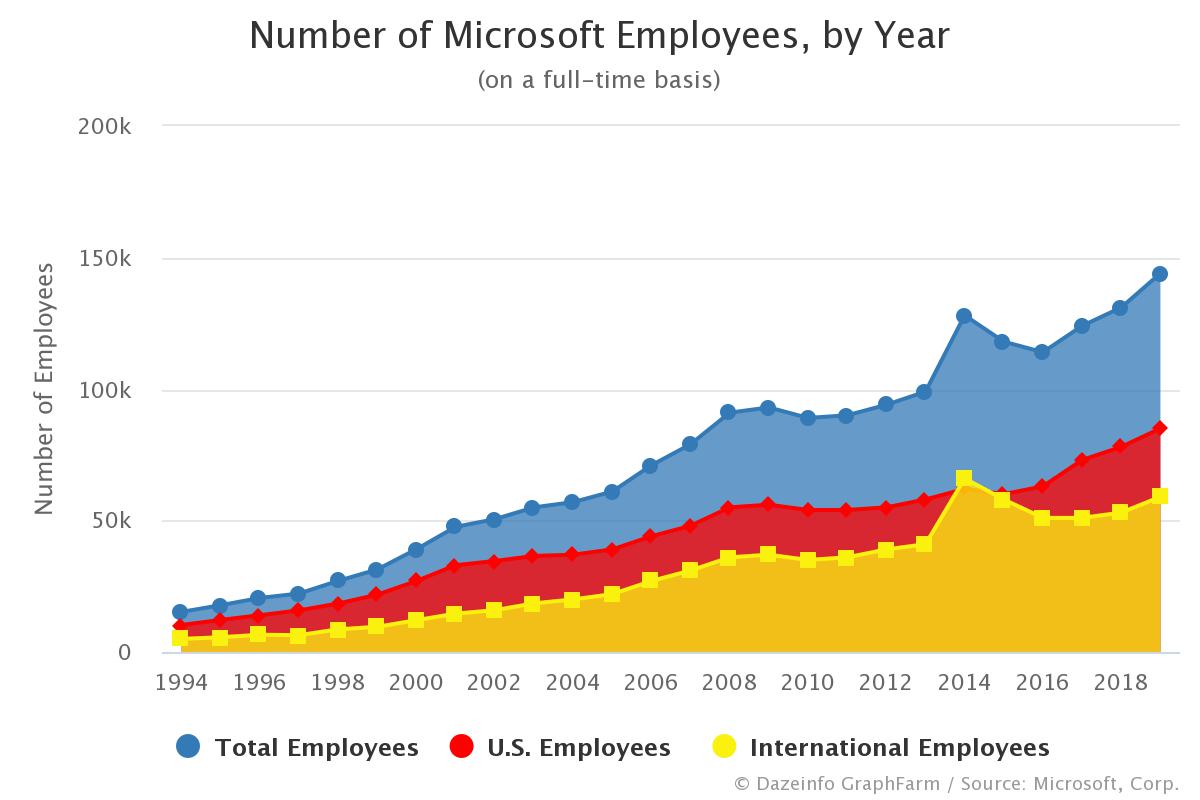
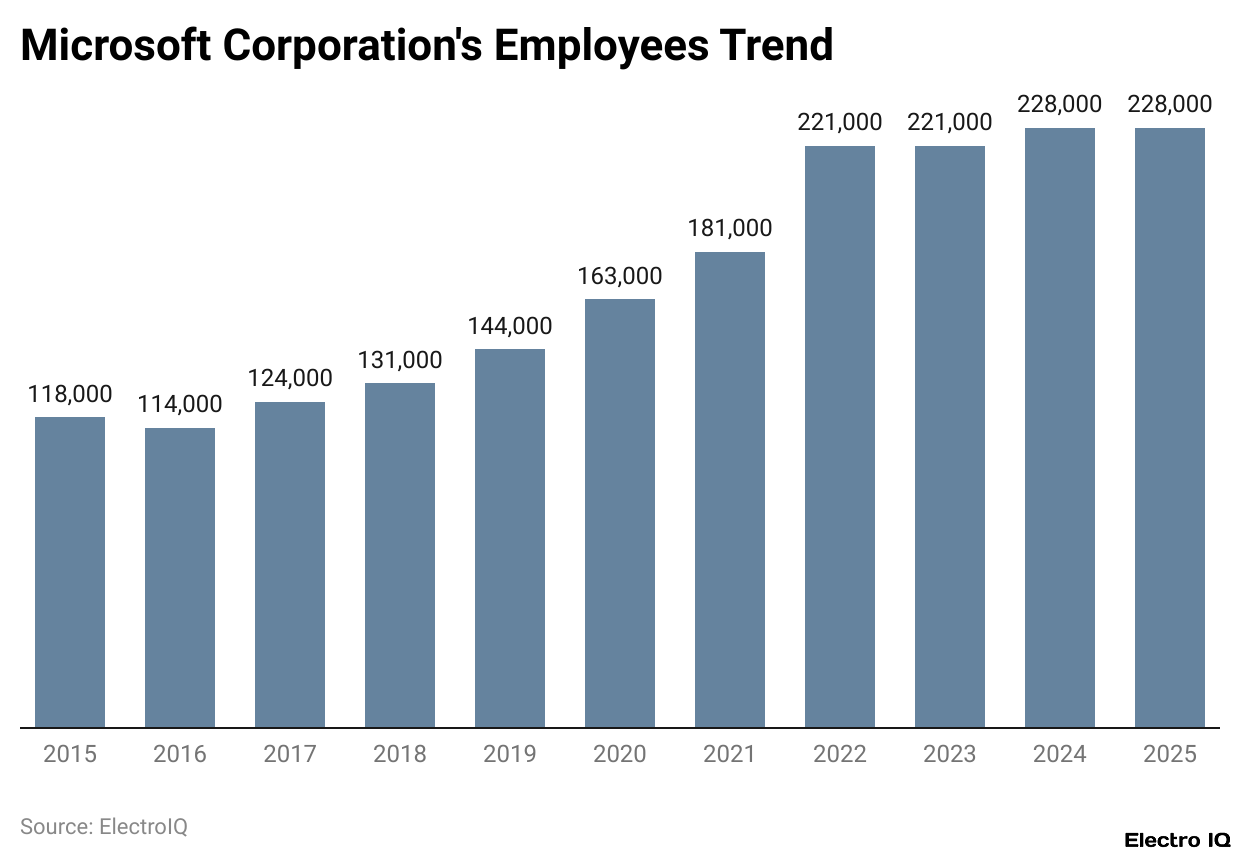
As of the latest fiscal disclosures, Microsoft employs approximately 221,000 people globally. While this number provides a sense of the company’s sheer scale, the financial implications of managing a workforce of this size are profound. In the world of high-stakes investing, headcount is a dual-edged sword—representing the creative power to drive innovation while simultaneously serving as a primary driver of operational expenditure (OPEX).
The Numbers Behind the Name: Tracking Microsoft’s Rapid Expansion
The trajectory of Microsoft’s headcount over the last decade serves as a proxy for its aggressive transition from a legacy software firm to a cloud and AI powerhouse. Under the leadership of CEO Satya Nadella, the company has undergone a fundamental shift in its business model, which is reflected in the sheer volume of human capital required to sustain its growth.
Historical Headcount Trends and Fiscal Growth
In the early 2010s, Microsoft’s workforce hovered around 90,000 to 100,000 employees. However, the pivot toward Azure (cloud computing) and the “Mobile First, Cloud First” strategy necessitated a massive influx of specialized talent. Between 2018 and 2023, the company saw a headcount increase of over 70%. From a financial perspective, this growth was funded by the massive high-margin cash flows from its Office 365 and Server products.
Investors track these trends to ensure that headcount growth does not outpace revenue growth. For Microsoft, the correlation has remained remarkably healthy. As the workforce expanded, the company’s market valuation soared, suggesting that each new hire was contributing disproportionately to the bottom line, rather than acting as a drag on profit margins.
Geographic Distribution and Labor Cost Optimization
Microsoft is a truly global corporation, with its workforce spread across North America, Europe, Asia, and Latin America. However, the distribution of these employees is a calculated financial decision. While the headquarters in Redmond, Washington, remains the hub of high-value engineering and executive leadership, Microsoft has strategically expanded its presence in regions with lower labor costs but high technical expertise, such as India and Eastern Europe.
By diversifying its workforce geographically, Microsoft optimizes its payroll expenses. For example, the Microsoft India Development Center (MSIDC) is one of its largest hubs outside the US. From a business finance standpoint, this allows the company to maintain 24/7 development cycles and tap into emerging markets while managing the weighted average cost of labor. This geographic strategy is a vital component of maintaining the company’s industry-leading operating margins.
Efficiency and Productivity: The Revenue Per Employee Metric
In the realm of personal finance and institutional investing, “Revenue Per Employee” (RPE) is one of the most telling metrics for assessing a company’s operational efficiency. It measures how effectively a company utilizes its human capital to generate top-line growth.
Comparing Microsoft to Big Tech Peers
When we analyze Microsoft’s headcount of 221,000 against its annual revenue—which recently exceeded $211 billion—we find an RPE of approximately $950,000 to $1,000,000. While this is lower than Apple’s staggering RPE (driven by high-margin hardware sales and a smaller relative workforce), it is significantly higher than many traditional industrial or service-based corporations.
For a business of Microsoft’s complexity, maintaining an RPE near the million-dollar mark is a testament to its scalable software-as-a-service (SaaS) model. Unlike a manufacturing firm that must hire more laborers to produce more units, Microsoft can sell millions of additional software licenses with negligible increases in staffing. This scalability is why the stock remains a favorite for long-term “buy and hold” portfolios.
The Shift to High-Margin Cloud Services
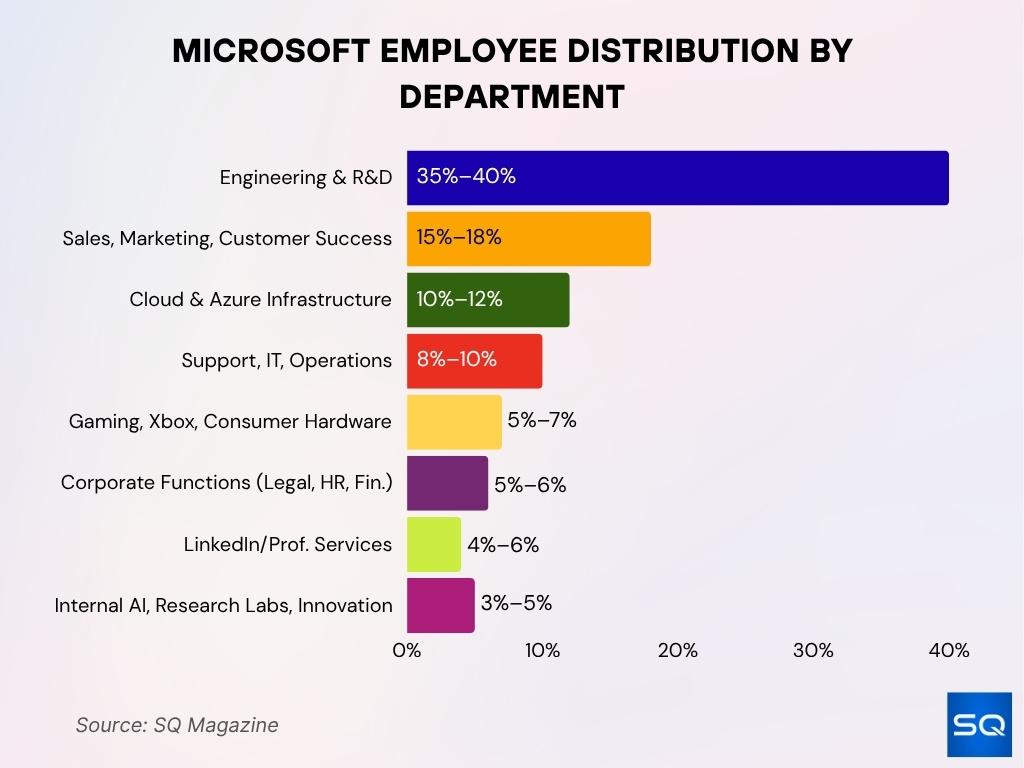
The composition of Microsoft’s workforce has shifted toward the Intelligent Cloud segment, which includes Azure. Cloud computing is inherently more labor-intensive in the setup phase (requiring data center engineers and cloud architects) but becomes highly profitable as it scales.
Financially, the move to the cloud has stabilized Microsoft’s income streams. By shifting from one-time license sales to recurring subscriptions, the company has created a predictable “annuity” model. This predictability allows the finance department to better forecast payroll obligations and capital expenditures, reducing the volatility that often plagues tech stocks.
The Cost of Innovation: R&D and Strategic Acquisitions
A significant portion of Microsoft’s 221,000 employees joined the company not through traditional hiring, but through large-scale corporate acquisitions. These moves are central to Microsoft’s brand of “growth through capital allocation.”
Integration Expenses: LinkedIn, GitHub, and Activision Blizzard
Microsoft’s acquisitions are massive financial undertakings that drastically alter its headcount overnight. The acquisition of LinkedIn added roughly 15,000 employees, while the GitHub deal brought in a smaller but highly specialized talent pool. The most recent and significant move—the acquisition of Activision Blizzard—added approximately 13,000 employees to the gaming division.
From an accounting perspective, these acquisitions involve complex integrations. Microsoft must balance the “goodwill” on its balance sheet with the reality of increased payroll and benefit obligations. Investors look closely at how quickly Microsoft can achieve “synergy”—the point where the combined entities operate more efficiently than they did separately. The financial success of these hires is measured by how quickly the acquired company’s products are integrated into the broader Microsoft ecosystem (e.g., integrating LinkedIn data into Dynamics 365).
Future-Proofing Through AI Investment
Currently, a massive portion of Microsoft’s capital is being diverted into Artificial Intelligence. This isn’t just about GPU clusters and data centers; it’s about the “war for talent.” AI researchers and engineers are among the most expensive employees in the world today, with total compensation packages often reaching mid-six to seven figures.
Microsoft’s partnership with OpenAI and its internal “Copilot” initiatives require a high concentration of expensive, specialized talent. For the finance-minded observer, this is a calculated risk. The company is betting that the productivity gains from AI will eventually allow it to grow its revenue without a linear increase in headcount, eventually leading to even higher profit margins.
Implications for Investors: Scaling in the Era of Automation
As we look toward the future, the “221,000” figure may become a high-water mark. The tech industry at large has entered a period of fiscal discipline, often referred to as the “Year of Efficiency.”
Balancing Growth with Fiscal Discipline
In 2023, Microsoft made the difficult financial decision to lay off approximately 10,000 employees. This move was a response to the post-pandemic economic cooling and a strategic realignment toward AI. To an investor, these layoffs, while socially challenging, signaled a commitment to fiscal responsibility. It demonstrated that management was willing to trim the “fat” to protect the company’s 40%+ operating margins.
This “right-sizing” is a common theme in business finance. By reducing headcount in legacy areas (like certain hardware divisions) and reinvesting that capital into high-growth areas (like Azure and AI), Microsoft ensures that its capital is always working in the most productive way possible.
The Long-Term Outlook for Stockholders
For those interested in the financial side of Big Tech, the headcount at Microsoft is a leading indicator of where the company believes the “next big thing” will be. When Microsoft hires thousands in the security space, it’s a sign that cybersecurity is a growing profit center. When they hire in the gaming sector, it’s a sign of long-term retail revenue goals.
In conclusion, Microsoft’s 221,000 employees represent one of the most powerful and expensive workforces in history. For the company to maintain its status as a market leader, it must continue to balance the high costs of this talent with the immense revenue they generate. As AI begins to automate routine tasks within the company itself, we may see Microsoft enter a new era of financial efficiency—where revenue continues to climb while the headcount stabilizes. For the savvy investor, watching these labor metrics is just as important as watching the quarterly earnings report. It is the human element that ultimately determines the fiscal success of the digital giant.
aViewFromTheCave is a participant in the Amazon Services LLC Associates Program, an affiliate advertising program designed to provide a means for sites to earn advertising fees by advertising and linking to Amazon.com. Amazon, the Amazon logo, AmazonSupply, and the AmazonSupply logo are trademarks of Amazon.com, Inc. or its affiliates. As an Amazon Associate we earn affiliate commissions from qualifying purchases.