
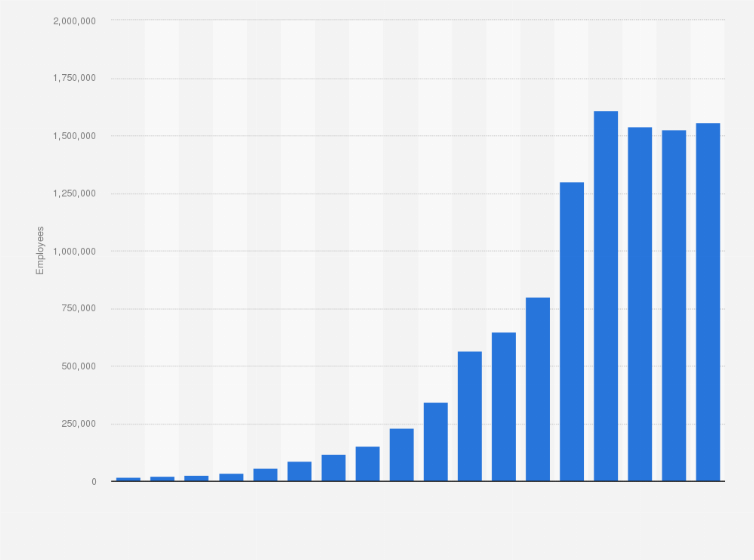
When evaluating the financial health and operational efficiency of global conglomerates, few metrics are as telling—or as staggering—as the total employee headcount. For Amazon, the numbers are more than just a census; they are a direct reflection of the company’s capital allocation strategy, its aggressive expansion into logistical infrastructure, and its long-term viability as a blue-chip investment. As of recent filings, Amazon employs approximately 1.5 million full-time and part-time workers globally. To put this in perspective, Amazon’s workforce is larger than the populations of several sovereign nations, positioning it as the second-largest private employer in the United States, trailing only Walmart.

From a financial perspective, managing a human capital pool of this magnitude presents a unique set of challenges and opportunities. For investors and business analysts, the question is not merely “how many employees does Amazon have,” but rather how that massive headcount influences the company’s bottom line, its operational margins, and its strategic pivot toward automation.
The Financial Architecture of Amazon’s Global Headcount
Understanding Amazon’s workforce requires a deep dive into the diverse segments of its business model. The company does not operate as a monolith; instead, its 1.5 million employees are distributed across vastly different economic engines, each with its own labor-to-revenue ratio.
The Divergence Between AWS and Retail Logistics
One of the most critical financial distinctions within Amazon is the headcount distribution between Amazon Web Services (AWS) and its sprawling retail and logistics operations. AWS, the company’s primary profit driver, operates with a relatively lean, high-skill workforce. The revenue generated per employee in the cloud computing sector is exponentially higher than that of the retail sector.
Conversely, the vast majority of Amazon’s 1.5 million employees are concentrated in fulfillment centers, delivery stations, and sorting facilities. These roles are labor-intensive and carry a significant impact on the company’s Operating Expenses (OpEx). For financial analysts, the “Cost of Sales” and “Fulfillment Costs” are the most scrutinized lines on the income statement, as they represent the massive capital required to maintain such a high-volume workforce.
Post-Pandemic “Right-Sizing” and Capital Efficiency
Following the unprecedented surge in e-commerce during 2020 and 2021, Amazon embarked on a historic hiring spree, nearly doubling its workforce in a two-year window. However, as the global economy shifted toward a high-interest-rate environment in 2023 and 2024, the company shifted its strategy from “growth at all costs” to “operational efficiency.”
This period saw the first significant layoffs in the company’s history, affecting roughly 27,000 corporate roles. From a business finance standpoint, this move was viewed as a “right-sizing” of the balance sheet. By trimming corporate overhead while maintaining its frontline logistical force, Amazon demonstrated a commitment to protecting its margins and improving its free cash flow—a move that was largely rewarded by the equity markets.
Labor as a Financial Lever: Managing Billions in Operational Expenses
In the world of corporate finance, labor is often the largest variable expense. For Amazon, a change of just one dollar in the average hourly wage across its fulfillment network can result in billions of dollars in additional annual expenses.
The Impact of Minimum Wage and Labor Competition
Amazon has been a vocal advocate for a $15 minimum wage, a move that was as much a strategic business decision as it was a social one. By setting a high floor for wages, Amazon effectively forced its competitors to match these costs, leveraging its massive scale to absorb labor price increases more efficiently than smaller retailers.
However, the financial pressure of rising labor costs remains a persistent risk. In many markets, Amazon now pays significantly higher than $15 to remain competitive in a tight labor market. These rising “Fulfillment Expenses” are a core component of the company’s financial reporting. Investors track the “Shipping and Fulfillment” costs as a percentage of net sales to determine if Amazon is successfully utilizing its massive workforce to generate incremental profit or if labor costs are eating into the margins of the retail business.

Unionization and Long-Term Financial Liabilities
A significant area of focus for financial analysts is the potential for large-scale unionization within Amazon’s ranks. From a strictly financial perspective, unionization typically leads to higher fixed labor costs, increased benefit obligations, and potential disruptions to the highly optimized “just-in-time” logistics model.
While Amazon has successfully navigated most unionization efforts to date, the financial community monitors these developments closely. Any shift toward a unionized workforce would require a re-evaluation of Amazon’s long-term margin guidance, as it would likely increase the “Cost of Goods Sold” (COGS) and reduce the flexibility of the company’s seasonal hiring strategies.
The Economic Model of Seasonal Scaling and Gig Economy Integration
Amazon’s ability to manage its headcount is not static; it is a dynamic, seasonal process that serves as a masterclass in financial elasticity.
The Prime Day and Holiday Surge
Every year, Amazon hires hundreds of thousands of seasonal workers to handle the peak demand of Prime Day and the Q4 holiday season. This “flex” model allows the company to meet consumer demand without carrying the massive financial burden of a permanent workforce during slower months.
From a cash flow perspective, this strategy is highly efficient. It allows Amazon to scale its Variable Costs in direct proportion to its Revenue growth. The financial mastery lies in the company’s ability to onboard, train, and offboard a population the size of a mid-sized city within a matter of months, all while maintaining the delivery speeds that define its brand value.
Amazon Flex and the Off-Balance-Sheet Workforce
Beyond the 1.5 million direct employees, Amazon utilizes a massive network of independent contractors through the “Amazon Flex” program and third-party Delivery Service Partners (DSPs). This is a crucial distinction for anyone looking at the company’s true economic footprint.
By utilizing contractors, Amazon reduces its direct liability for healthcare, retirement benefits, and payroll taxes. This “asset-light” approach to the “last mile” of delivery allows the company to maintain a smaller official headcount than its actual operations would suggest. For investors, this represents a sophisticated way to manage risk and maintain a higher Return on Invested Capital (ROIC).
Robotics, Automation, and the Long-term Financial Forecast
The ultimate question for the future of Amazon’s workforce is the intersection of human capital and capital expenditure (CapEx) in automation. Amazon is currently one of the world’s largest investors in robotics, specifically through its Amazon Robotics division.
The Capex vs. Opex Trade-off
The financial rationale for increasing the number of robots in fulfillment centers is clear: robots represent a high upfront Capital Expenditure but significantly lower long-term Operating Expenses. Unlike human employees, robots do not require health insurance, do not experience fatigue, and can work 24/7 with minimal marginal cost.
Amazon currently has over 750,000 robots deployed across its network. As this number grows, the growth rate of the human workforce is expected to decouple from the growth rate of the company’s total volume. For the finance-minded observer, this transition is the “Holy Grail” of scalability. If Amazon can continue to increase its revenue while plateauing or even reducing its total headcount, its profit margins will expand significantly, potentially re-rating the stock’s valuation.
Future Outlook: Efficiency Over Expansion
As we look toward the next decade, Amazon’s “how many employees” metric will likely become a secondary indicator to “revenue per employee.” The company has reached a stage of maturity where sheer size is no longer the goal; instead, the focus has shifted to the refinement of its massive economic engine.
The financial narrative of Amazon is moving from a story of rapid hiring to one of technological integration. By balancing a 1.5-million-strong workforce with cutting-edge AI and robotics, Amazon is attempting to solve the oldest problem in business finance: how to scale a labor-intensive operation into a high-margin, tech-driven powerhouse. For shareholders, the stability of this workforce—and the efficiency with which it is managed—remains the most critical factor in the company’s continued financial dominance.
aViewFromTheCave is a participant in the Amazon Services LLC Associates Program, an affiliate advertising program designed to provide a means for sites to earn advertising fees by advertising and linking to Amazon.com. Amazon, the Amazon logo, AmazonSupply, and the AmazonSupply logo are trademarks of Amazon.com, Inc. or its affiliates. As an Amazon Associate we earn affiliate commissions from qualifying purchases.