
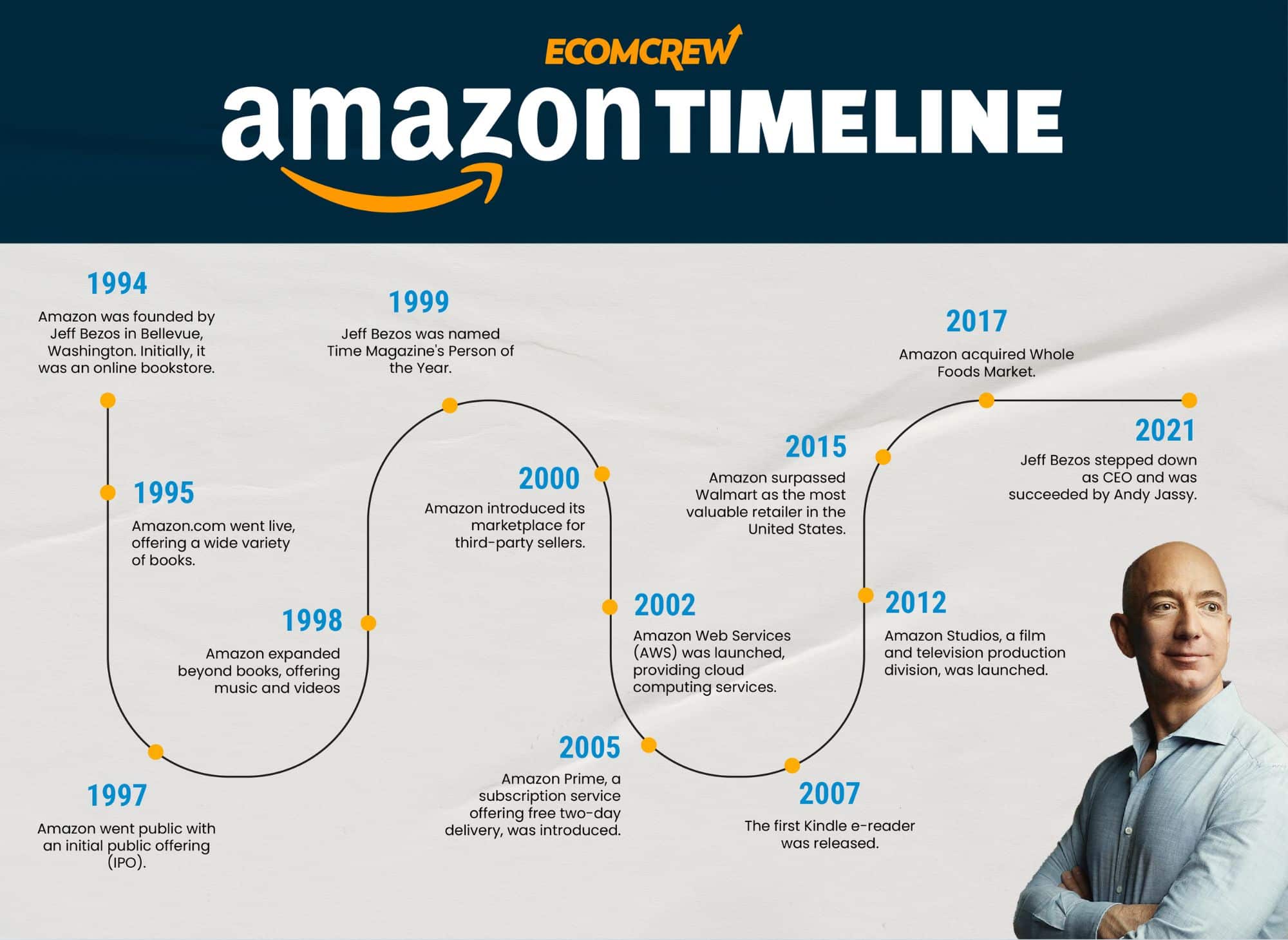
To understand how long Amazon has been around is to trace the timeline of the modern internet itself. While many consumers view Amazon primarily as a retail destination, its nearly 30-year history is a masterclass in technological evolution. Since its incorporation in July 1994, Amazon has transitioned from a modest online bookseller into a diversified technology conglomerate that provides the foundational infrastructure for the global digital economy. This article explores the three-decade technical journey of Amazon, focusing on the software breakthroughs, hardware innovations, and infrastructure shifts that have redefined the tech industry.
From Garage to Global Server: The Origins and Early Infrastructure (1994–2002)
Amazon’s technological journey began in a garage in Bellevue, Washington. While the company officially opened its virtual doors in 1995, the groundwork was laid in 1994 when Jeff Bezos identified the “2,300% annual growth” of the web. At that time, e-commerce was a theoretical concept rather than a functional reality.
The 1994 Inception: Cadabra and the Birth of E-commerce
In its earliest iteration, the technology behind Amazon (then briefly called Cadabra) was rudimentary. The site was built using basic HTML and relied on a massive relational database to manage inventory. In 1994, the challenge wasn’t just selling books; it was creating a secure, searchable interface that could handle concurrent users over dial-up connections. The technical achievement of this era was the implementation of the “1-Click” ordering system, patented in 1997. This wasn’t just a convenience feature; it was a complex data-handling breakthrough that allowed the server to store and recall encrypted credit card data and shipping preferences instantaneously, reducing friction in a way no other platform had achieved.
Scaling the Impossible: Early Database Management
As the company grew throughout the late 1990s, it faced the “monolith” problem. Amazon’s website was originally a giant, single-tiered software application. By the turn of the millennium, this architecture became a bottleneck. The tech team realized that to survive, they needed to decouple their services. This led to a monumental shift toward a service-oriented architecture (SOA). This internal pivot allowed different teams to manage specific site functions—such as the recommendation engine or the shopping cart—as independent services. This architectural decision, born of necessity in the late 90s, laid the technical foundation for what would eventually become cloud computing.
The AWS Revolution: Redefining the Internet’s Backbone (2002–2010)
If the first decade of Amazon was about building a store, the second decade was about building the internet’s engine. Around 2002, Amazon realized that its internal competence in managing massive scale, storage, and compute power was a product in itself.
The Birth of Cloud Computing (2006)
In 2006, Amazon Web Services (AWS) officially launched, forever changing the trajectory of software development. Before AWS, a tech startup had to invest thousands of dollars in physical servers and data center space before writing a single line of code. Amazon’s introduction of Simple Storage Service (S3) and Elastic Compute Cloud (EC2) introduced the concept of “Infrastructure as a Service” (IaaS). By commoditizing server space, Amazon allowed developers to rent virtualized hardware. This shift enabled the “lean startup” movement, powering future giants like Netflix, Pinterest, and Airbnb.
Elasticity and the Move Toward Microservices
The genius of Amazon’s tech during this era was “elasticity.” AWS allowed systems to scale up or down automatically based on traffic. Technologically, this was achieved through sophisticated virtualization layers that partitioned physical server resources into multiple virtual machines. Internally, Amazon perfected the “Two-Pizza Team” rule, where small teams owned the full lifecycle of a microservice. This methodology ensured that the Amazon.com site could handle the immense load of “Black Friday” events without a total system failure, as individual services could fail or scale without crashing the entire ecosystem.
Hardware and Ecosystem Innovation: Devices That Changed User Behavior (2007–2017)
As Amazon reached its 15th anniversary, it shifted focus from the “invisible” tech of servers to the “visible” tech of consumer electronics. This era proved that Amazon could integrate hardware with its sophisticated software backend.
Kindle (2007): Digitizing the Written Word
When the first Kindle was released in 2007, it wasn’t just a tablet; it was a wireless ecosystem. The “Whispersync” technology was a significant software milestone, using cellular networks (EV-DO) to allow users to download books without a computer or a Wi-Fi connection. The hardware utilized E-Ink technology, which required a specialized display controller to manage page refreshes while consuming minimal battery. This was Amazon’s first major foray into specialized Linux-based operating systems, proving they could manage a hardware supply chain as effectively as a software stack.
Echo and Alexa: The Rise of Ambient Computing
In 2014, Amazon introduced the Echo, powered by the Alexa Voice Service. This represented a massive leap in Natural Language Processing (NLP) and Machine Learning (ML). For a device to “wake up” to a specific word and process a command in milliseconds, Amazon had to solve the problem of latency. Most of the processing happened in the cloud; the device would capture a “snippet” of audio, send it to AWS servers for intent analysis, and return a response. This popularized “Ambient Computing,” where technology exists in the background of the user’s environment rather than requiring a screen-based interface.
Robotics and AI: The Algorithmic Future of Fulfillment (2012–Present)
As Amazon approaches its 30th year, its most impressive technical feats are occurring within the physical world, driven by advanced robotics and artificial intelligence. The transition from manual labor to an automated, AI-driven logistics network is the company’s current technical frontier.
Kiva Systems and Warehouse Automation
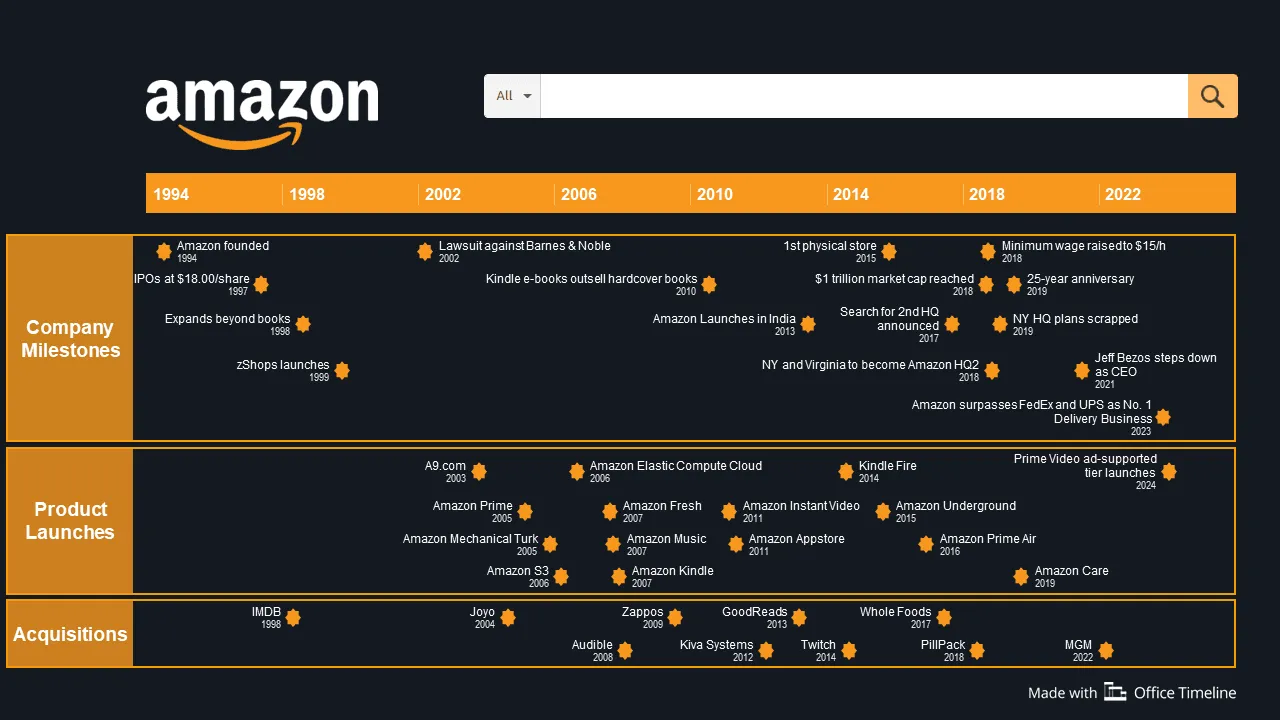
In 2012, Amazon acquired Kiva Systems, a robotics company. This led to the deployment of hundreds of thousands of autonomous mobile robots (AMRs) in fulfillment centers. These robots are not pre-programmed with fixed paths; they use computer vision and sensor fusion to navigate dynamic environments. The software orchestrating these robots is a marvel of “swarm intelligence,” ensuring that thousands of units can move simultaneously without collision to bring shelves to human workers.
Predictive Analytics and Anticipatory Shipping
Beyond physical robots, Amazon’s “anticipatory shipping” algorithm represents a peak in big data application. By analyzing years of user behavior, search history, and regional trends, Amazon’s AI can predict what a customer will buy before they buy it. The tech stack then moves that inventory to a local hub. This involves deep learning models that process petabytes of data daily. Furthermore, in their “Amazon Go” stores, the company utilizes “Just Walk Out” technology—a sophisticated blend of computer vision, deep learning algorithms, and sensor fusion—to eliminate the traditional point-of-sale system entirely.
The Next Three Decades: Quantum, Space, and Generative AI
How long Amazon stays at the top of the tech world will depend on its ability to lead the next wave of disruptive technologies. The company is currently investing heavily in sectors that will define the mid-21st century.
Project Kuiper and Satellite Internet
Amazon’s Project Kuiper is a planned low Earth orbit (LEO) satellite constellation designed to provide high-speed, low-latency broadband. This is a massive aerospace and networking challenge. The tech involves “optical inter-satellite links” (lasers) to transmit data between satellites in space, creating a mesh network that bypasses traditional ground-based fiber optics. This represents Amazon’s shift from being a user of the internet to being a literal provider of its physical layer.
Generative AI and the Bedrock Framework
In the current era of Generative AI, Amazon is positioning AWS as the primary workshop for AI developers. With “Amazon Bedrock,” they are providing a managed service that makes Foundation Models (FMs) from Amazon and leading AI startups available via an API. Instead of just building one “chatbot,” Amazon is building the infrastructure that allows every other company to build their own AI. This strategy mirrors the original launch of AWS in 2006, ensuring that as long as AI is the dominant tech trend, Amazon remains the underlying platform supporting it.
From a 1994 startup to a 2024 titan, Amazon’s longevity is a testament to its “Day 1” philosophy—a technical mindset that treats every day as a new opportunity to innovate and every legacy system as a candidate for disruption. While the interface we interact with may look like a simple store, the tech stack beneath it remains one of the most complex and influential achievements in human history.
aViewFromTheCave is a participant in the Amazon Services LLC Associates Program, an affiliate advertising program designed to provide a means for sites to earn advertising fees by advertising and linking to Amazon.com. Amazon, the Amazon logo, AmazonSupply, and the AmazonSupply logo are trademarks of Amazon.com, Inc. or its affiliates. As an Amazon Associate we earn affiliate commissions from qualifying purchases.