
In an increasingly data-driven world, the ability to represent numbers accurately and efficiently is paramount. While decimals and percentages offer convenient forms for everyday calculations, fractions remain fundamental for precision, particularly in scientific computing, engineering, and various aspects of software development. The question “how do you convert to a fraction” is not merely a mathematical exercise; it’s a gateway to understanding exact values, optimizing algorithms, and ensuring data integrity in technological applications. This article delves into how modern technology empowers us to convert various numerical forms into fractions, highlighting the tools, methods, and underlying principles that make this seemingly simple conversion a powerful asset in the tech landscape.
The Digital Toolkit for Fractional Conversions
Gone are the days when converting complex decimals or mixed numbers to fractions was a tedious, manual process prone to error. Today’s digital ecosystem offers a rich array of tools that streamline this conversion, making it accessible to professionals and students alike. These tools range from ubiquitous calculator apps to sophisticated programming environments, each offering unique advantages.
Calculator Apps and Built-in Functions
For quick and accessible conversions, many standard and scientific calculator applications, whether on smartphones, desktops, or web-based platforms, include built-in functions for fraction conversion. These tools often allow users to input decimals and, with a tap of a button (commonly labeled “F<>D” or similar), receive the equivalent fraction in its simplest form. Some advanced calculators can even handle mixed numbers, converting them to improper fractions and vice versa. The convenience of these apps makes them invaluable for on-the-fly calculations and educational purposes, providing instant feedback and verifying manual conversions. They often employ algorithms that search for rational approximations within a certain tolerance, making them highly effective for common cases.
Scientific Computing Environments and Programming Languages
For developers, data scientists, and engineers, scientific computing environments and programming languages offer more robust and customizable solutions. Languages like Python, with its fractions module, provide precise control over fractional arithmetic. This module allows for the creation of Fraction objects from integers, floats, decimals, and even strings, maintaining exact rational numbers throughout calculations. Similarly, MATLAB, R, and Julia offer packages and functions designed for symbolic math and arbitrary-precision arithmetic, which inherently support fractional representations. This capability is crucial when floating-point inaccuracies could lead to significant errors in complex simulations, financial models, or scientific experiments. Programmatic conversion also allows for automation, enabling large datasets to be processed or dynamic calculations to be performed while preserving numerical exactness.
Specialized Math Software and Online Platforms
Beyond general-purpose tools, specialized mathematical software and online platforms provide advanced capabilities for fraction conversion and symbolic manipulation. Wolfram Alpha, for instance, is an computational knowledge engine that can take virtually any numerical input and present its fractional equivalent, often alongside other useful representations and mathematical properties. Symbolab, Mathway, and similar platforms offer step-by-step solutions, which are particularly beneficial for learning and understanding the underlying mechanics of the conversion process. These tools are often more adept at handling complex expressions, recurring decimals, and irrational numbers, offering approximations or continued fraction expansions where exact rational representation is not possible. Their ability to contextualize results with explanations makes them powerful educational aids and reliable reference tools for researchers.
Beyond Basic Math: Why Fractions Matter in Tech
The utility of fractions extends far beyond the classroom. In various technological domains, understanding and applying fractional representations can be critical for achieving precision, optimizing performance, and ensuring the reliability of systems.
Data Representation and Precision
In computer science, representing numbers accurately is a constant challenge. Floating-point numbers, while efficient, are often approximations and can introduce subtle errors over many operations. Fractions, on the other hand, offer exact rational representations. This is vital in areas such as cryptography, where precise number theory is foundational; in scientific simulations, where cumulative rounding errors can invalidate results; and in graphics rendering, where exact aspect ratios and coordinate transformations are necessary for visual fidelity. For instance, expressing a probability as 1/3 rather than 0.33333333 prevents loss of information and ensures that subsequent calculations maintain mathematical exactness, which is critical in machine learning models and statistical analysis.
Algorithm Optimization and Efficiency
Algorithms that rely on precise numerical calculations can benefit significantly from fractional arithmetic. By avoiding floating-point conversions and operating directly with fractions, developers can sometimes achieve more deterministic and predictable results. For example, in certain computational geometry algorithms or in financial systems dealing with exact currency conversions, maintaining fractional precision throughout intermediate steps can prevent rounding errors from accumulating and affecting the final output. Furthermore, in some scenarios, fractional arithmetic can be more efficient, especially when dealing with rational numbers that have repeating decimal expansions, as it avoids the overhead of managing long strings of decimal places that are inherently inexact.
User Interface and Experience (UI/UX)
While users typically interact with decimals or whole numbers, fractions play an indirect but important role in UI/UX design, particularly concerning responsiveness and visual consistency. Aspect ratios for images and videos are fundamentally fractional (e.g., 16:9, 4:3), ensuring content scales correctly across different screen sizes and resolutions. Similarly, in responsive web design, layout grids and element sizing often rely on proportional or fractional units to adapt seamlessly to various viewports. Understanding these underlying fractional relationships allows designers and front-end developers to create fluid, aesthetically pleasing interfaces that maintain their integrity regardless of the user’s device, contributing significantly to a positive user experience.
Step-by-Step: A Practical Guide to Digital Fraction Conversion
Understanding the tools is one thing; applying them effectively is another. This section provides a practical, conceptual guide to performing fraction conversions using digital tools, focusing on common scenarios.
Converting Decimals to Fractions Digitally
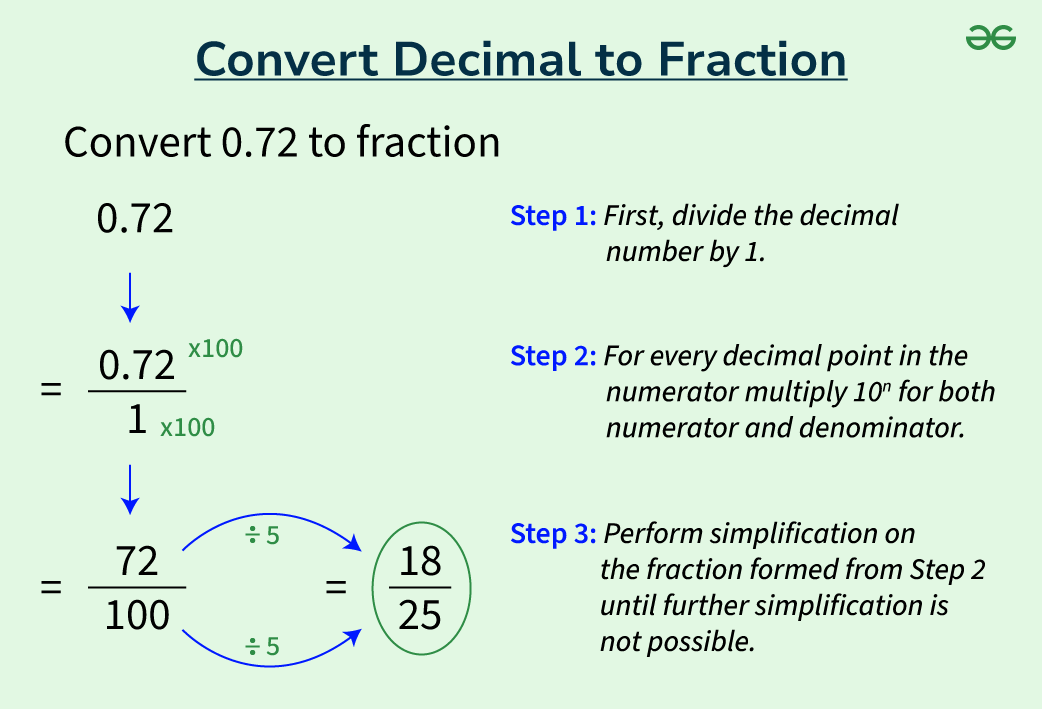
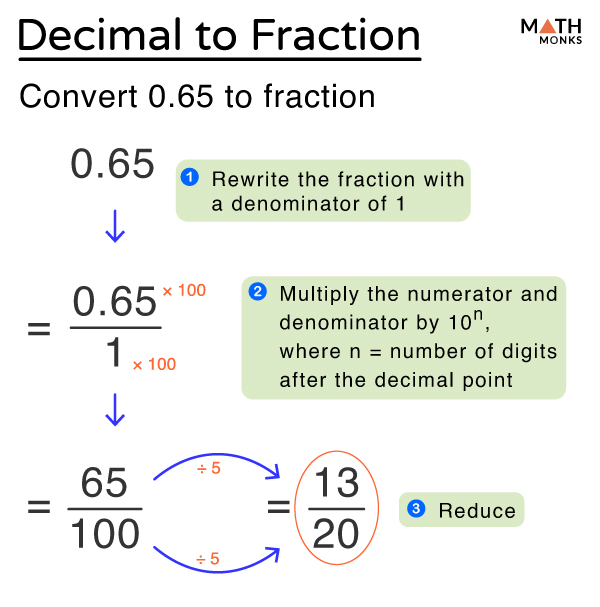
The most frequent conversion task is turning a decimal into a fraction. For terminating decimals (e.g., 0.25, 1.75), digital tools typically identify the place value of the last digit and express the number as a fraction over a power of ten, then simplify. For example, 0.25 becomes 25/100, which simplifies to 1/4. Calculator apps and programming modules automate this simplification process. For non-terminating, recurring decimals (e.g., 0.333…), the process is more complex, involving algebraic manipulation to isolate the repeating part. Digital tools often implement algorithms that detect repeating patterns and use this algebraic method to find the exact rational fraction (e.g., 0.333… becomes 1/3).
Handling Recurring Decimals with Tech
When confronted with recurring decimals, manual conversion can be cumbersome. Technology offers elegant solutions. Dedicated math software or programming languages with symbolic math capabilities can instantly identify the repeating block and generate the exact fraction. For instance, inputting “0.142857142857…” into Wolfram Alpha will yield 1/7. In Python, you can achieve this by passing the decimal as a string to the Fraction constructor (e.g., Fraction('0.142857142857')), which then determines the underlying fraction. These tools leverage sophisticated algorithms that essentially reverse the division process, finding the smallest integer numerator and denominator that produce the given repeating decimal.
From Percentages to Fractions, Instantly
Converting percentages to fractions is straightforward: a percentage is simply a fraction out of 100. So, 75% becomes 75/100. Digital tools automate the simplification of this fraction. Most calculator apps allow direct input of percentages or offer a percentage key to facilitate this. In programming contexts, dividing the percentage value by 100 before passing it to a fraction constructor (e.g., Fraction(75/100)) will achieve the desired result, with the tool handling the simplification to 3/4. This instant conversion is invaluable in data analysis, where percentages are often used to express proportions but fractions might be needed for exact calculations or ratio comparisons.
Overcoming Challenges and Ensuring Accuracy
While technology simplifies fraction conversion, it’s crucial to be aware of potential pitfalls and best practices to ensure accuracy and reliability.
Understanding Floating-Point Limitations
A significant challenge arises when converting floating-point numbers (standard decimal representations in computers) to fractions. Due to the binary nature of computers, many decimal numbers cannot be represented exactly as finite binary fractions, leading to tiny inaccuracies. For example, 0.1 is not precisely 0.1 in binary; it’s a very close approximation. When converting such a floating-point number to a fraction, the software might produce a very complex, high-denominator fraction that accurately reflects the binary approximation rather than the intended decimal value. To mitigate this, some tools allow specifying a tolerance or working with decimal strings to ensure the conversion operates on the exact decimal value rather than its binary float representation.
Verifying Results and Cross-Referencing
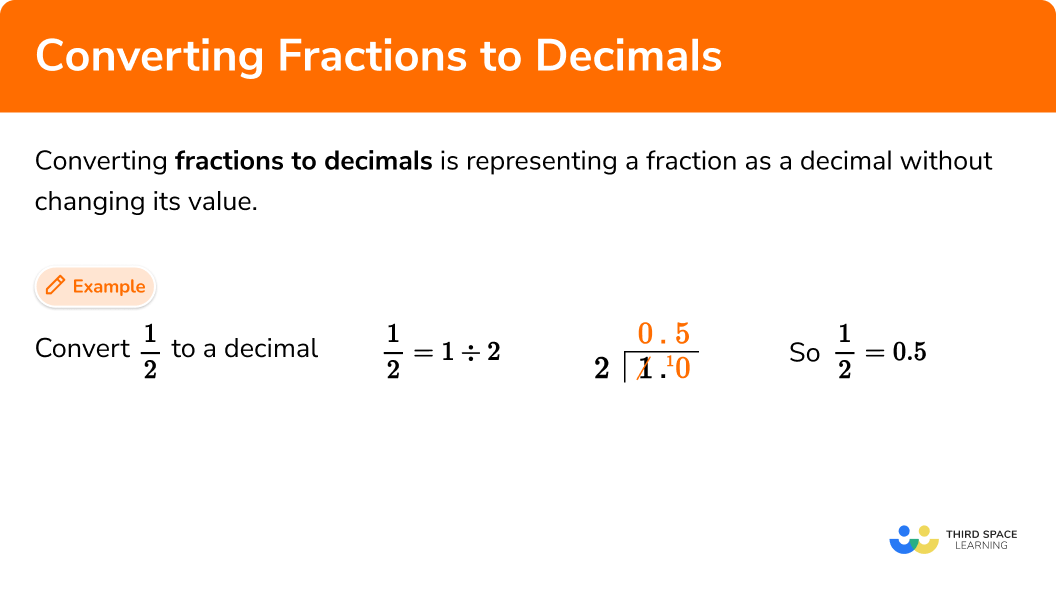
Even with advanced tools, it’s good practice to verify results, especially in critical applications. For simpler conversions, a quick mental check or reverse conversion (fraction to decimal) can confirm accuracy. For more complex cases, cross-referencing with multiple reliable tools or understanding the step-by-step logic provided by educational platforms can build confidence in the output. Understanding the context of the number being converted (e.g., is it an exact measurement, an approximation, or a repeating decimal?) helps in interpreting the fractional result appropriately.
Choosing the Right Tool for the Job
The choice of tool depends heavily on the specific task. For casual conversions, a smartphone calculator is sufficient. For academic learning or step-by-step understanding, platforms like Symbolab are ideal. For developing robust software applications where exact arithmetic is paramount, programming languages with dedicated fraction modules (like Python’s fractions) or symbolic math libraries are indispensable. For high-performance scientific computing where precision is balanced with speed, carefully managed floating-point operations alongside strategic use of fractional representations might be necessary. Aligning the tool with the requirement ensures both efficiency and accuracy.
Conclusion
The ability to convert numbers to fractions, simplified and enhanced by modern technology, is more than just a mathematical trick; it’s a fundamental skill in the digital age. From the humble calculator app to sophisticated programming environments, technology provides the means to achieve unparalleled precision, optimize algorithmic performance, and ensure clarity in data representation. As we continue to push the boundaries of computing, artificial intelligence, and data science, the exactness offered by fractional arithmetic, readily accessible through our digital toolkits, will remain an essential component for building robust, reliable, and insightful technological solutions. Understanding “how do you convert to a fraction” in the context of technology is about embracing precision and leveraging the power of exact numbers to forge a more accurate and efficient digital future.
aViewFromTheCave is a participant in the Amazon Services LLC Associates Program, an affiliate advertising program designed to provide a means for sites to earn advertising fees by advertising and linking to Amazon.com. Amazon, the Amazon logo, AmazonSupply, and the AmazonSupply logo are trademarks of Amazon.com, Inc. or its affiliates. As an Amazon Associate we earn affiliate commissions from qualifying purchases.