
Navigating the world of loans can feel like deciphering a complex financial code. Whether you’re considering a mortgage, an auto loan, a personal loan, or even consolidating debt, one of the most critical figures you’ll encounter is the monthly payment. Understanding how this number is derived isn’t just about financial literacy; it’s about empowerment. It allows you to budget effectively, compare loan offers intelligently, and ultimately make informed decisions that impact your financial well-being for years to come.
Many people rely solely on lenders to tell them their monthly payment, accepting the figure without truly understanding its components. However, taking the time to grasp the underlying calculation can reveal hidden insights, help you identify potential pitfalls, and even save you a significant amount of money over the life of the loan. This comprehensive guide will demystify the process, breaking down the formula and offering practical tools to help you calculate and understand your loan payments with confidence.

Understanding the Core Components of a Loan Payment
Before diving into the mechanics of calculation, it’s essential to understand the fundamental elements that constitute any loan and, consequently, influence your monthly payment. Each of these components plays a crucial role in shaping the final figure you pay back each month.
Principal
The principal is the original amount of money you borrow. If you take out a $100,000 mortgage, $100,000 is your principal. This is the sum upon which interest is calculated, and it’s the amount you are obligated to repay in full, separate from any interest or fees. Over the life of an amortizing loan, each monthly payment gradually reduces this principal balance.
Interest Rate (APR vs. Nominal)
The interest rate is essentially the cost of borrowing money, expressed as a percentage of the principal. It’s the fee lenders charge for the use of their capital. However, it’s vital to distinguish between different types of interest rates:
- Nominal Interest Rate: This is the stated interest rate on a loan, typically expressed annually. For calculation purposes, this annual rate needs to be converted into a monthly rate (annual rate divided by 12).
- Annual Percentage Rate (APR): The APR is a broader measure of the cost of borrowing money, encompassing not only the interest rate but also other charges and fees associated with the loan, such as origination fees, discount points, and some closing costs. While the nominal rate is used in the direct monthly payment calculation, the APR provides a more accurate picture of the total annual cost of the loan and is crucial for comparing different loan products.
Loan Term (Amortization Period)
The loan term, or amortization period, refers to the length of time over which you agree to repay the loan. Common loan terms are 15 or 30 years for mortgages, 3 to 7 years for auto loans, and 1 to 5 years for personal loans. The longer the loan term, the lower your monthly payment will typically be, because the principal and interest are spread out over a greater number of payments. However, a longer term also means you’ll pay more in total interest over the life of the loan. Conversely, a shorter term results in higher monthly payments but significantly less total interest paid.
The Amortization Formula: The Mathematical Backbone
The calculation of monthly loan payments is based on a standard amortization formula. Amortization is the process of paying off debt over time through regular, equal payments. Each payment consists of both principal and interest, with the proportion changing over the loan’s life—more interest in the early years and more principal towards the end.
Deconstructing the Formula
The standard formula for calculating a fixed monthly loan payment (M) is:
M = P [ i(1 + i)^n ] / [ (1 + i)^n – 1 ]
Let’s break down each variable:
- M = Your monthly loan payment.
- P = The principal loan amount (the initial amount borrowed).
- i = Your monthly interest rate. This is the annual interest rate divided by 12 (e.g., if the annual rate is 6%, then i = 0.06 / 12 = 0.005).
- n = The total number of payments over the life of the loan. This is the loan term in years multiplied by 12 (e.g., for a 30-year loan, n = 30 * 12 = 360).
This formula looks intimidating, but it’s a precise mathematical way to distribute the total cost of the loan (principal + interest) evenly across all scheduled payments, ensuring the loan is fully paid off by the end of the term.
Step-by-Step Calculation Example
Let’s put the formula into practice with a common scenario:
Imagine you take out a personal loan for:
- P (Principal) = $20,000
- Annual Interest Rate = 7%
- Loan Term = 5 years
First, convert the annual rate and term into their monthly equivalents:
- i (Monthly Interest Rate) = 7% / 12 = 0.07 / 12 = 0.0058333
- n (Total Number of Payments) = 5 years * 12 months/year = 60 payments
Now, plug these values into the formula:
M = 20,000 [ 0.0058333(1 + 0.0058333)^60 ] / [ (1 + 0.0058333)^60 – 1 ]
- Calculate (1 + i)^n: (1 + 0.0058333)^60 = (1.0058333)^60 ≈ 1.417625
- Calculate i(1 + i)^n: 0.0058333 * 1.417625 ≈ 0.0082705
- Calculate (1 + i)^n – 1: 1.417625 – 1 = 0.417625
- Divide step 2 by step 3: 0.0082705 / 0.417625 ≈ 0.019803
- Multiply by P: 20,000 * 0.019803 ≈ $396.06
So, your estimated monthly payment for this loan would be approximately $396.06. This example demonstrates the power of the formula and how each variable precisely contributes to the final payment.
Practical Approaches to Calculating Loan Payments
While understanding the manual calculation is valuable, most people rely on more accessible tools for everyday use. Fortunately, numerous resources can perform these calculations instantly and accurately.
Leveraging Online Loan Calculators
The easiest and most common method for calculating loan payments is using online calculators. Nearly every financial institution, personal finance website, and even some government sites offer free loan calculators. You simply input the principal amount, interest rate, and loan term, and the calculator instantly provides the monthly payment, often alongside an amortization schedule and total interest paid.
- Pros: Fast, convenient, user-friendly, often include additional features like amortization schedules.
- Cons: Requires an internet connection, results are only as good as the data entered.
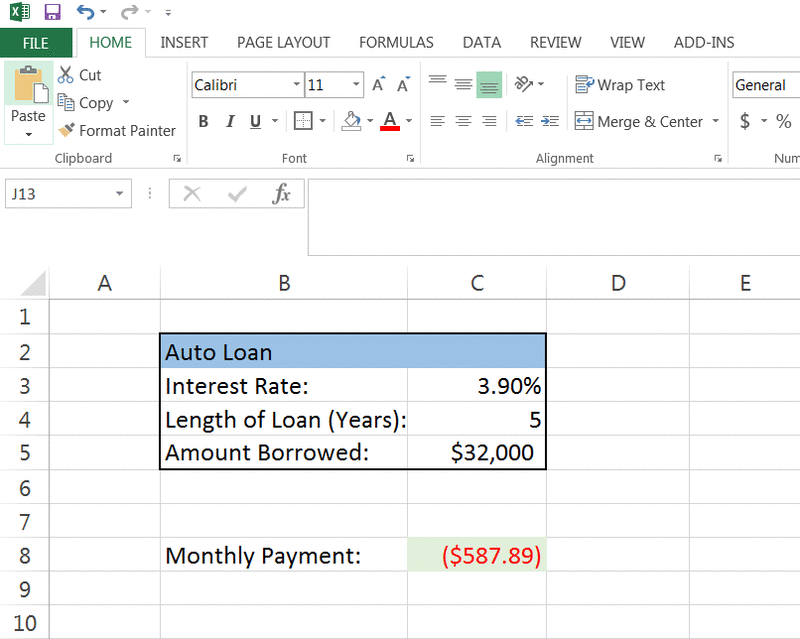
Using Spreadsheet Software (Excel/Google Sheets)
For those who prefer a more hands-on approach or need to analyze various loan scenarios, spreadsheet software like Microsoft Excel or Google Sheets is incredibly powerful. These programs have built-in financial functions designed specifically for loan calculations.
- PMT Function: The most relevant function is
PMT. The syntax typically looks like this:PMT(rate, nper, pv, [fv], [type])rate: The monthly interest rate (annual rate / 12).nper: The total number of payments (loan term in years * 12).pv: The present value or principal loan amount.fv: [Optional] The future value, or a cash balance you want to attain after the last payment (defaults to 0).type: [Optional] When payments are due (0 for end of period, 1 for beginning of period; defaults to 0).
- Example for the $20,000 loan at 7% for 5 years:
=PMT(0.07/12, 60, -20000)would yield approximately $396.06. Note the negative sign for the principal amount, as it represents an outflow of cash. - Pros: Highly customizable, excellent for scenario planning (“what if” analyses), allows for tracking and complex financial modeling.
- Cons: Requires basic spreadsheet proficiency, slight learning curve for functions.
Financial Calculators and Apps
For professionals or individuals who frequently work with financial calculations offline, dedicated financial calculators (like the HP 12c or Texas Instruments BA II Plus) are invaluable. There are also numerous smartphone apps available that replicate these functions, offering portability and ease of use.
- Pros: Portable, can be used offline, specific design for financial calculations.
- Cons: Can be an upfront investment, requires familiarity with specific calculator inputs.
Beyond the Number: What Your Monthly Payment Tells You
Calculating the monthly payment is just the first step. The real value lies in understanding what that number signifies and how it interacts with other aspects of your financial life.
Impact of Interest Rates and Loan Terms
Your monthly payment is highly sensitive to changes in both the interest rate and the loan term. Even a small reduction in the interest rate can lead to significant savings over the life of a long-term loan. Similarly, extending the loan term might lower your monthly payment, but it invariably increases the total interest you’ll pay. Conversely, shortening the term increases monthly payments but drastically reduces overall interest. Understanding these trade-offs is crucial for optimizing your borrowing strategy.
The Power of Extra Payments
Knowing your precise monthly payment also highlights the impact of making extra payments. Even small additional contributions to your principal can shave years off your loan term and save you thousands in interest. When you make an extra payment, that entire amount typically goes directly towards reducing your principal balance, which then reduces the base upon which future interest is calculated.
Understanding Amortization Schedules
An amortization schedule is a table detailing each payment made on a loan, showing how much goes towards interest and how much towards the principal, and the remaining principal balance after each payment. Examining this schedule—which most online calculators and spreadsheets can generate—reveals:
- In the early stages of a loan, a larger portion of your payment goes towards interest.
- As the loan matures, more and more of each payment goes towards paying down the principal.
- The exact point at which you can become equity-rich (in the case of a mortgage).
This insight can be incredibly motivating for those looking to pay off debt faster.
Why Understanding Your Loan Payment Matters
The ability to calculate and comprehend your monthly loan payment is more than a technical skill; it’s a cornerstone of sound financial management.
Budgeting and Financial Planning
Your loan payments are fixed expenses that must be factored into your monthly budget. Knowing the exact figure allows you to allocate funds accurately, ensuring you can meet your obligations without straining your finances. It’s critical for creating a realistic budget and sticking to it, preventing financial stress and potential late fees.
Making Informed Borrowing Decisions
When comparing loan offers, looking solely at the advertised interest rate isn’t enough. Understanding how the rate, principal, and term translate into a concrete monthly payment helps you compare apples to apples. You can assess whether a particular loan truly fits within your financial capacity and long-term goals. It also empowers you to negotiate better terms or seek alternative financing options if the calculated payment seems too high.

Identifying Potential Savings
By running different scenarios through a calculator, you can uncover opportunities to save. Perhaps increasing your down payment slightly lowers your principal enough to make a difference, or opting for a slightly shorter term (if affordable) could save you a substantial amount in interest. This proactive approach to understanding your loan details can lead to significant financial advantages over time.
In conclusion, while the amortization formula might seem daunting, the concept of calculating monthly loan payments is accessible to everyone through various tools. Taking the time to master this skill provides a powerful advantage, transforming you from a passive borrower into an active participant in your financial future. It’s about clarity, control, and ultimately, smarter money management.
aViewFromTheCave is a participant in the Amazon Services LLC Associates Program, an affiliate advertising program designed to provide a means for sites to earn advertising fees by advertising and linking to Amazon.com. Amazon, the Amazon logo, AmazonSupply, and the AmazonSupply logo are trademarks of Amazon.com, Inc. or its affiliates. As an Amazon Associate we earn affiliate commissions from qualifying purchases.