
Navigating the complexities of financing a new or used vehicle can often feel like deciphering a secret code, especially when it comes to understanding interest. For many, a car loan represents one of the most significant debts they will undertake after a mortgage. The interest rate on this loan doesn’t just add to your monthly payment; it significantly impacts the total cost of your vehicle over its lifetime. Without a clear grasp of how interest is calculated, borrowers risk overpaying, missing opportunities for savings, and ultimately making less informed financial decisions.
This article delves into the mechanics of car loan interest, demystifying the calculations and equipping you with the knowledge to approach your next vehicle purchase with confidence. We’ll explore the fundamental concepts, walk through various calculation methods—from manual formulas to digital tools—and discuss practical strategies to minimize your interest burden. Understanding these principles is not just about crunching numbers; it’s about taking control of your financial future and ensuring your car ownership experience is as cost-effective as possible.
Understanding the Fundamentals of Car Loan Interest
Before we dive into the calculations, it’s crucial to establish a solid understanding of the core components that make up car loan interest. This foundation will illuminate why rates vary and how they impact your repayment structure.
What is Interest and APR?
At its simplest, interest is the cost of borrowing money. When you take out a car loan, the lender charges you interest as compensation for the risk they take and the service they provide. This interest is typically expressed as a percentage of the principal loan amount.
While the interest rate is a critical figure, the Annual Percentage Rate (APR) is often a more comprehensive metric for comparing loan offers. The APR not only includes the interest rate but also incorporates other fees associated with the loan, such as administrative fees, origination fees, or discount points, spread out over the loan term. This provides a more accurate representation of the true annual cost of borrowing. Always compare APRs, not just interest rates, when evaluating different loan options, as a lower interest rate might be offset by higher fees, resulting in a higher APR.
Key Factors Influencing Your Interest Rate
Several crucial factors determine the interest rate you’ll be offered on a car loan. Lenders assess these elements to gauge the risk involved in lending to you:
- Credit Score: This is arguably the most significant factor. A higher credit score (typically 700+) indicates a lower risk borrower, as it demonstrates a history of responsible debt management. Borrowers with excellent credit scores usually qualify for the lowest interest rates. Conversely, a lower credit score often leads to higher interest rates to compensate the lender for the increased risk of default.
- Loan Term: The length of your loan (e.g., 36, 48, 60, 72, or 84 months) also plays a role. Shorter loan terms typically come with lower interest rates because the lender is exposed to risk for a shorter period. While a longer term might mean lower monthly payments, it almost always results in paying more interest over the life of the loan.
- Down Payment: A larger down payment reduces the amount you need to borrow, which in turn reduces the lender’s risk. Consequently, a substantial down payment can often help you secure a lower interest rate. It also decreases the total amount of interest you’ll pay since the principal balance is smaller from the outset.
- Debt-to-Income Ratio (DTI): Lenders look at your DTI to assess your ability to manage additional debt. This ratio compares your total monthly debt payments to your gross monthly income. A lower DTI indicates that you have more disposable income to cover new loan payments, making you a more attractive borrower.
- Vehicle Age and Type: The age and type of the vehicle can also influence rates. New cars often qualify for lower rates due to their higher resale value and lower risk of mechanical issues. Used cars, especially older models, might carry slightly higher rates.
- Market Conditions: Broader economic factors, such as the prime rate set by the Federal Reserve, also influence interest rates across the board. When the prime rate is high, loan rates tend to follow suit.
Amortization: The Loan Repayment Schedule
Car loans, like many other types of loans (mortgages, personal loans), are typically amortizing loans. This means that each monthly payment you make consists of two parts: a portion that goes towards reducing the principal balance and a portion that covers the interest accrued since your last payment.
In the early stages of an amortizing loan, a larger percentage of your payment goes towards interest, and a smaller portion reduces the principal. As you continue to make payments, the outstanding principal balance decreases. Consequently, the interest component of your payment gradually shrinks, and a larger portion of each subsequent payment is applied to the principal. This systematic reduction of the loan balance over time, with the corresponding adjustment in interest and principal allocation, is the essence of amortization. Understanding this concept is key to grasping how your total interest paid is distributed over the life of the loan.
Step-by-Step: Manual Calculation Methods
While most people rely on calculators, understanding the underlying formulas for car loan interest calculation can provide invaluable insight and allow you to estimate payments and total costs with precision.
Simple Interest Calculation (for a single period)
Most car loans use simple interest. This means interest is calculated only on the principal amount that remains outstanding. The basic formula for calculating simple interest for a single period (e.g., one month) is:
Interest = Principal Balance × (Interest Rate / Number of Payments Per Year)
Let’s break it down:
- Principal Balance: The current amount of money you owe on the loan.
- Interest Rate: Your annual interest rate expressed as a decimal (e.g., 5% becomes 0.05).
- Number of Payments Per Year: For monthly payments, this is 12.
Example:
Suppose you have a principal balance of $20,000, an annual interest rate of 6% (0.06), and make monthly payments.
Monthly Interest = $20,000 × (0.06 / 12) = $20,000 × 0.005 = $100
This $100 is the interest portion of your first monthly payment. After this payment, your principal balance will decrease, and the interest calculated for the next month will be slightly lower. This is the core of how amortization works.
Estimating Monthly Payments with a Formula
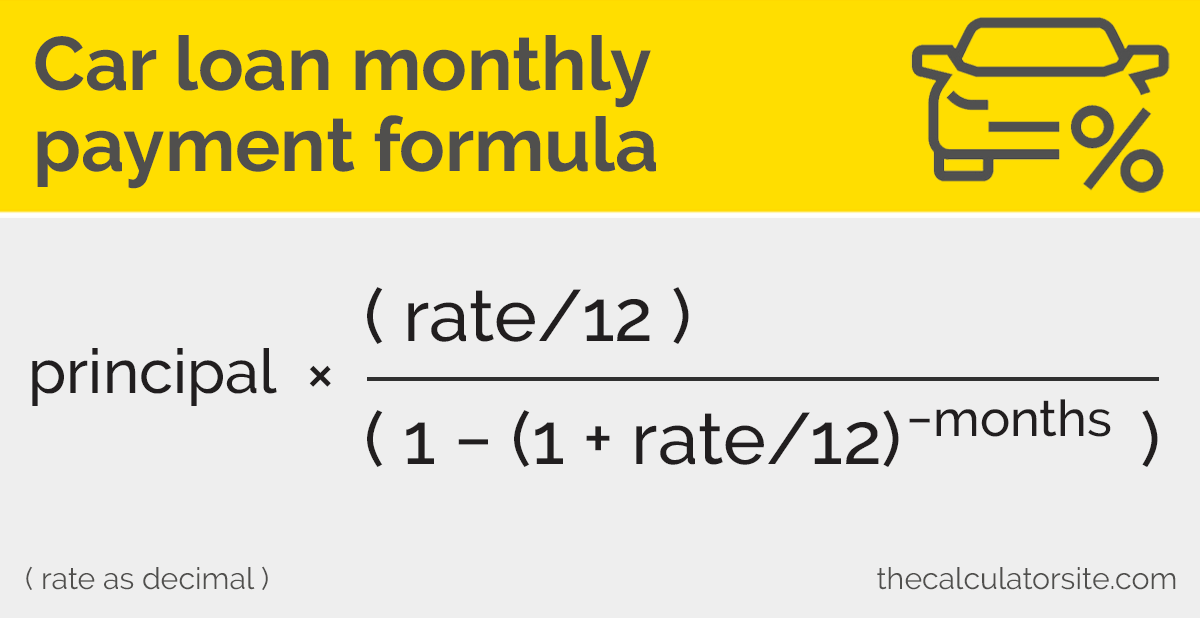
While a bit more complex, you can also manually calculate an estimated monthly payment for an amortizing loan using the following formula. This formula assumes a fixed interest rate and fixed monthly payments over the loan term.
M = P [ i(1 + i)^n ] / [ (1 + i)^n – 1]
Where:
- M: Your monthly payment
- P: The principal loan amount (the total amount you borrowed)
- i: Your monthly interest rate (annual interest rate / 12, expressed as a decimal)
- n: The total number of payments (loan term in years × 12)
Example:
Let’s say you borrow $25,000 for a car at an annual interest rate of 5% for 60 months (5 years).
- P = $25,000
- i = 0.05 / 12 = 0.00416667
- n = 60
Plugging these values into the formula:
- (1 + i)^n = (1 + 0.00416667)^60 = (1.00416667)^60 ≈ 1.283359
- M = 25000 [ 0.00416667 * 1.283359 ] / [ 1.283359 – 1 ]
- M = 25000 [ 0.00534733 ] / [ 0.283359 ]
- M = 133.68325 / 0.283359
- M ≈ $471.86
This manual calculation gives you the approximate monthly payment. While it requires a calculator for powers, it illustrates the mathematical basis of your loan payments.
The Amortization Schedule Approach
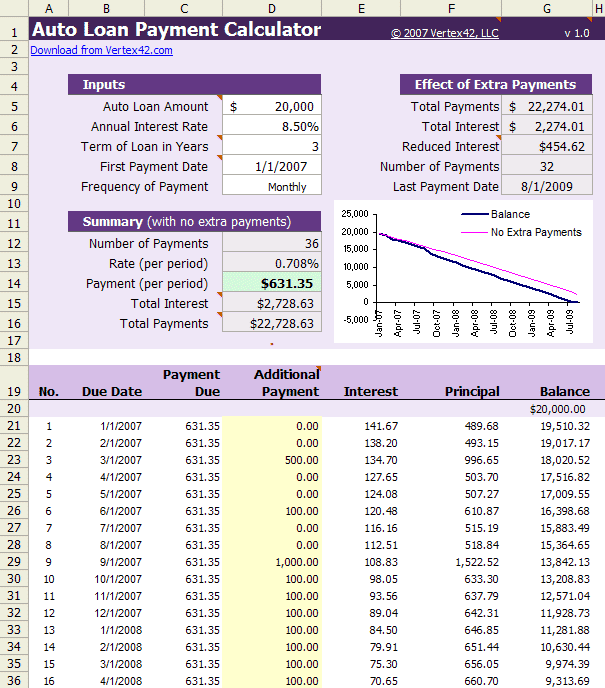
For a complete picture, creating an amortization schedule is the most thorough manual method. This is a table that details every single payment you’ll make over the life of the loan. For each payment, it shows:
- The payment number
- The fixed monthly payment amount (calculated using the formula above)
- The portion of the payment that goes towards interest (calculated using the simple interest formula on the remaining principal)
- The portion of the payment that goes towards principal (Monthly Payment – Interest Portion)
- The new outstanding principal balance
By creating an amortization schedule, you can see exactly how much interest you pay each month, how quickly your principal reduces, and the total interest paid over the entire loan term. While tedious to create by hand for a long loan, it offers unparalleled transparency into your loan’s structure.
Leveraging Digital Tools for Precision
While manual calculations are valuable for understanding the mechanics, digital tools offer unparalleled speed, accuracy, and convenience for calculating car loan interest and payments.
Online Car Loan Calculators

The internet is replete with free online car loan calculators offered by financial institutions, automotive websites, and personal finance portals. These tools are incredibly user-friendly and require only a few inputs:
- Loan Amount (Principal)
- Interest Rate (APR)
- Loan Term (in months or years)
Upon entering this information, the calculator instantly provides:
- Your estimated monthly payment
- The total interest you’ll pay over the life of the loan
- The total cost of the car (principal + total interest)
Many advanced calculators also allow you to factor in down payments, trade-in values, and even sales tax, providing a highly accurate estimate tailored to your specific situation. They can also generate full amortization schedules with a click, eliminating the need for complex manual calculations. These tools are invaluable for comparing different loan scenarios quickly and understanding the impact of varying interest rates or loan terms.
Spreadsheet Software (Excel/Google Sheets)
For those who prefer a more hands-on approach or need to perform complex scenario analyses, spreadsheet software like Microsoft Excel or Google Sheets offers powerful functions for car loan calculations.
-
PMT Function: The
PMTfunction is specifically designed to calculate the payment for a loan based on constant payments and a constant interest rate.=PMT(rate, nper, pv, [fv], [type])- rate: The interest rate per period (e.g., annual rate / 12).
- nper: The total number of payments for the loan (loan term in years * 12).
- pv: The present value, or the principal amount of the loan.
- fv (optional): The future value, or a cash balance you want to attain after the last payment is made (usually 0 for loans).
- type (optional): When payments are due (0 for end of period, 1 for beginning of period).
By simply inputting your loan details into this function, Excel or Google Sheets will instantly calculate your exact monthly payment.
-
Building a Custom Amortization Schedule: Spreadsheets are also ideal for constructing a dynamic amortization schedule. You can set up columns for payment number, beginning balance, interest paid, principal paid, and ending balance. By using formulas that reference the previous row’s ending balance, you can automatically generate the entire schedule, allowing you to easily see how changes to the interest rate, principal, or term affect the payment breakdown and total interest paid. This level of customization and control is perfect for detailed financial planning.
Mobile Apps and Financial Planning Software
Beyond general online calculators and spreadsheets, numerous specialized mobile apps and comprehensive financial planning software platforms exist. Many banking apps and standalone personal finance apps (e.g., Mint, YNAB, specific loan calculators) include car loan calculation features. These apps often provide:
- Intuitive interfaces
- Ability to save and compare multiple loan scenarios
- Integration with other financial planning tools (e.g., budgeting, debt management)
- Real-time updates if interest rates change (for refinancing options)
For a more holistic approach to personal finance, dedicated software can track your loans alongside investments, budgets, and other financial goals, offering a consolidated view of your financial health and helping you make informed decisions about your car loan within a broader financial context.
Strategies to Reduce Your Interest Burden
Understanding how interest is calculated is the first step; the next is to actively seek ways to reduce the amount you pay. Even small adjustments can lead to significant savings over the life of a car loan.
Improving Your Credit Score
As established, your credit score is a primary determinant of your interest rate. Taking steps to improve it before applying for a car loan can lead to substantial savings. Strategies include:
- Paying bills on time: Payment history is the most important factor in your credit score.
- Reducing existing debt: Lowering your credit utilization ratio (amount of credit used vs. available) can boost your score.
- Checking your credit report for errors: Disputing and correcting inaccuracies can quickly improve your score.
- Avoiding new credit applications: Each new application can temporarily ding your score.
A few months of focused effort can elevate your score enough to qualify for a better rate.
Making a Larger Down Payment
A larger down payment directly reduces the principal amount you need to borrow. This not only lowers your monthly payments but also decreases the total interest paid over the loan term, simply because there’s less money on which interest can accrue. Furthermore, a substantial down payment can signal to lenders that you are a lower-risk borrower, potentially qualifying you for a better interest rate. Aim for at least 20% if possible, especially for new cars, to mitigate depreciation and reduce your loan-to-value ratio.
Opting for a Shorter Loan Term
While a longer loan term (e.g., 72 or 84 months) might seem appealing due to lower monthly payments, it invariably leads to paying significantly more interest overall. Shorter loan terms (e.g., 36 or 48 months) come with higher monthly payments but almost always result in a lower total interest cost and often a lower interest rate as well. If your budget allows for the higher monthly payment, opting for the shortest term you can comfortably afford is a financially savvy move.
Refinancing Your Car Loan
If you’ve already secured a car loan but your credit score has improved, market rates have dropped, or you initially received an unfavorable rate, refinancing could be a viable option. Refinancing involves taking out a new loan to pay off your existing car loan, ideally at a lower interest rate or with more favorable terms. This can reduce your monthly payment and/or the total interest paid. Before refinancing, compare the new loan’s APR and any associated fees to ensure it truly offers a better deal than your current loan.
Negotiating the Best Rate
Don’t settle for the first loan offer you receive. Shop around with multiple lenders – banks, credit unions, and online lenders – to compare rates and terms. Credit unions, in particular, often offer competitive rates to their members. Once you have a pre-approval or offer from one lender, you can leverage it to negotiate with other lenders, including the dealership’s financing department. This competitive bidding process can often secure you a lower interest rate than you might have gotten by only considering one option.
Beyond the Calculation: What Else to Consider
While calculating interest is paramount, a holistic view of your car loan involves understanding other aspects that can affect your financial outlay.
Prepayment Penalties
Some loan agreements include prepayment penalties, which are fees charged by the lender if you pay off your loan early (either through extra payments or refinancing). Lenders implement these to recoup some of the interest income they lose when a loan is retired ahead of schedule. Before signing any loan agreement, meticulously review the terms and conditions to identify if a prepayment penalty exists. If it does, understand how it’s calculated and whether it could negate the benefits of early repayment or refinancing. Most car loans today, especially from larger banks and credit unions, do not have prepayment penalties, but it’s always wise to confirm.
Understanding the Fine Print
The loan agreement is a legally binding document that outlines all the terms and conditions of your car loan. Beyond the interest rate and term, pay close attention to:
- Fees: Look for origination fees, documentation fees, late payment fees, and any other charges that could add to your cost.
- Default clauses: Understand what constitutes a default and the lender’s rights if you fail to meet your payment obligations.
- Insurance requirements: Lenders often require specific types and levels of auto insurance (e.g., full coverage) to protect their collateral.
- GAP insurance: While often offered by dealerships, understand if this additional insurance is included or required, and its cost. It covers the difference between what you owe on your car and its actual cash value if it’s totaled or stolen.
Reading the fine print carefully can prevent unpleasant surprises down the road and ensure you are fully aware of your obligations and rights.
The Total Cost of Ownership
Calculating interest on your car loan is a crucial step, but it’s only one component of the total cost of car ownership. To truly understand the financial impact of your vehicle, you must also factor in:
- Purchase Price: The initial cost of the car.
- Sales Tax and Registration Fees: Government-mandated costs that vary by state.
- Insurance: Ongoing premiums for auto insurance.
- Fuel: The cost of gasoline or charging.
- Maintenance and Repairs: Regular servicing, unexpected repairs, and wear-and-tear items like tires.
- Depreciation: The decrease in your car’s value over time, which is often the largest hidden cost of ownership.
- Parking Fees/Tolls: If applicable.
By considering all these elements, you gain a comprehensive understanding of the financial commitment involved in owning a car, allowing you to budget effectively and make more sustainable financial decisions.
Understanding how interest is calculated on a car loan is an empowering piece of financial knowledge. It moves you from being a passive borrower to an informed consumer capable of making strategic decisions. By grasping the fundamentals of interest and APR, leveraging calculation methods, and proactively implementing strategies to reduce your interest burden, you can significantly lower the overall cost of your vehicle. Remember that a car loan is a major financial commitment; approaching it with a clear understanding of its components ensures you drive away with not just a new car, but also a smart financial decision.
aViewFromTheCave is a participant in the Amazon Services LLC Associates Program, an affiliate advertising program designed to provide a means for sites to earn advertising fees by advertising and linking to Amazon.com. Amazon, the Amazon logo, AmazonSupply, and the AmazonSupply logo are trademarks of Amazon.com, Inc. or its affiliates. As an Amazon Associate we earn affiliate commissions from qualifying purchases.