
In the world of finance, whether personal or business, percentages are more than just mathematical curiosities; they are the bedrock of informed decision-making. From calculating the discount on a new purchase to understanding the interest on a loan, assessing investment returns, or dissecting a company’s profit margins, percentages are ubiquitous. Mastering them isn’t merely about arithmetic; it’s about gaining a clearer lens through which to view your financial landscape, empowering you to make smarter choices, optimize your spending, and strategically grow your wealth.
This guide will demystify percentages, breaking down their fundamental concepts and illustrating their critical applications across various financial scenarios. We’ll move beyond the basic definition to explore practical calculations, advanced financial metrics, and the indispensable tools that simplify these processes, ensuring you’re well-equipped to navigate the numerical nuances of your financial journey.

The Foundational Basics: Understanding What a Percentage Is
Before diving into complex financial models, it’s crucial to grasp the core concept of a percentage. This fundamental understanding is your first step towards financial literacy and confidence.
Defining the Percentage: A Universal Financial Language
A percentage literally means “per hundred” or “out of every hundred.” It’s a way of expressing a number as a fraction of 100, often denoted by the percent sign (%). For instance, 50% means 50 out of 100, or 50/100, which simplifies to 1/2. In finance, this common language allows for easy comparison of ratios, rates, and changes, regardless of the absolute scale of the numbers involved. When you hear about an interest rate of 5%, you immediately understand it’s 5 units per every 100 units of the principal amount. Similarly, a 20% discount signifies a reduction of 20 units for every 100 units of the original price. This standardized approach simplifies financial communication and analysis globally.
Why Percentages Matter in Finance: Quantifying Your Financial World
The relevance of percentages in finance cannot be overstated. They are the metric for measuring:
- Interest Rates: How much you earn on savings or pay on loans.
- Discounts and Markups: The savings on a purchase or the profit added to a cost.
- Taxes: The portion of your income or purchases owed to the government.
- Investment Returns: The growth or loss of your portfolio over time.
- Inflation: The rate at which purchasing power decreases.
- Budget Allocation: How much of your income goes towards different spending categories.
- Profit Margins: A business’s profitability relative to its revenue.
- Market Share: A company’s proportion of the total market.
Without percentages, comparing disparate financial figures would be challenging, if not impossible. They provide a standardized way to evaluate performance, costs, and benefits.
Converting Between Decimals, Fractions, and Percentages: The Calculation Toolkit
To effectively work with percentages, you need to seamlessly convert between their different forms.
- Percentage to Decimal: Divide the percentage by 100.
- Example: 25% = 25 / 100 = 0.25
- Decimal to Percentage: Multiply the decimal by 100 and add the % sign.
- Example: 0.75 = 0.75 * 100 = 75%
- Fraction to Percentage: Divide the numerator by the denominator, then multiply by 100.
- Example: 1/4 = 1 ÷ 4 = 0.25 = 25%
- Percentage to Fraction: Place the percentage over 100 and simplify.
- Example: 40% = 40/100 = 2/5
These conversions are crucial for setting up and solving financial problems, as most calculations require percentages to be in decimal form.
Practical Applications: Calculating Key Financial Percentages
Understanding the ‘what’ is the first step; the next is applying this knowledge to real-world financial scenarios. Here, we’ll cover the most common percentage calculations you’ll encounter in personal and business finance.
Finding a Percentage of a Number: Discounts, Taxes, and Commissions
This is perhaps the most frequent percentage calculation in daily life. You want to know a portion of a whole. The basic formula is:
Percentage (as a decimal) × Whole Amount
-
Example 1: Calculating a Discount
You see a laptop priced at $800, advertised with a 15% discount. How much is the discount?- Convert 15% to a decimal: 15 / 100 = 0.15
- Multiply by the whole amount: 0.15 × $800 = $120
- The discount is $120. The final price would be $800 – $120 = $680.
-
Example 2: Calculating Sales Tax
You buy an item for $50, and the sales tax rate is 7%. How much sales tax do you pay?- Convert 7% to a decimal: 7 / 100 = 0.07
- Multiply by the item price: 0.07 × $50 = $3.50
- The sales tax is $3.50. The total cost would be $50 + $3.50 = $53.50.
-
Example 3: Calculating a Commission
A salesperson earns a 10% commission on sales. If they make $3,000 in sales, how much is their commission?- Convert 10% to a decimal: 10 / 100 = 0.10
- Multiply by total sales: 0.10 × $3,000 = $300
- Their commission is $300.
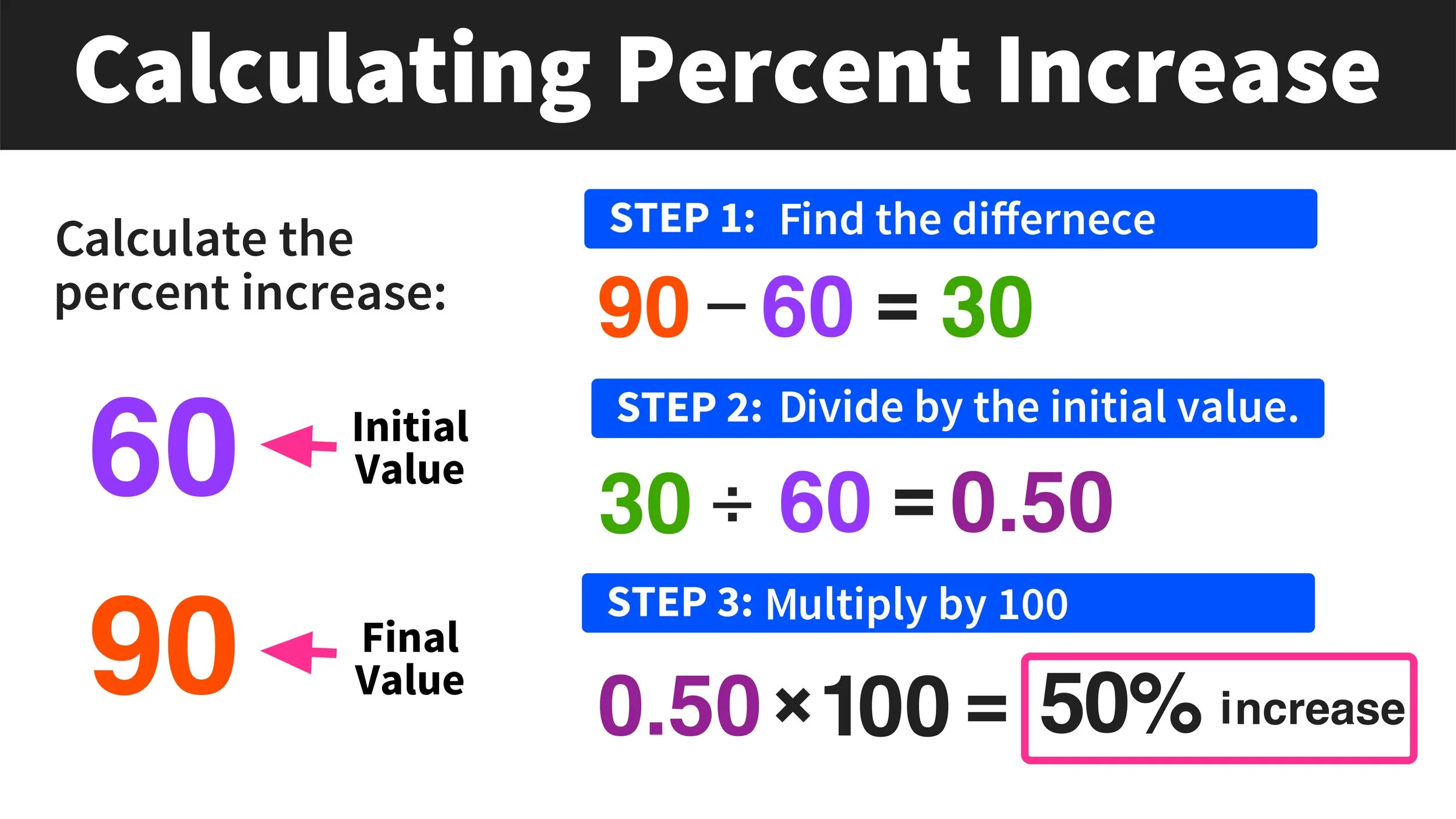
Determining Percentage Increase or Decrease: Investment Growth, Inflation, and Salary Adjustments
Tracking changes over time is vital for evaluating financial performance. Whether it’s your investment portfolio, a company’s revenue, or the cost of living, percentage change gives context to absolute numbers.
The general formula for percentage change is:
((New Value – Old Value) / Old Value) × 100%
- Example 1: Investment Growth
Your stock investment was worth $5,000 last year and is now worth $6,500. What is the percentage increase?- New Value = $6,500, Old Value = $5,000
- ($6,500 – $5,000) / $5,000 = $1,500 / $5,000 = 0.3
- 0.3 × 100% = 30% increase.
- Example 2: Decrease in Value
A car was bought for $25,000 and after a year, its market value is $20,000. What is the percentage decrease?- New Value = $20,000, Old Value = $25,000
- ($20,000 – $25,000) / $25,000 = -$5,000 / $25,000 = -0.2
- -0.2 × 100% = -20% decrease (or a 20% depreciation).
Calculating “What is X percent of Y?”: Profit Margins, Budget Allocation, and Market Share
Sometimes, you know the part and the whole, and you want to express the part as a percentage of the whole. This is common for analyzing proportions.
The formula is:
(Part / Whole) × 100%
-
Example 1: Calculating Profit Margin
A product sells for $120, and the cost to produce it was $90. What is the gross profit margin?- First, find the profit (Part): $120 – $90 = $30
- Then, (Profit / Selling Price) × 100%: ($30 / $120) × 100% = 0.25 × 100% = 25%
- The gross profit margin is 25%.
-
Example 2: Budget Allocation
If your monthly income is $4,000 and you spend $800 on rent, what percentage of your income goes to rent?- (Rent / Income) × 100%: ($800 / $4,000) × 100% = 0.2 × 100% = 20%
- 20% of your income is allocated to rent.
Advanced Financial Scenarios Involving Percentages
Beyond basic calculations, percentages are integral to understanding more complex financial instruments and performance indicators.
Interest Rates: Simple vs. Compound Interest
Interest rates, expressed as percentages, are the cost of borrowing money or the return on lending/saving money.
- Simple Interest: Calculated only on the principal amount.
- Formula: Principal × Rate (as decimal) × Time (in years)
- Example: $1,000 at 5% simple interest for 3 years = $1,000 × 0.05 × 3 = $150.
- Compound Interest: Interest calculated on the initial principal and also on the accumulated interest from previous periods. This is the “interest on interest” effect and is crucial for long-term savings and investments.
- Formula: A = P(1 + r/n)^(nt) where A=final amount, P=principal, r=annual interest rate, n=number of times interest is compounded per year, t=time in years.
- Example: $1,000 at 5% compounded annually for 3 years = $1,000 * (1 + 0.05)^3 = $1,157.63.
Understanding the compounding frequency (annually, semi-annually, quarterly, monthly) is key as it significantly impacts the actual return (APY) or cost (APR).
Financial Ratios and Performance Metrics: Deeper Insights
Businesses and investors rely heavily on financial ratios, almost all of which are expressed as percentages, to assess a company’s health, profitability, and efficiency.
- Profitability Ratios:
- Gross Profit Margin: (Gross Profit / Revenue) × 100% – Indicates how much profit a company makes from its sales after accounting for the cost of goods sold.
- Net Profit Margin: (Net Income / Revenue) × 100% – Shows the percentage of revenue left after all expenses, including taxes and interest, have been deducted.
- Return on Investment (ROI): ((Current Value of Investment – Cost of Investment) / Cost of Investment) × 100% – A widely used metric to evaluate the efficiency of an investment or to compare the efficiency of several different investments.
- Debt-to-Income Ratio: (Total Monthly Debt Payments / Gross Monthly Income) × 100% – A key indicator for lenders when assessing an individual’s creditworthiness.
Budgeting and Financial Planning: Structuring Your Spending
Percentages are fundamental to creating and sticking to a budget. They provide a flexible framework that adapts to varying income levels.
- The 50/30/20 Rule: A popular budgeting guideline suggesting that 50% of your after-tax income should go to needs (housing, groceries), 30% to wants (dining out, entertainment), and 20% to savings and debt repayment.
- Allocating Percentages of Income: Instead of fixed dollar amounts, setting percentage targets for categories like savings (e.g., 15% of gross income), housing (e.g., max 30%), or transportation (e.g., 10%) provides a scalable budgeting solution.
Tools and Resources for Percentage Calculations
While the underlying math is straightforward, modern tools can simplify and accelerate percentage calculations, especially for complex financial planning.
Calculators (Standard and Online): Quick and Accessible Solutions
For quick, one-off calculations, a basic scientific calculator is invaluable. Many smartphones also have built-in calculators with percentage functions. Online percentage calculators are also readily available for specific needs, such as tips, taxes, or discounts, providing instant results without manual formula entry. These are perfect for everyday financial decisions.
Spreadsheets (Excel, Google Sheets): Power for Complex Financial Models
For more intricate financial analysis, budgeting, and forecasting, spreadsheets like Microsoft Excel or Google Sheets are indispensable. They allow you to:
- Automate calculations: Enter formulas once, and they automatically update as inputs change.
- Organize data: Create detailed budgets, track investments, and manage multiple financial accounts.
- Model scenarios: Easily see the impact of different interest rates, investment returns, or spending changes.
- Visualize data: Create charts and graphs to understand trends and proportions at a glance.
Learning basic spreadsheet functions for percentages (e.g.,=A1*0.05for 5% of A1, or=(B2-A2)/A2for percentage change) can profoundly enhance your financial management capabilities.
Financial Software and Apps: Streamlined Financial Management
Many personal finance software programs (e.g., Quicken, Mint) and banking apps integrate percentage calculations seamlessly. They automatically categorize transactions, calculate budget percentages, track investment performance, and even project future growth based on interest rates. While they handle the heavy lifting, understanding the underlying percentage mechanics still empowers you to interpret their outputs correctly and make informed adjustments.
Conclusion: Empowering Your Financial Future with Percentages
Understanding “how do I find percentages” is not just about mastering a mathematical concept; it’s about unlocking a crucial skill set for financial empowerment. From the simplest daily transactions to complex investment strategies and business analysis, percentages are the language that quantifies value, change, and proportion in the financial world.
By grasping the fundamental definitions, practicing the practical applications, and leveraging available tools, you gain the confidence to analyze discounts, decipher interest rates, evaluate investment performance, and manage your budget with greater precision. Embrace percentages as an essential component of your financial toolkit, and you’ll find yourself making more informed, strategic decisions that pave the way for a more secure and prosperous financial future.
aViewFromTheCave is a participant in the Amazon Services LLC Associates Program, an affiliate advertising program designed to provide a means for sites to earn advertising fees by advertising and linking to Amazon.com. Amazon, the Amazon logo, AmazonSupply, and the AmazonSupply logo are trademarks of Amazon.com, Inc. or its affiliates. As an Amazon Associate we earn affiliate commissions from qualifying purchases.