
In the vast landscape of personal finance and business, few mathematical concepts are as universally applied and fundamentally critical as percentages. From deciphering a discount at your favorite store to calculating your investment returns, understanding interest rates on loans, or analyzing a company’s profit margins, percentages are the silent workhorses that empower informed financial decisions. Yet, for many, the phrase “figure out percentages” can evoke a sense of unease. This comprehensive guide aims to demystify percentages, providing you with a clear, step-by-step understanding of how they work, why they matter in the world of money, and how to confidently apply them in various financial scenarios.
Mastering percentages isn’t just about crunching numbers; it’s about gaining clarity, control, and confidence over your financial life. It’s the difference between guessing your potential savings on a sale item and knowing precisely how much you’re keeping in your pocket. It’s what allows you to compare different loan offers accurately or understand the real impact of inflation on your purchasing power. Let’s embark on this journey to transform percentages from a mathematical mystery into a powerful financial tool.
The Core Concept: Understanding What a Percentage Is
At its heart, a percentage is simply a way to express a part of a whole as a fraction of 100. The word “percent” literally means “per hundred” or “out of every hundred.” This standardized way of comparing quantities makes percentages incredibly versatile and easy to interpret across different contexts.
Defining the Percentage: What Does “%” Really Mean?
The symbol “%” is shorthand for “divided by 100.” So, when you see 50%, it means 50 out of 100, or 50/100. Similarly, 25% is 25/100, and 100% represents the entire whole (100/100 = 1). This “out of 100” framework provides a common denominator for comparison, making it easy to gauge relative proportions quickly. For instance, knowing that your budget allocates 30% to housing and 15% to food immediately tells you which category consumes a larger portion of your income.
The Basic Formula: How to Express a Part of a Whole as a Percentage
The fundamental formula for calculating a percentage is straightforward:
Percentage = (Part / Whole) × 100
Let’s break this down:
- Part: The specific amount or value you are interested in.
- Whole: The total amount or value that the “part” belongs to.
- × 100: Multiplies the decimal or fractional result by 100 to convert it into a percentage.
For example, if you spent $300 on groceries from a monthly income of $2,000, your grocery expense as a percentage of your income would be: ($300 / $2,000) × 100 = 0.15 × 100 = 15%.
Practical Examples: Everyday Financial Scenarios
To solidify this understanding, let’s consider common financial applications:
- Discounts: A shirt originally priced at $50 is on sale for $40. The discount amount is $10. To find the percentage discount: ($10 / $50) × 100 = 20%. So, it’s a 20% discount.
- Tips: You want to leave a 15% tip on a $60 meal. Here, you’re finding the “part” when given the “whole” and the “percentage.” Convert 15% to a decimal (0.15) and multiply by the whole: 0.15 × $60 = $9 tip.
- Simple Interest: If you invest $1,000 at a 3% simple interest rate per year, the interest earned in one year is: 0.03 × $1,000 = $30.
These examples illustrate that percentages aren’t abstract concepts but tangible tools used in your daily financial interactions.
Calculating Percentages in Personal Finance
In personal finance, percentages are the language of financial health and planning. They help you gauge your financial position, make informed spending decisions, and plan for future goals.
Budgeting and Expense Tracking
Effective budgeting relies heavily on percentages. You might aim to follow the 50/30/20 rule, allocating 50% of your income to needs, 30% to wants, and 20% to savings and debt repayment. To implement this, you’d calculate:
- Needs budget: 0.50 × Net Income
- Wants budget: 0.30 × Net Income
- Savings/Debt: 0.20 × Net Income
Similarly, tracking expenses against your budget involves percentages. If your housing budget is $800 and you spend $900, you’ve overspent by $100. As a percentage of your budget: ($100 / $800) × 100 = 12.5% over budget.
Discounts and Sales
Understanding percentage discounts empowers you to identify genuine savings. If an item is 25% off its original price of $80, the discount is 0.25 × $80 = $20. The final price is $80 – $20 = $60. Conversely, if you know the final price and the original, you can calculate the discount percentage, as shown in the earlier example.
Interest Rates (Savings & Loans)
Interest rates, whether for savings accounts, credit cards, mortgages, or car loans, are always expressed as percentages.
- Annual Percentage Rate (APR): The annual rate charged for borrowing or earned by an investment. A 19% APR on a credit card means you pay 19% of your outstanding balance in interest over a year (though usually compounded monthly).
- Annual Percentage Yield (APY): The effective annual rate of return taking into account compounding interest. An APY of 2% on a savings account means your money will grow by approximately 2% over a year due to interest earning interest.
Understanding these percentages is crucial for comparing financial products and assessing the true cost of borrowing or the real return on savings.
Taxes and Deductions
From income tax brackets to sales tax and property tax, percentages dictate how much of your income or purchases go to the government.
- Sales Tax: If sales tax is 8% and your purchase is $100, you pay an additional $8 (0.08 × $100) in tax.
- Income Tax: If your taxable income is in the 22% bracket, it means a certain portion of your income is taxed at that rate. Understanding effective tax rates (total tax paid as a percentage of total income) gives a clearer picture.
- Deductions: Pre-tax deductions for retirement or health insurance reduce your taxable income, effectively saving you money based on your marginal tax rate.
Investment Growth and Returns
Percentages are paramount in evaluating investment performance.
- Return on Investment (ROI): A key metric to measure the profitability of an investment relative to its cost. If you invest $1,000 and it grows to $1,200, your profit is $200. Your ROI is ($200 / $1,000) × 100 = 20%.
- Portfolio Performance: Your annual statement will show your portfolio’s growth as a percentage, allowing you to compare it against benchmarks or other investment options.
Percentages in Business Finance and Beyond
For entrepreneurs, business owners, and those interested in macroeconomics, percentages provide critical insights into performance, market dynamics, and economic health.
Profit Margins
Businesses live and breathe by their profit margins, which are always expressed as percentages.
- Gross Profit Margin: (Gross Profit / Revenue) × 100. This indicates how much profit a company makes from its sales after accounting for the direct costs of production.
- Net Profit Margin: (Net Profit / Revenue) × 100. This shows the percentage of revenue left after all expenses, including taxes and interest, have been deducted. High-profit margins often signal a healthy, efficient business.
Sales Growth and Market Share
- Sales Growth: Businesses track the percentage increase or decrease in sales over periods (e.g., “sales grew by 15% this quarter”). This indicates expansion or contraction.
- Market Share: (Company’s Sales / Total Market Sales) × 100. This percentage reveals a company’s proportion of the total sales in its industry, a key indicator of competitive position.
Financial Ratios
Many crucial financial ratios used to evaluate a company’s health are expressed as percentages or are derived from percentage calculations. While delving deep into each is beyond this guide, understanding percentages forms the foundation for interpreting ratios like debt-to-equity or return on assets.
Inflation and Economic Indicators
On a broader scale, economic health is often communicated through percentages.
- Inflation Rate: The percentage increase in the price of goods and services over a period, eroding purchasing power. A 3% inflation rate means prices, on average, are 3% higher than a year ago.
- Unemployment Rate: The percentage of the total labor force that is unemployed and actively seeking work.
- GDP Growth Rate: The percentage increase in a country’s Gross Domestic Product, signaling economic expansion or contraction.
These percentages are vital for policymakers, investors, and consumers to understand the economic environment.
Common Percentage Pitfalls and How to Avoid Them
While percentages are powerful, they can be misleading if not understood correctly. Avoiding common errors is crucial for accurate financial analysis.
The “Of” Means Multiply: A Common Error
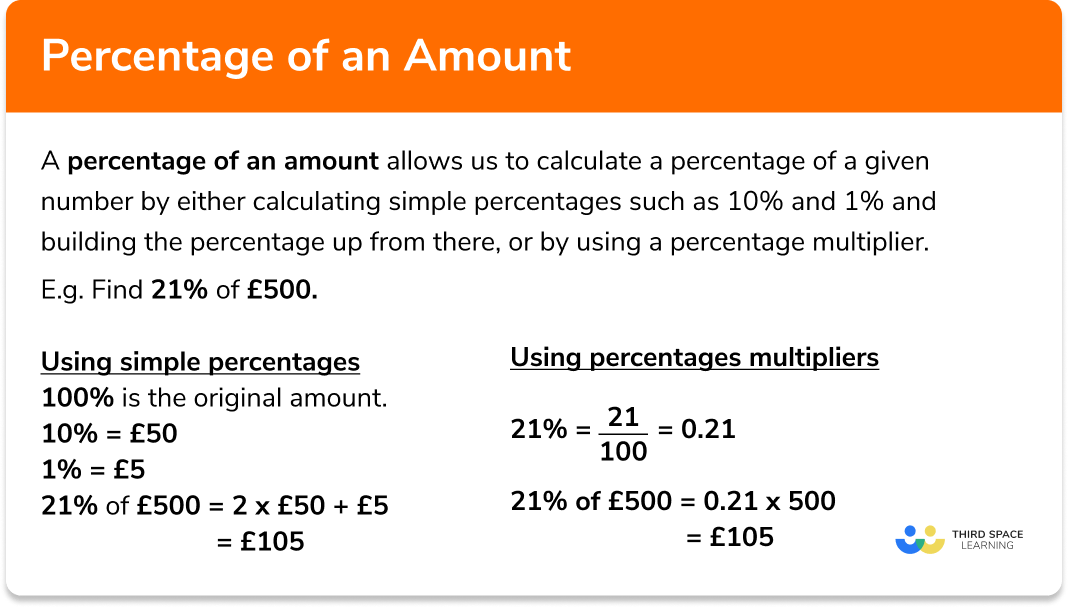
A frequent mistake is forgetting that “X percent of Y” means X/100 * Y. For example, if you want to find 10% of $500, it’s not 10 + 500. It’s 0.10 × $500 = $50. Always convert the percentage to its decimal equivalent (by dividing by 100) before multiplying.
Percentage Point vs. Percentage Change: A Crucial Distinction
This is a subtle but significant difference, especially in financial news.
- Percentage Point Change: Refers to the absolute difference between two percentages. If an interest rate increases from 3% to 4%, that’s a 1 percentage point increase.
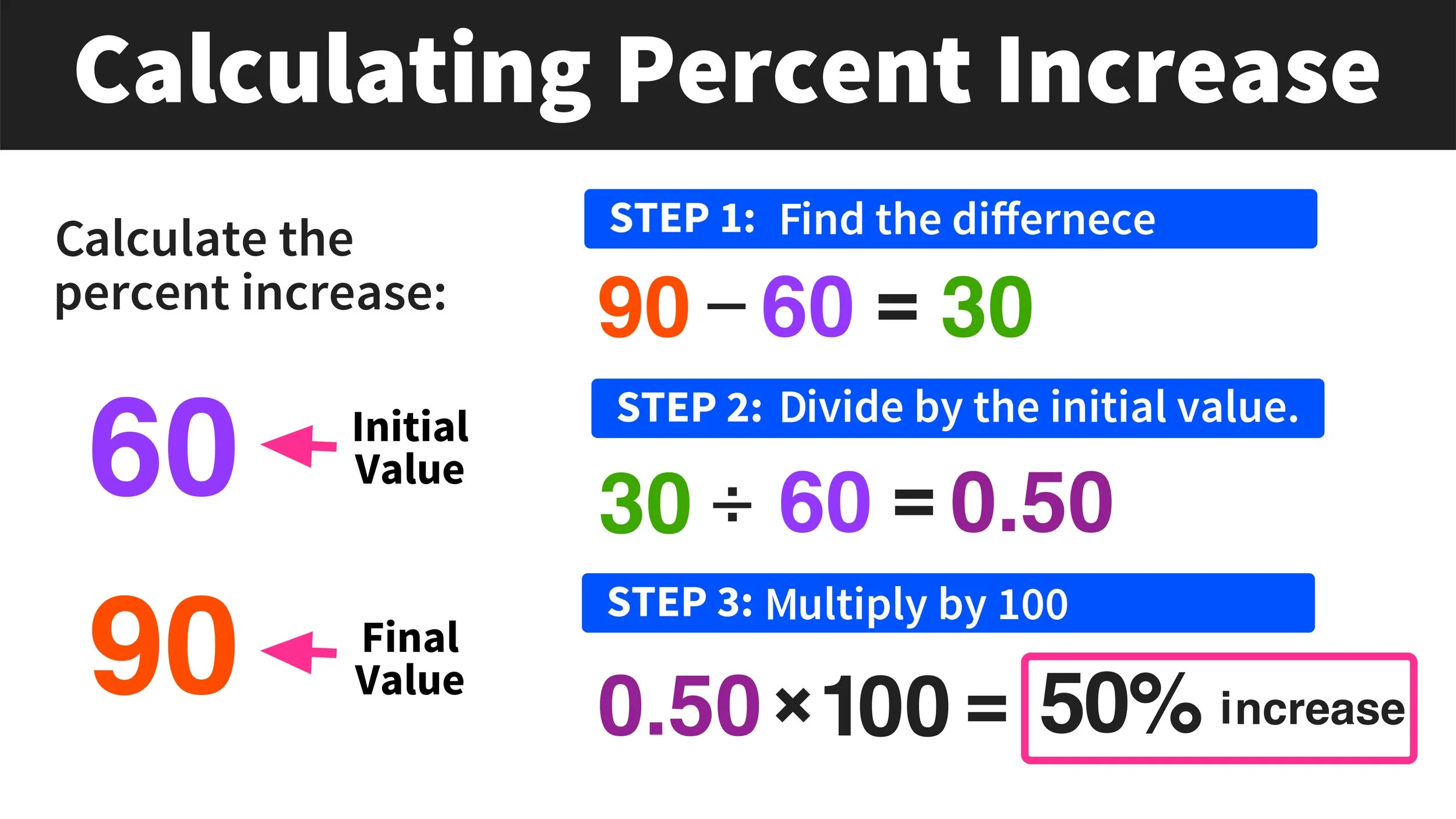
- Percentage Change: Refers to the relative change. An increase from 3% to 4% is a (1/3) × 100 = 33.33% percentage increase.
Confusing these two can lead to drastic misinterpretations of financial news or investment performance.
Base Value Matters: Why a Percentage Change Isn’t Always What It Seems
A 50% increase sounds substantial, but its real impact depends on the starting (base) value. A stock rising from $2 to $3 is a 50% increase, but only a $1 gain. A stock rising from $100 to $101 is a 1% increase, but also a $1 gain. When comparing percentage changes, always consider the absolute numbers involved.
Cumulative vs. Simple Percentages: Discounts Stacking Up
Be wary when multiple percentage changes are applied sequentially. Two 10% discounts are not the same as one 20% discount. If an item is $100 and you get 10% off, it’s $90. A further 10% off the new price of $90 is $9 (0.10 * $90), making the final price $81. This is a total discount of $19, not $20. Discounts often compound, reducing the base value for the next discount calculation.
Tools and Strategies for Mastering Percentage Calculations
Fortunately, you don’t need to be a math whiz to master percentages. Various tools and strategies can simplify the process and boost your confidence.
Manual Calculation Techniques
For simple calculations, mental math or a basic calculator can suffice.
- Finding 10%: A quick way to estimate 10% of any number is to move the decimal one place to the left (e.g., 10% of $450 is $45).
- Finding 1%: Move the decimal two places to the left (e.g., 1% of $450 is $4.50).
- Building Up: You can combine these. If you need 15%, calculate 10% and add half of that amount (e.g., 15% of $450 = $45 + $22.50 = $67.50).
Spreadsheet Power (Excel/Google Sheets)
For more complex or recurring calculations, spreadsheets are invaluable. They allow you to:
- Input Formulas: Directly use formulas like
=(Part/Whole)*100in cells. - Automate Calculations: Once set up, the percentages automatically update when your raw data changes.
- Analyze Data: Easily track budget adherence, investment growth, or sales performance over time using percentage metrics.
Online Calculators and Financial Apps
The internet is replete with free percentage calculators, loan calculators, ROI calculators, and budgeting apps that handle the math for you. While convenient, always understand the underlying principles and verify the accuracy of the tools, especially for significant financial decisions. Many banking and investment apps also provide clear percentage breakdowns of your financial activity.
Developing a Financial Mindset
Ultimately, mastering percentages is part of developing robust financial literacy. It’s about cultivating a mindset where you instinctively ask “What percentage?” when confronted with financial figures. This analytical approach empowers you to scrutinize claims, compare offers, and make financially sound decisions rather than relying on guesswork or incomplete information. Consistent practice and application in your daily financial life will solidify your understanding and make percentage calculations second nature.

Conclusion
Percentages are more than just mathematical constructs; they are the fundamental building blocks of financial understanding and empowerment. From managing your personal budget and maximizing savings to evaluating investment opportunities and comprehending economic trends, the ability to “figure out percentages” is a non-negotiable skill in today’s financial world. By grasping the core concept, applying the formulas to real-world scenarios, and being mindful of common pitfalls, you can transform a potentially intimidating subject into a powerful tool that puts you firmly in control of your financial destiny. Embrace the numbers, and unlock a clearer, more confident path to financial success.
aViewFromTheCave is a participant in the Amazon Services LLC Associates Program, an affiliate advertising program designed to provide a means for sites to earn advertising fees by advertising and linking to Amazon.com. Amazon, the Amazon logo, AmazonSupply, and the AmazonSupply logo are trademarks of Amazon.com, Inc. or its affiliates. As an Amazon Associate we earn affiliate commissions from qualifying purchases.