
In the complex world of personal finance, business operations, and investing, numbers tell a story. But raw numbers alone often lack context. This is where percentages step in, transforming isolated figures into meaningful insights that drive informed decisions. Whether you’re trying to understand a discount, calculate interest on a loan, evaluate investment returns, or simply stick to a budget, the ability to confidently “figure out a percentage” isn’t just a useful skill—it’s a foundational pillar of financial literacy.
Many people feel intimidated by percentages, viewing them as a purely mathematical concept divorced from everyday life. However, from your morning coffee purchase to planning for retirement, percentages are ubiquitous, shaping how you earn, save, spend, and invest. This guide aims to demystify percentages, providing you with a clear, actionable understanding of what they are, how to calculate them, and—most importantly—how to apply them effectively across various financial scenarios to achieve greater clarity and control over your money. By the end, you’ll not only know how to figure out a percentage but also appreciate its indispensable role in your financial journey.
The Foundation: What Exactly Is a Percentage?
Before we delve into practical applications, it’s crucial to grasp the fundamental concept of what a percentage represents. Stripped down to its essence, a percentage is simply a way to express a part of a whole as a fraction of 100. The term “percent” literally means “per hundred” or “out of every hundred.”
Defining the Core Concept
Imagine a pie cut into 100 equal slices. If you take 25 of those slices, you have 25 out of 100, which is precisely 25%. This “part per hundred” representation makes it incredibly easy to compare different quantities, even if their original “wholes” are vastly different. It standardizes comparison, allowing us to see proportional relationships at a glance.
Why “Per Hundred” Matters in Finance
The power of percentages in finance lies in this standardization. When banks quote interest rates, they don’t say “you’ll earn $5 on every $100 you save.” They say “5% interest.” This allows you to immediately understand the earning potential, regardless of whether you have $100 or $1,000,000. Similarly, when a store offers a “20% discount,” you instantly know the proportion of the price you’ll save, simplifying quick mental calculations and comparisons between different offers. This universal language of “per hundred” makes financial data accessible and comparable across varied contexts, from micro-transactions to macroeconomic trends.
The Basic Formula: Part / Whole x 100
At its heart, figuring out any percentage boils down to a simple formula:
Percentage = (Part / Whole) × 100
Let’s break this down:
- Part: This is the specific quantity or amount you are interested in.
- Whole: This is the total amount or the base from which the “part” is drawn.
- × 100: Multiplying by 100 converts the resulting decimal or fraction into a percentage format, giving it the “per hundred” meaning.
For example, if you spent $30 on groceries from a total budget of $500, and you want to know what percentage of your budget went to groceries:
(30 / 500) × 100 = 0.06 × 100 = 6%
So, 6% of your budget was spent on groceries. This basic formula is the bedrock for all percentage calculations you’ll encounter in finance.
Practical Percentage Calculations You’ll Use Daily
With the basic formula in hand, let’s explore the most common ways you’ll need to calculate percentages in your financial life. Each scenario leverages the “Part / Whole x 100” principle, sometimes re-arranged to solve for different variables.
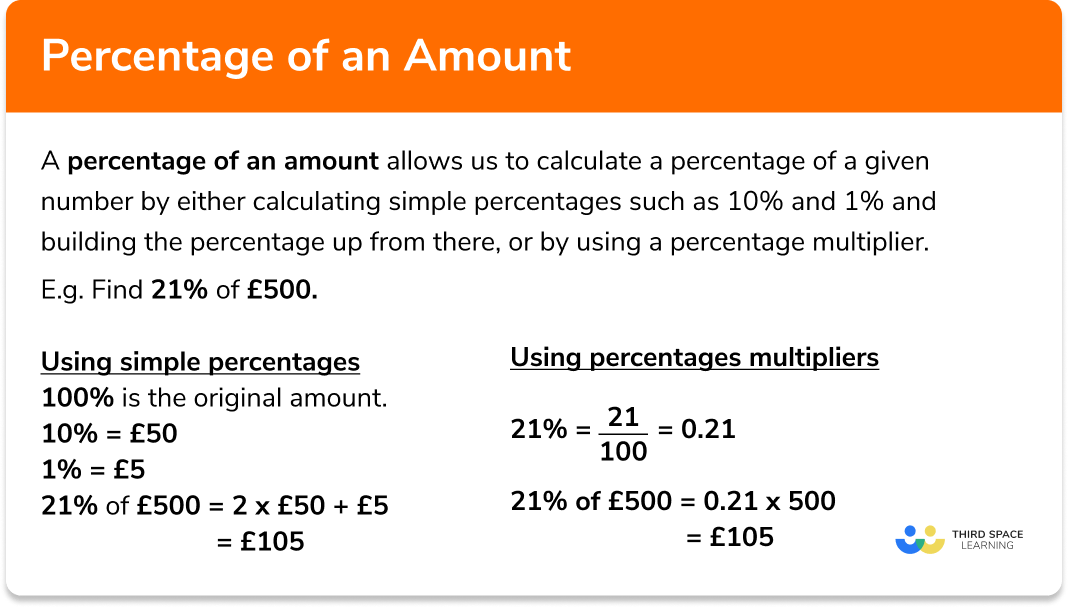
Calculating a Percentage of a Number
This is perhaps the most frequent percentage calculation. You have a total amount (the whole), and you want to find a specific portion of it expressed as a percentage. This is crucial for understanding discounts, sales tax, tips, and interest earnings.
Formula: Amount = Percentage (as a decimal) × Whole
To convert a percentage to a decimal, simply divide it by 100 (e.g., 20% = 0.20).
Examples:
- Discounts: A jacket costs $120, and there’s a 25% discount.
- Discount amount = 0.25 × $120 = $30.
- New price = $120 – $30 = $90.
- Sales Tax: Your total bill is $50, and the sales tax is 8%.
- Tax amount = 0.08 × $50 = $4.
- Total cost = $50 + $4 = $54.
- Interest Earnings: You have $1,000 in a savings account earning 2% annual interest.
- Interest earned in one year = 0.02 × $1,000 = $20.
Finding the Percentage One Number Is of Another
This calculation helps you understand proportions and ratios, vital for budgeting, analyzing profit margins, or comparing performance. Here, you’re directly applying the basic “Part / Whole x 100” formula.
Examples:
- Budget Allocation: Your monthly income is $4,000, and your rent is $1,200. What percentage of your income goes to rent?
- ($1,200 / $4,000) × 100 = 0.30 × 100 = 30%.
- Profit Margins: You bought an item for $20 and sold it for $25. Your profit is $5. What is your profit margin as a percentage of the selling price?
- ($5 / $25) × 100 = 0.20 × 100 = 20%. (Often, profit margin is calculated against the cost price or revenue, so ensure you know the “whole” for comparison).
- Meeting Savings Goals: You want to save $5,000 this year and have already saved $1,500. What percentage of your goal have you reached?
- ($1,500 / $5,000) × 100 = 0.30 × 100 = 30%.
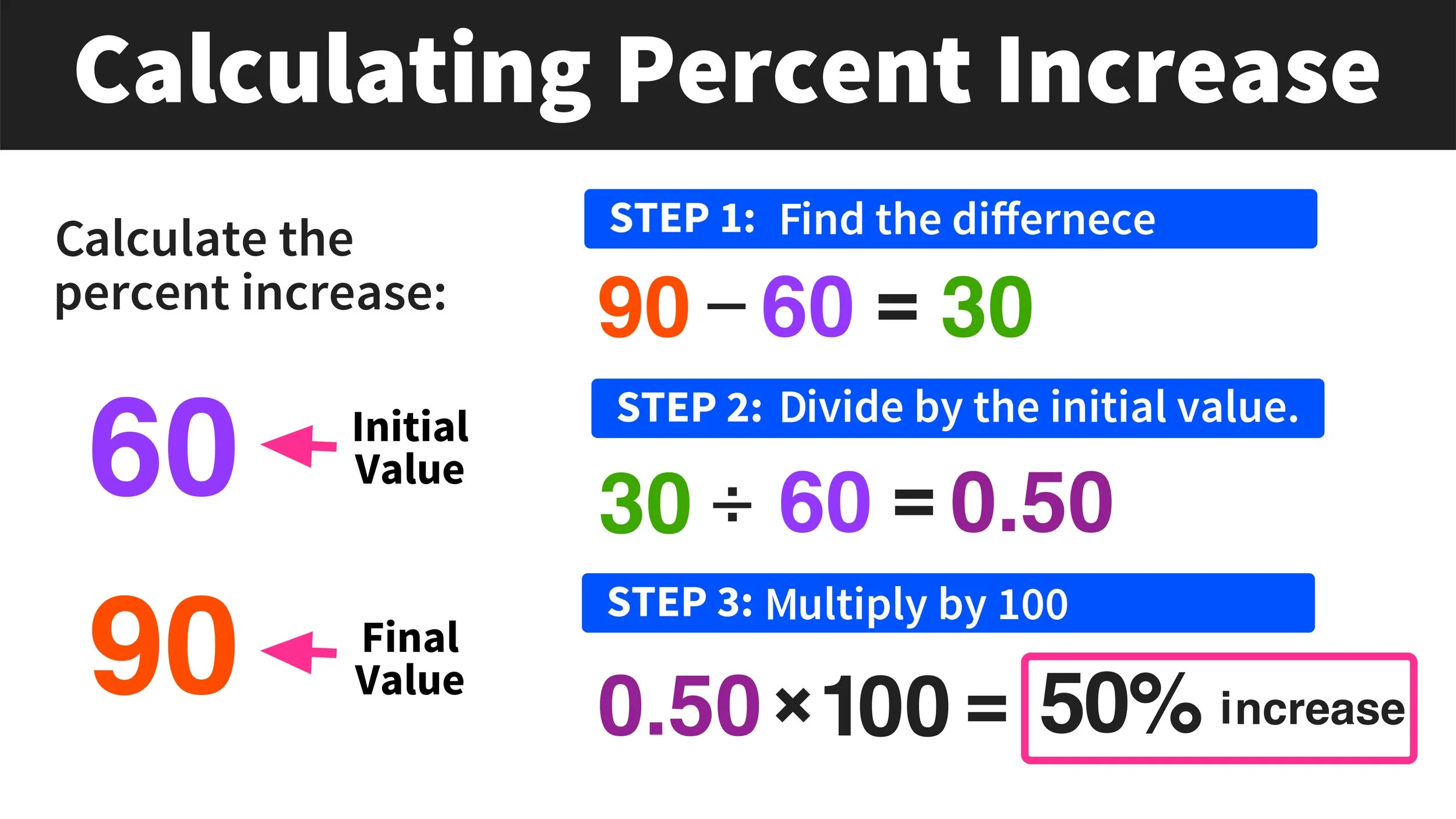
Determining Percentage Increase or Decrease
This is essential for tracking growth (investments, income) or decline (depreciation, expenses) over time. It allows you to gauge the magnitude of change relative to the initial amount.
Formula:
Percentage Change = ((New Value – Old Value) / Old Value) × 100
If the result is positive, it’s a percentage increase; if negative, it’s a percentage decrease.
Examples:
- Investment Growth: Your investment portfolio grew from $10,000 to $11,500 in one year.
- Percentage Increase = (($11,500 – $10,000) / $10,000) × 100 = ($1,500 / $10,000) × 100 = 0.15 × 100 = 15%.
- Price Drop: The price of an item you wanted dropped from $75 to $60.
- Percentage Decrease = (($60 – $75) / $75) × 100 = (-$15 / $75) × 100 = -0.20 × 100 = -20%. (A 20% price drop).
- Inflation: If a basket of goods cost $100 last year and $103 this year, what was the inflation rate?
- Percentage Increase = (($103 – $100) / $100) × 100 = ($3 / $100) × 100 = 3%.
Percentages in Action: Key Financial Applications
Understanding how to calculate percentages is only half the battle; the real value comes from applying these calculations to make smarter financial choices. Here’s a look at where percentages are indispensable across various facets of your financial life.

Personal Finance & Budgeting
Percentages are the bedrock of effective personal finance. They help you visualize how your money is allocated and where potential adjustments can be made.
- Budget Allocation: The 50/30/20 rule (50% needs, 30% wants, 20% savings/debt) is entirely percentage-based. You use percentages to ensure your spending aligns with your financial goals.
- Tracking Spending: Knowing what percentage of your income goes to housing, transportation, or entertainment helps identify areas for optimization.
- Debt-to-Income Ratios: Lenders use this critical percentage to assess your ability to manage monthly payments and repay debts. A high percentage indicates higher risk.
Investing & Savings
Percentages are the language of returns, risks, and diversification in the investment world.
- Return on Investment (ROI): This tells you the profitability of an investment as a percentage of its original cost, making it easy to compare different investment opportunities.
- Compound Interest: The magic of compound interest relies heavily on percentages. Understanding how a percentage interest rate applied repeatedly can grow your money significantly over time is key to long-term wealth building.
- Portfolio Diversification: Investors allocate percentages of their portfolio to different asset classes (e.g., 60% stocks, 40% bonds) to manage risk.
Debt Management
Whether it’s a mortgage, student loan, or credit card, percentages define the cost of borrowing.
- Interest Rates: Annual Percentage Rate (APR) on loans and credit cards is a critical percentage that determines how much extra you’ll pay for borrowing. Lower APRs mean lower costs.
- Minimum Payments: While expressed as a dollar amount, minimum payments are often calculated as a small percentage of your outstanding balance, which can lead to slow debt repayment if only minimums are paid.
- Debt Reduction Strategies: Understanding the percentage of your income going towards debt payments can motivate you to prioritize repayment.
Business Finance
For entrepreneurs and business owners, percentages are vital for monitoring performance, profitability, and growth.
- Profit Margins: Gross profit margin, operating profit margin, and net profit margin are all percentages that indicate the efficiency and profitability of a business.
- Sales Growth: Businesses track percentage increases in sales year-over-year to measure success and set future targets.
- Expense Ratios: What percentage of revenue is spent on marketing, salaries, or utilities provides insights into cost control.
Taxes & Discounts
These common financial interactions are almost always expressed in percentages.
- Sales Tax: A percentage added to the price of goods and services.
- Income Tax Brackets: Your income tax liability is determined by percentages applied to different portions of your income.
- Discounts & Markdowns: Understanding a 15% off sale versus “buy one, get one 50% off” requires percentage calculations to find the true savings.
Avoiding Common Percentage Pitfalls
While percentages are powerful tools, they can also be misleading if not understood correctly. Be aware of these common traps.
Understanding the “Whole”
The most crucial aspect of any percentage calculation is correctly identifying the “whole” or the base amount. A percentage only makes sense in relation to what it’s a percentage of. Forgetting this can lead to vastly different conclusions. For example, a “20% raise” sounds great, but 20% of a $30,000 salary is less impactful than 20% of a $100,000 salary. Always ask: “Percentage of what?”
Percentage Points vs. Percent Change
This is a frequently misunderstood distinction, especially in finance news.
- Percentage Points: This refers to the absolute difference between two percentages. If an interest rate goes from 5% to 6%, that’s an increase of 1 percentage point.
- Percent Change: This refers to the relative change. If an interest rate goes from 5% to 6%, it’s actually a ((6-5)/5) * 100 = 20% increase in the interest rate itself. The nuance is critical: “1 percentage point increase” sounds much smaller than “a 20% increase in the rate.”
Cumulative Percentages
When multiple percentage changes occur, you cannot simply add or subtract them. For instance, if you get a 10% raise, and then later a 10% pay cut, you don’t end up with your original salary.
- Start with $100.
- 10% raise: $100 + ($100 * 0.10) = $110.
- 10% pay cut: $110 – ($110 * 0.10) = $110 – $11 = $99.
You ended up with $99, not $100. Each percentage change applies to the new current value, not the original. This is particularly relevant for investments, discounts, and inflation over time.
The Illusion of Large Numbers
A small percentage applied to a very large number can still represent a substantial amount. Conversely, a large percentage of a very small number might be insignificant. Always consider the absolute dollar amount behind the percentage, especially when dealing with national budgets, corporate profits, or large-scale investments. A 0.1% fee on a $1,000,000 investment is still $1,000.
Leveraging Tools for Percentage Mastery
While mental math is useful for quick estimates, you don’t always need to calculate percentages by hand. Several tools can assist, making complex financial analysis much simpler.
Basic Calculators and Spreadsheets
For everyday calculations, a simple calculator will suffice. For more involved scenarios, especially those involving multiple variables or tracking changes over time, spreadsheet software like Microsoft Excel or Google Sheets is invaluable. They allow you to set up formulas once and apply them to changing data, automating calculations for budgets, investment tracking, and profit analysis.
Online Financial Calculators
The internet is replete with specialized financial calculators. Need to figure out a mortgage payment? An ROI calculator? A compound interest projection? Many reputable financial websites offer free tools that handle the percentage calculations for you, allowing you to input variables and see instant results, which is excellent for scenario planning.
Understanding Financial Statements
Public companies and investment funds regularly publish financial statements (annual reports, quarterly earnings). These reports are full of percentages: growth rates, profit margins, expense ratios, debt levels. Learning to read and interpret these percentages provides a powerful lens into the health and performance of businesses and the economy.
Conclusion
The question “how do I figure out a percentage?” opens the door to a world of financial understanding and empowerment. Far from being an abstract mathematical concept, percentages are the connective tissue that links disparate financial figures into a coherent narrative. From managing your daily budget and navigating sales to evaluating complex investment opportunities and understanding economic indicators, a solid grasp of percentages is not merely beneficial—it’s essential for achieving true financial literacy.
By mastering the basic formulas, understanding common applications, and being mindful of potential pitfalls, you equip yourself with a critical tool for making informed, confident decisions about your money. Embrace percentages as your allies in the quest for financial clarity, and you’ll find yourself better prepared to build wealth, manage debt, and secure your financial future. The numbers tell a story; percentages help you read it fluently.
aViewFromTheCave is a participant in the Amazon Services LLC Associates Program, an affiliate advertising program designed to provide a means for sites to earn advertising fees by advertising and linking to Amazon.com. Amazon, the Amazon logo, AmazonSupply, and the AmazonSupply logo are trademarks of Amazon.com, Inc. or its affiliates. As an Amazon Associate we earn affiliate commissions from qualifying purchases.