
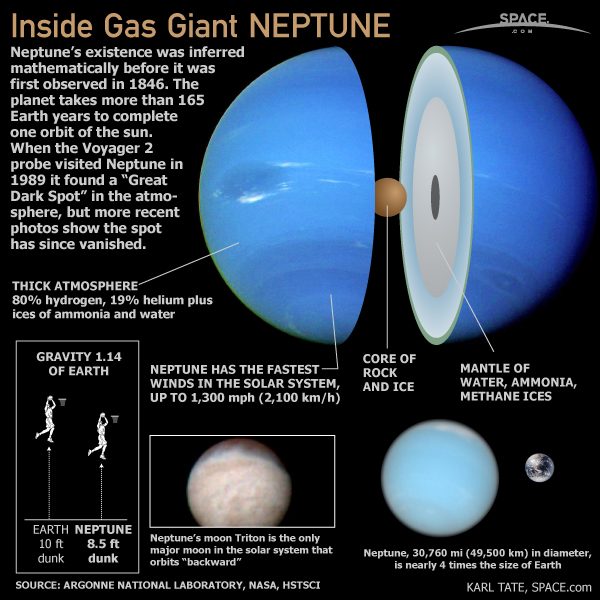
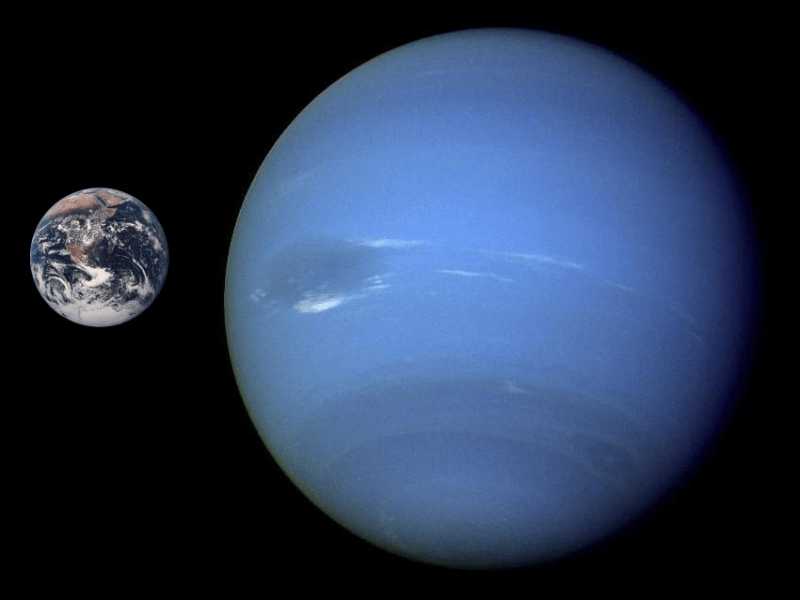
Neptune, the most distant recognized planet in our solar system, is a fascinating ice giant whose majestic presence has captivated astronomers for centuries. Its immense distance from Earth, approximately 4.5 billion kilometers on average, makes precise measurement a formidable technological challenge. Despite these hurdles, advancements in space exploration, remote sensing instrumentation, and sophisticated data analysis software have enabled humanity to pin down its dimensions with remarkable accuracy. The accepted equatorial diameter of Neptune is 49,244 kilometers (30,599 miles). Its polar diameter is slightly smaller, at 48,682 kilometers, a consequence of its rapid rotation, which flattens the planet at the poles and bulges it at the equator. This precise figure is not merely an observational fact; it represents a pinnacle of engineering and computational prowess, demonstrating how technology extends our senses across the cosmos.

The Technological Evolution of Planetary Measurement
Understanding a distant celestial body’s size is a testament to the continuous innovation in astronomical technology. Early attempts at planetary measurement relied heavily on optical instruments and rudimentary computational methods, gradually evolving into today’s highly complex digital systems.
Early Optical Instruments and Computational Methods
For centuries, the primary tools for astronomical observation were ground-based optical telescopes. Determining the angular size of a planet like Neptune, which appears as a tiny disk even in powerful telescopes, was an intricate process. Astronomers would measure the apparent diameter in arcseconds, comparing it to known celestial objects or employing micrometers attached to the eyepiece. These measurements were then combined with increasingly accurate calculations of Neptune’s distance from Earth, derived from orbital mechanics and Kepler’s laws. The underlying computational methods, initially performed manually, were meticulous and prone to human error, yet they laid the groundwork. The accuracy of these early measurements was inherently limited by atmospheric distortion (seeing conditions), the resolution limits of the optics themselves, and the manual nature of data recording and calculation. Software, in its most nascent form, might have been simple algorithms for orbital prediction or data correction, but nothing close to what we use today.
Digital Imaging Sensors: Capturing Distant Worlds
The advent of digital imaging sensors, specifically Charge-Coupled Devices (CCDs) in the late 20th century, revolutionized astronomical observation. Replacing photographic plates, CCDs offered vastly superior sensitivity, linearity, and dynamic range. For planetary science, this meant capturing fainter details, higher contrast, and more accurate photometric data. Modern telescopes equipped with these sensors could digitally record Neptune’s subtle disk, allowing for subsequent computer-aided analysis. Software played a crucial role here, not just for image acquisition and storage but for noise reduction, stacking multiple exposures to improve signal-to-noise ratio, and performing edge detection algorithms to delineate the planet’s limb more precisely. This digital transition marked a significant leap, moving from subjective visual estimations to quantifiable, pixel-based measurements that could be processed and refined.
Voyager 2: A Landmark in Deep Space Exploration Technology
While ground-based observations provided initial estimates, the definitive measurement of Neptune’s diameter came from the Voyager 2 spacecraft’s flyby in 1989. This mission was a monumental achievement in engineering and computing, pushing the boundaries of what was previously imaginable.
Engineering Precision for Interstellar Distances
The very ability of Voyager 2 to reach Neptune after a 12-year journey and precisely execute its flyby was an extraordinary feat of engineering. The spacecraft’s design incorporated robust shielding, redundant systems, and sophisticated power management (radioisotope thermoelectric generators – RTGs) to ensure its longevity in the harsh environment of deep space. Its attitude control system, powered by small thrusters and gyroscopes, maintained precise pointing for its instruments over billions of kilometers. Navigational precision, relying on an intricate network of ground stations (the Deep Space Network) and advanced trajectory computation software, was critical to ensure Voyager 2 arrived at the correct place and time for its close encounter. The margin for error was infinitesimal, making the successful execution a testament to human ingenuity in systems engineering.
Remote Sensing Instruments and Data Telemetry
Voyager 2 was equipped with a suite of cutting-edge remote sensing instruments designed for unprecedented scientific data collection. For determining Neptune’s diameter, the most critical instruments were the Narrow-Angle and Wide-Angle Cameras. These instruments utilized vidicon tubes, precursors to modern CCDs, to capture high-resolution images. Beyond imaging, the spacecraft also carried radio science instruments that could measure atmospheric occultations – how Neptune’s atmosphere blocked radio signals – providing indirect but highly accurate measurements of its atmospheric layers and overall size.
The data telemetry system was equally impressive. Operating at vast distances, Voyager 2 transmitted its findings back to Earth using a powerful radio antenna. The signal, incredibly weak by the time it reached Earth, required massive dish antennas of the Deep Space Network and highly sensitive receivers to capture it. Error-correction coding and sophisticated modulation techniques were employed to ensure data integrity over interstellar distances, minimizing corruption from cosmic noise.
Software Algorithms for Image Reconstruction and Analysis
Upon reception, the raw data from Voyager 2 was anything but a clear picture. It consisted of digital packets that required extensive processing. Specialized software algorithms were developed to reconstruct these packets into images. Further advanced image processing software was then used for:
- Geometric Correction: Adjusting for distortions introduced by the camera’s optics and the spacecraft’s motion.
- Photometric Calibration: Correcting for varying lighting conditions and sensor response.
- Limb Fitting: Applying sophisticated mathematical models to precisely locate the edge of the planetary disk in multiple images taken from different angles and distances. This process involved statistical analysis to minimize errors and derive the most accurate spherical or oblate spheroid fit to the observed data points.
- Stereographic Analysis: Using multiple images from slightly different perspectives to create 3D models and verify diameter measurements.
These software tools were indispensable, transforming raw telemetry into the stunning, scientifically rigorous data that allowed for the definitive determination of Neptune’s diameter.
Modern Astronomical Tools: Pushing the Boundaries of Resolution
Even after Voyager 2, technology continues to refine our understanding and measurement capabilities. Modern ground-based and space telescopes, coupled with advanced computational techniques, offer new avenues for planetary science.
Adaptive Optics and Large Telescope Arrays
Ground-based telescopes now routinely overcome the blurring effects of Earth’s atmosphere through adaptive optics (AO) technology. AO systems use deformable mirrors and real-time wavefront sensors to correct atmospheric distortions hundreds of times per second. This allows telescopes like the Keck Observatory or the Very Large Telescope to achieve resolutions comparable to (or even surpassing) space telescopes, revealing finer details on distant planets. When multiple telescopes are linked together in arrays, like the Very Large Array or ALMA, they employ interferometry—combining signals to achieve the resolution of a single, much larger virtual telescope. These technologies enable continuous, long-term monitoring of Neptune, observing changes in its atmosphere and allowing for more refined measurements of its precise shape and size over time, which might subtly vary due to atmospheric dynamics.
AI-Powered Image Processing and Data Mining
The sheer volume of data generated by modern telescopes and future missions necessitates advanced computational tools. Artificial intelligence (AI) and machine learning (ML) algorithms are increasingly deployed in astronomical image processing. AI can:
- Automate Feature Detection: Identifying atmospheric phenomena, storm systems, and subtle surface variations on Neptune.
- Enhance Resolution: Using super-resolution algorithms to infer finer details from existing image data.
- Optimize Data Correction: Developing adaptive algorithms to correct for instrument artifacts and environmental noise more effectively than traditional methods.
- Mine Archival Data: Sifting through decades of astronomical observations to detect subtle changes or patterns in Neptune’s appearance that might influence diameter measurements, such as seasonal variations in its cloud tops.
These AI tools accelerate the analysis process and can uncover insights that might be missed by human observers, leading to even greater precision in our understanding of Neptune’s physical characteristics.
Advanced Simulation Software for Gravitational Lensing and Occultation Analysis
Beyond direct imaging, advanced simulation software plays a critical role. For instance, precisely modeling the gravitational lensing effects of Neptune on background stars can offer another way to infer its mass and diameter. More commonly, sophisticated software is used to analyze stellar occultations—when Neptune passes in front of a distant star. By precisely timing how long the star’s light dims and brightens as it passes behind Neptune’s atmosphere, scientists can create incredibly detailed profiles of the planet’s atmospheric layers and derive an exceptionally accurate measure of its physical diameter. These simulations must account for atmospheric composition, temperature profiles, and the precise geometry of the occultation, requiring high-performance computing and complex numerical models.
The Future of Planetary Cartography: Robotics, AI, and Next-Gen Spacecraft
The pursuit of even greater precision and deeper understanding of ice giants like Neptune continues to drive technological innovation. Future missions will undoubtedly leverage robotics, AI, and novel spacecraft designs to push the boundaries further.
Miniaturized Probes and Swarm Technologies
Future exploration might involve constellations of miniaturized probes (CubeSats or SmallSats) rather than single, large spacecraft. These swarm technologies, operating autonomously or semi-autonomously, could provide multi-point observations of Neptune simultaneously, gathering data from various angles and altitudes. This distributed sensing approach would offer unprecedented spatial and temporal resolution, allowing for dynamic measurements of its shape, atmospheric dynamics, and magnetic field. The deployment, communication, and coordination of such a swarm would be a highly complex networking and AI challenge, requiring sophisticated software for autonomous navigation and data fusion.
AI for Autonomous Data Collection and Decision-Making
AI will empower future spacecraft to make intelligent decisions independently, especially crucial for missions operating at vast distances where real-time human control is impossible. AI systems could analyze onboard sensor data, identify scientifically valuable phenomena (e.g., erupting geysers, atmospheric anomalies), and dynamically adjust observation schedules or instrument settings to maximize data return. This capability would significantly enhance the efficiency and scientific yield of deep space missions, potentially leading to more accurate and detailed measurements of planetary parameters like diameter by optimizing data collection around key events.
Quantum Computing’s Potential in Astrodynamics
While still in its early stages, quantum computing holds immense promise for astrodynamics and planetary science. The complex calculations required for trajectory optimization, gravitational field modeling, and the analysis of vast datasets could be drastically accelerated by quantum computers. This could enable:
- Faster and more precise mission planning: Allowing for more intricate flyby trajectories to obtain optimal measurement angles.
- Enhanced data processing: Speeding up the analysis of high-resolution images and atmospheric occultation data, leading to quicker and more accurate results for planetary dimensions.
- Advanced simulations: Running highly detailed simulations of planetary interiors and atmospheres, helping to understand how internal structures might influence external measurements and vice versa.
The journey to ascertain Neptune’s diameter, from early telescopic observations to sophisticated robotic probes and AI-driven analysis, perfectly encapsulates humanity’s relentless drive to understand the cosmos through technological advancement. The stated diameter of 49,244 kilometers is not just a number, but a monument to decades of scientific curiosity, engineering excellence, and computational innovation.
aViewFromTheCave is a participant in the Amazon Services LLC Associates Program, an affiliate advertising program designed to provide a means for sites to earn advertising fees by advertising and linking to Amazon.com. Amazon, the Amazon logo, AmazonSupply, and the AmazonSupply logo are trademarks of Amazon.com, Inc. or its affiliates. As an Amazon Associate we earn affiliate commissions from qualifying purchases.