
Levittown represents far more than just a collection of suburban houses; it is a monumental case study in corporate identity, brand strategy, and the mass marketing of a lifestyle. Conceived and executed by Levitt & Sons in the post-World War II era, Levittowns—first on Long Island, New York, followed by Pennsylvania, New Jersey, and Maryland—became synonymous with the American Dream, fundamentally altering the landscape of housing development and consumer expectations. Its genesis, execution, and enduring legacy offer rich insights into how a company can brand not just a product, but an entire way of life.
The Birth of a Housing Brand: Levitt & Sons’ Vision
The origins of Levittown are deeply rooted in a confluence of societal need and entrepreneurial vision. The end of World War II unleashed an unprecedented demand for housing in the United States. Millions of returning veterans, many with new families, were eager to settle down, but faced a severe housing shortage. This created a colossal market opportunity that Levitt & Sons, led by Abraham Levitt and his sons William and Alfred, were uniquely positioned to capitalize on.

Post-War Demand and a Market Opportunity
The GI Bill provided accessible home loans, further fueling the housing boom. Traditional homebuilding methods, however, were too slow and costly to meet this overwhelming demand. Levitt & Sons recognized that efficiency and scale were key. They didn’t just see a need for houses; they saw a demand for homes that were affordable, modern, and offered the promise of a stable, family-oriented life. This understanding of consumer psychology, coupled with a deep appreciation for operational efficiency, laid the groundwork for their transformative brand strategy. They weren’t just selling shelter; they were selling a vision of future prosperity and happiness.
Henry Levitt’s Assembly Line Approach to Construction
The genius of William J. Levitt lay in his application of industrial assembly line principles to home construction. Inspired by Henry Ford’s automotive factories, Levitt broke down the complex process of building a house into 27 distinct steps. Each step was performed by specialized crews moving from house to house, rather than a single crew building one house from start to finish. This streamlined process dramatically reduced construction time and costs. By purchasing materials in bulk, often directly from manufacturers or even establishing their own subsidiaries for supplies like lumber and nails, Levitt & Sons achieved unprecedented economies of scale. This method wasn’t just a logistical triumph; it was a foundational element of their brand, promising rapid delivery and unmatched affordability, defining their corporate identity as innovators in mass-produced quality living.
Crafting the Levittown Corporate Identity
Levitt & Sons meticulously crafted a corporate identity that resonated deeply with the aspirations of post-war Americans. Their brand wasn’t accidental; it was engineered through standardized design, a clear brand promise of affordability and convenience, and masterful marketing that tapped into cultural desires.
Standardized Design as a Brand Signature
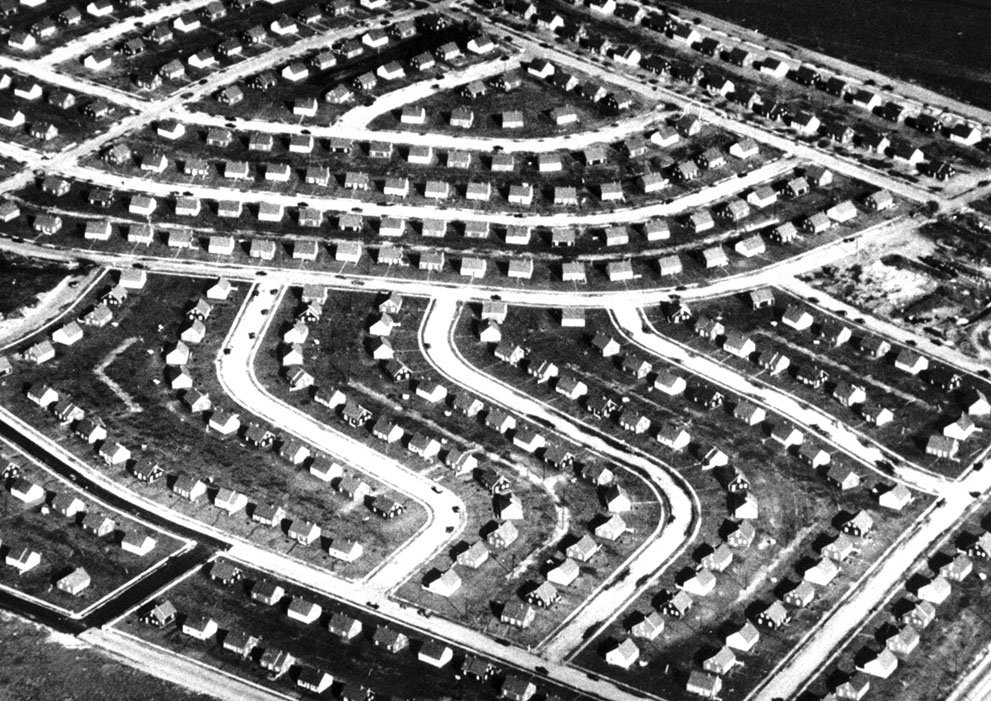
The visual identity of a Levittown home was instantly recognizable. While offering a few variations (such as the Cape Cod, Ranch, and Colonial models), the houses largely adhered to a standardized design. This uniformity, initially criticized by some, was a deliberate brand signature. It allowed for maximum efficiency in construction and created a cohesive aesthetic for the entire community. Each house featured built-in appliances, carports, and often, a television set—luxuries that were not standard in homes of that price point. These included amenities became part of the Levittown brand promise, signaling modern living and convenience to prospective buyers. The uniform landscaping, featuring a pre-planted tree, further cemented this planned, idyllic community image.
Efficiency, Affordability, and the Brand Promise
The core brand promise of Levitt & Sons was simple yet powerful: an affordable, modern home for the average American family. By cutting costs through efficient construction and bulk purchasing, Levittown homes were priced within reach of working-class families and veterans. The low down payments and accessible mortgages made homeownership a reality for millions who previously could only dream of it. This commitment to affordability became a central pillar of the Levittown brand. It wasn’t just about the physical house; it was about democratizing the American Dream, making it accessible to a broader demographic. This brand promise was a profound differentiator in a market hungry for solutions.
Marketing the American Dream: Beyond Bricks and Mortar
Levitt & Sons understood that they were selling more than just houses; they were selling a complete lifestyle. Their marketing campaigns emphasized community, safety, good schools, and a sense of belonging. They highlighted the convenience of suburban living, the spacious yards for children, and the camaraderie of neighbors. Model homes were meticulously staged to showcase the idealized family life residents could expect. Promotional materials depicted happy families enjoying their new homes and thriving communities. This aspirational branding successfully tapped into the collective post-war yearning for stability, security, and upward mobility. They positioned Levittown as the embodiment of the American Dream, a place where families could build a future.

Levittown as a Cultural Brand and Archetype
Beyond the corporate strategy, Levittown quickly evolved into a powerful cultural brand, shaping perceptions of suburban life and becoming an archetype for a new American identity. It influenced popular culture and redefined consumer expectations for homeownership.
The Iconography of Suburban Life
Levittown’s aesthetic, with its neat rows of standardized houses, manicured lawns, and community amenities, became an iconic representation of post-war American suburbia. It created a recognizable visual language that permeated media, from television shows to literature. This iconography solidified Levittown’s status as a cultural brand, a shorthand for a particular way of life characterized by conformity, family values, and consumerism. Even for those who never lived in a Levittown, the image of these communities contributed significantly to the collective consciousness of what it meant to live in the suburbs.
Shaping Consumer Expectations and Identity
The success of Levittown had a profound impact on consumer expectations regarding housing. It set a new standard for what an affordable, modern home should offer—from built-in appliances to ample green space. This influenced the entire housing industry, prompting other developers to adopt similar mass-production techniques and amenity packages. More subtly, Levittown helped shape a new personal identity for its residents. Moving to Levittown often symbolized a step up the economic ladder, an achievement of the American Dream. The shared experience of being a “Levittowner” fostered a unique sense of community and collective identity, tied to the brand’s promise of a better life.
Evolution and Enduring Legacy of the “Levittown” Brand
While the original Levitt & Sons company eventually moved on to other ventures and, in some forms, ceased to exist, the “Levittown” brand as a concept has endured. It represents not just specific physical locations but a pivotal moment in American history—the rise of the suburbs, the democratization of homeownership, and the power of mass production to fulfill widespread desires. The legacy of the “Levittown” brand continues to be debated and analyzed, symbolizing both the promise and the pitfalls of planned communities and homogeneous living. Its story remains relevant for understanding the evolution of brand building in the context of large-scale social and economic shifts.
Brand Impact and Critical Perspectives
The potent brand of Levittown, while overwhelmingly successful, was not without its complexities and criticisms. Its enduring legacy prompts a re-examination of how corporate identity can both uplift and inadvertently constrain.
The Double-Edged Sword of Uniformity
The standardized design that was a cornerstone of Levittown’s brand efficiency also became its most significant point of contention. While it allowed for affordability and rapid construction, it also led to a perceived lack of individuality. Critics argued that the uniformity fostered conformity and stifled personal expression, creating “ticky-tacky” rows of identical homes. This aspect became a double-edged sword for the brand: it allowed for mass appeal and recognition, but also drew the ire of those who valued architectural diversity and personalized living spaces. The brand’s strength in efficiency inadvertently led to a weakness in perceived uniqueness.
Challenges to the Homogeneous Brand Image
Levittown’s early brand image was largely built on a vision of a homogeneous, white, middle-class community. This exclusion, particularly the restrictive covenants that initially prevented non-white buyers, represented a significant ethical failing and a challenge to the brand’s broader “American Dream” promise. As society evolved and civil rights movements gained traction, this homogeneous image was increasingly challenged. Subsequent Levittowns were built under different regulations, but the early legacy of exclusion complicated the brand’s narrative. Over time, the communities became more diverse, reflecting shifts in national demographics, but the initial brand identity of a uniform, exclusive utopia cast a long shadow.
Adaptability and the Future of Levittown’s Identity
Despite its controversies, the physical Levittowns have shown remarkable adaptability. Homeowners have personalized their standardized houses with additions, renovations, and landscaping, transforming the original uniform landscape into a tapestry of individual expression. This organic evolution from within the communities demonstrates a resilience that transcends the original corporate brand vision. Today, “Levittown” signifies not just the vision of one company, but the ongoing story of communities that have aged, adapted, and redefined their own identities. The brand of Levittown, therefore, continues to evolve, reflecting both its historical origins as a meticulously crafted corporate identity and its living reality as a dynamic, diverse place where millions have built their lives.
aViewFromTheCave is a participant in the Amazon Services LLC Associates Program, an affiliate advertising program designed to provide a means for sites to earn advertising fees by advertising and linking to Amazon.com. Amazon, the Amazon logo, AmazonSupply, and the AmazonSupply logo are trademarks of Amazon.com, Inc. or its affiliates. As an Amazon Associate we earn affiliate commissions from qualifying purchases.