
Green’s Theorem stands as a foundational concept in vector calculus, offering a powerful bridge between different types of integrals in two dimensions. While originating as a pure mathematical construct, its profound implications resonate deeply within the realm of technology, underpinning algorithms and computational methods critical to computer graphics, engineering simulations, data analysis, and various software applications. Essentially, Green’s Theorem provides a method to relate a line integral around a simple, closed curve to a double integral over the plane region bounded by that curve. This elegant equivalence often simplifies complex calculations, making it an invaluable tool for developers and engineers building the digital world.
The Fundamental Concept: Bridging Vector Fields and Areas in Digital Space
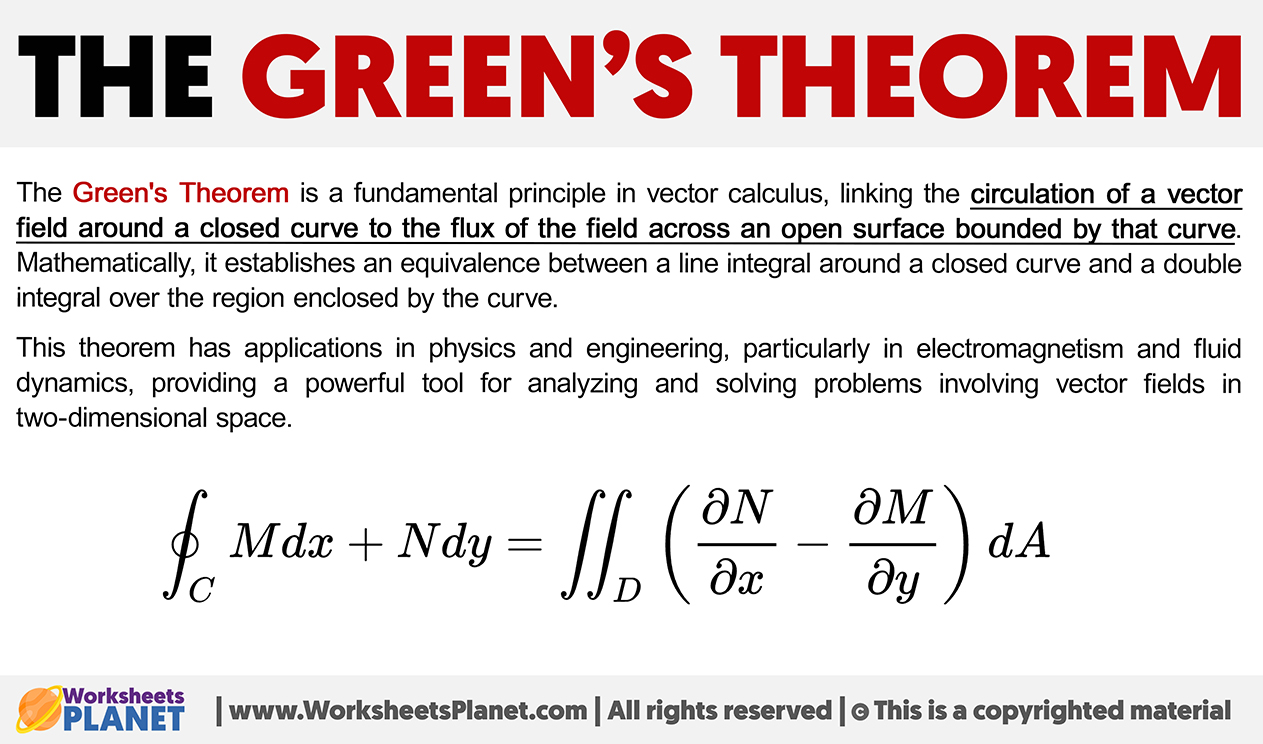
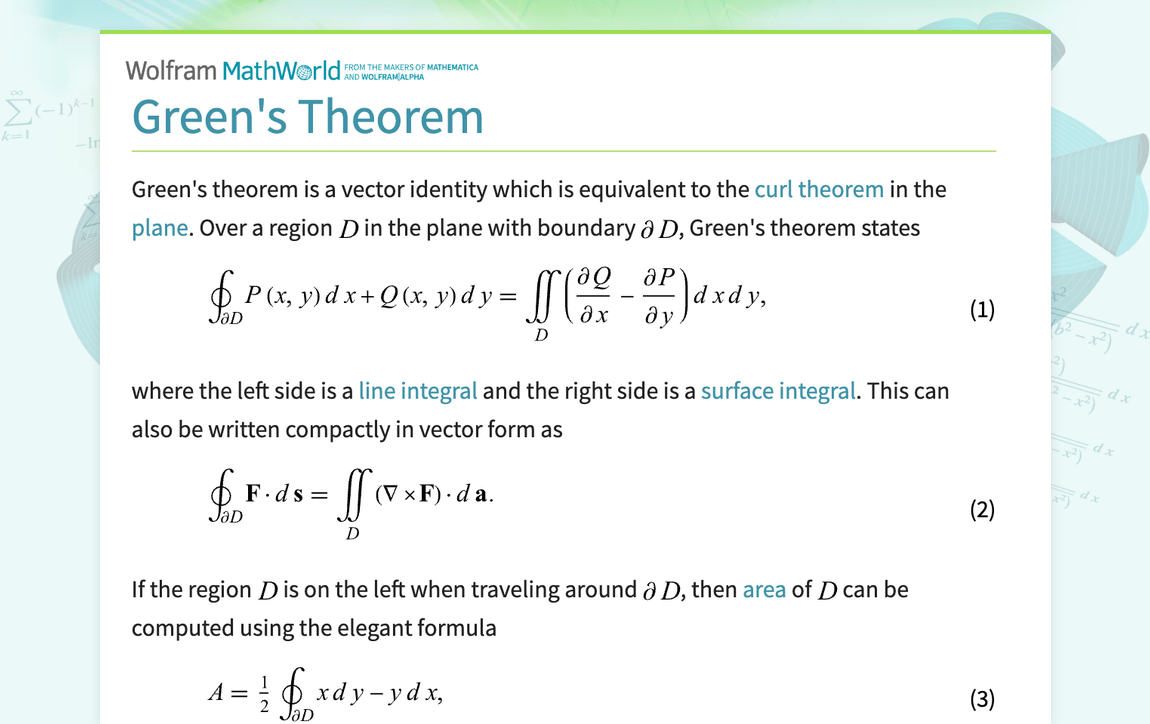
At its core, Green’s Theorem states that for a simply connected region $R$ in the plane with a piecewise smooth, simple closed boundary curve $C$, if $P(x,y)$ and $Q(x,y)$ are functions with continuous partial derivatives on an open region containing $R$, then:
$ointC (P , dx + Q , dy) = iintR left( frac{partial Q}{partial x} – frac{partial P}{partial y} right) , dA$
Here, the line integral on the left is taken counterclockwise along the boundary curve $C$, and the double integral on the right is taken over the region $R$. This theorem essentially converts a summation along a boundary into a summation over an area. For technologists, this isn’t merely an abstract mathematical identity; it’s a computational shortcut. In many digital scenarios, evaluating a line integral directly can be computationally expensive or difficult to parameterize accurately. Green’s Theorem often transforms such problems into an area integral that is easier or more efficient to calculate numerically, particularly when dealing with polygonal regions common in computer graphics and geometric modeling.
This relationship is particularly useful when dealing with vector fields, which are ubiquitous in physics engines, fluid simulations, and electromagnetic modeling within software. A vector field assigns a vector to each point in space, representing forces, velocities, or other directional quantities. Green’s Theorem provides a way to understand the net “circulation” of a vector field around a closed loop by analyzing the “curl” or rotational tendency of the field within the enclosed region. This conceptual link is vital for algorithms that need to quantify effects like fluid flow, magnetic flux, or forces acting on objects within a defined boundary.
Green’s Theorem in Computer Graphics and Visualization
The application of Green’s Theorem is particularly pronounced in the field of computer graphics, where the manipulation and rendering of two-dimensional shapes are fundamental. Its ability to simplify area calculations and understand boundary interactions makes it a silent workhorse behind many visual effects and geometric computations.
Area Calculation and Polygon Meshes
One of the most direct and widely utilized applications of Green’s Theorem in computer graphics is the precise calculation of the area of a two-dimensional polygon. For any arbitrary polygon defined by a sequence of vertices $(x1, y1), (x2, y2), dots, (xn, yn)$, Green’s Theorem can be used to derive the well-known “shoelace formula.” By setting $P(x,y) = -y/2$ and $Q(x,y) = x/2$, the integrand $(partial Q/partial x – partial P/partial y)$ becomes $(1/2 – (-1/2)) = 1$. The double integral then simply evaluates to the area of the region $R$. The line integral, when approximated over the segments of the polygon, yields:
Area $= frac{1}{2} sum{i=1}^n (xi y{i+1} – x{i+1} yi)$ (with $x{n+1}=x1, y{n+1}=y_1$)
This formula is incredibly efficient and accurate for calculating polygon areas, making it indispensable for:
- Game Development: Collision detection for 2D sprites, calculating areas for texture mapping, and optimizing level geometry.
- CAD Software: Determining the surface area of complex 2D designs for manufacturing specifications.
- Image Processing: Analyzing the area of segmented regions in an image, such as for object recognition or medical imaging.
- Rendering Engines: Optimizing rendering processes by accurately determining visible surface areas.
Fluid Dynamics and Simulation
Beyond static geometry, Green’s Theorem plays a conceptual role in the algorithms that power fluid dynamics simulations, crucial for realistic visual effects in movies and games, as well as scientific and engineering applications. While full 3D fluid simulations often involve extensions like the divergence theorem (a 3D analogue), the principles Green’s Theorem embodies for 2D fields are foundational.
For example, when simulating fluid flow around an object in 2D, understanding the circulation of the velocity field is key. Green’s Theorem allows engineers and physicists to relate the circulation (line integral of the velocity field) to the curl of the velocity field (double integral) over the region. This helps in modeling phenomena like vortices, lift, and drag, which are critical for accurate and visually convincing fluid behavior in computational fluid dynamics (CFD) software and virtual environments.
Algorithmic Efficiency and Computational Geometry
The primary benefit of Green’s Theorem from an algorithmic perspective is its potential to transform a problem from one domain (boundary integration) to another (area integration) where computation may be significantly more efficient or straightforward. This transformation is a cornerstone of computational geometry and numerical methods.
Optimizing Integrations in Software
Many problems in engineering and science require the evaluation of integrals. Direct numerical integration of line integrals, especially along complex curves, can be prone to errors or computationally intensive, requiring fine discretization of the curve. By converting these to area integrals using Green’s Theorem, algorithms can sometimes leverage simpler discretization schemes for the region, leading to faster computations and improved accuracy. This is particularly relevant in:
- Finite Element Analysis (FEA): Though often involving higher-dimensional theorems, the conceptual elegance of relating boundary conditions to volumetric effects, as demonstrated by Green’s Theorem in 2D, underpins the formulation of many element stiffness matrices.
- Boundary Element Methods (BEM): These methods explicitly solve partial differential equations by discretizing only the boundary of a domain, often converting volumetric integrals to boundary integrals, or vice-versa, depending on the problem structure. Green’s Theorem provides a fundamental theoretical basis for such transformations in 2D.
Geometric Operations in Digital Design
Software for digital design, from architectural modeling to circuit board layout, constantly performs geometric operations. While users interact with intuitive tools, underlying these interactions are complex algorithms. Green’s Theorem supports the accurate and efficient execution of operations like:
- Area verification: Ensuring designs meet specified area constraints.
- Overlap detection: Identifying where different geometric shapes intersect or overlap, critical for design rule checking in electronics or construction.
- Offsetting and boolean operations: When modifying shapes, the calculation of new areas or the combination/subtraction of shapes often relies on fundamental geometric algorithms that trace back to principles exemplified by Green’s Theorem.
Beyond Graphics: Engineering Software and Data Analysis
While computer graphics offers intuitive examples, the influence of Green’s Theorem extends to broader engineering and data-driven applications, often abstracted away in powerful software tools.
Finite Element Analysis (FEA) and Simulation Tools
Modern FEA software (e.g., ANSYS, Abaqus, SolidWorks Simulation) is indispensable for engineers designing structures, components, and systems. These tools simulate physical phenomena like stress, heat transfer, fluid flow, and electromagnetism. While FEA primarily deals with partial differential equations over entire volumes (often in 3D), the mathematical principles that relate boundary conditions to the behavior within a domain, central to Green’s Theorem, are foundational. In simplified 2D FEA problems, Green’s Theorem can directly convert boundary forces or heat fluxes into equivalent distributed loads within an element, allowing for more robust and accurate numerical solutions. The transformation from boundary conditions to field equations is a core aspect of how these powerful simulation tools operate.
Geographic Information Systems (GIS)
GIS software, used for mapping, spatial analysis, and environmental modeling, frequently deals with complex polygonal regions representing land parcels, watersheds, or population zones. The precise calculation of areas, perimeters, and centroids of these irregular polygons is a daily operation in GIS. As discussed, the shoelace formula derived from Green’s Theorem is a primary method for these computations. This ensures accuracy in land management, urban planning, resource allocation, and disaster response where exact spatial measurements are critical. From calculating the area of a national park to determining the acreage of agricultural land, GIS systems leverage this theorem for fundamental spatial data processing.

The Enduring Relevance of Fundamental Mathematics in Modern Tech
In an age dominated by high-level programming languages, abstract frameworks, and advanced AI models, it might seem that foundational mathematical theorems like Green’s Theorem are relics of the past. However, this could not be further from the truth. While developers might not explicitly code the theorem daily, its principles are deeply embedded in the algorithms, libraries, and engines that power modern technology.
Understanding Green’s Theorem offers critical insights into:
- Algorithm Design: It provides a blueprint for how to simplify complex problems by transforming their mathematical representation. This inspires optimization strategies in various computational tasks.
- Debugging and Performance Optimization: A grasp of the underlying mathematics allows engineers to better diagnose issues in simulations, understand performance bottlenecks in graphics rendering, and refine numerical methods for greater efficiency and accuracy.
- Innovation: True innovation often stems from a deep understanding of fundamentals. Knowing why certain algorithms work, rather than just how to use them, empowers developers to push boundaries, create novel solutions, and build more robust and intelligent software.
Ultimately, Green’s Theorem serves as a powerful reminder that the sophisticated technological tools we rely on daily are built upon elegant and enduring mathematical truths. Its role in simplifying calculations and connecting seemingly disparate mathematical concepts continues to make it a silent, yet indispensable, force in the advancement of digital technology.
aViewFromTheCave is a participant in the Amazon Services LLC Associates Program, an affiliate advertising program designed to provide a means for sites to earn advertising fees by advertising and linking to Amazon.com. Amazon, the Amazon logo, AmazonSupply, and the AmazonSupply logo are trademarks of Amazon.com, Inc. or its affiliates. As an Amazon Associate we earn affiliate commissions from qualifying purchases.