
In the vast landscape of organic chemistry, certain molecular structures serve as fundamental building blocks, enabling the synthesis of countless complex compounds vital to modern technology. Among these, the imine stands out—a versatile functional group characterized by a carbon-nitrogen double bond. While seemingly esoteric, understanding imines is critical for advancements in areas ranging from advanced materials science and pharmaceutical development to computational chemistry and green synthesis, all cornerstones of the contemporary tech sector.
The Fundamental Chemistry Behind Imines: A Technical Overview
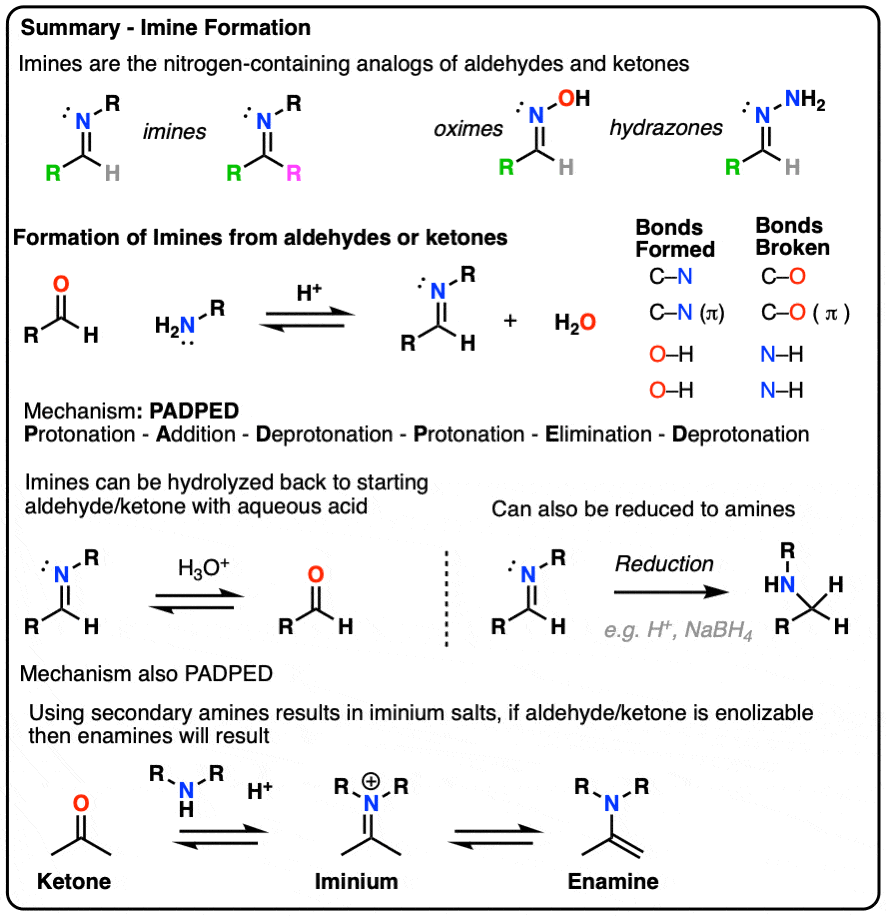
At its core, an imine is an organic compound featuring a C=N double bond. This structure is typically formed through the condensation reaction between a primary amine and an aldehyde or ketone, with the elimination of a water molecule. This reaction is a cornerstone of synthetic organic chemistry due to its relative simplicity and high atom economy in many contexts.

Defining the Carbon-Nitrogen Double Bond
The C=N double bond in an imine is analogous to the C=O double bond found in aldehydes and ketones, but with distinct chemical properties due to the difference in electronegativity and size between nitrogen and oxygen. The carbon atom in the imine functional group is sp2 hybridized, as is the nitrogen atom, leading to a planar geometry around the double bond. The nitrogen atom typically possesses a lone pair of electrons, which influences the imine’s basicity and nucleophilic character.
Imines are generally electrophilic at the carbon atom, making them susceptible to nucleophilic attack. This electrophilicity can be modulated by the substituents attached to both the carbon and nitrogen atoms. Electron-withdrawing groups enhance electrophilicity, making the imine more reactive, while electron-donating groups reduce it. The presence of the lone pair on nitrogen also allows imines to act as weak bases, capable of protonation.
Key Characteristics and Types
Imines are classified based on the substituents attached to the carbon atom:
- Aldimines: Formed from aldehydes, where the carbon atom of the C=N bond is attached to at least one hydrogen atom.
- Ketimines: Formed from ketones, where the carbon atom of the C=N bond is attached to two alkyl or aryl groups.
The stability of imines can vary significantly. Simple imines derived from aliphatic aldehydes are often prone to hydrolysis back to the starting amine and aldehyde, especially in the presence of water or acid. However, steric hindrance, conjugation with aromatic systems, or the presence of electron-withdrawing groups can significantly enhance their stability, making them robust intermediates or final products.
A related concept crucial in understanding imine reactivity is tautomerism. Imines can exist in equilibrium with their tautomeric form, known as enamines, particularly when there is an alpha-hydrogen atom available on the carbon adjacent to the imine carbon. Enamines possess a carbon-carbon double bond adjacent to a nitrogen atom and are nucleophilic at the alpha-carbon, offering a different reactivity profile essential in various synthetic transformations. This dynamic equilibrium is often exploited in synthetic methodologies, providing access to diverse chemical structures.
Imines as Building Blocks in Advanced Materials and Polymer Science
The unique reactivity and reversibility of imine bonds make them exceptionally valuable in the burgeoning field of advanced materials science and polymer technology. Here, imines are not just intermediates but often integral components that impart specific functional properties to materials.
From Basic Structures to High-Performance Materials
One of the most significant applications of imine chemistry in materials science is the construction of novel polymers. Polyimines, also known as Schiff base polymers, are formed by linking multiple imine units together. These polymers exhibit a range of fascinating properties, including high thermal stability, inherent conductivity, and photoluminescence, depending on the specific monomers used.
For instance, conjugated polyimines can be engineered for use in organic electronics, such as organic light-emitting diodes (OLEDs), organic solar cells, and field-effect transistors. Their tunability allows for precise control over electronic and optical properties, pushing the boundaries of flexible electronics and next-generation display technologies. Furthermore, imine linkages are being explored in the development of robust, yet lightweight, structural materials for aerospace and automotive applications, offering superior mechanical properties and environmental resistance.
Dynamic Covalent Chemistry (DCC) and Responsive Systems
The reversible nature of imine formation and cleavage is a cornerstone of dynamic covalent chemistry (DCC). This field focuses on creating materials whose constituent bonds can break and reform under specific conditions, leading to self-healing, adaptable, and stimuli-responsive materials. Imines are a prime example of dynamic covalent bonds due to their relatively easy formation and hydrolysis, often catalyzed by acids or bases, or even by changes in temperature.
This reversibility allows for the development of:
- Self-healing polymers: Materials that can autonomously repair damage, extending their lifespan and reducing waste, crucial for durable electronics and protective coatings.
- Stimuli-responsive gels and hydrogels: Materials that change their properties (e.g., stiffness, volume, porosity) in response to external cues like pH changes, temperature shifts, or light irradiation. These are critical for applications in soft robotics, smart drug delivery systems, and advanced filtration membranes.
- Molecular machines and switches: Designing molecular systems where imine bonds act as “on-off” switches, allowing for precise control over molecular motion and function, paving the way for nanorobotics and intelligent materials with programmable behavior.
The ability to control material properties dynamically through imine chemistry represents a significant technological leap, enabling the creation of materials far more sophisticated and adaptive than traditional, static polymers.
The Role of Imines in Pharmaceutical Innovation and Drug Discovery
In the realm of pharmaceutical technology, imine chemistry is indispensable, contributing both to the synthesis of active pharmaceutical ingredients (APIs) and the design of novel drug candidates. The versatility of the imine functional group makes it a powerful tool in medicinal chemistry.
Imines in Medicinal Chemistry: Synthesis and Bioactivity
Imines often serve as crucial synthetic intermediates in the preparation of a wide array of nitrogen-containing heterocyclic compounds, which constitute a large percentage of FDA-approved drugs. For example, the Pictet-Spengler reaction, a classic method for synthesizing tetrahydroisoquinolines (a common scaffold in alkaloids and drug molecules), proceeds through an imine intermediate. Similarly, the synthesis of many beta-lactam antibiotics, a cornerstone of antibacterial therapy, involves imine-related steps.
Beyond their role as synthetic precursors, the imine functional group itself can contribute directly to a drug’s bioactivity. The electrophilic carbon of the imine can interact with nucleophilic residues in biological macromolecules (like enzymes or receptors), potentially leading to covalent modification or strong non-covalent interactions. This characteristic can be leveraged to design drugs that inhibit enzyme activity or disrupt protein-protein interactions, which are key mechanisms for many therapeutic agents. Examples of drugs or drug candidates containing imine linkages or imine-derived structures span various therapeutic areas, including anticancer agents, antivirals, and enzyme inhibitors. Their ability to chelate metal ions also makes them relevant in designing metallodrugs.
AI and Computational Tools in Imine-Based Drug Design
The complexity of drug discovery demands advanced technological solutions, and imine chemistry is increasingly benefiting from artificial intelligence (AI) and computational tools. These technologies accelerate every stage of the drug development pipeline, from initial target identification to lead optimization.
- Virtual Screening and Molecular Docking: AI-powered algorithms and software packages can rapidly screen vast libraries of compounds containing imine structures (or their precursors) against specific protein targets. Molecular docking simulations predict how imine-containing molecules will bind to a receptor site, estimating binding affinities and identifying potential drug candidates. This drastically reduces the need for costly and time-consuming experimental screening.
- Quantitative Structure-Activity Relationship (QSAR) Models: Machine learning models are trained on datasets of imine-based compounds with known biological activities. These models can then predict the activity of novel imine derivatives based on their molecular structure, guiding chemists toward synthesizing the most promising compounds.
- Retrosynthetic Analysis Software: AI tools can assist in planning the synthesis of complex imine-containing molecules. By working backward from the target molecule to simpler, readily available starting materials, these programs identify optimal synthetic routes, often suggesting novel imine-forming reactions or protecting group strategies that human chemists might overlook.
- Predicting Reactivity and Stability: Computational chemistry simulations (e.g., DFT calculations) can accurately predict the stability, reactivity, and spectroscopic properties of imines under various conditions, enabling chemists to design more robust synthetic routes and anticipate potential side reactions or degradation pathways.
By integrating these AI and computational tools, the pharmaceutical industry can accelerate the discovery and development of imine-based drugs, making the process more efficient, cost-effective, and ultimately, leading to new therapies faster.
Emerging Technologies and Future Prospects
The versatility of imine chemistry ensures its continued relevance and expansion into future technological frontiers.
Catalysis and Green Chemistry
Imines are central to many catalytic cycles, particularly in asymmetric catalysis, where the goal is to synthesize one enantiomer of a chiral molecule preferentially. Chiral imines can serve as chiral auxiliaries or ligands in catalysts, directing the stereochemical outcome of reactions. This is crucial for the pharmaceutical industry, where the enantiomeric purity of drugs is often paramount for efficacy and safety. Advances in solid-phase imine chemistry and photocatalytic imine transformations are also paving the way for more efficient and environmentally benign synthetic processes, aligning with the principles of green chemistry and sustainable technology development.

Biosensors and Diagnostic Technologies
The specific reactivity and ease of formation of imine bonds are being leveraged in the development of advanced biosensors and diagnostic tools. Imines can be designed to selectively react with specific biomarkers present in biological samples, leading to a detectable signal (e.g., color change, fluorescence, electrochemical response). For example, imine-forming reactions can be used to immobilize enzymes or antibodies onto sensor surfaces, creating highly specific detection platforms for diseases, environmental pollutants, or food contaminants. This integration of imine chemistry with nanotechnology and microfluidics holds immense promise for developing rapid, portable, and highly sensitive diagnostic devices, contributing significantly to digital health and the Internet of Things (IoT) in healthcare.
From the foundational understanding of its carbon-nitrogen double bond to its sophisticated applications in self-healing materials, life-saving drugs, and intelligent sensors, the imine functional group exemplifies how fundamental chemistry fuels cutting-edge technological innovation. Its inherent versatility ensures that imine chemistry will continue to be a vibrant area of research and development, driving progress across diverse sectors of the tech industry for years to come.
aViewFromTheCave is a participant in the Amazon Services LLC Associates Program, an affiliate advertising program designed to provide a means for sites to earn advertising fees by advertising and linking to Amazon.com. Amazon, the Amazon logo, AmazonSupply, and the AmazonSupply logo are trademarks of Amazon.com, Inc. or its affiliates. As an Amazon Associate we earn affiliate commissions from qualifying purchases.