
A purifier, at its core, is a technological device or system designed to remove contaminants, impurities, or unwanted substances from a given medium, such as air, water, or even specific industrial liquids and gases. Its fundamental purpose is to render the treated medium cleaner, safer, or more suitable for a particular application by employing various physical, chemical, or biological processes. In an era increasingly conscious of environmental quality and personal well-being, purifiers represent a vital segment of consumer and industrial technology, leveraging sophisticated engineering to address complex contamination challenges.
The Core Concept of Purification
The concept of purification revolves around the targeted removal of undesirable elements that compromise the integrity or safety of a substance. This process is distinct from simple filtration, though filtration often forms a critical component of purification systems. While filtration might merely separate larger particles, purification aims for a more comprehensive cleansing, often tackling microscopic contaminants, dissolved solids, chemicals, and biological agents.
Defining Impurities
Impurities can take many forms, depending on the medium being purified. In water, these might include sediments, dissolved minerals (like lead or mercury), chlorine, pesticides, bacteria, viruses, and volatile organic compounds (VOCs). For air, common impurities range from dust, pollen, pet dander, and smoke particles to airborne bacteria, viruses, mold spores, and gaseous pollutants like formaldehyde or ozone. Industrial processes often deal with even more specific contaminants, such as fine particulates in exhaust gases or specific chemical residues in manufacturing fluids. The effectiveness of a purifier is directly tied to its ability to identify and neutralize these diverse arrays of contaminants.
The Fundamental Goal
The fundamental goal of any purifier is to improve the quality of the medium to a predetermined standard, often exceeding naturally occurring levels of purity. This can be for health and safety reasons, such as ensuring potable drinking water or breathable air in homes, or for operational efficiency in industrial settings, where contaminant-free liquids or gases are essential for machinery longevity and product quality. The technical challenge lies in developing systems that are not only effective in removing a broad spectrum of impurities but also efficient, reliable, and often, environmentally sustainable.
Diverse Types of Purifiers and Their Technologies
The world of purifiers is vast, with specialized devices tailored to specific needs and environments. Each type leverages distinct technological principles to achieve its purification objective.
Water Purifiers: Ensuring Potable Safety
Water purifiers are perhaps the most common and vital category, critical for public health worldwide. They employ a combination of technologies to tackle various waterborne contaminants.
Filtration (Sediment, Carbon)
This is often the first line of defense. Sediment filters mechanically remove larger particles like dirt, rust, and sand. Carbon filters, particularly activated carbon filters, use a process called adsorption to trap organic compounds, chlorine, pesticides, herbicides, and some heavy metals, significantly improving water taste and odor.
Reverse Osmosis (RO)
RO systems are highly effective, forcing water through a semi-permeable membrane at high pressure. This membrane has microscopic pores that block even dissolved inorganic solids, salts, lead, and fluoride, while allowing purified water molecules to pass through. RO systems typically include pre-filters (sediment, carbon) and post-filters for comprehensive treatment.
UV Sterilization
Ultraviolet (UV) purifiers use UV-C light to inactivate microorganisms like bacteria, viruses, and cysts by disrupting their DNA, rendering them unable to reproduce and cause illness. UV treatment is a chemical-free disinfection method, often used in conjunction with other filtration stages to ensure water clarity for effective UV exposure.
Distillation
Distillers work by boiling water, turning it into steam, and then condensing the steam back into liquid form. This process leaves behind most impurities, including minerals, heavy metals, and microorganisms. While highly effective, it is energy-intensive and can remove beneficial minerals.
Ion Exchange
Used primarily to soften water by removing hardness-causing ions like calcium and magnesium, ion exchange resins swap these ions for less problematic ones, such as sodium. This technology is also used in specialized filters to remove specific heavy metals.
Air Purifiers: Enhancing Indoor Air Quality
Air purifiers are increasingly popular for mitigating indoor air pollution, which can often be several times higher than outdoor levels.
HEPA Filters
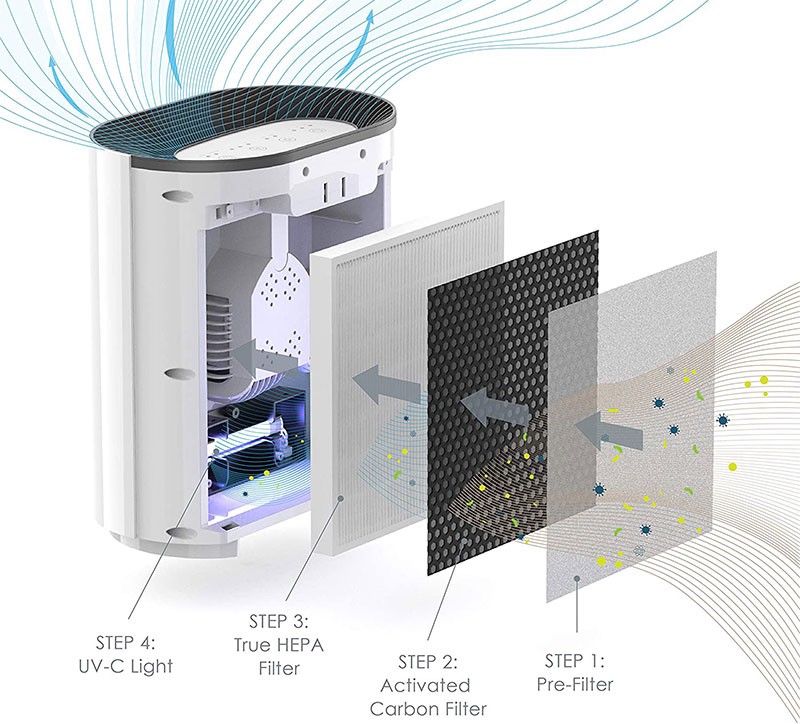
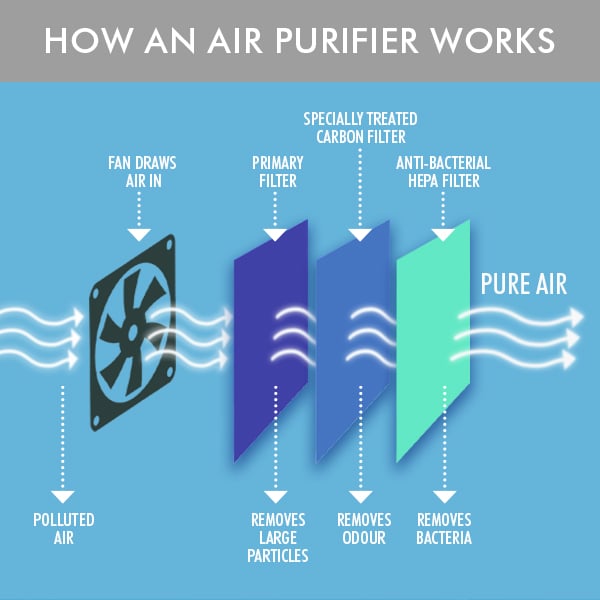
High-Efficiency Particulate Air (HEPA) filters are the gold standard for removing airborne particulates. These mechanical filters are designed to capture 99.97% of particles 0.3 microns in size, including dust, pollen, pet dander, mold spores, and smoke particles, effectively trapping them rather than simply letting them pass through.

Activated Carbon Filters
Similar to their water counterparts, activated carbon filters in air purifiers are crucial for adsorbing gaseous pollutants. They excel at removing odors, volatile organic compounds (VOCs) from paints, cleaners, and furnishings, and other airborne chemicals that HEPA filters cannot capture.
UV-C Light
Integrated into some air purifiers, UV-C lamps target airborne pathogens like bacteria, viruses, and mold spores. As air passes through the purification chamber, the UV light sterilizes these microorganisms, preventing their proliferation.
Ionizers/Electrostatic Precipitators
These technologies release a stream of negatively charged ions into the air, which attach to airborne particles. The charged particles then stick to oppositely charged plates within the purifier or to surfaces in the room, effectively removing them from the air. While effective, some ionizers can produce ozone, which is an irritant.
Photocatalytic Oxidation (PCO)
PCO purifiers use UV light in conjunction with a titanium dioxide (TiO2) coated filter. When UV light hits the TiO2, it creates highly reactive hydroxyl radicals and super-oxide ions that break down VOCs, bacteria, and viruses into harmless carbon dioxide and water molecules.
Other Specialized Purifiers
Beyond air and water, purification technologies extend to a myriad of industrial and niche applications, such as oil purifiers for machinery, gas purifiers for laboratories, and medical-grade purifiers for sterile environments. These often employ specific chemical adsorbents, membrane technologies, or catalytic converters tailored to their unique contaminant profiles.
Key Technologies and Components Driving Purification
Modern purifiers are complex gadgets integrating multiple technologies to achieve superior performance, longevity, and user convenience.
Filtration Media and Pore Sizes
The efficacy of a purifier is heavily dependent on the quality and characteristics of its filtration media. From multi-layered HEPA filters with precisely engineered fiber structures to RO membranes with angstrom-sized pores, the science of materials and microfiltration is central. Advanced composite materials are continually being developed to offer improved flow rates, longer lifespan, and broader contaminant removal capabilities.
Adsorption vs. Physical Blockage
These are two primary mechanisms. Physical blockage, as seen in HEPA or sediment filters, physically traps particles too large to pass through. Adsorption, crucial for carbon filters, involves chemical bonding or attraction of molecules to the surface of the filter material. Understanding the interplay and optimal combination of these mechanisms is key to designing comprehensive purification systems.
Advanced Sensor Integration
Many high-end purifiers now incorporate an array of sensors. Air purifiers might have particulate matter (PM2.5), VOC, and humidity sensors that continuously monitor air quality. Water purifiers can feature total dissolved solids (TDS) sensors to gauge water purity. These sensors provide real-time data, allowing the purifier to operate more intelligently, adjusting fan speeds or indicating filter replacement needs.
Smart Features and Connectivity
The integration of IoT (Internet of Things) technology has transformed purifiers into smart appliances. Wi-Fi connectivity allows users to monitor air/water quality, control settings, schedule operations, and receive maintenance alerts via smartphone apps. This connectivity also enables features like automatic mode adjustment based on external air quality data, remote diagnostics, and seamless integration into smart home ecosystems.
The Evolving Landscape of Purification Technology
The field of purification technology is dynamic, driven by increasing environmental concerns, advancements in materials science, and the pervasive trend of smart, connected devices.
Energy Efficiency and Sustainability
Future purifiers are focusing on reducing their environmental footprint. This involves developing more energy-efficient motors for air purifiers, optimizing RO systems to reduce wastewater, and extending filter lifespans through advanced materials and regeneration capabilities. Manufacturers are also exploring the use of recyclable and biodegradable filter components.
Miniaturization and Portability
As technology advances, there’s a growing trend towards more compact and portable purification solutions. Personal air purifiers, travel-friendly water filtration bottles, and even wearable air purification devices are emerging, offering on-the-go protection and flexibility to consumers.
AI-Driven Optimization and Predictive Maintenance
Artificial intelligence (AI) and machine learning (ML) are beginning to play a significant role. AI algorithms can analyze sensor data to predict filter longevity more accurately, optimize operational cycles based on usage patterns and environmental conditions, and even identify specific types of pollutants to tailor purification strategies. This leads to more efficient operation, reduced waste, and proactive maintenance.
The Future of Holistic Environmental Control
Looking ahead, purifiers are likely to integrate more deeply into holistic environmental control systems. Imagine a smart home system that not only purifies air and water but also monitors food quality, manages waste, and optimizes energy consumption, all driven by interconnected sensors and AI. The goal is a truly clean, healthy, and sustainable living environment, with purifiers forming a crucial, intelligent component of this integrated future.
aViewFromTheCave is a participant in the Amazon Services LLC Associates Program, an affiliate advertising program designed to provide a means for sites to earn advertising fees by advertising and linking to Amazon.com. Amazon, the Amazon logo, AmazonSupply, and the AmazonSupply logo are trademarks of Amazon.com, Inc. or its affiliates. As an Amazon Associate we earn affiliate commissions from qualifying purchases.