
In the dynamic world of technology, from the intricate movements of a robotic arm to the seamless rendering of a virtual environment, a foundational concept underpins nearly every operation: the frame of reference. Far from being a mere abstract idea confined to physics textbooks, frames of reference are the invisible scaffolding that allows machines to perceive, interact, and operate within our complex world. Understanding what a frame of reference is, and its pervasive applications across various tech domains, unlocks deeper insights into how modern technology functions and evolves.
The Foundational Concept in Technology
At its core, a frame of reference provides a basis for measurement, observation, and description. Without a defined frame, concepts like position, velocity, orientation, or even time become meaningless in a computational context. It’s the essential ingredient for bringing order to data and enabling intelligent action.

Defining a Frame of Reference
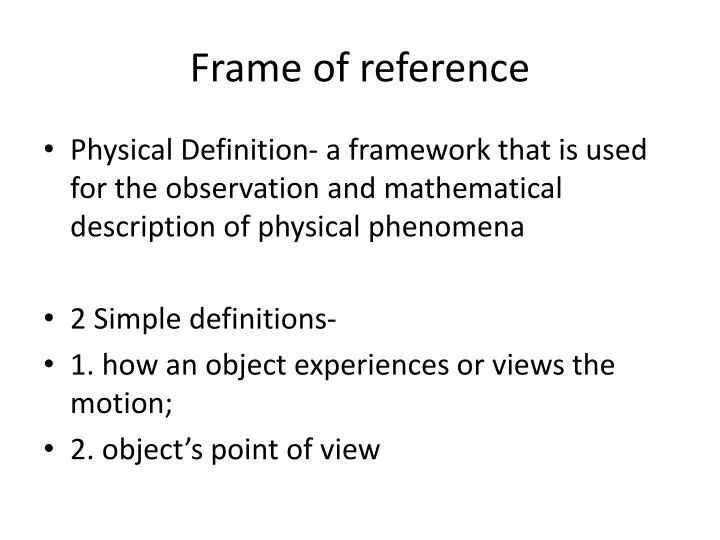
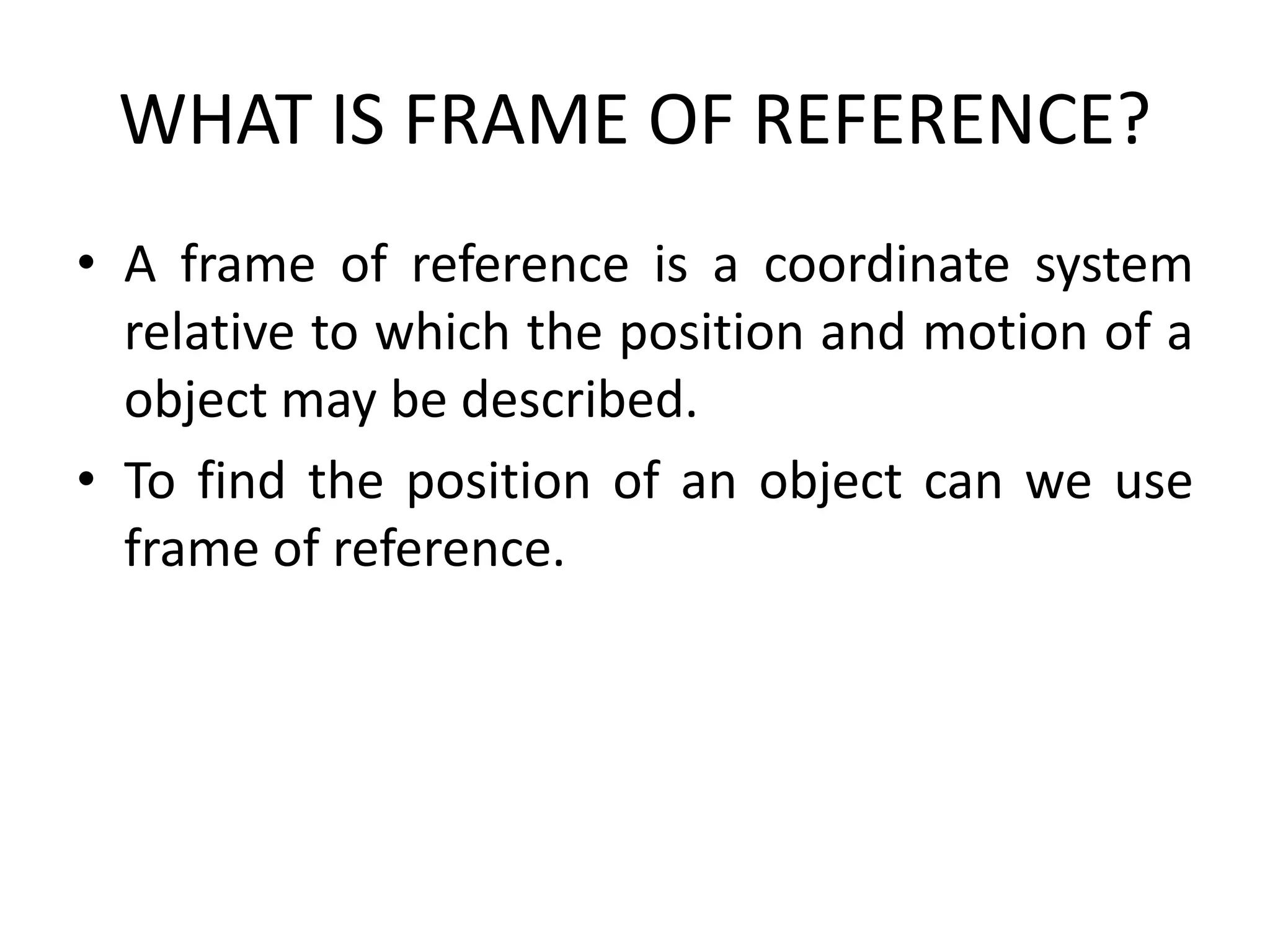
Conceptually, a frame of reference is a system or set of coordinates used to specify the location, orientation, or other properties of an object or event relative to an observer or a fixed point. Think of it as a perspective point, complete with its own origin and axes, from which all measurements are made.
In technological applications, this often translates into:
- Coordinate Systems: A standard Cartesian (x, y, z) system is the most common example, defining positions in 3D space. Other systems, like spherical or cylindrical, are used depending on the application.
- Origins: A specific point designated as (0,0,0) from which all other points are measured. This could be the base of a robot, a corner of a room, or the center of a game map.
- Axes: Perpendicular lines or vectors extending from the origin, defining directions (e.g., forward/backward, up/down, left/right).
- Orientation: Beyond position, a frame of reference also defines an object’s rotation or alignment relative to its surroundings. This is crucial for anything from camera angles to robot grippers.
Critically, a system might involve multiple frames of reference. For instance, a robot operating in a factory might have a “world frame” (fixed to the factory floor), a “robot base frame” (fixed to the robot’s base), and a “tool frame” (fixed to the end-effector). The relationships between these frames are defined by transformations, allowing data from one frame to be accurately represented in another.
Why it Matters for Machines and Systems
For machines, especially autonomous ones, sensing and acting in an environment requires absolute clarity regarding their own state and the state of objects around them. A consistent frame of reference is the bedrock of this clarity. Without it, a robot attempting to pick up an object might miscalculate its position, an autonomous vehicle might misjudge a lane, or a virtual reality headset might fail to synchronize the user’s view with their physical movement, leading to disorientation.
Moreover, in collaborative technological ecosystems, disparate systems must communicate and share data about spatial information. A universally agreed-upon frame of reference, or a clear method for transforming between different local frames, is paramount for interoperability and seamless integration. This ensures that when one system reports an object’s position, another system can interpret that information correctly, regardless of its own internal coordinate system.
Frames of Reference in Artificial Intelligence and Robotics
The fields of Artificial Intelligence (AI) and Robotics are perhaps where the practical application of frames of reference is most tangible and critical. From navigating complex environments to interpreting visual data, these systems are fundamentally built upon robust spatial understanding facilitated by defined reference frames.
Robotic Navigation and Manipulation
Robots rely heavily on frames of reference for almost every action. Consider a robotic arm tasked with assembling components on an assembly line.
- World Frame: Defines the entire workspace, typically fixed to the factory floor or a stationary point. All significant objects (conveyors, workstations) are defined within this frame.
- Robot Base Frame: Attached to the robot’s base, it moves if the robot is mobile. The robot’s internal kinematics are calculated relative to this frame.
- Joint Frames: Each joint on the robot arm has its own frame, allowing for precise calculation of angles and movements.
- End-Effector/Tool Frame: This frame is at the tip of the robot’s gripper or tool. It’s crucial for performing tasks like grasping an object or welding, as the robot needs to know the exact position and orientation of its tool relative to the target object.
Sophisticated algorithms perform continuous transformations between these frames, allowing the robot to translate high-level commands (“pick up object A”) into precise joint movements. For mobile robots, Simultaneous Localization and Mapping (SLAM) algorithms constantly build and update a map of the environment (a world frame) while simultaneously determining the robot’s own position within that map (its robot frame).
Computer Vision and Perception Systems
Computer vision systems, which enable machines to “see” and interpret images or video, also inherently deal with frames of reference.
- Camera Frame: The perspective of the camera itself. Objects in an image are initially described relative to the camera’s lens and sensor.
- Object Frame: A local frame defined around a recognized object (e.g., the center of a detected face, or the bounding box of a car).
- World Frame (reconstructed): Through techniques like structure from motion or 3D reconstruction, computer vision algorithms attempt to infer the positions of objects and the camera within a global, real-world coordinate system.
For applications like augmented reality, accurately mapping the camera frame (the device’s view) to a persistent world frame (the real environment) is paramount for overlaying virtual objects convincingly. Misalignment of these frames results in “drift” or “jitter” of virtual content.
AI Agents and Environmental Understanding
In AI, particularly in areas like reinforcement learning or intelligent agents operating in simulated or real-world environments, a frame of reference dictates how the agent perceives its state and the consequences of its actions.
- Agent-Centric Frame: The agent perceives its environment relative to itself (e.g., “object is 2 units in front and 1 unit to my left”). This is common in game AI or simple robot navigation.
- Global Frame: The agent has access to a broader map or understanding of the environment, allowing it to plan paths and actions relative to fixed landmarks or global coordinates.
The choice of frame can significantly impact the complexity of an AI model and its ability to generalize. A well-defined frame helps an AI system categorize, localize, and predict interactions, leading to more robust and intelligent behavior.
Software Development and Data Interpretation
Beyond physical robots, frames of reference are fundamental within the realm of pure software, influencing everything from graphical user interfaces to complex data analytics.
Coordinate Systems in Graphics and UI
Every pixel on your screen and every object rendered in a 3D application exists within a specific frame of reference.
- Screen Space: The 2D coordinate system of your display, typically with (0,0) at the top-left corner. UI elements are positioned and sized within this frame.
- World Space (3D): In games or CAD software, this is the overarching 3D coordinate system where all game objects, environments, and characters are initially placed.
- Local Object Space: Each 3D model (e.g., a character, a tree) has its own local coordinate system. Its vertices are defined relative to its own origin. When the object is placed in the world, its local frame is transformed into the world frame.
- View Space/Camera Space: This is the 3D space from the perspective of the virtual camera. Objects are transformed into this space before projection onto the 2D screen.
Understanding these transformations is crucial for game developers, graphic designers, and UI/UX engineers to ensure objects are rendered correctly, interactions are precise, and user experiences are intuitive.
Data Science and Analytics Context
While not always explicitly called “frames of reference,” the concept of a consistent context for data interpretation is equally vital in data science. When analyzing time-series data, the “frame of reference” is the timeline itself, with specific start and end points and defined intervals. When integrating data from multiple sources, aligning their respective schemas and definitions (their “frames”) is essential to avoid misinterpretations.
Consider geo-spatial data: different map projections (e.g., Mercator vs. UTM) are essentially different frames of reference, each with its own advantages and distortions. A data scientist must understand which projection is being used to accurately interpret locations and distances. Similarly, in statistical analysis, defining a baseline or a control group establishes a frame against which experimental results are measured.
Network Protocols and Time Synchronization
Even in networking, where physical space might seem less relevant, frames of reference play a role.
- Protocol Stacks: Each layer of a network protocol (e.g., TCP/IP model) operates within its own frame of reference regarding data encapsulation, headers, and payload. The network interface card (NIC) sees raw bits, while the application layer sees structured data.
- Time Synchronization: Critical for distributed systems. Network Time Protocol (NTP) establishes a common time frame of reference across multiple machines, ensuring that logs, transactions, and events are timestamped consistently, which is vital for debugging, security, and data integrity. Without a synchronized time frame, causality in distributed systems becomes impossible to determine.
Implications for Future Tech and Digital Security
As technology continues to advance, the sophisticated handling of frames of reference will only become more paramount, driving innovation in new frontiers and fortifying existing systems.
Augmented and Virtual Reality (AR/VR)
AR and VR systems are heavily reliant on highly accurate and stable frames of reference. For AR, the device needs to precisely track its own position and orientation within the real world (its “real-world frame”) and then anchor virtual content relative to that frame. Any discrepancy leads to an “uncanny valley” effect where virtual objects don’t appear physically present. In VR, the user’s head and hand movements must be flawlessly mapped to the virtual world’s frame of reference to prevent motion sickness and create a truly immersive experience. Future advancements will demand even more robust and adaptable spatial understanding, including semantic frames of reference (e.g., “this is the kitchen counter frame” rather than just a set of coordinates).
Autonomous Systems and Ethical AI
The precision of frames of reference is non-negotiable for autonomous vehicles, drones, and future intelligent systems. An autonomous car needs to understand not just its own position, but the positions and velocities of all other vehicles, pedestrians, and static objects within a shared, dynamic world frame. This extends to ethical AI; how an AI system frames a problem, or the data it uses as its reference point, can significantly influence its decisions and potential biases. Ensuring that AI systems operate within unbiased and comprehensive frames of reference will be a critical challenge in developing fair and equitable autonomous technologies.
Security Perspectives and Threat Modeling
In digital security, while not a physical frame of reference, the concept translates to understanding different “perspectives” or “contexts.” A security analyst uses a specific frame of reference (e.g., the network perimeter, an endpoint, a user’s identity) to identify vulnerabilities. Threat modeling involves stepping into the “frame of reference” of an attacker to anticipate potential exploits. Understanding how different system components, users, and external threats view a system (i.e., their respective frames of reference) is crucial for designing resilient security architectures and incident response plans.
In conclusion, the frame of reference is a silent workhorse of modern technology. From the visible precision of robotics to the invisible logic of network protocols, it underpins how machines perceive, process, and interact with the world. As our technological ambitions grow, a deeper appreciation and more sophisticated implementation of frames of reference will continue to drive innovation across every domain, making our digital and physical interactions more seamless, intelligent, and secure.
aViewFromTheCave is a participant in the Amazon Services LLC Associates Program, an affiliate advertising program designed to provide a means for sites to earn advertising fees by advertising and linking to Amazon.com. Amazon, the Amazon logo, AmazonSupply, and the AmazonSupply logo are trademarks of Amazon.com, Inc. or its affiliates. As an Amazon Associate we earn affiliate commissions from qualifying purchases.