
The question “what console has the most games?” seems straightforward, yet its answer is anything but simple. Delving into the vast and ever-evolving landscape of video game libraries requires a nuanced understanding of counting methodologies, historical context, and the dynamic nature of digital distribution. From legacy systems with sprawling physical collections to modern platforms leveraging extensive backward compatibility and subscription services, identifying a single definitive winner is a complex technological assessment.
The Elusive Definition of “Most Games”
Before crowning a victor, it’s crucial to establish what constitutes a “game” and how we count them. The sheer volume of titles available on any given platform is influenced by a multitude of factors, each presenting its own set of challenges for accurate tabulation.
Counting Methodologies: Physical vs. Digital
Traditionally, game counts were based on physically released cartridges or discs. This approach provided a finite, tangible number for each console generation. However, the digital age has revolutionized game distribution. Modern consoles heavily rely on digital storefronts, which host not only major releases but also a deluge of independent titles, digital-only expansions, and re-releases. Many smaller, experimental games might never see a physical release, significantly inflating digital library numbers. Furthermore, some digital titles are cross-platform, appearing on multiple consoles, making a unique count per console difficult without careful de-duplication.
Backward Compatibility and Cross-Generational Titles
A significant factor in current-generation console libraries is backward compatibility. Platforms like the PlayStation 5 and Xbox Series X/S can play titles from their predecessors. This immediately grants them access to libraries potentially thousands of games deep without those titles being specifically designed for the new hardware. The Xbox ecosystem, in particular, has championed backward compatibility, meticulously curating and enhancing games from Xbox 360 and original Xbox eras. Similarly, many games are “cross-generational,” released for both the older and newer consoles, further blurring the lines of what counts as a distinct title for a specific piece of hardware.
Regional Exclusives and Indie Surges
Another layer of complexity comes from regional exclusivity. Some games are released only in specific territories, adding to a console’s overall global library but not necessarily its local one. More significantly, the explosion of independent game development has led to an unprecedented surge in titles. Digital storefronts are often less curated than physical retail, allowing a vast array of indie games, many of which might be niche or smaller in scope, to be published. While these contribute to raw numbers, their impact on the platform’s overall appeal might vary widely compared to AAA releases.
A Look Back: Historical Giants of Console Libraries
To appreciate the current landscape, a journey into the past reveals some titans of game quantity, often thanks to their long lifespans and widespread adoption. These consoles became fertile ground for developers, leading to immense game catalogs.
The PlayStation 2 Era: A Reign of Abundance
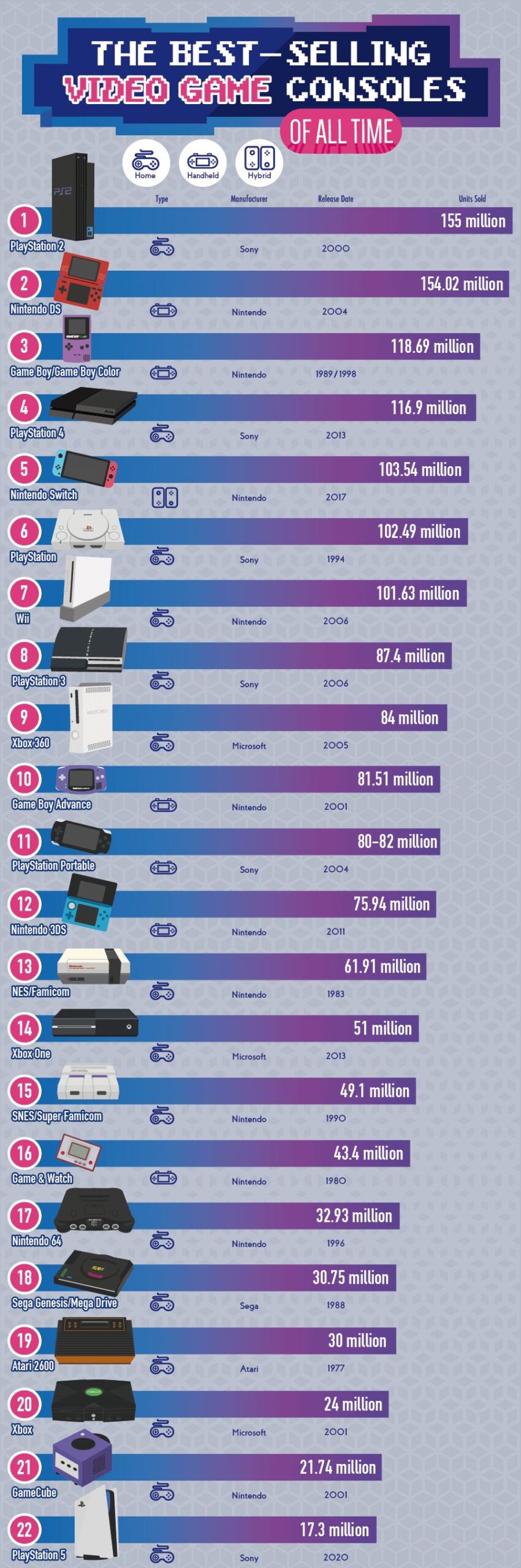
Widely considered the best-selling home console of all time, the PlayStation 2 (PS2) boasts an undeniably massive library. With a production run spanning over a decade (2000-2013) and over 155 million units sold worldwide, its sheer market penetration made it an attractive platform for developers. Estimates for its game count vary, but most sources place it well over 3,800 unique titles released globally. This number includes a diverse array of genres, from critically acclaimed blockbusters to obscure Japanese RPGs and countless budget-bin sports titles. Its long life cycle allowed for multiple generations of developers to contribute, solidifying its place as a historical giant in terms of game volume.
The Nintendo DS/3DS Legacy: Portable Powerhouses
While home consoles often grab headlines for library size, Nintendo’s portable systems have consistently delivered staggering numbers. The Nintendo DS, released in 2004, and its successor, the Nintendo 3DS (released 2011), collectively represent an enormous catalog. The DS alone is estimated to have over 2,000 unique titles in North America, with its global count reaching well over 3,000. The 3DS followed suit, adding another 1,300+ titles to its own unique library, alongside its backward compatibility with DS games. These systems capitalized on a massive casual gaming market and a robust indie scene (especially for the 3DS eShop), leading to an incredible proliferation of software.
Sega’s Contribution: A Deep Dive into Early Libraries
While perhaps not reaching the astronomical numbers of the PS2 or DS, earlier consoles also presented impressive libraries for their time. The Sega Master System, for example, had a respectable global library of over 300 games, which was substantial for the 8-bit era. The Sega Genesis (Mega Drive) built on this, accumulating over 900 official titles in its lifespan. These systems, particularly in their respective competitive eras, showcased how a solid install base and a strong development pipeline could lead to hundreds of games, setting precedents for the library sizes we see today.
The Modern Console Arena: Current-Gen Contenders
In the contemporary gaming landscape, the methods for acquiring and playing games have diversified, making raw console-specific counts more challenging and less indicative of the total accessible library. Subscription services and robust backward compatibility heavily influence perceived game availability.
PlayStation 5: Expanding its Digital Horizon
The PlayStation 5, released in 2020, inherently benefits from its robust backward compatibility with the PlayStation 4. The PS4 library itself is immense, estimated to be well over 4,000 unique titles by the end of its generation. Therefore, when considering the total accessible games on a PS5, one must factor in the vast majority of these PS4 titles. Beyond this, the PS5 has its own growing library of native next-gen games, which currently number in the hundreds. Furthermore, PlayStation Plus, a subscription service, offers a rotating catalog of hundreds of games, including a “Game Catalog” with PS4 and PS5 titles, and a “Classics Catalog” for older PlayStation games. While not all accessible on the PS5 hardware (some classics are streaming-only), the PS Plus ecosystem significantly expands the perceived library.
Xbox Series X/S: The Power of Backward Compatibility and Game Pass
The Xbox Series X and Series S, also launched in 2020, stand out primarily due to Microsoft’s aggressive and comprehensive backward compatibility program. These consoles can play thousands of games spanning four generations: Xbox One, Xbox 360, and original Xbox titles. The Xbox One alone had a library of well over 3,000 games. When combined with the hundreds of Xbox 360 and original Xbox titles that have been made backward compatible, and the growing native Series X/S library, the total accessible game count is staggeringly high, likely surpassing 5,000 unique titles across all compatible generations. Moreover, Xbox Game Pass dramatically amplifies this. With hundreds of first-party and third-party games available on demand, including all new Xbox Game Studios releases on day one, Game Pass offers an unparalleled “all-you-can-play” library that constantly rotates and expands, pushing the accessible game count even higher.
Nintendo Switch: A Unique Hybrid Library
The Nintendo Switch, launched in 2017, operates on a different philosophy. While it lacks backward compatibility with previous Nintendo home consoles (like Wii U or Wii), its longevity and immense popularity have resulted in a truly massive native library. As of late 2023, the Nintendo Switch eShop features well over 5,000 unique titles, a number that continues to grow rapidly. This includes first-party blockbusters, a vast selection of acclaimed indie games (many of which found a perfect home on the hybrid portable-console device), and numerous ports from other platforms. Its unique form factor has made it a darling for both casual players and hardcore enthusiasts, leading to a prolific output from developers globally, making it a strong contender in terms of its native console library. Nintendo Switch Online also offers a growing library of classic NES, SNES, N64, Sega Genesis, Game Boy, and Game Boy Advance titles, further expanding its accessible vintage collection.
The PC: An Unrivaled Library
While the discussion typically revolves around dedicated consoles, no assessment of “most games” would be complete without acknowledging the personal computer. The PC, as a gaming platform, operates with a fundamentally different, and significantly larger, ecosystem.
Steam and Digital Distribution: A Gateway to Millions
Digital storefronts like Steam, GOG, Epic Games Store, and Itch.io host an astronomical number of games. Steam alone boasts over 50,000 unique titles listed on its platform, a number that dwarfs even the most prolific console libraries. This figure continues to grow daily, with thousands of new games being added annually. The open nature of PC development, lower barriers to entry for independent developers, and diverse business models contribute to this overwhelming quantity.
Emulation and Legacy Titles: Extending the PC’s Reach
Beyond native PC games, the platform’s versatility means it can emulate virtually every console ever made (legalities aside). This ability to run software designed for older hardware—from Atari and NES to PlayStation 3 and Wii U—effectively grants the PC access to every console library ever created. This isn’t just theoretical; a thriving community supports and enhances these emulation efforts, making countless historical games playable on modern PC hardware.
The Open-Ended Nature of PC Gaming
The PC is not a closed ecosystem like a console. Its hardware is upgradable, its software environment is open, and it supports an endless array of input devices and peripherals. This flexibility allows it to adapt to new gaming paradigms and to host games developed across decades without the hard generational breaks typical of consoles. Consequently, when considering the sheer volume of playable software, the PC stands alone as the platform with the most games, by an order of magnitude.
Quality Over Quantity: The Ultimate Gaming Experience
While the raw number of games is an interesting metric for tech enthusiasts and collectors, it rarely tells the full story of a platform’s value or the ultimate gaming experience it offers. A massive library, while impressive, doesn’t automatically equate to a superior choice for every player.
Exclusive Titles and Platform Identity
Often, it’s the exclusive titles that define a console’s identity and drive its sales. While a console might have thousands of games, a handful of critically acclaimed, platform-exclusive blockbusters can be far more influential than hundreds of generic shovelware titles. These exclusives showcase the unique capabilities of the hardware or the creative vision fostered by the platform holder, offering experiences unavailable elsewhere.
Genre Diversity and Niche Audiences
A large library is valuable if it offers genuine diversity, catering to a wide range of tastes and niche genres. Some consoles might have a numerically large library but skew heavily towards certain genres (e.g., sports games, Japanese RPGs). A more balanced library, even if slightly smaller, might provide a richer overall experience for a broader audience. The availability of accessibility features and different control schemes also contributes significantly to the quality of the experience for diverse players.
User Experience and Accessibility Features
Beyond the games themselves, the overall user experience plays a crucial role. How easy is it to navigate the storefront? Are games well-curated and easily discoverable? Are there robust community features? How intuitive is the hardware and software interface? Modern consoles and PC platforms increasingly integrate features like quick resume, seamless game streaming, and robust accessibility options, all of which enhance the enjoyment of any game, regardless of its origin or the library’s total size. Ultimately, the “best” console isn’t just about the number of games it holds, but how well it delivers those games to its audience, optimizing for enjoyment, performance, and player satisfaction.
aViewFromTheCave is a participant in the Amazon Services LLC Associates Program, an affiliate advertising program designed to provide a means for sites to earn advertising fees by advertising and linking to Amazon.com. Amazon, the Amazon logo, AmazonSupply, and the AmazonSupply logo are trademarks of Amazon.com, Inc. or its affiliates. As an Amazon Associate we earn affiliate commissions from qualifying purchases.