
Bitcoin has evolved from a niche cryptographic experiment into a trillion-dollar asset class, often referred to as “digital gold.” At the heart of this financial revolution lies a process known as mining. While the term might evoke images of pickaxes and tunnels, Bitcoin mining is a sophisticated financial and computational endeavor that serves as the backbone of the decentralized economy. For investors, entrepreneurs, and finance enthusiasts, understanding how mining works is essential to grasping the value proposition of the world’s leading cryptocurrency.
To understand Bitcoin mining from a financial perspective, one must view it as a competitive industry where participants—miners—invest capital (hardware) and operational expenses (electricity) to secure a network in exchange for a high-value digital commodity. This article explores the economic mechanics, the cost-benefit realities, and the long-term investment implications of Bitcoin mining.

The Financial Infrastructure of Bitcoin Mining
Bitcoin mining is not merely a technical process; it is a decentralized monetary policy in action. Unlike traditional fiat currencies, which are issued by central banks at the discretion of policymakers, Bitcoin is issued through a pre-programmed mathematical algorithm.
Mining as a Decentralized Central Bank
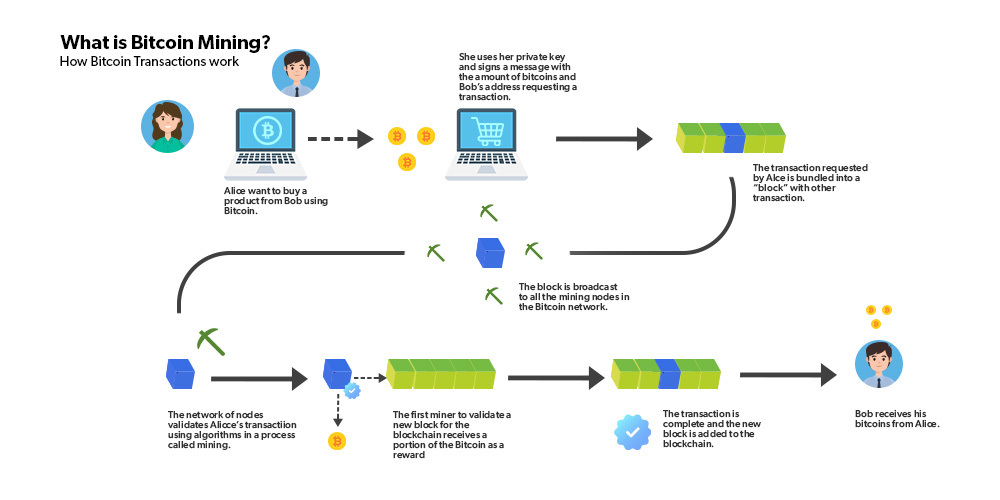
In the traditional financial system, central banks manage the supply of money. In the Bitcoin ecosystem, mining fulfills this role. Every ten minutes, a new “block” of transactions is added to the blockchain, and the miner who successfully validates that block is rewarded with newly minted Bitcoin. This ensures a predictable, transparent, and immutable inflation schedule. From an investment standpoint, this eliminates the risk of “printing money” that devalues a currency, making Bitcoin a unique hedge against traditional monetary expansion.
The Proof of Work Economic Model
The mechanism that governs mining is called “Proof of Work” (PoW). To earn the right to update the ledger and claim the Bitcoin reward, miners must solve a complex mathematical puzzle. This requires immense computational power. Economically, PoW creates a “cost of production” for Bitcoin. Because it requires significant energy and expensive hardware to produce a single Bitcoin, the asset gains intrinsic value tied to the resources expended to create it. This relationship mirrors the gold industry, where the price of gold is intrinsically linked to the cost of extracting it from the earth.
Turning Electricity into Digital Assets: The Cost-Benefit Analysis
Entering the mining industry requires a rigorous financial assessment. It is a high-stakes business where profit margins are dictated by the efficiency of hardware and the cost of energy.
Capital Expenditure (CapEx) vs. Operational Expenditure (OpEx)
A mining operation’s profitability is determined by two primary financial pillars:
- CapEx (Capital Expenditure): This involves the purchase of specialized hardware known as ASICs (Application-Specific Integrated Circuits). Unlike standard computers, ASICs are designed solely for mining Bitcoin. These machines can cost anywhere from $2,000 to over $10,000 per unit, and their technological lifespan is relatively short as newer, more efficient models enter the market.
- OpEx (Operational Expenditure): The primary recurring cost is electricity. Mining is energy-intensive, and a miner’s ability to remain profitable depends largely on securing low-cost power. Many professional mining firms locate their operations near hydroelectric dams or in regions with surplus wind or solar energy to minimize these costs.
The Role of ASIC Hardware in Profitability
To maximize Return on Investment (ROI), a miner must calculate the “hash rate”—the speed at which their hardware can solve the PoW puzzle. A higher hash rate increases the probability of winning the block reward but also consumes more power. Investors in this space must constantly balance the efficiency of their machines (measured in Joules per Terahash) against the current market price of Bitcoin. If the price of Bitcoin falls below the cost of the electricity required to mine it, the operation becomes “unprofitable,” forcing less efficient miners to shut down.
Understanding Bitcoin Halving and Its Impact on Revenue
One of the most critical financial events in the Bitcoin ecosystem is the “Halving.” Approximately every four years, the reward for mining a block is cut in half. This event is a core component of Bitcoin’s scarcity model.
The Scarcity Principle and Block Rewards
When Bitcoin first launched, the reward was 50 BTC per block. Through successive halving events, this has dropped to 25, 12.5, 6.25, and currently 3.125 BTC. From a supply-side economics perspective, the halving reduces the rate at which new Bitcoin enters the market. Historically, these events have led to significant price appreciation as the reduction in supply meets steady or increasing demand. For miners, however, the halving is a double-edged sword: their revenue in BTC terms drops by 50% overnight, requiring the price of Bitcoin to increase or their operational efficiency to improve to maintain the same profit levels.
Transaction Fees as a Secondary Income Stream
As the block reward continues to diminish, the secondary component of miner revenue—transaction fees—becomes increasingly important. Every user who sends Bitcoin pays a fee to have their transaction processed. These fees are collected by the miner who solves the block. In the long term, once all 21 million Bitcoins have been mined (estimated to happen around the year 2140), transaction fees will become the sole incentive for miners to continue securing the network. This creates a sustainable, market-driven economy where users pay for the security and finality of the network.
Strategic Investment Paths: Solo vs. Pool Mining
For those looking to generate income through mining, there are several strategic approaches, each with its own risk-reward profile.
Risk Mitigation through Mining Pools
The mathematical difficulty of mining is currently so high that it is virtually impossible for an individual with a single machine to successfully mine a block. To counter this, miners join “Mining Pools.” In a pool, thousands of miners combine their computational power to solve blocks collectively. When the pool wins a reward, it is distributed among the participants based on the amount of work each contributed. This provides a steady, predictable income stream (similar to dividends) rather than a “lottery” style payout of solo mining.
Cloud Mining and Hosted Mining
For investors who want exposure to mining without managing physical hardware, “Cloud Mining” or “Hosted Mining” services have emerged.
- Hosted Mining: An investor buys the hardware, but a professional data center manages the electricity, cooling, and maintenance for a fee.
- Cloud Mining: An investor “rents” hash power from a company for a set period.
While these options lower the barrier to entry, they also introduce counterparty risk. Investors must perform due diligence to ensure the provider is legitimate and that the fees do not erode the potential for profit.
The Future of Mining as a Macroeconomic Tool
Bitcoin mining has transcended its origins as a hobbyist activity and has become an institutional-grade industry with significant macroeconomic implications.
Institutional Adoption and Public Mining Companies
Today, several massive mining operations are publicly traded on stock exchanges like the NASDAQ (e.g., Marathon Digital Holdings, Riot Platforms). These companies allow traditional stock market investors to gain exposure to the Bitcoin mining sector without holding the digital asset directly. This institutionalization has brought greater professionalization to the industry, with companies using complex financial instruments, such as power purchase agreements and futures contracts, to hedge against energy price volatility and Bitcoin price swings.
Regulatory Risks and Tax Implications
As mining becomes a significant business sector, it has come under the scrutiny of global regulators. From a financial planning perspective, miners must navigate a complex web of tax obligations. In many jurisdictions, the IRS and other tax authorities view mined Bitcoin as gross income at the time of receipt, based on its fair market value. Furthermore, potential environmental regulations or carbon taxes could impact the bottom line. Savvy mining investors must stay informed on the evolving legal landscape to protect their capital and ensure long-term sustainability.

Conclusion
Bitcoin mining is the fundamental engine that drives the security, issuance, and decentralization of the world’s premier digital asset. Economically, it represents a perfect competition market where only the most efficient and strategically located players thrive.
For those looking at Bitcoin through a financial lens, mining offers a way to produce a scarce asset at a potential discount to market prices. However, it requires a deep understanding of energy markets, hardware cycles, and the unique supply-demand dynamics of the Bitcoin protocol. Whether through direct hardware investment, mining pools, or public equities, mining remains a cornerstone of the digital finance world—a bridge between the physical world of energy and the digital world of sovereign wealth.
aViewFromTheCave is a participant in the Amazon Services LLC Associates Program, an affiliate advertising program designed to provide a means for sites to earn advertising fees by advertising and linking to Amazon.com. Amazon, the Amazon logo, AmazonSupply, and the AmazonSupply logo are trademarks of Amazon.com, Inc. or its affiliates. As an Amazon Associate we earn affiliate commissions from qualifying purchases.