
Internationalized Domain Names (IDNs) represent a pivotal advancement in the global accessibility of the internet. For decades, the internet’s foundational infrastructure, specifically its Domain Name System (DNS), was largely confined to a limited set of characters derived from the Latin alphabet. This restriction, primarily to ASCII (American Standard Code for Information Interchange), meant that domain names could only be registered and displayed using letters A-Z, digits 0-9, and hyphens. While functional, this system inherently created a barrier for billions of internet users worldwide who speak languages with non-Latin scripts, such as Arabic, Chinese, Cyrillic, or Devanagari. IDNs shatter these linguistic barriers, allowing domain names to be expressed in a vast array of native languages and scripts, making the internet truly global and inclusive.

Understanding the Basics: ASCII vs. Unicode
To fully grasp the significance of IDNs, it’s essential to understand the underlying character encoding standards that govern how text is represented in digital systems.
The Limitations of ASCII
ASCII, developed in the 1960s, is a 7-bit character encoding standard that can represent 128 characters. These include uppercase and lowercase English letters, numbers, and basic punctuation marks. For early computing and the nascent internet, ASCII was sufficient. However, as the internet expanded beyond English-speaking regions, its limitations became glaringly obvious. Every language outside of the Latin script, or even those using accented Latin characters, could not be directly represented in a domain name. This forced users in non-Latin script regions to translate or transliterate their desired domain names into ASCII, often leading to awkward, less intuitive, or culturally irrelevant web addresses. This created a digital divide, where access to and navigation of the web was inherently biased towards English and Latin-script users.
The Promise of Unicode
Unicode emerged as a comprehensive solution to ASCII’s limitations. It is a universal character encoding standard designed to represent text in virtually all of the world’s writing systems. Instead of a mere 128 characters, Unicode can represent over a million characters, encompassing everything from Latin, Greek, Cyrillic, Arabic, Chinese, Japanese, Korean, Hindi, and countless other scripts, including symbols and emojis. This vast capacity allows for digital text to accurately reflect the diversity of human language. However, the fundamental challenge for domain names was integrating this rich Unicode capability into an internet infrastructure that was built on, and still primarily operates on, ASCII. The DNS, the internet’s phonebook, was designed to handle only ASCII characters for domain labels. This is where IDNs and their enabling technologies come into play.
The Mechanics of IDNs: Punycode and DNS Resolution
The ingenious solution that bridges the gap between the Unicode world of human languages and the ASCII-based DNS is a process called Punycode.
Punycode: Bridging the Gap
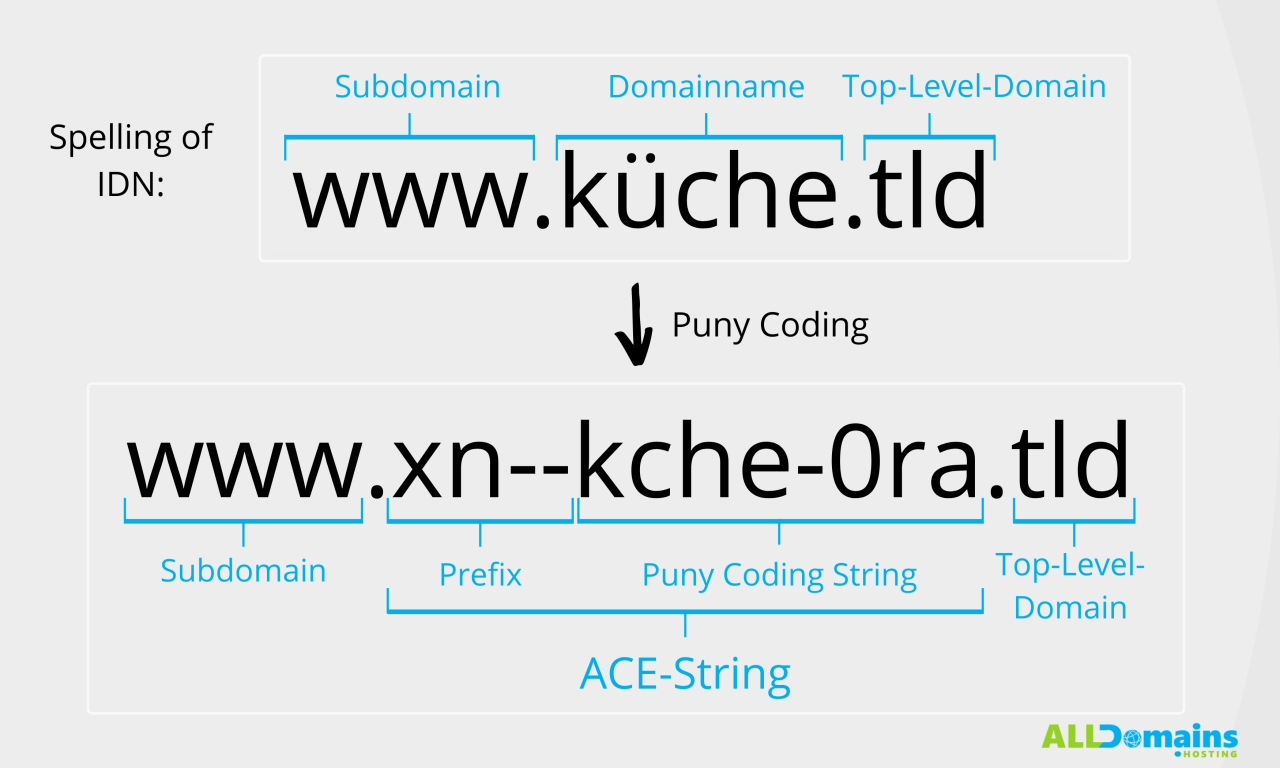
Punycode is an encoding syntax that converts Unicode strings of characters into a limited ASCII character set. When a user types an IDN, such as “例.कॉम” (example.com in Chinese), into their browser, the browser (or the underlying system) doesn’t send “例.कॉम” directly to the DNS. Instead, it first converts “例.कॉम” into its Punycode equivalent. The Punycode representation of an IDN always begins with the prefix “xn--“, followed by an ASCII string. For instance, “例.कॉम” might convert to something like “xn--fsqu00a.com”. This ASCII string is what is actually sent to the DNS resolvers. The “xn--” prefix signals to systems that this is not a regular ASCII domain name but an encoded IDN. This mechanism allows the underlying DNS infrastructure, which remains ASCII-only for domain labels, to continue functioning without requiring a massive, disruptive overhaul. The beauty of Punycode lies in its transparency to the end-user for most interactions; they see the native script, while the technical translation happens behind the scenes.
How IDNs Function in the DNS
The Domain Name System (DNS) is a hierarchical and distributed naming system for computers, services, or any resource connected to the Internet or a private network. It translates human-readable domain names (like “example.com”) into numerical IP addresses (like “93.184.216.34”) that computers use to identify each other. When an IDN, after being converted to its Punycode form (e.g., “xn--fsqu00a.com”), is queried, it traverses the DNS just like any other ASCII domain name. The query goes to a root server, then a Top-Level Domain (TLD) server (like the .com server), and finally to the authoritative name server for that specific domain. This server then provides the IP address corresponding to the website. The critical aspect is that the entire resolution process within the DNS operates on the Punycode ASCII string. Only at the very edge, in the user’s web browser or application, is the Punycode decoded back into the native script for display. This ensures compatibility with the existing global internet infrastructure while providing a localized experience for users.
The Impact and Benefits of IDNs
IDNs are more than just a technical workaround; they are a fundamental step towards a truly global and equitable internet. Their benefits extend across various facets of digital interaction and economy.
Expanding Global Reach and Inclusivity
Perhaps the most significant benefit of IDNs is their ability to expand the internet’s reach to non-Latin script populations. By allowing users to navigate the web using domain names in their native languages, IDNs break down linguistic barriers that previously excluded billions. This means that individuals in countries like China, India, Russia, or the Arab world can type website addresses using their familiar scripts, fostering greater comfort and ease of use. This inclusivity is crucial for digital literacy and participation, as it lowers the barrier to entry for new internet users who may not be familiar with the Latin alphabet. It allows local businesses, governments, and organizations to establish an online presence that resonates directly with their target audience, enhancing their visibility and accessibility within their own cultural contexts.
Enhancing User Experience and Brand Recognition
For businesses and organizations, IDNs offer a powerful tool for enhancing user experience and solidifying brand recognition in local markets. Imagine a French company having a .fr domain with French accented characters, or a Japanese brand using its name directly in Japanese script within the domain. This provides a more authentic and intuitive online experience for local users. It eliminates the need for users to transliterate or remember complex ASCII representations of foreign names, reducing typing errors and improving navigation speed. From a branding perspective, an IDN allows companies to maintain consistency between their offline brand identity (often in native script) and their online presence, reinforcing their message and making their digital assets more memorable and trusted by local consumers. This localization can significantly boost user engagement and loyalty.
Cultural Relevance and Digital Equity
IDNs play a vital role in promoting cultural relevance and digital equity. By enabling the use of diverse scripts, they affirm the linguistic and cultural identities of internet users worldwide. This fosters a sense of ownership and belonging, making the internet feel less like a foreign construct and more like a global public space that respects and reflects the world’s diversity. It supports the preservation and promotion of languages online that might otherwise be underrepresented in the ASCII-dominated digital landscape. From a digital equity standpoint, IDNs ensure that access to information and participation in the digital economy is not contingent on proficiency in the Latin alphabet, thus creating a more level playing field for global internet users and empowering communities to build their digital presence in their own terms.
Challenges and Considerations
Despite their profound benefits, IDNs also introduce certain challenges and considerations that need careful management.
Security Concerns: Homograph Attacks
One of the most significant security concerns associated with IDNs is the potential for homograph attacks. A homograph attack occurs when malicious actors register domain names that visually resemble legitimate, well-known domains but use characters from different scripts that look identical or very similar. For example, a Cyrillic ‘a’ (а) might look exactly like a Latin ‘a’ (a) but belong to a completely different domain. An attacker could register a Punycode domain that decodes to “pаyраl.com” (using a Cyrillic ‘a’) and users, seeing what appears to be “paypal.com,” might unwittingly enter their credentials on a phishing site. Browser manufacturers and security organizations have implemented various countermeasures, such as displaying the Punycode form alongside the native script for suspicious domains or restricting which non-Latin scripts can be mixed with Latin ones within a single domain. However, vigilance remains crucial for users.
Implementation Complexities and Browser Support
While most modern web browsers and email clients support IDNs, inconsistencies can still arise. Older software or specific configurations might not properly display native script IDNs, defaulting instead to their Punycode form. This can degrade the user experience and create confusion. Furthermore, the complexities of registering and managing IDNs can vary by registrar and TLD operator. There are also nuances in how different operating systems and applications handle different Unicode characters, which can sometimes lead to rendering issues if not properly accounted for. Developers and website administrators need to ensure their systems are robustly configured to handle IDNs correctly across various platforms and user agents.
The Future of IDNs
The future of IDNs is tied to the continued evolution of internet standards and user adoption. As the internet penetrates deeper into non-Latin speaking regions, the demand for and reliance on IDNs will only grow. Initiatives by organizations like ICANN (Internet Corporation for Assigned Names and Numbers) continue to refine policies and processes for IDN registration and management. The focus will likely shift towards improving security measures, streamlining the registration process, and enhancing universal acceptance – ensuring that IDNs work seamlessly across all applications and services, from web browsing to email and secure certificates. The ultimate goal is to make IDNs indistinguishable in functionality from traditional ASCII domains, allowing for truly seamless global digital interaction.
Adopting and Managing IDNs
For those looking to leverage IDNs, understanding the practicalities of adoption and management is key.
For Domain Registrants
If you are looking to register an IDN, the process is largely similar to registering a standard ASCII domain, but with a few crucial differences. You will need to find a domain registrar that supports IDN registrations for your desired Top-Level Domain (TLD). Many registrars now offer this service. When searching for and registering an IDN, you will typically input the domain name in its native script. The registrar’s system will then handle the Punycode conversion for the underlying DNS registration. It is vital to consider which TLDs support IDNs in your target language, as not all TLDs have implemented full IDN support. Furthermore, registrants should be aware of any specific character policies or restrictions imposed by the TLD registry for certain scripts to avoid registration issues. After registration, ensuring proper website hosting and email configuration to correctly handle the IDN is also important.
For Web Developers and Service Providers
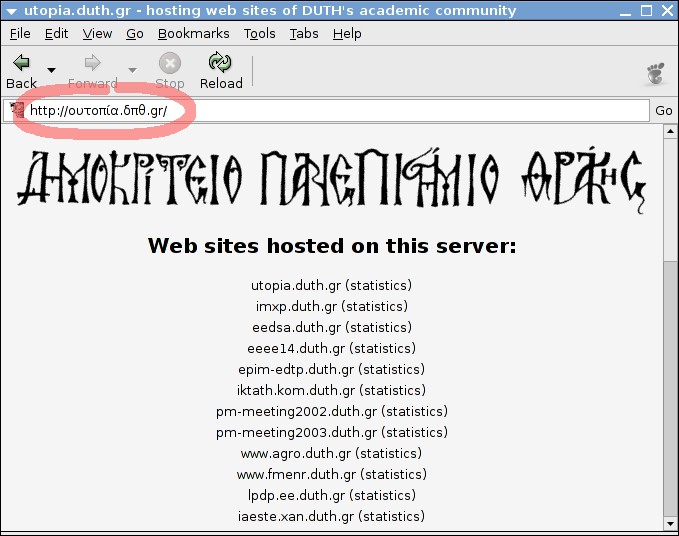
Web developers and service providers must ensure their applications and systems are IDN-ready. This includes ensuring that websites properly display IDNs in their native script, that web servers are configured to serve content for IDN domains, and that email systems can send and receive emails from IDN-enabled addresses. For developers, this often means utilizing libraries and frameworks that inherently support Unicode and IDN conversion where necessary. It is also important to test IDN functionality across different browsers, operating systems, and email clients to ensure universal accessibility. Implementing security best practices, such as rigorous input validation and staying informed about browser security updates regarding homograph attack mitigation, is paramount to protect users and maintain trust in IDN-enabled services. By proactively embracing IDN compatibility, developers and providers contribute to a more inclusive and functional global internet.
aViewFromTheCave is a participant in the Amazon Services LLC Associates Program, an affiliate advertising program designed to provide a means for sites to earn advertising fees by advertising and linking to Amazon.com. Amazon, the Amazon logo, AmazonSupply, and the AmazonSupply logo are trademarks of Amazon.com, Inc. or its affiliates. As an Amazon Associate we earn affiliate commissions from qualifying purchases.