
The precise selection of a drill bit for tapping is a foundational skill in manufacturing, engineering, and even advanced DIY projects. It’s a critical step that dictates the quality, strength, and integrity of a threaded hole. For a common thread size like 5/16-18, understanding the underlying principles ensures not just a successful tap, but also optimal performance of the fastener in the finished assembly. This guide delves into the specifics for a 5/16-18 tap, providing the definitive answer while exploring the technical rationale and best practices for flawless execution.
Understanding Tap and Drill Bit Fundamentals
Before identifying the correct drill bit, it’s essential to grasp the core concepts of taps and drill bits themselves. These tools, while seemingly simple, embody centuries of engineering refinement designed to create reliable mechanical connections.

The Anatomy of a Tap
A tap is a cutting tool used to create internal screw threads in a hole. It’s essentially a screw with flutes, cutting edges, and specific relief angles. Taps are categorized by their thread form (e.g., Unified National Coarse – UNC, Unified National Fine – UNF, Metric), size (major diameter and pitch), and series (e.g., standard, taper, plug, bottoming). The 5/16-18 designation refers to a tap with a major diameter of 5/16 inches and 18 threads per inch (TPI). This is a common coarse thread used for general-purpose fastening where resistance to stripping is important.
When a tap cuts threads, it doesn’t remove all the material down to the minor diameter. Instead, it forms a thread profile that engages with a mating screw. The percentage of thread engagement is a crucial factor, typically aiming for 60-75%. This is because higher thread engagement (e.g., 100%) doesn’t necessarily yield a proportionally stronger joint but significantly increases the tapping torque required, making tap breakage more likely. Conversely, too low engagement results in a weak joint.
Drill Bits: Types and Materials
Drill bits are tools used to create cylindrical holes. For tapping, the hole created by the drill bit is called the “tap drill hole.” Its diameter must be carefully selected to leave just enough material for the tap to cut the desired thread depth and engagement.
Drill bits come in various materials and geometries, each suited for different applications:
- High-Speed Steel (HSS): Standard for general-purpose drilling in most metals.
- Cobalt (HSS-Co): Offers higher heat resistance and hardness, suitable for tougher materials like stainless steel.
- Carbide: Extremely hard and heat-resistant, ideal for very hard or abrasive materials, often used in production environments.
- Black Oxide: A surface treatment for HSS bits, reducing friction and preventing corrosion.
- Titanium Nitride (TiN) Coated: A hard ceramic coating that extends tool life and improves lubricity.
For tapping, a standard twist drill bit is typically used. The accuracy of its diameter is paramount. A dull or poorly sharpened drill bit will create an oversized or undersized hole, compromising the tapping process.
Why Precision Matters: The Role of Thread Engagement
Thread engagement, expressed as a percentage, describes how much of the tap’s thread profile is cut into the workpiece material. An ideal thread engagement for most applications falls between 60% and 75%.
- Higher Engagement (e.g., 75% or more): While it sounds stronger, it demands significantly more torque to tap, increasing the risk of tap breakage, especially in harder materials. The strength gains beyond 75% are often negligible in practical terms.
- Lower Engagement (e.g., 50% or less): Creates a weaker threaded connection that is more prone to stripping under load. This can lead to fastener failure and compromised assembly integrity.
The precise diameter of the tap drill hole directly controls the resulting thread engagement. Therefore, selecting the correct drill bit is not merely about making a hole; it’s about engineering the optimal conditions for the subsequent thread-cutting operation.
Determining the Correct Tap Drill Size for a 5/16-18 Tap
For a 5/16-18 Unified National Coarse (UNC) tap, identifying the correct drill bit size is straightforward, though understanding the nuances behind the selection is key for consistently good results.
Standard Tap Drill Charts
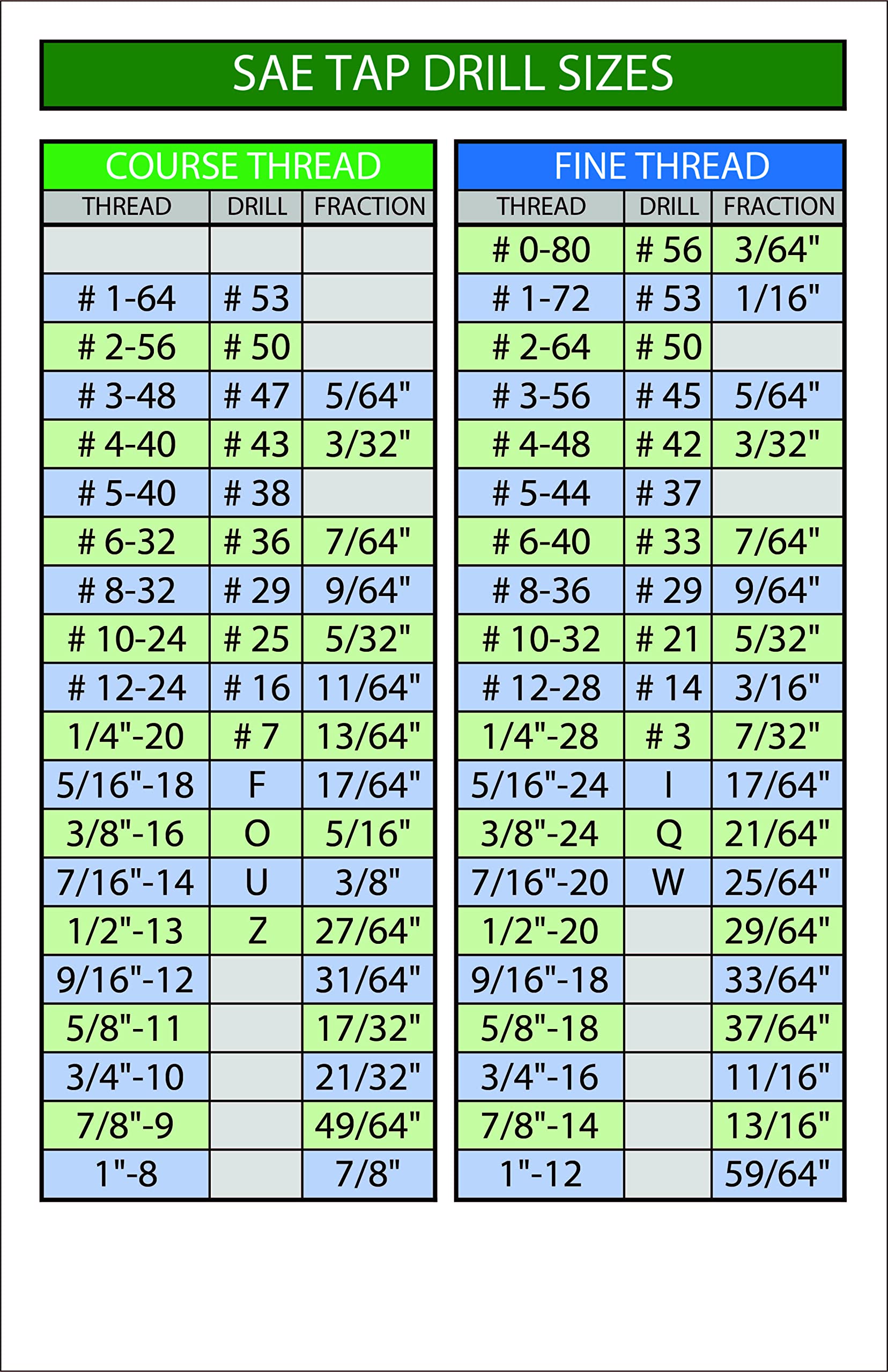
The most reliable method for determining the correct tap drill size is to consult a standard tap drill chart. These charts are widely available from tool manufacturers, engineering handbooks, and online resources. They list the recommended drill sizes for various thread forms and sizes, typically targeting a thread engagement between 65% and 75%.
For a 5/16-18 UNC tap, the standard recommended drill bit sizes are:
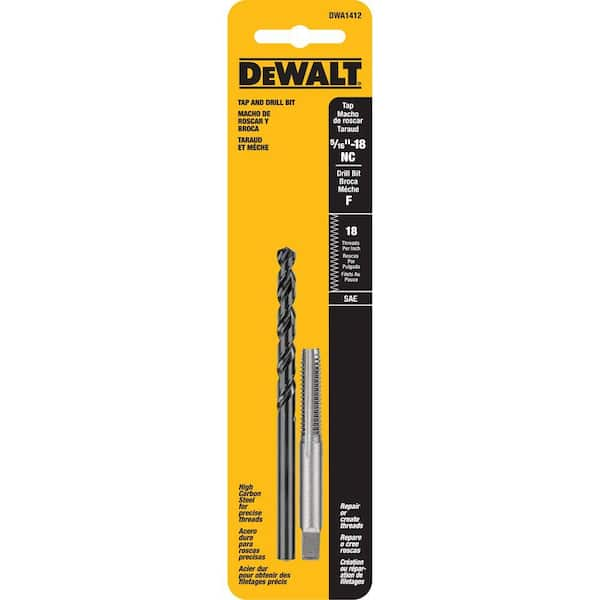
- #F drill bit (0.2570 inches)
- 17/64 inch drill bit (0.2656 inches)
The #F drill bit is generally preferred as it provides a slightly higher thread engagement (closer to 75%) which is desirable in many applications, especially in softer materials where maximum pull-out strength is needed. The 17/64 inch drill bit provides a slightly lower thread engagement (closer to 65-70%) which can be easier to tap, especially in harder materials, reducing the risk of tap breakage. The choice between the two often comes down to material properties and specific application requirements.
Calculating for Desired Thread Engagement
While charts are convenient, understanding the calculation allows for custom thread engagement percentages if required. The formula for calculating the theoretical drill size for a specific thread engagement is:
$$D{drill} = D{major} – ( frac{0.01299}{N} times (%Engagement) )$$
Where:
- $D_{drill}$ = Recommended drill bit diameter
- $D{major}$ = Major diameter of the tap (for 5/16-18, $D{major}$ = 0.3125 inches)
- $N$ = Threads per inch (for 5/16-18, $N$ = 18)
- %Engagement = Desired percentage of thread engagement (e.g., 0.75 for 75%)
Let’s calculate for a 75% thread engagement for a 5/16-18 tap:
$D{drill} = 0.3125 – ( frac{0.01299}{18} times 0.75 )$
$D{drill} = 0.3125 – (0.00072166… times 0.75)$
$D{drill} = 0.3125 – 0.00054125$
$D{drill} approx 0.3069$ inches.
Wait, this calculation is incorrect. The formula for the tap drill size for a 75% thread is typically:
$D{tap_drill} = D{major} – frac{1}{N} times frac{0.6495}{2} times 2 times (1 – text{Engagement Percentage})$
No, the simpler way to think about it, and the one that typically aligns with charts, is:
$D{drill} = D{major} – 2 times (text{Single Thread Height for } 100% text{ Engagement} times text{Desired Engagement Factor})$
Or more practically:
$D{tap_drill} = D{major} – (text{Thread Height} times 2 times text{Desired Thread Engagement})$
$D_{tap_drill} = text{Major Diameter} – frac{1.08253}{text{Threads Per Inch}} times text{Desired Thread Engagement Factor}$
Let’s use a common approximation formula for Unified National threads, which targets approximately 75% thread engagement:
$$D{drill} = D{major} – frac{1}{N}$$
For 5/16-18:
$D{drill} = 0.3125 – frac{1}{18}$
$D{drill} = 0.3125 – 0.05555…$
$D_{drill} approx 0.2569$ inches.
This calculated value, 0.2569 inches, aligns almost perfectly with the #F drill bit (0.2570 inches). This confirms that the #F drill bit is an excellent choice for achieving a strong, typically ~75% thread engagement for a 5/16-18 UNC tap.
The 5/16-18 UNC Specification
The “UNC” stands for Unified National Coarse. This standard defines the thread form and dimensions for fasteners in the United States, Canada, and the United Kingdom. Coarse threads, like 5/16-18, have a larger pitch (fewer threads per inch) compared to fine threads (UNF).
Characteristics of UNC threads:
- Larger thread depth: Provides good stripping resistance and is less prone to cross-threading.
- Easier to manufacture: Larger threads are more forgiving.
- Common in general engineering: Used where rapid assembly and disassembly are required, or where material properties (like cast iron or aluminum) might not support fine threads well.
Understanding the UNC specification reinforces the importance of using the correct tap drill size to achieve the intended mechanical properties of this standard thread.
Preparing for Tapping: Best Practices and Techniques
Identifying the correct drill bit is only half the battle. Proper preparation and technique are crucial for a successful tapping operation, preventing tap breakage, and ensuring high-quality threads.
Material Considerations
The type of material being tapped significantly influences the drilling and tapping process:
- Soft Metals (Aluminum, Brass): Generally easy to drill and tap. Tend to produce long, stringy chips. A #F drill bit is often suitable for maximum thread engagement.
- Mild Steel: Common material. Requires good lubrication and careful chip management. #F or 17/64 depending on desired engagement and power source.
- Stainless Steel, Tool Steel, Hardened Alloys: These are challenging materials. They are tough and work-harden easily. Cobalt drill bits are recommended, along with a 17/64 drill bit to reduce tapping torque. Slow speeds, heavy feed pressure, and abundant high-quality cutting fluid are essential.
- Plastics: Vary greatly. Some plastics can be tapped directly, others require specific tap geometries. Tapping plastics often requires oversized drill bits or specific plastic taps to account for material flow and avoid cracking.
Always match your drill bit material and tapping technique to the workpiece material.
Proper Drilling Technique
A poorly drilled hole will lead to poor threads, regardless of tap quality.
- Pilot Hole (Optional but Recommended): For larger holes or harder materials, starting with a smaller pilot drill bit can improve accuracy and prevent the main drill bit from walking.
- Center Punch: Always center punch the exact location for the hole to guide the drill bit accurately.
- Secure Workpiece: The workpiece must be rigidly clamped to prevent movement during drilling.
- Straight Drilling: Use a drill press whenever possible to ensure the hole is perpendicular to the surface. If using a hand drill, use a drilling guide or level to maintain perpendicularity.
- Appropriate Speed and Feed: Match the drill speed to the material. Harder materials require slower speeds. Apply consistent, firm pressure (feed) to allow the drill bit to cut efficiently.
- Lubrication/Coolant: Use cutting fluid during drilling, especially for metals, to reduce friction, dissipate heat, and prolong drill bit life.
- Chip Evacuation: Periodically back out the drill bit to clear chips from the flutes, preventing chip packing and heat buildup.
Lubrication and Chip Management
Lubrication is just as vital for tapping as it is for drilling. Tapping fluids reduce friction between the tap and the workpiece, improve cutting action, extend tap life, and aid in chip evacuation. Different materials benefit from different types of lubricants (e.g., sulfurized oil for steel, paraffin for aluminum, specific tapping fluids for stainless steel).
Chip management during tapping involves:
- Tap Selection: Spiral point taps push chips forward through the hole, ideal for through-holes. Spiral flute taps lift chips out of the hole, good for blind holes.
- Reversing (for hand tapping): When hand tapping, turn the tap forward 1/2 to 3/4 turn, then reverse 1/4 to 1/2 turn to break chips. This prevents chip packing and reduces torque.
- Cleaning Blind Holes: For blind holes, clear chips frequently to prevent packing at the bottom, which can lead to tap breakage. Compressed air or magnets can assist.
Common Pitfalls and Troubleshooting
Even with the correct drill bit and best practices, issues can arise. Understanding common problems and their solutions can save time and material.
Oversized vs. Undersized Holes
- Oversized Hole: If the drill bit chosen is too large (e.g., using 17/64 when #F was needed for 75% engagement), or if the drill bit wobbles, or if the drill is dull creating a larger hole than specified, the resulting threads will have reduced thread engagement. This leads to a weaker connection prone to stripping. There is no fix for an oversized hole other than drilling it out larger and using a larger tap (e.g., a Helicoil insert or a larger bolt) or filling and re-drilling.
- Undersized Hole: If the drill bit is too small (e.g., using 1/4 inch instead of #F), or if the drill bit is clogged with chips, the hole will be too small. This means the tap will encounter excessive resistance, requiring significantly more torque. This dramatically increases the risk of tap breakage and can lead to rough or incomplete threads. The fix is to re-drill with the correct size drill bit, if possible, before tapping. If threads have already been started, the material may be too hard to remove without damage.
Tap Breakage Prevention
Tap breakage is a common and frustrating problem. The primary causes are:
- Incorrect Tap Drill Size: Too small a hole is the leading cause.
- Misalignment: Tapping at an angle puts extreme side loads on the tap. Use a tap guide or drill press for alignment.
- Lack of Lubrication: Dry tapping generates excessive friction and heat.
- Clogged Chips: Chips packing in the flutes prevent the tap from cutting freely.
- Dull Tap: A worn tap requires more force to cut.
- Hard Material: Extremely hard materials or work-hardened spots can cause taps to snap.
- Starting and Stopping: In power tapping, erratic starts and stops can shock the tap.
Prevention involves using the correct drill size, proper lubrication, frequent chip clearance, and ensuring perfect alignment. If a tap breaks, specialized tap extractors can sometimes remove the broken piece, though it’s often a difficult process.
Ensuring Thread Quality
Visually inspect threads for quality. Good threads should be:
- Clean and Sharp: Edges should be well-defined, not torn or smeared.
- Consistent: Threads should look uniform throughout the depth of the hole.
- Free from Burrs: Excess material should not be present at the thread crests.
A “go/no-go” gauge is the professional tool for checking thread quality, ensuring that the threads fall within tolerance. If threads are poor, revisit your drill size, lubrication, and tapping technique. Sometimes, using a different tap type (e.g., a plug tap after a taper tap) can improve finish in blind holes.
By meticulously adhering to these guidelines, especially regarding the crucial drill bit selection for a 5/16-18 tap, you can confidently produce strong, accurate, and reliable threaded holes for any application.
aViewFromTheCave is a participant in the Amazon Services LLC Associates Program, an affiliate advertising program designed to provide a means for sites to earn advertising fees by advertising and linking to Amazon.com. Amazon, the Amazon logo, AmazonSupply, and the AmazonSupply logo are trademarks of Amazon.com, Inc. or its affiliates. As an Amazon Associate we earn affiliate commissions from qualifying purchases.