
Mastering the art of thread cutting, or tapping, is a fundamental skill for anyone involved in mechanical assembly, custom fabrication, or DIY projects, often intersecting with the world of custom electronics enclosures, robotics, and other tech-driven creations. Precision is paramount in this process, and perhaps no decision is more critical than selecting the correct drill bit size for the hole you intend to tap. An undersized hole will make the tap difficult to turn, potentially leading to tap breakage, while an oversized hole will result in weak, loose, or stripped threads that fail to hold. For a common 1/4 inch tap, understanding the precise drill bit required is the first step towards a strong, reliable threaded connection.
Understanding the Basics: Tapping and Threading
Before diving into specific sizes, it’s essential to grasp the core concepts behind tapping and why a meticulous approach to drill bit selection is non-negotiable. This isn’t just about making a hole; it’s about preparing a cavity that will perfectly accommodate a new set of threads.
What is Tapping?
Tapping is the process of cutting internal threads into a pre-drilled hole using a tool called a tap. These threads allow screws, bolts, or other threaded fasteners to be securely inserted, creating a strong mechanical joint. The tap itself is a hardened steel tool with cutting edges that progressively remove material as it’s turned into the hole, forming the characteristic helical ridges of a thread.
Types of Threads
Threads come in various forms, each with specific dimensions and applications. The most common thread forms in the U.S. and Canada are based on the Unified National (UN) system, which includes Unified National Coarse (UNC) and Unified National Fine (UNF). Metric threads, defined by the ISO metric screw thread standard, are prevalent globally. The pitch (distance between threads) and the major diameter (the largest diameter of the thread) are critical factors. For a 1/4 inch tap, this typically refers to the major diameter of the bolt that will eventually be screwed into the tapped hole.
Why the Right Drill Bit Matters
The hole drilled prior to tapping is known as the “tap drill size.” This hole is slightly smaller than the tap’s major diameter, allowing the tap to cut away the remaining material to form the threads.
- Too Small: An undersized tap drill leaves too much material for the tap to cut. This significantly increases friction and resistance, making the tap prone to binding, overheating, and ultimately, breaking. Broken taps are notoriously difficult to remove and can ruin a workpiece.
- Too Large: An oversized tap drill removes too little material, resulting in threads that are shallow, weak, and may not engage properly with the fastener. This leads to loose connections, reduced shear strength, and the possibility of threads stripping under load.
- Just Right: The correct tap drill size ensures that the tap cuts approximately 75% to 80% of a full thread. This percentage is considered ideal, providing maximum strength without excessive tapping effort or risk of tap breakage. While a 100% thread is theoretically strongest, it requires significantly more torque to cut and offers only a marginal increase in strength compared to 75%, making the higher risk of tap breakage impractical for most applications.
The Standard Solution: Unpacking the 1/4 Inch Tap
When someone refers to a “1/4 inch tap,” they are typically referring to the nominal major diameter of the screw or bolt it is designed to accept. However, this 1/4 inch tap can come in different thread pitches, which critically impacts the required drill bit size.
Unified National Coarse (UNC) vs. Fine (UNF) Threads
For a 1/4 inch diameter, the two most common thread pitches you’ll encounter are:
- 1/4-20 UNC (Unified National Coarse): This indicates a 1/4-inch nominal major diameter with 20 threads per inch (TPI). Coarse threads are generally stronger and more resistant to stripping in softer materials, quicker to assemble, and less prone to cross-threading.
- 1/4-28 UNF (Unified National Fine): This indicates a 1/4-inch nominal major diameter with 28 threads per inch (TPI). Fine threads have a greater resistance to loosening from vibration, allow for finer adjustments, and are often used where material thickness is limited or a higher tensile strength is required.
It’s crucial to identify which type of 1/4 inch tap you have before selecting a drill bit. Taps are usually marked on their shank (e.g., “1/4-20 NC” or “1/4-28 NF”). If unmarked, you can count the threads over a 1-inch length or use a thread gauge.
The Specific Drill Bit Sizes for 1/4″ Taps
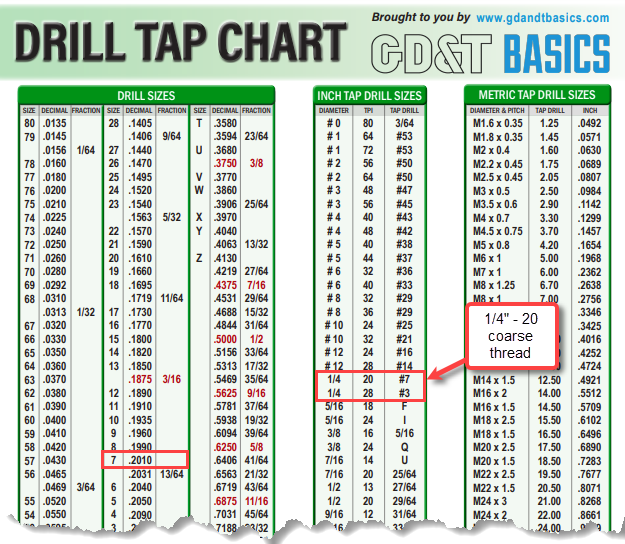
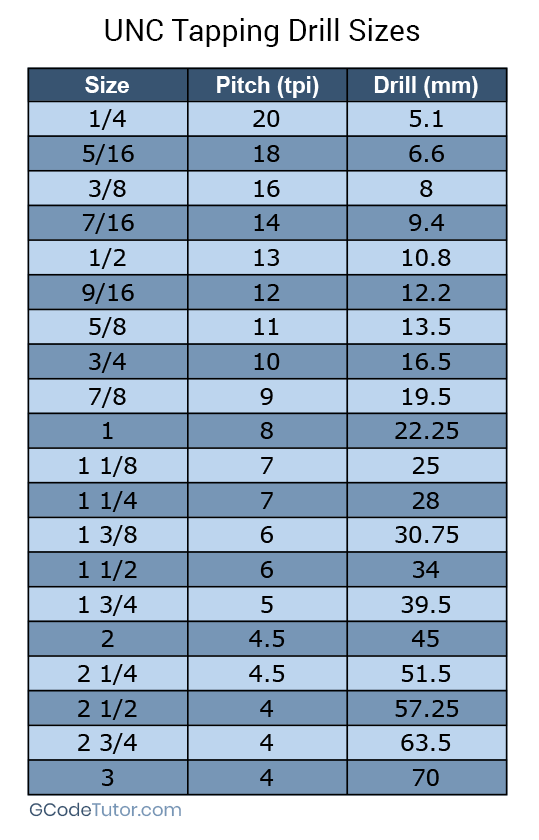
The recommended drill bit sizes are established standards to achieve the optimal 75-80% thread engagement. These sizes are typically found on tap drill charts.
-
For a 1/4-20 UNC Tap:
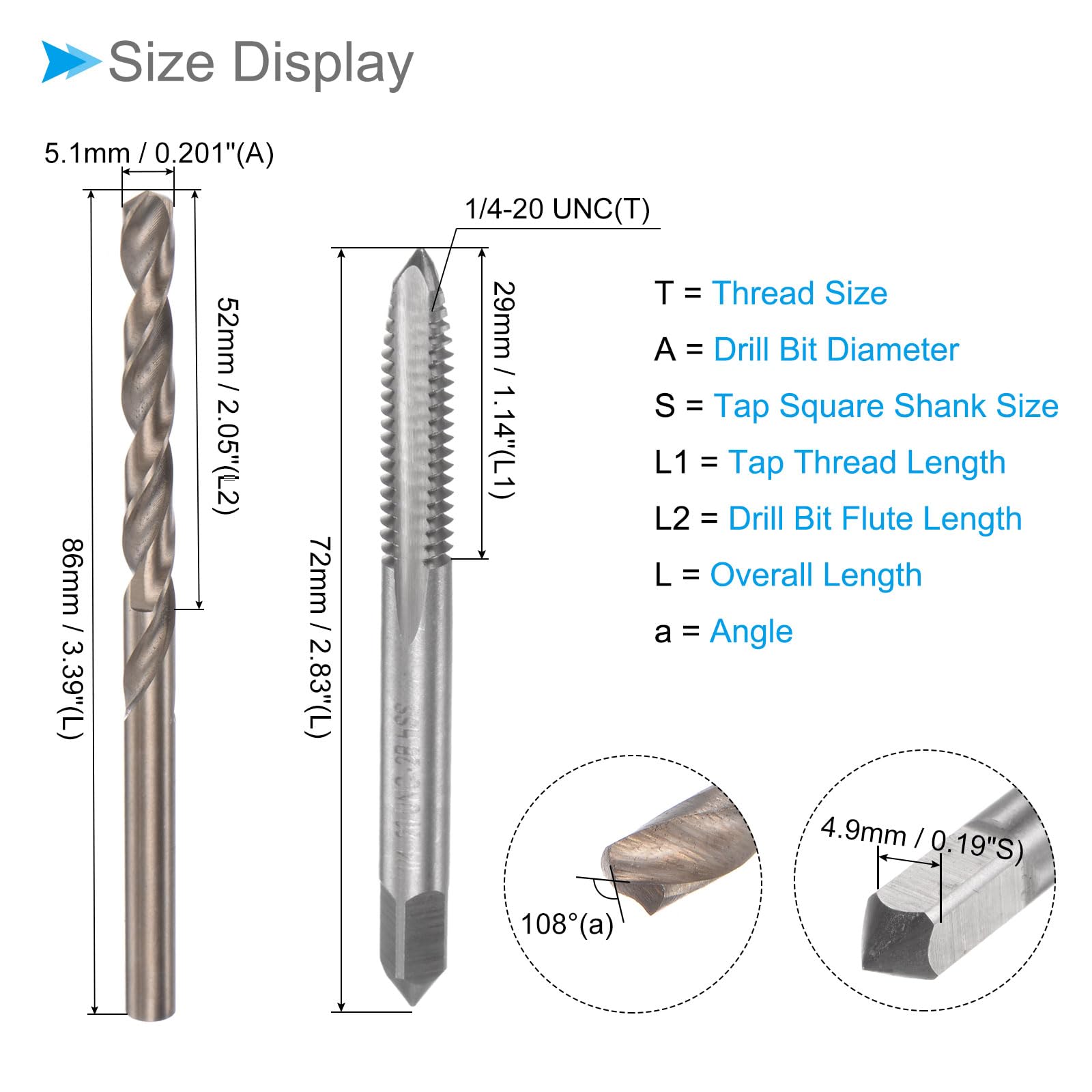
The standard drill bit size is #7.- A #7 drill bit has a diameter of 0.2010 inches (5.105 mm).
- This size is widely recommended for achieving a robust thread percentage in most materials.
-
For a 1/4-28 UNF Tap:
The standard drill bit size is #3.- A #3 drill bit has a diameter of 0.2130 inches (5.410 mm).
- The slightly larger drill bit for UNF threads is due to the finer pitch, which requires less material removal to achieve adequate thread depth.
It’s important to note that these are fractional (numbered) drill bit sizes. If you’re working with metric drill bits, you would convert to the closest appropriate metric size, often erring slightly on the smaller side if a precise match isn’t available, but generally, sticking to the standard Imperial sizes for Imperial taps is best.
Beyond the Basics: Factors Influencing Drill Bit Choice
While the #7 and #3 drill bits are standard recommendations, certain factors can influence whether you might deviate slightly, typically by opting for a slightly larger drill bit to reduce tapping torque.
Material Hardness and Type
The type and hardness of the material being tapped play a significant role:
- Soft Materials (e.g., Aluminum, Brass, Plastics): These materials offer less resistance to cutting. Using the standard tap drill size will generally result in excellent threads. In extremely soft materials, you might even consider a slightly larger drill to reduce the risk of material “galling” or binding, but this should be approached cautiously to avoid thread weakness.
- Harder Materials (e.g., Stainless Steel, Tool Steel): Tapping harder materials generates more friction and cutting forces. To reduce the risk of tap breakage, especially with smaller taps, some machinists opt for a drill bit that yields a slightly lower thread percentage (e.g., 70-75%). This means using a drill bit that is infinitesimally larger than the standard #7 or #3, but this practice requires experience and careful consideration. For example, some charts might list a 5.2mm or 5.3mm drill bit for 1/4-20 UNC in harder materials if working with metric drills.
- Thin Materials: When tapping very thin materials, the number of engaged threads is limited regardless of percentage. Aiming for the standard 75-80% thread is still the best practice to maximize the strength available.
Desired Thread Percentage
As mentioned, 75% to 80% thread engagement is the industry standard for strength and ease of tapping. However, you can deliberately choose a different thread percentage:
- Higher Thread Percentage (e.g., 85-90%): Achieved with a slightly smaller drill bit than standard. This results in maximum thread strength but significantly increases the torque required to tap and the risk of tap breakage. Rarely used except in critical applications with extremely strong taps and precise control.
- Lower Thread Percentage (e.g., 60-70%): Achieved with a slightly larger drill bit than standard. Reduces tapping torque and risk of breakage, making tapping easier, especially in hard materials or with small taps. However, it compromises thread strength. Useful for non-critical applications or materials that are very difficult to tap.
For a 1/4-inch tap, sticking to the #7 for UNC and #3 for UNF ensures the optimal balance for most general-purpose applications.
Tapered Pipe Taps (NPT) – A Special Case
It’s crucial to distinguish between straight thread taps (like UNC/UNF) and tapered pipe taps (NPT). A 1/4 inch NPT tap is used to create tapered threads for sealing pipe connections, not for attaching standard bolts. The required drill bit size for a 1/4 inch NPT tap is significantly larger than for a 1/4 inch UNC/UNF tap because the threads are tapered. For a 1/4-18 NPT (18 TPI), the recommended drill bit size is 7/16 inches (0.4375 inches or 11.11 mm). This highlights the importance of correctly identifying your tap type.
Best Practices for Drilling and Tapping
Achieving precise threads isn’t just about the right drill bit; it also involves proper technique throughout the drilling and tapping process.
Proper Drilling Technique
- Center Punch: Always start by center punching the exact location where the hole is to be drilled. This prevents the drill bit from “walking” and ensures accuracy.
- Pilot Hole (Optional but Recommended): For larger holes or harder materials, drilling a small pilot hole first can improve accuracy and ease the workload on the final tap drill bit.
- Secure Workpiece: Clamp your workpiece firmly to prevent movement during drilling.
- Use a Drill Press: For maximum perpendicularity, use a drill press. Handheld drills are acceptable for non-critical applications but introduce more room for error.
- Appropriate RPM: Use the correct drill speed for the material. Slower speeds for harder materials and larger bits, faster speeds for softer materials and smaller bits.
- Coolant/Lubricant: Apply cutting fluid during drilling, especially in harder materials, to reduce heat and friction, prolong bit life, and improve chip evacuation.
Lubrication is Key
Just as with drilling, lubrication is vital during tapping. A suitable tapping fluid (specific to the material, e.g., sulfurized cutting oil for steel, kerosene for aluminum) reduces friction, dissipates heat, and helps clear chips, all of which extend tap life and produce cleaner threads. Never tap dry.
Tapping Techniques and Avoiding Breakage
- Start Straight: Crucially, ensure the tap enters the hole perfectly perpendicular to the surface. A tap guide or a tap wrench with a T-handle and an alignment collar can assist.
- Turn and Reverse: Turn the tap clockwise (for right-hand threads) for about a half to full turn, then reverse it about a quarter to half turn. This “cut-and-break” action breaks off chips, clears the flutes, and prevents the tap from binding. Repeat this cycle until the threads are cut through.
- Steady Pressure: Apply firm, consistent downward pressure to start the tap, then primarily rotational force once the threads begin to engage. Avoid excessive downward force as it can lead to tap breakage.
- Through Holes vs. Blind Holes: For through holes, chips naturally fall through. For blind holes (holes that don’t go all the way through), ensure frequent chip clearance. Bottoming taps are designed to cut threads all the way to the bottom of a blind hole, but they require a plug or taper tap to start the threads.
Measuring and Verification
After tapping, use the intended bolt or a thread gauge to verify the quality and fit of the threads. The bolt should thread smoothly with light resistance and no binding or excessive play.
Common Pitfalls and Troubleshooting
Even with the correct drill bit, issues can arise. Understanding common problems can help in prevention and rectification.
Tap Breakage
The most frustrating outcome, often due to:
- Incorrect Tap Drill Size: Too small, leading to excessive resistance.
- Lack of Lubrication: Increased friction and heat.
- Misalignment: Tap binding against the hole wall.
- Forcing the Tap: Applying too much rotational force without backing off to clear chips.
- Workpiece Movement: A shifting workpiece can bind the tap.
- Using a Dull Tap: Worn taps require more force to cut.
Loose or Stripped Threads
This usually indicates:
- Incorrect Tap Drill Size: Too large, resulting in shallow threads.
- Worn Tap: A dull tap may not cut full threads.
- Soft Material: In very soft materials, threads can strip easily if overloaded. Consider thread inserts (like Helicoils) for stronger threads in soft materials.
Inaccurate Hole Size
Always double-check your drill bit size before drilling. Use a caliper to measure the drill bit itself, as sizes can sometimes be mislabeled or difficult to read. For critical applications, consider using reamers after drilling to ensure a precisely sized hole before tapping.
By meticulously following these guidelines, from selecting the correct #7 or #3 drill bit for your 1/4 inch tap (and discerning between UNC and UNF), to applying proper drilling and tapping techniques, you can confidently create strong, reliable threaded connections for any project, ensuring your components are securely fastened and function as intended.
aViewFromTheCave is a participant in the Amazon Services LLC Associates Program, an affiliate advertising program designed to provide a means for sites to earn advertising fees by advertising and linking to Amazon.com. Amazon, the Amazon logo, AmazonSupply, and the AmazonSupply logo are trademarks of Amazon.com, Inc. or its affiliates. As an Amazon Associate we earn affiliate commissions from qualifying purchases.