
Determining the correct copper wire size for a 200 amp electrical service is a critical technical decision that impacts safety, system efficiency, and compliance with electrical codes. This process involves a meticulous understanding of electrical principles, material properties, and strict adherence to industry standards, primarily the National Electrical Code (NEC). Selecting an undersized conductor poses significant fire hazards and risks of equipment damage due to overheating, while oversizing can lead to unnecessary material costs without proportional benefit.
The Foundation: Understanding Ampacity and Code Requirements
At the core of wire sizing is the concept of ampacity, the maximum current, in amperes, that a conductor can continuously carry without exceeding its temperature rating. For a 200 amp service, the chosen wire must safely handle a continuous current draw of up to 200 amperes under various operating conditions.

Decoding Ampacity and Voltage
Residential and commercial electrical services in North America typically operate at 240 volts (V) single-phase or 208V/120V three-phase for larger commercial applications. A 200 amp service implies the main overcurrent protection device (breaker) is rated for 200 amperes. The service entrance conductors, which bring power from the utility meter to the main service panel, must be sized to carry this full load.
The ampacity of a conductor is influenced by several factors:
- Conductor Material: Copper (Cu) is highly conductive and offers excellent performance, making it a preferred choice, especially for its superior conductivity compared to aluminum for a given gauge.
- Conductor Temperature Rating: Wires are rated for specific maximum operating temperatures (e.g., 60°C, 75°C, 90°C). Higher temperature ratings allow for higher ampacities, but the overall system must be considered, including terminations and equipment ratings.
- Insulation Type: The type of insulation dictates the wire’s temperature rating and its suitability for specific environments (wet, dry, extreme temperatures).
- Installation Method: How the wire is installed (e.g., in conduit, direct burial, exposed) affects its ability to dissipate heat.
- Ambient Temperature: Higher surrounding temperatures reduce the wire’s ability to dissipate heat, thus requiring derating.
- Number of Current-Carrying Conductors in a Raceway/Cable: As more conductors are grouped together, heat dissipation decreases, necessitating derating.
The Primacy of the National Electrical Code (NEC)
The National Electrical Code (NFPA 70), adopted in whole or in part by all 50 states and many jurisdictions worldwide, is the definitive standard for safe electrical installation. Article 310 of the NEC provides the foundational requirements for conductors, including sizing, applications, and ampacity ratings. For service entrance conductors, specific sections like 230.79 and 230.42 dictate minimum sizes.
The NEC tables are indispensable. Specifically, NEC Table 310.16 (formerly 310.15(B)(16) in older editions) is central to determining the allowable ampacities of insulated conductors rated up to 2000 volts, based on their temperature rating and installation conditions. For a 200 amp service, the conductors supplying the main panel are considered service entrance conductors.
Key Factors Influencing Conductor Sizing
Beyond basic ampacity, several other technical considerations must be meticulously evaluated to ensure the safe and reliable operation of a 200 amp service.
Material Matters: Copper vs. Aluminum
While the title specifically requests copper wire, understanding its advantages over aluminum helps contextualize the choice. Copper boasts higher conductivity, mechanical strength, and corrosion resistance compared to aluminum. This means a smaller gauge copper wire can carry the same current as a larger gauge aluminum wire. For instance, while a 200 amp service might require 2/0 AWG copper, it would typically demand 4/0 AWG aluminum for comparable ampacity. The superior reliability of copper terminations is another significant factor, reducing risks of loose connections and overheating.
Environmental and Installation Considerations
The environment in which the wire is installed profoundly impacts its effective ampacity.
- Conduit Fill: When multiple conductors run within a single conduit, the heat generated by each conductor contributes to the overall temperature inside the conduit. The NEC mandates derating factors for more than three current-carrying conductors in a raceway or cable to prevent overheating. For a standard 200 amp service, typically two ungrounded (hot) conductors and one neutral conductor are considered current-carrying. A grounding conductor is also present but not usually considered current-carrying for derating purposes unless specific conditions apply.
- Ambient Temperature: If the service conductors run through an area with an ambient temperature consistently higher than 30°C (86°F), the ampacity ratings from NEC Table 310.16 must be adjusted downwards using correction factors found in tables like NEC Table 310.15(B)(2)(a). For example, conductors installed in an unconditioned attic space in a hot climate may require a larger gauge.
- Exposure to Elements: Conductors exposed to direct sunlight or extreme weather may require specific insulation types (e.g., XHHW, THWN) and potentially derating, though direct sunlight generally falls under ambient temperature considerations.
Voltage Drop Calculations
For longer wire runs, voltage drop becomes a critical technical consideration. As current flows through a conductor, there is a voltage loss due to the wire’s resistance. Excessive voltage drop can lead to inefficient operation of electrical equipment, dimming lights, and overheating motors. The NEC recommends maintaining voltage drop within reasonable limits, typically no more than 3% for feeders and branch circuits.
While voltage drop is less frequently a primary concern for the relatively short run of a service entrance conductor from the meter to the main panel, it can become significant if the distance is unusually long (e.g., hundreds of feet from a utility pole to a remote building). The formula for calculating voltage drop for single-phase circuits is:
VD = (2 * K * I * L) / CMA

Where:
- VD = Voltage Drop
- K = Approximate K-factor (resistance per circular mil-foot) for copper (approx. 12.9 for 75°C wire)
- I = Current in amperes
- L = Length of the one-way circuit in feet
- CMA = Circular Mil Area of the conductor
If calculations show an excessive voltage drop for the chosen conductor size, a larger conductor must be selected, even if the initial ampacity rating was sufficient.
Navigating NEC Tables for 200 Amp Service
For a standard 200 amp residential or light commercial service using copper conductors, the primary reference is NEC Table 310.16, “Allowable Ampacities of Insulated Conductors Rated Up to 2000 Volts, 60°C Through 90°C (140°F Through 194°F), Not More Than Three Current-Carrying Conductors in Raceway, Cable, or Earth (Directly Buried), Based on Ambient Temperature of 30°C (86°F).”
Determining Service Entrance Conductor Size
Let’s assume typical conditions: a 200 amp service, copper conductors, installed in conduit, with an ambient temperature not exceeding 30°C. We also assume the terminals for the main breaker and meter base are rated for 75°C. The lowest temperature rating among the conductor, overcurrent device, and termination points dictates the ampacity to use. Typically, 75°C is the most common and practical choice for service entrance conductors.
Referring to NEC Table 310.16, under the 75°C column for copper conductors:
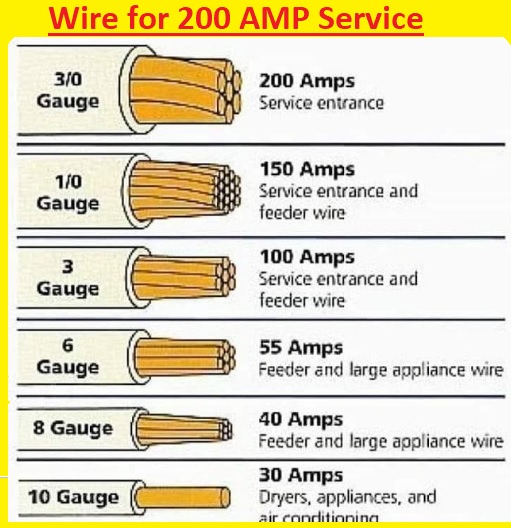
- 2/0 AWG copper is rated for 175 amps.
- 3/0 AWG copper is rated for 200 amps.
- 4/0 AWG copper is rated for 230 amps.
Based purely on the 75°C column, a 3/0 AWG copper conductor would be the minimum size required to safely carry 200 amps. However, the NEC provides specific exceptions for service entrance conductors under Article 230.
NEC Section 230.42(B) and Table 310.15(B)(7) (or 310.15(B)(16) in older editions, often referred to for service entrance conductor sizing) can allow for smaller conductors under specific conditions. For example, for a 200 amp service, in many jurisdictions, 2/0 AWG copper is permitted for the ungrounded service entrance conductors if the service is a dwelling unit and meets specific criteria outlined in the NEC. This exception typically applies when the service conductors supply the entire load of a dwelling unit, benefiting from demand factors that effectively reduce the perceived continuous load.
It’s crucial to consult the latest local adopted edition of the NEC and any local amendments, as well as the utility company’s specific requirements, as they might have stricter guidelines.
Adjustments and Derating Factors
If ambient temperature or conduit fill conditions deviate from the standard assumptions (30°C, 3 current-carrying conductors), derating factors must be applied:
- Ambient Temperature Correction: For temperatures above 30°C, a correction factor (e.g., from NEC Table 310.15(B)(2)(a)) must be applied. If the adjusted ampacity falls below 200 amps, the next larger wire size is required.
- Conduit Fill Derating: If more than three current-carrying conductors are installed in a raceway, cable, or bundle, adjustment factors (e.g., from NEC Table 310.15(B)(3)(a)) must be applied. For example, five current-carrying conductors would require multiplying the ampacity by 0.80.
Grounding and Bonding Requirements
Beyond the main service entrance conductors, the grounding electrode conductor (GEC) and equipment grounding conductors must also be correctly sized. For a 200 amp service, the minimum size for the copper grounding electrode conductor to a ground rod or pipe is typically #4 AWG copper (referencing NEC Table 250.66). If connected to a concrete-encased electrode or a larger metallic water pipe system, the GEC might be larger. Proper bonding of all metallic components and services (water pipes, gas lines, structural steel) is equally vital for safety.
Safety, Compliance, and Professional Expertise
The installation of a 200 amp electrical service is a complex task with significant safety implications. Adherence to technical standards is not merely a recommendation but a legal requirement.
Local Ordinances and Permits
Before any work begins, it is imperative to check local building codes and secure the necessary permits from the Authority Having Jurisdiction (AHJ). Local codes often adopt the NEC but may include specific amendments or additional requirements. Permitting ensures that the installation will be inspected by qualified officials, verifying compliance and safety.
The Indispensable Role of a Qualified Electrician
While understanding the principles of wire sizing is crucial, the actual design and installation of a 200 amp service should always be performed by a licensed and qualified electrician. An experienced professional possesses the intricate knowledge of the NEC, local codes, utility company requirements, and best practices. They can accurately assess specific site conditions, perform precise calculations, select appropriate materials, and ensure all connections are made safely and correctly. Attempting to install or modify a main electrical service without proper training and licensing is extremely dangerous and could lead to severe injury, fire, or costly property damage.
In summary, for a 200 amp service, the general recommendation for copper service entrance conductors is 3/0 AWG copper if strictly following the 75°C column of NEC Table 310.16 for a continuous 200A load. However, for dwelling units, specific NEC exceptions often permit 2/0 AWG copper for service entrance conductors. Always verify with the latest NEC edition, local amendments, and the utility company, and entrust the work to a licensed electrician. This technical precision ensures a safe, reliable, and compliant electrical system for years to come.
aViewFromTheCave is a participant in the Amazon Services LLC Associates Program, an affiliate advertising program designed to provide a means for sites to earn advertising fees by advertising and linking to Amazon.com. Amazon, the Amazon logo, AmazonSupply, and the AmazonSupply logo are trademarks of Amazon.com, Inc. or its affiliates. As an Amazon Associate we earn affiliate commissions from qualifying purchases.